
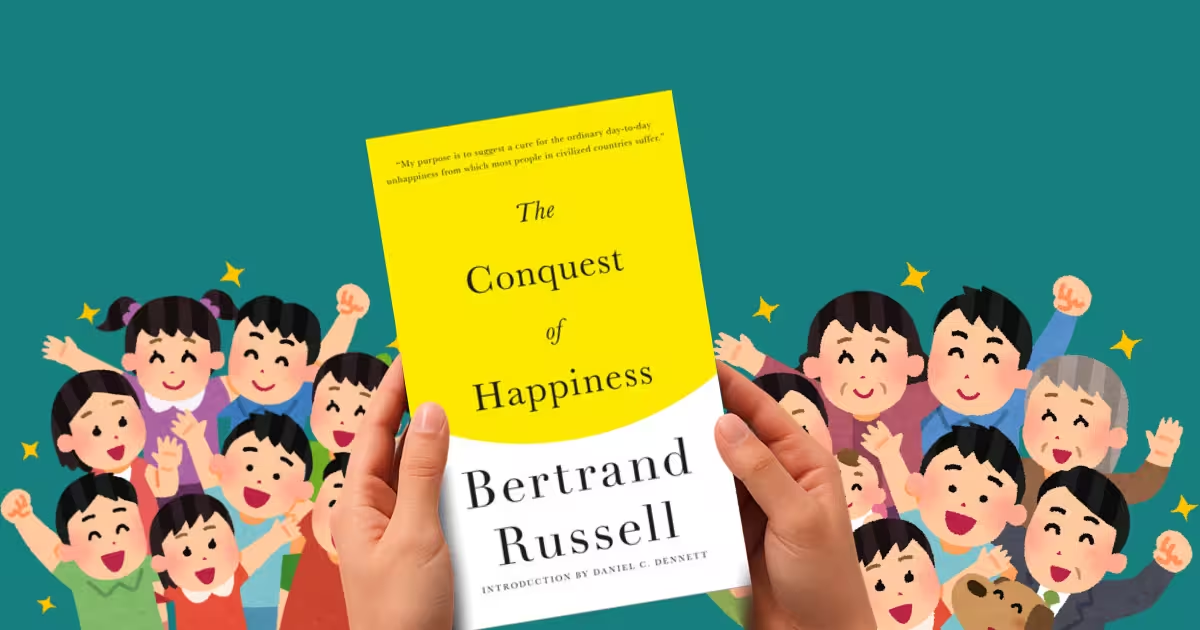
Do you wake up feeling like success is an exhausting treadmill that leads nowhere? The Conquest of Happiness will show you how to break free from this modern anxiety and finally find quiet, lasting joy.
In The Conquest of Happiness Bertrand Russell argues that modern unhappiness is largely a product of self-absorption, societal competition, and the exhaustion of city life. To fix this, he suggests looking outward, cultivating genuine interests, and abandoning the exhausting race for social status.
The Conquest of Happiness is best for burned-out professionals, overthinkers, and anyone feeling trapped in the endless loop of modern comparison. But not for readers looking for a quick fix, clinical psychological advice, or spiritual mysticism.
Table of Contents
1. Introduction
The Conquest of Happiness is authored by British philosopher Bertrand Russell, originally published in Great Britain in 1930.
Context: Briefly, this book is a philosophical self-help guide written by a prominent logician and public intellectual who shifted his focus toward practical, day-to-day moral questions. Russell draws heavily on his own early struggles with despair to diagnose why modern people are so miserable.
Purpose: The central argument of The Conquest of Happiness is that happiness is not a mystical gift bestowed upon a lucky few, but a state that can be actively conquered through a combination of outward focus and simple, natural living.
The author insists that many people who are currently unhappy could become happy by directing their efforts away from their own egos.
2. Background
To fully understand where The Conquest of Happiness comes from, it is good to know a bit about the author. According to the biography sections provided in the preface of the book, Russell was born in 1872 and did not start his life as a happy person.
In his youth, he struggled with dark moods and frequently considered suicide, only kept alive by his desire to learn more mathematics. Over time, he learned to stop agonizing over his own perceived flaws. By the 1920s, after witnessing the horrors of the First World War and traveling extensively, he began writing for the general public.
He wanted to offer practical solutions for the ordinary, day-to-day unhappiness that plagues average people.
3. The Conquest of Happiness Summary
I read The Conquest of Happiness carefully, and it contains an incredibly thorough breakdown of human emotion. The author divides his work into two main sections: the causes of unhappiness and the causes of happiness. I want to give you a complete picture so you understand exactly what the text offers.
1. The Causes of Unhappiness
Russell points out that animals are naturally content if they are healthy and fed, but humans somehow manage to be miserable even when these basic needs are met. He identifies several distinct traps we fall into:
✅ Self-Absorption: The worst offender is an obsession with the self. He categorizes these sufferers into three types. The “sinner” is paralyzed by guilt and early childhood moral conditioning. The narcissist only cares about being admired, losing the ability to love others. The megalomaniac wants to be feared and powerful, completely losing touch with reality.
✅ Byronic Unhappiness: Some people pretend that being depressed makes them intellectually superior. Russell argues that attributing your misery to the bleakness of the universe is backward; usually, these people are unhappy for physical or social reasons first, and then they blame the cosmos.
✅ Competition: In the business world, people are not fighting for actual survival. They are fighting for social supremacy. The typical professional man ruins his nerves trying to outshine his peers, forgetting how to read, relax, or enjoy a quiet evening. This competitive philosophy poisons both work and leisure.
✅ Boredom and Excitement: We are terrified of being bored. To escape the natural, slow rhythm of life, we seek out frantic stimulation. This creates a terrible cycle. Just like a person building a tolerance to a drug, we need more and more intense thrills to feel anything at all.
✅ Fatigue: Modern city life assaults us with noise, hurried commutes, and the constant presence of strangers. This creates emotional and nervous fatigue, which is far worse than physical tiredness. We take our worries to bed, failing to practice the mental discipline of putting our problems aside when we cannot solve them.
✅ Envy: This is perhaps the most destructive emotion. Instead of enjoying what we have, we fixate on what our neighbor has. The envious person wishes to inflict misfortune on others and destroys their own peace of mind in the process.
2. The Causes of Happiness
After diagnosing the sickness, the author moves on to the cure. While the first half of the book focuses on stripping away bad habits, the second half focuses on building healthy ones.
✅ Zest: This is an appetite for life. The happy person takes an active, unforced interest in a wide variety of things, from food to hobbies to the people around them.
✅ Affection: We need to feel securely loved to function well. A lack of affection causes people to turn inward and become defensive.
✅ Work: Having something to do is much better than having nothing to do. Constructive work provides a necessary outlet for energy and a sense of achievement.
✅ Impersonal Interests: A happy life requires minor hobbies that have nothing to do with our main career. These allow us to rest our minds and escape our primary anxieties.
✅ Resignation: We must learn to accept the things we cannot change. Fretting over unavoidable inconveniences wastes massive amounts of emotional energy.
4. The Conquest of Happiness Analysis
When I look at this book critically, I find myself agreeing with the author’s core logic. The arguments are incredibly sound because they rely on observable human behavior rather than abstract theory.
Does the author effectively support his claims? Yes, mostly through sharp observational examples rather than clinical data. For instance, his description of the tired businessman at a dinner party rings just as true today as it did decades ago.
The Conquest of Happiness absolutely fulfills its stated purpose. It strips away the complicated, pseudo-intellectual excuses we make for our bad moods and forces us to look in the mirror.
However, one point to note is the historical context. According to the World Health Organization, over 332 million people suffer from depression today.
A modern reader must remember that this text addresses ordinary dissatisfaction, not clinical depression requiring medical intervention. Still, as a philosophical framework for daily living, it is brilliantly effective.
5. Strengths and Weaknesses
What I Found Compelling (Strengths):
▶️ The author writes with blunt honesty. He does not coddle the reader. His assertion that envy is the basis of modern democracy is a bold, fascinating claim.
▶️ The advice on mental discipline is highly practical. The instruction to face your worst fears directly until they become boring is a surprisingly modern cognitive behavioral technique.
Shortcomings (Weaknesses):
▶️ Some of the societal observations feel dated. The rigid gender roles and assumptions about family structure reflect the 1930 publication date.
▶️ The author occasionally oversimplifies the ease with which one can just “turn outward.” For people dealing with severe trauma, sheer willpower is rarely enough.
6. Comparison with Similar Works
If we compare this text to Man’s Search for Meaning by Viktor Frankl, we see two different approaches to mental survival. Frankl focuses on finding meaning through extreme suffering, heavily rooted in existential psychology.
Russell focuses on avoiding unnecessary suffering by practicing common sense. You can also compare it to The Art of Happiness by the Dalai Lama.
Both books argue that happiness is a state of mind achieved through discipline, but the Dalai Lama leans heavily on spiritual compassion, whereas this book relies entirely on pragmatic, secular logic.
7. Conclusion
I highly recommend this book to any modern professional feeling crushed by the weight of the daily grind. It is best suited for general audiences who are tired of complicated self-help routines and just want straight, practical talk.







