

Ever wonder why you feel torn between the comfort of faith and the cold logic of science? Do the rigid rules of ancient traditions secretly limit your true potential? Is society really better off clinging to orthodox beliefs, or did we just forget how to question them?
in Has Religion Made Useful Contributions to Civilization?, Bertrand Russell aggressively argues that institutional religion is a fear-based disease that actively hinders human, intellectual, and moral progress. He claims its only real historical contributions were calendar-making and eclipse prediction, while its dark legacy includes preserving ignorance, creating artificial guilt, and cloaking hatred as righteousness.
Who will actually love/benefit: Skeptics, rationalists, philosophy enthusiasts, and curious minds who want to understand the historical friction between orthodox dogmas and human freedom. It is perfect for those seeking logical arguments against blind faith.
Who will bounce: Devout individuals, religious apologists, and those who find it offensive to see their faith dissected strictly as a political and social mechanism of control.
Welcome to a raw, honest look at one of the most controversial essays of the twentieth century. I want to take you through this piece exactly as I experienced it, stripping away the noise to show you exactly what makes it tick.
We will look at the facts, the historical context, and the hard truths presented, ensuring you have every necessary detail right here.
Table of Contents
1. Introduction
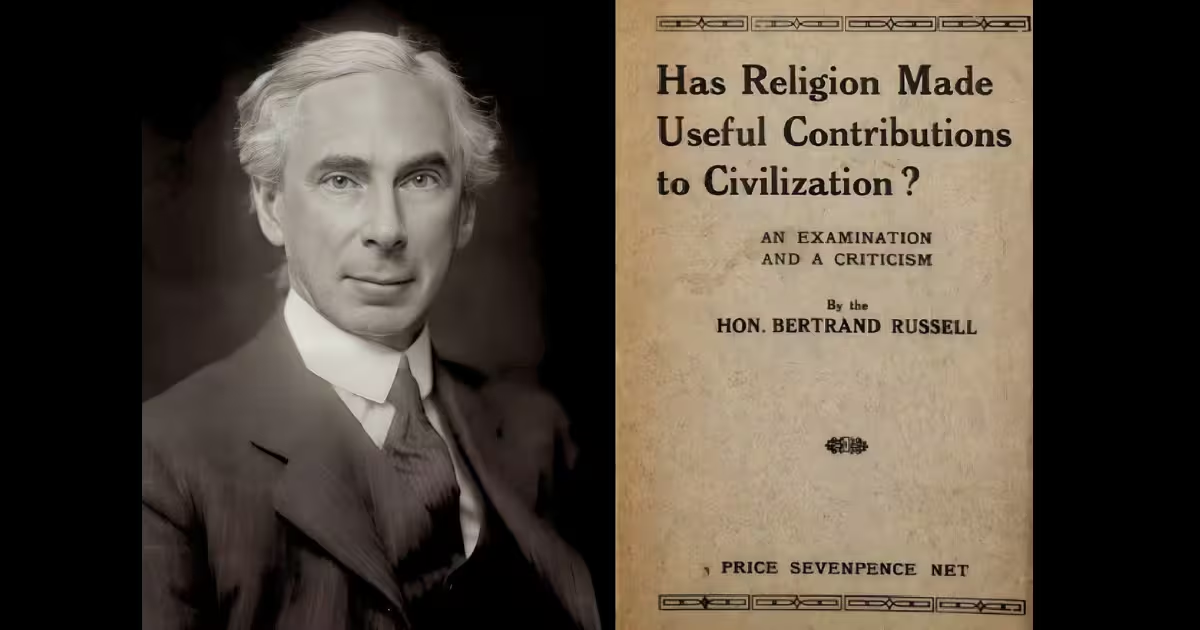
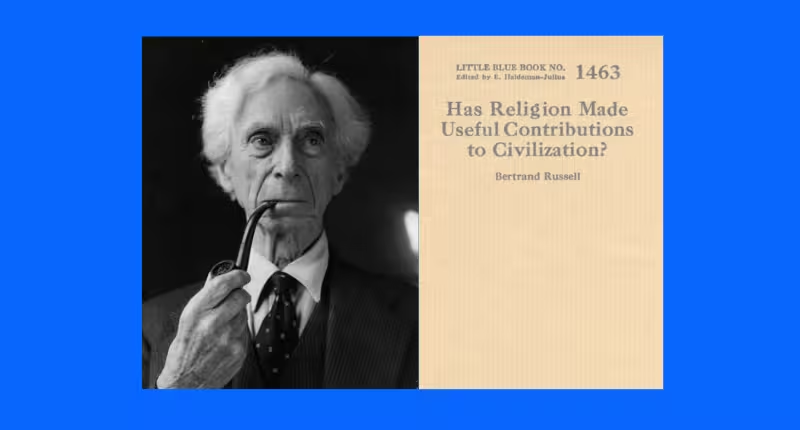
Title and Author Information: The book is Has Religion Made Useful Contributions to Civilization? by the brilliant mathematician and philosopher, Bertrand Russell. It was published as Little Blue Book No. 1463.
Russell wrote this piece during a time when challenging religious orthodoxy still carried heavy social consequences. He was a Nobel laureate and a fierce advocate for logic, mathematics, and peace.
Has Religion Made Useful Contributions to Civilization? falls into the genre of philosophical critique and rationalist sociology.
The primary argument of Has Religion Made Useful Contributions to Civilization? is incredibly direct. Russell sets out to prove that religion operates as an institutional weapon of fear.
He argues that it restricts human happiness, suppresses scientific discovery, and manipulates human psychology to maintain power.
2. Background
To fully grasp the weight of Has Religion Made Useful Contributions to Civilization?, we have to remember the intellectual climate of Russell’s time. According to BBC historical archives, Russell frequently engaged in highly publicized, controversial radio debates about the existence of God and the moral standing of religion.
He refused to accept traditions just because they were popular. His intellectual honesty made him a leading voice in secularism, forcing society to look at the uncomfortable realities of religious history.
3. Has Religion Made Useful Contributions to Civilization? Summary
I want to break this down point by point so you get the exact substance of Has Religion Made Useful Contributions to Civilization?. You will not need to go back and read the original after absorbing this summary.
The Illusion of Contribution
Russell opens with a blunt thesis, stating clearly that he regards religion as “a disease born of fear and as a source of untold misery to the human race”. He concedes only two minor historical services: it helped fix the calendar in early days, and it caused Egyptian priests to chronicle eclipses carefully enough to predict them. Beyond those two items, he knows of no other useful contributions.
Churches Over Founders
A massive point I learned from Has Religion Made Useful Contributions to Civilization? is the stark difference between a religion’s founder and the institution that follows.
Russell notes that the teachings of Christ in the Gospels have had “extraordinarily little to do with the ethics of Christians”.
Christ taught his followers to give their goods to the poor, not to fight, not to go to Church, and not to punish adultery.
Yet, neither Catholics nor Protestants have shown a strong desire to follow these teachings. The same is true for Buddhism, where the Buddha was amiable and enlightened, but the Tibetan Buddhist priesthood became obscurantist, tyrannous, and cruel.
The Enemy of Intellectual Progress
Because a Church claims to hold absolute, unchanging truth revealed in perfection, it naturally becomes an opponent of all intellectual and moral progress.
Russell reminds us that the Church opposed Galileo and Darwin, and in his own day, it opposed Freud. He cites a historical letter where Pope Gregory the Great actually forced a bishop to stop teaching grammar, stating that Latinity did not recover until the Renaissance.
The Morbid Obsession with Sex
Russell argues that the worst feature of the Christian religion is its attitude towards sex, which he calls morbid and unnatural. The Church historically viewed Woman primarily as the “Temptress” and the inspirer of impure lusts.
By stamping out all knowledge of the art of love and making marriage indissoluble, the Church tried to ensure that permitted sex would involve “very little pleasure and a great deal of pain”.
The active opposition to birth control shares the same motive, ensuring women are worn out from having a child every year.
The Danger of the Concept of Sin
The ethical concept of Sin does an extraordinary amount of harm because it gives people an outlet for sadism that they believe is legitimate and noble. For example, Christians object to the dissemination of knowledge regarding the prevention of syphilis because they want sinners to be punished.
They are willing to see this punishment extend to innocent wives and children, which Russell calls “fiendish cruelty”. Keeping young people artificially ignorant about sex creates nervous diseases and an unnatural sense of shame.
The Logical Problem of Evil
Russell logically destroys the idea that suffering is a divine purification for sin. He argues this is merely a rationalization of sadism.
If God is omnipotent and created the world knowing in advance the sins man would commit, He is clearly responsible for all the consequences of those sins. If a man fathered a child knowing the child would be a homicidal maniac, the father would be responsible for the crimes.
A Dying Universe
Looking at the physical world, Russell sees no evidence of a divine plan. The second law of thermodynamics indicates that the universe is running down and will eventually reach a condition of “universal death”. He finds this crawling, pitiful cosmic process totally unappealing as evidence of a grand design.
Egotism and the Soul
Christianity’s emphasis on the individual soul actually damaged social virtue. The most virtuous medieval man was one who retired from the world, not one who reformed finances or criminal law. This separation of soul and body made men more egotistic and shut up in themselves than nature intended.
The Reality of Intolerance
The fierce intolerance of Christianity was inherited from the Jewish belief in the exclusive reality of their God. Before this, the ancient world, as seen in the writings of Herodotus, was generally hospitable and tolerant of foreign gods and customs.
The modern Christian is only milder today thanks to generations of freethinkers who made Christians ashamed of their traditional beliefs.
Free Will as a Tool for Punishment
The doctrine of free will is practically useless and actively harmful. When a motor car breaks down, we do not call it a “wicked motor car” and punish it by withholding gasoline; we find the problem and fix it. Yet, we refuse to apply this common sense to human beings, treating bad behavior as sin rather than the result of antecedent causes.
The Psychology of Righteousness
Ultimately, religion is built on fear, conceit, and hatred. The concept of righteousness is simply a tool for the herd to justify punishing the behaviors it dislikes, enhancing its own self-esteem while letting loose its impulse to cruelty.
4. Has Religion Made Useful Contributions to Civilization? Analysis
Has Religion Made Useful Contributions to Civilization? is an outstanding, fiercely logical dismantling of sacred traditions. I felt completely captivated by how Russell cuts through centuries of dogma with sharp, unyielding reason.
Russell effectively supports his arguments by pointing to undeniable historical realities.
He highlights how the Churches officially opposed the abolition of slavery as long as they dared, and how the German Churches stated it was contrary to Christianity to deprive deposed royal houses of their private property.
He discusses whether Has Religion Made Useful Contributions to Civilization? fulfills its stated purpose, and I believe it absolutely does. It contributes meaningfully to the fields of sociology and secular ethics by proving exactly how institutional dogmas inflict unnecessary pain on the population.
5. Strengths and Weaknesses
Strengths: The most compelling argument in the entire text is his motor car analogy. He logically points out that we treat machines with more scientific compassion than we treat our own children.
We figure out why a car is broken, but we punish a child for failing, completely ignoring the root causes of human behavior. This completely shattered the traditional notion of punitive justice for me.
Weaknesses: A noticeable shortcoming is his sweeping generalization regarding the origins of faith. He claims the sole psychological impulses behind religion are fear, conceit, and hatred.
This feels slightly biased, as it ignores the genuine community building, charity, and artistic inspiration that many local religious communities provide, separate from the rigid structures of the Vatican or high priesthoods.
7. Comparison with Similar Works
Books like Christopher Hitchens’ God Is Not Great or Richard Dawkins’ The God Delusion carry the exact same torch. However, Russell’s tone is completely different.
He does not rely on modern biology or aggressive journalism. Instead, he uses pure philosophical logic and historical sociology to diagnose the institutional mechanics of fear.
8. Conclusion
I strongly recommend this essay to anyone who refuses to accept the status quo blindly. Who would benefit most? Both general audiences and academic specialists.
Russell writes clearly, avoiding dense jargon, making his heavy philosophical concepts accessible to everyone. We can actually eliminate fear and hatred from human nature through educational, economic, and political reforms.
By choosing a rational education based on kindness instead of severe punishment, we have the potential to build a better society. Religion is merely the dragon that guards the door to our golden age.