
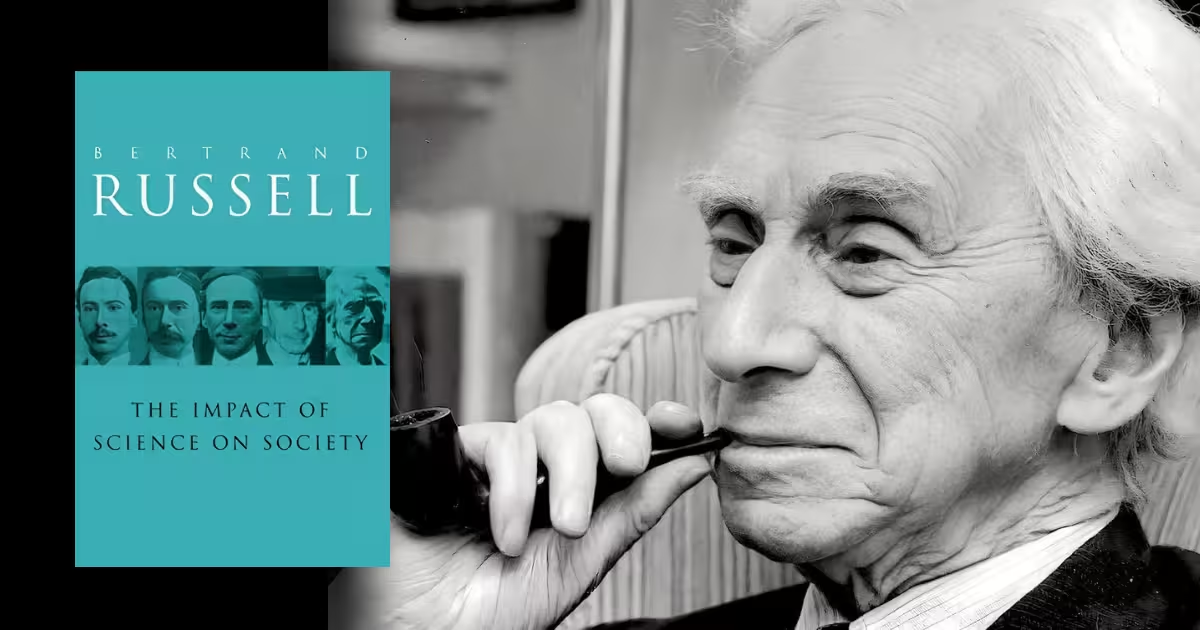
What happens when human beings acquire almost godlike power before they acquire the wisdom to control themselves? Bertrand Russell’s The Impact of Science on Society is the book that made me stop thinking about science merely as a way of discovering facts and start thinking about it as a force that can reshape politics, war, democracy, morality, human psychology, and perhaps the future of civilization itself.
Overview
Bertrand Russell’s The Impact of Science on Society (1953) is not merely a philosophical essay—it is a chillingly accurate prophecy about our present moment. Russell, one of the greatest minds of the twentieth century, argues that science has given humanity unprecedented power while our wisdom has failed to keep pace.
He warns that unless we establish world government, control population growth, and preserve individual liberty against totalitarian systems, science will destroy us.
The Impact of Science on Society is a masterclass in clear thinking about technology, politics, and human nature. Reading it in 2026 feels like reading today’s news—except Russell wrote it seventy-three years ago.
Preferred readers
The Impact of Science on Society is best for:
- Anyone who worries about AI, nuclear weapons, or climate change and wants to understand how we got here
- Philosophy students seeking Russell’s clearest thoughts on science and society
- Political scientists studying the roots of totalitarianism
- Tech optimists who need a sobering dose of reality
- Readers who appreciate clear, elegant prose about complex ideas
- Anyone born after 1990 who wonders why the world feels so unstable
Not for:
- Readers looking for a technical scientific analysis—this is philosophy and social commentary
- Those who prefer their politics without a side of moral urgency
- Anyone offended by Russell’s unapologetic atheism and criticism of religion
- Readers who want a cheerful, optimistic book about technology
Table of Contents
Introduction
The Impact of Science on Society is a philosophical and political examination of the consequences of scientific knowledge and scientific technique.
The book was written by Bertrand Arthur William Russell (1872–1970), one of the most influential philosophers, mathematicians, logicians, essayists, and political thinkers of the twentieth century. Russell was awarded the 1950 Nobel Prize in Literature for writings that championed humanitarian ideals and freedom of thought.
The Impact of Science on Society contains seven chapters:
- Science and Tradition
- General Effects of Scientific Technique
- Scientific Technique in an Oligarchy
- Democracy and Scientific Technique
- Science and War
- Science and Values
- Can a Scientific Society Be Stable?
Russell’s argument begins with a simple historical observation. Human beings have existed for an extraordinarily long time, but science has been a dominant force in human intellectual life for only a relatively short period.
In The Impact of Science on Society, Russell writes that science had been a dominant factor in educated belief for roughly 300 years and a major source of economic technique for about 150 years when he was writing.
His conclusion is unsettling:
“We are at the very beginning of its work in transforming human life.”
That sentence gives the book its real emotional force.
Russell was not merely describing what science had already done. He was asking what might happen next.
Context
The Impact of Science on Society emerged during a period of profound anxiety. The Second World War had ended only eight years earlier. The atomic bombings of Hiroshima and Nagasaki were fresh in memory.
The Cold War was intensifying. The Soviet Union had tested its first atomic bomb in 1949, and the hydrogen bomb was on the horizon. Russell, who had been a pacifist during the First World War and a supporter of the Allied cause during the Second, was deeply concerned about humanity’s future.
The Impact of Science on Society is Russell’s attempt to answer a question that haunts us still: Can we survive our own power?
Purpose
Russell’s central argument of The Impact of Science on Society is both simple and devastating: Science has given humanity godlike power without godlike wisdom. As he puts it, “Knowledge is power, but it is power for evil just as much as for good”. He argues that we are in “the middle of a race between human skill as to means and human folly as to ends”.
Russell writes: “The world has been living on capital, and so long as it remains industrial it must continue to do so. This is one inescapable though perhaps rather distant source of instability in a scientific society”.
This statement, written in 1951, reads like a description of our current environmental crisis.
Background
To understand Russell’s arguments, we must understand the intellectual climate of the early 1950s. The horrors of Nazi Germany had revealed what “scientific” racism and totalitarian organization could achieve. The Soviet Union under Stalin had shown that a revolution supposedly for human liberation could become a nightmare of forced labor, purges, and state terror.
Meanwhile, the United States and Britain were building nuclear arsenals that could end civilization.
Russell was uniquely positioned to comment on all this. He had been a pacifist during the First World War, imprisoned for his anti-war activism. He had visited the Soviet Union in 1920 and met Lenin, returning deeply critical of Bolshevik tyranny. He had taught in America and China. He understood both the promise and the peril of the modern world.
The Impact of Science on Society is also shaped by Russell’s lifelong commitment to clarity and rationality. He believed that most human suffering came from muddled thinking, and that clear thought could solve almost any problem—if only people would use it.
The Impact of Science on Society Summary
Chapter 1: Science and Tradition
Russell begins by tracing how science gradually replaced superstition. He notes that “Science, as a dominant factor in determining the beliefs of educated men, has existed for about 300 years; as a source of economic technique, for about 150 years”. In this brief period, it has become “an incredibly powerful revolutionary force”.
The chapter is a tour de force of intellectual history. Russell shows how eclipses, comets, and witchcraft—once objects of terror—were gradually understood as natural phenomena. He recounts how Charles II founded the Royal Society and “made science fashionable,” partly as a way to counter religious “fanatics”.
The last witchcraft trial in England was in 1664, and the laws against witchcraft were repealed in 1736—changes Russell attributes almost entirely “to the spread of the scientific outlook”.
Russell identifies three key elements of the scientific outlook:
✅ Observation versus Authority: “Statements of fact should be based on observation, not on unsupported authority”. He notes that Aristotle, despite being married twice, never thought to count his wives’ teeth to verify his claim that women have fewer teeth than men.
✅ The Autonomy of the Physical World: “The inanimate world is a self-acting, self-perpetuating system, in which all changes conform to natural laws”.. This idea, derived from Galileo and Newton, made physics an independent science.
✅ The Dethronement of Purpose: The universe does not exist for humanity’s benefit. “Purpose” is “a concept which is scientifically useless”. Darwin’s theory of evolution by natural selection completed this revolution by explaining adaptation without divine design.
Russell concludes the chapter with a striking image: the pre-scientific universe was “like a child’s doll’s house, with people as the dolls”.
The scientific universe is vastly larger, colder, and more indifferent. But science has also exalted humanity through power. “It is not by prayer and humility that you cause things to go as you wish, but by acquiring a knowledge of natural laws”.
Chapter 2: General Effects of Scientific Technique
This chapter explores how science transformed society through technology. Russell traces the history from gunpowder and the mariner’s compass through the Industrial Revolution to electricity and atomic energy.
The section on the Industrial Revolution is particularly striking. Russell writes: “I do not think any student of economic history can doubt that the average of happiness in England in the early nineteenth century was lower than it had been a hundred years earlier; and this was due almost entirely to scientific technique”.
He describes the horrors of early industrialization: children working twelve to sixteen hours a day, often beginning at age six or seven; children beaten to keep them awake, sometimes rolling into machinery and being killed or mutilated.
In America, the cotton gin made slavery more profitable and more brutal.
Russell argues that scientific technique inevitably makes society “more organic”—more interdependent. This has positive effects (greater prosperity) and negative ones (greater vulnerability to disruption). “With every increase of organization war becomes more serious”.
The chapter also contains a prescient discussion of mass psychology. Russell notes that “the subject which will be of most importance politically is mass psychology”. He predicts that “social psychologists of the future” will use education and propaganda to control beliefs.
He mentions that “there is only one country which has succeeded in creating this politician’s paradise”—a reference to the Soviet Union.
Chapter 3: Scientific Technique in an Oligarchy
Russell defines oligarchy as “any system in which ultimate power is confined to a section of the community”. He argues that scientific technique gives oligarchies unprecedented power.
The chapter is a devastating critique of totalitarianism, particularly Soviet communism. Russell describes how a ruling party that “base[s] its claim to exclusive power upon the rightness of this creed” must suppress all dissent. “There must be an organ of government whose duty it is to pronounce as to what is orthodox, and to punish heresy”.
He describes the system of forced labor in the Soviet Union: “Men and women are seized in their homes in the middle of the night; there is no trial, and often no charge is formulated; they disappear, and inquiries by their families remain unanswered”. He estimates that “at least 8 per cent” of adult males were in forced labor camps.
Russell also speculates about future horrors: “Diet, injections, and injunctions will combine, from a very early age, to produce the sort of character and the sort of beliefs that the authorities consider desirable”.
He envisions selective breeding, with “all but 5 per cent of males and 30 per cent of females” sterilized.
However, Russell concludes that scientific dictatorships will ultimately fail because they cannot tolerate the freedom necessary for scientific progress. “Freedom in scientific research is incompatible with dictatorship”.
He argues that “democracy will in the long run be victorious”..
Chapter 4: Democracy and Scientific Technique
Did you know that Bertrand Russell believed the average citizen in a democracy has less real power than a medieval peasant—and that he proposed a radical solution seventy years ago that we still haven’t tried?
Chapter 4, “Democracy and Scientific Technique,” is Russell’s attempt to rescue democracy from two powerful enemies: the cult of the hero (fascism) and the worship of the machine (communism). He argues that democracy, in its traditional form, is no longer adequate for a scientific society. The sheer size of modern states makes individual citizens feel powerless. Organizations have grown so large that individuals have become mere “cogs in the machine.” And unless we find ways to restore meaningful participation, democracy will wither and die.
This is not a chapter about voting. It’s a chapter about power—who has it, who should have it, and how to distribute it in a world where technology has made everything bigger, faster, and more interconnected.
Russell’s solutions are surprisingly concrete: federalism, devolution, vocational representation, and the preservation of independent institutions. He is not content to defend democracy in the abstract. He wants to reinvent it for the modern world.
Section 1: The Ambiguous Meaning of Democracy
Russell begins by acknowledging a fundamental problem: the word “democracy” has become meaningless. He writes:
“The word ‘democracy’ has become ambiguous. East of the Elbe it means ‘military dictatorship of a minority enforced by arbitrary police power.’ West of the Elbe its meaning is less definite, but broadly speaking it means ‘even distribution of ultimate political power among all adults except lunatics, criminals, and peers.'”
–The Impact of Science on Society
This is a characteristically Russellian opening—wry, precise, and devastating. He is pointing out that the Soviet Union called itself a democracy, but it was actually a tyranny. The West called itself a democracy, but even there, the definition was fuzzy.
Russell defines democracy as “approach to equality of power.” He acknowledges that “democracy is a matter of degree.” No system is perfectly democratic. Some are more democratic than others.
But Russell also notes that people expect more from democracy than just power distribution. They expect “a considerable measure of liberty for individuals and groups.” Religious persecution, for instance, would be excluded from most people’s idea of democracy, even though it’s technically compatible with majority rule.
Russell proposes a shift in language:
“I incline to think that ‘liberty,’ as the word was understood in the eighteenth and nineteenth centuries, is no longer quite the right concept; I should prefer to substitute ‘opportunity for initiative.'”
–The Impact of Science on Society
This is a crucial insight. The old idea of liberty was negative—freedom from interference. The new idea of liberty must be positive—the opportunity to act, to create, to make a difference. In a scientific society, this is what really matters.
Section 2: The Failure of Democracy to Inspire
Russell then addresses a painful truth:
“It cannot be denied that democracy no longer inspires the same enthusiasm as it inspired in Rousseau and the men of the French Revolution.” –The Impact of Science on Society
He explains why:
“This is, of course, mainly because it has been achieved. Advocates of a reform always overstate their case, so that their converts expect the reform to bring the millennium. When it fails to do so there is disappointment, even if very solid advantages are secured.”- The Impact of Science on Society
This is a classic observation about human psychology. We always expect too much from political change. When it doesn’t deliver utopia, we become disillusioned.
Russell illustrates this with the French Revolution:
“In France under Louis XVI many people thought that all evils proceeded from kings and priests, so they cut off the king’s head and turned priests into hunted fugitives.
But still they failed to enjoy celestial bliss. So they decided that although kings are bad there is no harm in emperors.”
–The Impact of Science on Society
The same thing happened with democracy, Russell argues. Its sober advocates—Bentham and his school—had modest expectations. They wanted to eliminate specific evils. They succeeded. But the enthusiasts—the followers of Rousseau—expected more. When more didn’t come, they became disillusioned.
The result was that people listened to critics like Carlyle and Nietzsche. “In many minds the cult of the hero replaced the cult of the common man. And the cult of the hero, in practice, is fascism.”
Russell is making a crucial point: democracy is not a religion. It’s a practical system for managing conflict and distributing power. If we expect it to be a religion, we will be disappointed—and we may end up embracing something worse.
The Impact of Science on Society
Section 3: Three Views of the Individual
Russell introduces a framework that is central to the chapter. There are three ways of viewing the individual:
- As a common man – This is the democratic view. Everyone is equal. Everyone has one vote. Everyone’s voice counts the same.
- As a hero – This is the fascist view. Some people are extraordinary. They should lead. The rest should follow.
- As a cog in the machine – This is the communist view. The individual is nothing apart from the social body. Organizations are what matter.
Russell writes:
“We have thus three points of view, leading to three different political philosophies. You may view an individual, (a) as a common man, (b) as a hero, (c) as a cog in the machine. The first view leads you to old-fashioned democracy, the second to fascism, and the third to communism.” –The Impact of Science on Society
But Russell is not content to choose one. He argues that all three views are valid in different situations:
“Everybody exemplifies all three points of view in different situations. Even if you are the greatest of living poets, you are a common man where your ration book is concerned, or when you go to the polling booth to vote. However humdrum your daily life may be, there is a good chance that you will now and again have an opportunity for heroism… You are a cog in the machine if you work in an organized group.”- The Impact of Science on Society
Russell’s insight is that modern science has “increase[d] the proportion of your life in which you are a cog.” This is the problem. We are becoming cogs more of the time, and common men and heroes less of the time. The business of a modern democracy is to find ways to reverse this trend.
Russell proposes a balanced approach:
“In a good social system, every man will be at once a hero, a common man, and a cog, to the greatest possible extent.”
Qua hero – opportunity for initiative.
Qua common man – security.
Qua cog – usefulness.
A nation cannot achieve great excellence by any one of these alone. Russell gives examples:
- “In Poland before the partition, all were heroes (at least all nobles).”
- “The Middle West is the home of the common man.”
- “In Russia everyone outside the Politburo is a cog.”
No one of these three is quite satisfactory.
Section 4: The Dangers of the Cog Theory
Russell is particularly critical of the cog theory, which he associates with communism:
“The cog theory, though mechanically feasible, is humanly the most devastating of the three.”
He explains why:
“A cog, we said, should be useful. Yes, but useful for what? You cannot say useful for promoting initiative, since the cog mentality is antithetic to the hero mentality. If you say useful for the happiness of the common man, you subordinate the machine to its effect in human feelings, which is to abandon the cog theory.” –The Impact of Science on Society
The only way to justify the cog theory, Russell argues, is “by worship of the machine.”
“You must make the machine an end in itself, not a means to what it produces. Human beings then become like slaves of the lamp in The Arabian Nights. It no longer matters what the machine produces, though on the whole bombs will be preferred to food because they require more elaborate mechanisms for their production.” – The Impact of Science on Society
Russell then delivers one of his most memorable passages:
“In time men will come to pray to the machine: ‘Almighty and most merciful Machine, we have erred and strayed from thy ways like lost screws; we have put in those nuts which we ought not to have put in, and we have left out those nuts which we ought to have put in, and there is no cogginess in us’—and so on.” – The Impact of Science on Society
This is Russell at his most satirical. He is mocking the idea that human beings exist to serve machines, rather than the other way around.
His conclusion is blunt:
“This really won’t do. The idolatry of the machine is an abomination. The Machine as an object of adoration is the modern form of Satan, and its worship is the modern diabolism.”
Russell is not against machines. He is against worshiping them:
“Whatever else may be mechanical, values are not, and this is something which no political philosopher must forget.”
The Impact of Science on Society
Section 5: The Problem of Scale and the Need for Devolution
Russell now turns to the practical problem: how to preserve individual initiative in a world of large organizations.
The main point is this:
“Scientific technique, by making society more organic, increases the extent to which an individual is a cog; if this is not to be an evil, ways must be found of preventing him from being a mere cog.” – The Impact of Science on Society
This requires initiative. But in a modern society, most initiative “will be what may be called in a large sense ‘political,’ that is to say, it will consist of advice as to what some organization should do.”
For this to work, organizations must be democratically governed. And the federal principle must be carried so far that “every energetic person can hope to influence the government of some social group of which he is a member.”
Russell then points out the central problem of modern democracy:
“Democracy, at present, defeats its object by the vastness of the constituencies involved.”
He gives a personal example:
“Suppose you are an American, interested in a Presidential election. If you are a Senator or a Congressman, you can have a considerable influence, but the odds are about 100,000 to 1 that you are neither. If you are a ward politician you can do something. But if you are an ordinary citizen you can only vote. And I do not think there has ever been a Presidential election where one man’s abstention would have altered the result. And so you feel as powerless as if you lived under a dictatorship.” – The Impact of Science on Society
This is one of the most striking passages in The Impact of Science on Society. Russell is saying that the average American has no real power—no more than a Soviet citizen. The system is formally democratic, but in practice, it’s oligarchic.
In England, Russell notes, it’s slightly better:
“In 1945 I worked for a candidate who got a majority of forty-six, so if my work converted twenty-four people the result would have been different if I had been idle.”
This is a small consolation. Russell is being characteristically honest: he felt important because he made a difference in a close election. But even he admits this is rare.
Russell argues for more devolution:
“Things would be better if people took an interest in local politics, but unfortunately few do. Nor is this surprising, since most of the important issues are decided nationally, not locally.”
He laments the decline of civic pride:
“In the Middle Ages each city wished to be pre-eminent in the splendor of its cathedral, and we still profit by the result. In our own time, Stockholm had the same feeling about its Town Hall, which is splendid. But English large towns seem to have no such feeling.”- The Impact of Science on Society
Russell is advocating for a return to localism—not as a rejection of the national, but as a complement to it.
The Impact of Science on Society
Section 6: Federalism and Vocational Representation
Russell proposes a federal solution:
“In all federal systems, the general principle should be to divide the affairs of each component body into home affairs and foreign affairs, the component bodies having free control of their home affairs, and the federal body having authority in matters which are foreign affairs for the components but not for it.”
This is a classic federal principle. Local bodies control local matters. Larger bodies control matters that affect the whole.
But Russell adds a crucial element:
“This principle should be applied not only geographically, but also vocationally.”
He explains:
“In old days, when travel was slow and roads often impassable, geographical location was more important than it is now. Now, especially in a small country like ours, there would be no difficulty in allocating certain governmental functions to bodies like the trade unions, which classify people by their occupation, not by their habitation.”
This is a radical idea. Russell is proposing that workers in an industry should have control over their own affairs—not just through unions, but through formal governmental structures. The foreign relations of an industry—access to raw materials, prices—would be controlled centrally. Everything else would be local.
Russell acknowledges the practical difficulties:
“Of course the system would be difficult to work in time of war, and so long as there is imminent risk of war it is impossible to escape from the authority of the State except to a very limited degree.”-The Impact of Science on Society
But he argues that it’s worth thinking about for peacetime:
“I have thought it worth while to think for a moment of the world as it may be when a world government has ended the present nightmare dread of war.”
The Impact of Science on Society
Section 7: Independent Institutions
Russell also advocates for bodies that are “though really part of the State, have a very considerable degree of independence.”
He gives examples:
- Universities
- The Royal Society
- The B.B.C.
- The Port of London Authority
These bodies work well because of “a certain degree of homogeneity in the community.” If they were taken over by extremists, Parliament would intervene. But in the meantime, they have autonomy, which is “highly desirable.”
Russell notes a difference between British and American universities:
“Our older universities, being governed by men with respect for learning, are, I am happy to observe, much more liberal towards academically distinguished communists than the universities of America, in which men of learning have no voice in the government.”-The Impact of Science on Society
This is a pointed critique of American anti-communism. Russell is saying that academics should govern universities, not politicians or trustees.
Section 8: The Special Case of Art and Literature
Russell turns to artists and writers:
“Art and literature are peculiar in the modern world in that those who practice them retain the individual liberty of former times, and are practically untouched by scientific technique unless they are drawn into the cinema.”
But this is changing. Artists are becoming dependent on public bodies. “If an artist is prepared to starve, nothing can prevent him from doing his best.” But most artists are not prepared to starve.
Russell warns:
“In Russia they are already mere licensed sycophants. Elsewhere, before long, with conscription of labor, no one will be allowed to practice literature or painting unless he can get twelve magistrates or ministers of religion to testify to his competence. I am not quite sure that the aesthetic taste of these worthy men will always be impeccable.”-The Impact of Science on Society
This is classic Russell—dry, ironic, and deadly serious.
He argues:
“Liberty, in the old-fashioned sense, is much more important in regard to mental than to material goods.”
The reason is simple:
“In regard to mental goods what one man possesses is not taken from other men, whereas with material goods it is otherwise.”
Russell is making a fundamental point about the nature of ideas. Unlike food or land, ideas are non-rivalrous. My knowledge doesn’t diminish yours. This means that freedom is less costly in the intellectual realm than in the material realm.
The Impact of Science on Society
Section 9: The Problem of Incentive
Russell acknowledges one of the classic objections to socialism:
“Under capitalism, the incentive is fear of starvation; under communism, it is the fear of drastic police punishment. Neither is quite what the democratic socialist wants.”
Russell proposes a middle way:
“My own belief is that a collective profit motive can be, and should be, combined with socialism.”
He gives an example:
“Take, say, coal mining. The State should decide, at the beginning of each year, what prices it is prepared to pay for coal of various qualities. Methods of mining should be left to the industry. Every technical improvement would then result in more coal or less work for miners.”
In this system, the profit motive survives, “but without the old evils.” Workers benefit directly from improvements. There is no exploitation of labor for private profit.
Section 10: Mental Goods and Opportunity
Russell argues that for mental goods, “neither justice nor incentive is important; what is important is opportunity.”
He is clear about what this means:
“Opportunity, of course, includes remaining alive, and to this extent involves material goods. But most men of great creative power are not interested in becoming rich, so that a modest subsistence would suffice.”
He makes a controversial statement:
“And if these men are put to death, like Socrates, when their work is done, no harm is done to anyone.”
This is a shocking statement, but Russell means something specific: the work itself cannot be undone. Socrates’ death did not erase his philosophy. The harm is in preventing the work—in hampering it while the creator is alive.
Russell concludes:
“No society can be progressive without a leaven of rebels, and modern technique makes it more and more difficult to be a rebel.”
The Impact of Science on Society
Section 11: The Problem of Scientific Expense
Russell acknowledges that in science, complete freedom is impossible:
“The difficulty arises from the vast expense of scientific apparatus.”
He gives a pointed example:
“If Guy Fawkes had demanded gunpowder on the ground that it was one of the tools of his trade, I think James I’s government would have viewed the request somewhat coldly, and this applies with even more force to the nuclear physicists of our time.”
Russell is saying that governments have a right to ask what scientists plan to do with expensive equipment. They don’t have a right to demand scientific orthodoxy.
Fortunately, “in science it is fairly easy to estimate a man’s ability.” This means it’s possible to fund scientists based on ability, not political conformity.
Russell acknowledges that “its observance is precarious, and mightily easily cease in a time of acute scientific controversy.” But he hopes that Western Europe will maintain the principle.
The Impact of Science on Society
Section 12: The Artist’s Dilemma
For artists and writers, the problem is different:
“On the one hand, freedom is more possible, because the authorities are not asked to provide expensive apparatus. But on the other hand merit is much more difficult to estimate.”
Russell notes:
“The older generation of artists and writers is almost invariably mistaken as to the younger generation: the pundits almost always condemn new men who are subsequently judged to have outstanding merit.”
This is a devastating critique of academic institutions. “Such bodies as the French Academy or the Royal Academy are useless, if not harmful.”
Russell’s solution is practical:
“I think the only solution is that the artist should support himself by work other than his art, until such time as he gets a knighthood. He should seek ill-paid half-time employment, live austerely, and do his creative work in his spare time.”
This is not ideal, but it preserves freedom. “The most that can be hoped—and this is much—is that a man who does good work will not be punished for it.”
The Impact of Science on Society
Section 13: The Utopian Tradition and the Good Society
Russell concludes the chapter by reflecting on the utopian tradition:
“The construction of Utopias used to be despised as the foolish refuge of those who could not face the real world. But in our time social change has been so rapid, and so largely inspired by utopian aspirations, that it is more necessary than it used to be to consider the wisdom or unwisdom of dominant aspirations.”
He notes that Marx and Lenin were themselves utopians. “Lenin had the almost unique privilege of actually constructing his Utopia in a great and powerful State.” The result, Russell argues, was unsatisfactory—”mainly due to intellectual errors on the part of Marx and Lenin.”
Russell proposes a different vision of the good society:
“In a good society, a man should (1) be useful, (2) be as far as possible secure from undeserved misfortune, (3) have opportunity for initiative in all ways not positively harmful to others.”
He elaborates on each:
- Usefulness – A man should earn his living in a way that is “generally acknowledged to be useful.” If he wants to be a poet or a missionary, he should do that in his leisure time.
- Security – “Unemployment, illness, and old age do not deserve punishment, and should not be allowed to bring avoidable suffering.”
- Opportunity for initiative – This is “a more difficult matter, but not less important.”
Russell argues that a socialist community without opportunity for initiative would be “boring”:
“Read Plato’s Republic and More’s Utopia—both socialist works—and imagine yourself living in the community portrayed by either. You will see that boredom would drive you to suicide or rebellion.”
He uses a mountaineering analogy:
“A man who has never had security may think that it would satisfy him, but in fact—to borrow an analogy from mountaineering—it is only a base camp from which dangerous ascents can begin. The impulse to danger and adventure is deeply ingrained in human nature, and no society which ignores it can long be stable.”
The Impact of Science on Society
Section 14: Finding Non-Destructive Adventures
Russell acknowledges that modern society has limited opportunities for adventure. He tells a wonderful story:
“Eighty years ago, Vanderbilt and Jay Gould each claimed ownership of the Erie Railroad; each had a printing press to prove how many shares he owned; each had a posse of corrupt judges ready to give any legal decision demanded of them; each had physical control of a portion of the rolling stock. On a given day, one started a train at one end of the line, the other at the other; the trains met in the middle; each was full of hired bravos, and the two gangs had a six-hour battle.”
Russell comments:
“Obviously Vanderbilt and Jay Gould enjoyed themselves hugely; so did the bravos; so did the whole American nation except those who wanted to use the Erie Railroad. So did I when I read about the affair. Nevertheless, the affair was thought to be a scandal.”
The point is that this impulse to adventure “has to seek satisfaction in the construction of hydrogen bombs, which is at once more harmful and less emotionally satisfying.”
Russell argues that the solution is:
“Providing opportunities for contests that are not conducted by violent means.”
Democracy provides this:
“If you hate socialism or capitalism, you are not reduced to assassinating Mr. Attlee or Mr. Churchill; you can make election speeches, or, if that doesn’t satisfy you, get yourself elected to Parliament.”
Russell concludes:
“Such activities suffice to satisfy most men’s combative instincts.”
For artists and writers, whose creative impulses are not combative, the solution is liberty:
“Liberty to employ your leisure as you like. This is the only solution, because such activities are sometimes extremely valuable, but the community has no way of judging… whether the artist’s or writer’s work is worthless or shows immortal genius.”
The final sentence of the chapter is a warning:
“Some part of life—perhaps the most important part—must be left to the spontaneous action of individual impulse, for where all is system there will be mental and spiritual death.”
Chapter 5: Science and War
This is the shortest chapter but perhaps the most urgent. Russell traces the history of science in warfare from Archimedes to the atomic bomb. He notes that until recently, science had not made war more deadly—improvements in medicine had offset improvements in weapons.
But the atomic bomb changed everything. “Some eminent authorities, including Einstein, have pointed out that there is a danger of the extinction of all life on this planet”.
Russell warns: “We have to choose, within the next fifty years or so, between two alternatives. Either we must allow the human race to exterminate itself, or we must forgo certain liberties which are very dear to us”.
He concludes: “A clear choice must be made within fifty years, the choice between Reason and Death”.
He fears “that mankind may choose Death”.
Chapter 6: Science and Values
What if I told you that the most dangerous idea of the twentieth century wasn’t communism or fascism—but the belief that “truth” is whatever works, and that the police can make reality?
Chapter 6, “Science and Values,” is the philosophical heart of The Impact of Science on Society. Here, Russell stops describing what science does to the world and asks the uncomfortable question: What should science do for us?
This chapter is where Russell’s brilliance as a philosopher really shines. He doesn’t just critique science; he critiques the philosophies that have grown up around science. He takes aim at pragmatism, the idea that truth is whatever works. He warns that this philosophy, if taken seriously, leads to tyranny. And he does all this while maintaining his characteristic clarity and wit.
But the chapter is also surprisingly personal. Russell, the cold rationalist, the atheist, the logician, ends up talking about love. He calls it “the root of the matter.” This is not what you expect from a man famous for his icy intellect. And that’s what makes this chapter so powerful.
Section 1: The Shift from Contemplation to Action
Russell begins by contrasting two views of science. The first view, associated with Newton and his English contemporaries, saw science as proof of God’s existence. The universe was orderly, and that order was evidence of a divine lawgiver.
The second view, associated with French materialists, saw science as a way to understand a purposeless universe. This view inspired humility—a sense of human insignificance in the face of cosmic vastness.
Russell illustrates this second view with a poem by Leopardi:
“Dear to me always was this lonely hill / And this hedge that excludes so large a part / Of the ultimate horizon from my view. / But as I sit and gaze, my thought conceives / Interminable vastnesses of space…”
This is the contemplative view of science. It’s about understanding the world, not changing it. But Russell argues that this view has become old-fashioned. “Owing to the triumph of technique,” he writes, science is now conceived “as showing how to change the world.”
The philosopher who best expressed this new view was Karl Marx. In his Theses on Feuerbach (1845), Marx wrote:
“The question whether objective truth belongs to human thinking is not a question of theory, but a practical question. The truth, i.e. the reality and power, of thought must be demonstrated in practice. … Philosophers have only interpreted the world in various ways, but the real task is to alter it.”
This is a radical shift. It says that truth isn’t about correspondence to reality—it’s about what works. It says that knowledge isn’t for understanding—it’s for action.
In the United States, this philosophy was developed by John Dewey, “universally acknowledged as America’s most eminent philosopher.” Dewey’s pragmatism, as Russell describes it, “analyzes away the concept ‘truth,’ for which it substitutes ‘utility.'”
Section 2: The Dangerous Consequences of Pragmatic “Truth”
Russell is not content to leave this philosophy unchallenged. He argues that pragmatism, whatever its intentions, leads to the appeal to force.
He gives a brilliant example. Suppose you believe that Caesar crossed the Rubicon. According to traditional philosophy, this belief is true because Caesar did cross the Rubicon. According to pragmatism, your belief is “true” if it’s profitable to believe it. But what happens when the profitable belief is false?
Russell points out that “there have been cases of historical beliefs which, after being generally accepted for a long time, have in the end been admitted to be mistaken.” In such cases, the accepted falsehood was more profitable than the truth. So pragmatism would have called the falsehood “true” and the truth “false.”
This isn’t just an abstract point. Russell shows the political implications:
“The pragmatic theory of truth is inherently connected with the appeal to force. If there is a non-human truth, which one man may know while another does not, there is a standard outside the disputants, to which, we may urge, the dispute ought to be submitted; hence a pacific and judicial settlement of disputes is at least theoretically possible.
If, on the contrary, the only way of discovering which of the disputants is in the right is to wait and see which of them is successful, there is no longer any principle except force by which the issue can be decided.”
This is where Russell’s argument gets chilling. He writes:
“If you control the police it gives you the godlike power of making truth. You cannot make the sun cold, but you can confer pragmatic ‘truth’ on the proposition ‘the sun is cold’ if you can ensure that everyone who denies it is liquidated. I doubt whether Zeus could do more.”
This is a direct reference to totalitarian regimes—both Nazi and Soviet—that used propaganda and terror to enforce their versions of reality. Russell understood that once you reject the idea of objective truth, you have no defense against tyranny. The ruler who controls the police can simply declare what is true.
Russell is also critical of the engineer’s philosophy that reduces science to technique. He writes:
“Practical men have no wish to make changes elsewhere, and can therefore accept a philosophy which treats the surface of the earth as if it were the whole universe. But even on the surface of the earth our power is limited. To forget that we are hemmed in by facts which are for the most part independent of our desires is a form of insane megalomania.”
This “insane megalomania” is exemplified by Stalin, who “refus[ed] to believe that heredity can have the temerity to ignore Soviet decrees”—a reference to Lysenkoism, the pseudoscientific doctrine imposed on Soviet biology. Russell compares Stalin to “Xerxes whipping the Hellespont to teach Poseidon a lesson.”
Section 3: What Science Can Actually Do for Human Happiness
After this critique, Russell turns to the positive possibilities. He lists the concrete benefits that science can bring:
Abolition of Poverty
Before agriculture, “each human individual required two or more square miles to sustain life.” Agriculture increased the food supply but also introduced slavery, serfdom, and absolute monarchy. Industrialism, if used wisely, could do better. Russell writes:
“Given an intelligent democracy not misled by some dogmatic creed, this possibility will be used to raise the standard of life. It has been so used, to a limited extent, in Britain and America.”
The key conditions for this are democracy, trade unionism, and birth control. Without these, industrialism will simply create “a regime like that in which the Pharaohs built the pyramids.”
Improvement in Health
Russell cites specific statistics: In 1920, infant mortality in England and Wales was 80 per thousand. By 1948, it was 34 per thousand. The general death rate in 1948 (10.8 per thousand) was “the lowest ever recorded up to that date.” Anesthetics have “much diminished” human suffering.
Reduction in Crime
Street lighting, telephones, fingerprinting, and the psychology of crime and punishment have made it possible “for the police to reduce crime below anything that the most utopian philosopher of the ‘Age of Reason’ would have imagined possible.”
Increase in Education
The increased productivity of labor has made education possible for everyone. Russell notes that in America, “even university education is free.” He tells a story about New York taxi drivers who were Ph.D.s and would “start arguing about philosophy at imminent risk to himself and me.”
More Diffused Happiness
Russell concludes: “There is more diffused happiness than ever before, and if the fear of war were removed this improvement would be very much greater than it is.”
Section 4: The Intellectual Temper Required for a Good World
Russell then turns to the kind of thinking required to create a good society. He argues that we need a “desire to know the important facts” and “an unwillingness to give assent to pleasant illusions.”
He contrasts this rationalism with dogmatic creeds:
“There are in the world at the present day two great opposing systems of dogma: Catholicism and Communism. If you believe either with such intensity that you are prepared to face martyrdom, you can live a happy life, and even enjoy a happy death if it comes quickly. You can inspire converts, you can create an army, you can stir up hatred of the opposite dogma and its adherents, and generally you can seem immensely effective.”
Russell is asked: “What can you, with your cold rationalism, offer to the seeker after salvation that is comparable to the cozy homelike comfort of a fenced-in dogmatic creed?”
His answer is blunt:
“I do not say that I can offer as much happiness as is to be obtained by the abdication of reason. I do not say that I can offer as much happiness as is to be obtained from drink or drugs or amassing great wealth by swindling widows and orphans. It is not the happiness of the individual convert that concerns me; it is the happiness of mankind.”
He uses a powerful analogy: If your child is ill, you don’t listen to a quack who tells you cheerful lies. You accept medical diagnosis, however doubtful. “If people loved humanity as genuinely as they love their children, they would be as unwilling in politics as in the home to let themselves be deceived by comfortable fairy tales.”
Russell also argues that fanatical creeds always do harm. They “cannot allow free inquiry.” They “must oppose intellectual progress.” They give power to “a caste professionally devoted to maintenance of the intellectual status quo.”
He illustrates this with a personal story:
“I knew once a fanatical advocate of an international language, but he preferred Ido to Esperanto. Listening to his conversation, I was appalled by the depravity of the Esperantists, who, it seemed, had sunk to hitherto unimaginable depths of wickedness. Luckily, my friend failed to convince any government, and so the Esperantists survived. But if he had been at the head of a State of two hundred million inhabitants, I shudder to think what would have happened to them.”
This is classic Russell—wry, ironic, and deadly serious.
Section 5: Love, Compassion, and Intellectual Honesty
This is where Russell gets personal. He writes:
“The root of the matter is a very simple and old-fashioned thing, a thing so simple that I am almost ashamed to mention it, for fear of the derisive smile with which wise cynics will greet my words. The thing I mean—please forgive me for mentioning it—is love, Christian love, or compassion.”
This is a remarkable statement from a man who was famously atheist and often accused of cold intellectualism. Russell is not advocating sentimentality—he’s advocating genuine care for others.
He distinguishes between genuine compassion and sentimentalism. The sentimentalist, he argues, “will say that you are coldly intellectual, and that, if you really minded the sufferings of others, you could not be so scientific about them. The sentimentalist will claim to have a tenderer heart than yours, and will show it by letting the suffering continue rather than suffer himself.”
He illustrates this with a quote from Gilbert and Sullivan:
“I heard one day / A gentleman say / That criminals who / Are sawn in two / Do not much feel / If this be true / How lucky for you.”
This is the attitude of those who pretend that horrors don’t exist. Russell contrasts this with the honest acknowledgment of suffering. He cites the Munich surrender, where appeasers pretended that Nazis didn’t persecute Jews. He cites fellow-travelers who “maintain, (a) that there is no forced labor in Russia, (b) that there is nothing Russians find more delectable than being worked to death in an arctic winter.”
Section 6: The Death Wish and the Climber Metaphor
Russell identifies a disturbing psychological feature of his time: the death wish. He writes:
“Everyone knows how some primitive communities, brought suddenly into contact with white men, become listless, and finally die from mere absence of the will to live. In Western Europe, the new conditions of danger which exist are having something of the same effect. Facing facts is painful, and the way out is not clear.”
This is a remarkably frank admission. Russell is saying that many people in the West were so overwhelmed by the threat of nuclear war that they had given up hope. They were “tired and feeble,” like “the late Romans to the barbarians.”
But Russell refuses to give in to despair. He argues that hope is rational. He compares humanity to “a man climbing a difficult and dangerous precipice, at the summit of which there is a plateau of delicious mountain meadows.” The climber is exhausted. “If he lets go he will find rest in death. Hope calls: ‘One more effort—perhaps it will be the last effort needed.'”
Russell ends this section with a stark question:
“Does the exhausted climber make one more effort, or does he let himself sink into the abyss? In a few years those of us who are still alive will know the answer.”
Section 7: The Path Forward
Russell concludes the chapter by outlining the conditions for a better world:
▶️ Abolition of war – “Science offers the possibility of far greater well-being for the human race than has ever been known before. It offers this on certain conditions: abolition of war, even distribution of ultimate power, and limitation of the growth of population.”
▶️ Even distribution of power – “The even distribution of ultimate power, economic as well as political, has been nearly achieved in Britain, and other democratic countries are rapidly moving towards it.”
▶️ World government – Russell argues that with only two superpowers (the United States and the Soviet Union), the possibility of world government is closer than ever before. “If either becomes preponderant… the preponderant Power can establish a single Authority over the whole world, and thus make future wars impossible.”
▶️ Reduction of malevolence – Russell identifies “hate and malevolence” as the deepest psychological obstacles. He argues that material prosperity will help, as it did in the Victorian Age. “Consider the immense diminution of cruelty in Britain during the Victorian Age; this was mainly due to rapidly increasing wealth in all classes.”
▶️ Change in propaganda – “Nationalist propaganda, in any violent form, will have to be illegal, and children in schools will not be taught to hate and despise foreign nations.”
Russell concludes:
“What stands in the way? Not physical or technical obstacles, but only the evil passions in human minds: suspicion, fear, lust for power, hatred, intolerance. I will not deny that these evil passions are more dominant in the East than in the West, but they certainly exist in the West as well. The human race could, here and now, begin a rapid approach to a vastly better world, given one single condition: the removal of mutual distrust between East and West.”
Chapter 7: Can a Scientific Society Be Stable?
What if everything you believe about progress, technology, and human survival is wrong—and what if Bertrand Russell proved it seventy years ago with the cold logic of a mathematician?
The final chapter of The Impact of Science on Society is where Russell stops being a philosopher and becomes something closer to a prophet. “Can a Scientific Society Be Stable?” is not a rhetorical question—it is a genuine inquiry, posed with the precision of a physicist and the urgency of a man who knows the clock is ticking.
Russell defines “stable” in the physical sense: “A top is ‘stable’ so long as it rotates with more than a certain speed; then it becomes unstable and the top falls over. An atom which is not radioactive is ‘stable’ until a nuclear physicist gets hold of it. A star is ‘stable’ for millions of years, and then one day it explodes.”
This is not a question about whether we want stability. It’s a question about whether stability is possible. Russell asks: “Can a society in which thought and technique are scientific persist for a long period, as, for example, ancient Egypt persisted, or does it necessarily contain within itself forces which must bring either decay or explosion?”
The answer, as Russell presents it, is deeply unsettling. A scientific society can be stable—but only under conditions that seem almost impossible to achieve. And if it cannot achieve those conditions, it will collapse. Not might. Will.
Section 1: The Race Between Skill and Folly
Russell opens with a statement that has become one of the most quoted passages in The Impact of Science on Society:
“Broadly speaking, we are in the middle of a race between human skill as to means and human folly as to ends. Given sufficient folly as to ends, every increase in the skill required to achieve them is to the bad.”
This is the heart of Russell’s argument. Science gives us power, but it does not tell us how to use that power wisely. It is like giving a child a loaded gun—or, more accurately, like giving a child the keys to a nuclear arsenal.
Russell writes:
“The human race has survived hitherto owing to ignorance and incompetence; but, given knowledge and competence combined with folly, there can be no certainty of survival. Knowledge is power, but it is power for evil just as much as for good. It follows that, unless men increase in wisdom as much as in knowledge, increase of knowledge will be increase of sorrow.”
This is a direct echo of Ecclesiastes: “For in much wisdom is much grief; and he that increaseth knowledge increaseth sorrow.” But Russell is not being religious—he is being logical. If you have more power and no more wisdom, you will cause more harm. It’s simple arithmetic.
Section 2: Physical Causes of Instability
Russell groups possible causes of instability into three categories: physical, biological, and psychological. He begins with physical causes.
The Depletion of Natural Resources
Russell writes:
“Both industry and agriculture, to a continually increasing degree, are carried on in ways that waste the world’s capital of natural resources.”
He traces the history of agricultural destruction back to ancient times. In places like the Nile Valley, exceptional conditions allowed sustained fertility, but in most places, agriculture has always depleted the soil. “While population was sparse, people merely moved on when their former fields became unsatisfactory.” Then human sacrifice was used as fertilizer—it “had the double advantage of increasing the yield and diminishing the number of mouths to be fed”—but “the method came to be frowned upon, and its place was taken by war.”
The problem, Russell notes, has only gotten worse. “At last the creation of the Dust Bowl in the United States compelled attention to the problem.” He is referring to the ecological disaster of the 1930s, when poor farming practices combined with drought to destroy vast areas of the American Midwest.
Russell’s conclusion is stark:
“It is now known what must be done if the world’s supply of food is not to diminish catastrophically. But whether what is necessary will be done is a very doubtful question.”
The Depletion of Raw Materials
Russell uses tin as an example: “Cornwall produced tin from Phoenician times until very lately; now the tin of Cornwall is exhausted. Lightheartedly, the world contents itself with observing that there is tin in Malaya, forgetting that that too will be used up presently.”
Oil is the most pressing example. “The supply is being rapidly depleted, and will be used up even more swiftly in the wars that are to be expected for possession of such supplies as will remain.”
Russell anticipates the objection that atomic energy will replace oil. He responds: “But what will happen when all the available uranium and thorium have done their work of killing men and fishes?”
His conclusion is devastating:
“The indisputable fact is that industry—and agriculture in so far as it uses artificial fertilizers—depends upon irreplaceable materials and sources of energy. No doubt science will discover new sources as the need arises, but this will involve a gradual decrease in the yield of a given amount of land and labor, and in any case is an essentially temporary expedient.”
And then the killer line:
“The world has been living on capital, and so long as it remains industrial it must continue to do so. This is one inescapable though perhaps rather distant source of instability in a scientific society.”
Russell wrote this in 1951. Today, we call this “unsustainability.” We talk about “peak oil” and “resource depletion.” But Russell saw it coming decades before anyone else was talking about it in these terms.
Section 3: Biological Causes of Instability
Russell now turns to population growth, which he calls “the most important” biological factor.
The Success of Humanity
Russell notes that humanity has been remarkably successful biologically—if you measure success by numbers. He writes:
“In his early days man must have been a very rare species. His two great advantages—the capacity of using his hands to manipulate tools, and the power of transmitting experience and invention by means of language—are slowly cumulative.”
Three great advances increased the human population: the domestication of animals, the adoption of agriculture, and the industrial revolution. Each allowed more people to be supported.
The Problem of Medicine
Russell then makes a controversial argument:
“Medicine cannot, except over a short period, increase the population of the world.”
He explains: In the fourteenth century, if medicine had known how to combat the Black Death, the population would have been larger. “But the deficiency was soon made up to its Malthusian level by natural increase.”
In China, he observes, “European and American medical missions do much to diminish the infant death rate; the consequence is that more children die painfully of famine at the age of five or six. The benefit to mankind is very questionable.”
This is brutal honesty. Russell is not saying that medicine is bad—he is saying that medicine, without population control, simply shifts the problem. It saves lives now, but those lives will starve later.
The Dependency on Food Producers
Russell makes another crucial point:
“Industry, except in so far as it ministers directly to the needs of agriculture, is a luxury: in bad times its products will be unsalable, and only force directed against food-producers can keep industrial workers alive, and that only if very many food-producers are left to die.”
This is a fundamental insight. Industrial society depends on agriculture. If farmers stop producing food, everyone starves. In good times, industrial products can be traded for food. In bad times, there is nothing to trade—so the industrial workers must either starve or use force to take food.
Russell notes that this has already happened:
“In Russia, after the First World War, the peasants had just about the amount of food they wanted for themselves, and would not willingly part with any of it for the purchase of urban products. At that time, and again during the famine in the early thirties, the urban population was kept alive only by the energetic use of armed force. In the famine, as a result of government action, millions of peasants died of starvation; if the government had been neutral the town-dwellers would have died.”
This is a chilling description of Soviet policy. Russell is not exaggerating—the Ukrainian famine of 1932-33 killed millions. He is saying that this is what happens when industrial society faces food shortages.
The Population Explosion
Russell provides a specific statistic:
“At present the population of the world is increasing at about 58,000 per diem.”
This is one of the most quoted figures from the book. Russell notes that “War, so far, has had no very great effect on this increase, which continued throughout each of the world wars.”
He warns:
“If the increase of population is not checked, there must be a very general lowering of the standard of life in what are now prosperous countries… Detroit will have to give up making private cars, and confine itself to lorries. Such things as books, pianos, watches will become the rare luxuries of a few exceptionally powerful men.”
The ultimate result, Russell argues, will be “a uniformity of misery.” The world will achieve “a new stability, but at the cost of everything that gives value to human life.”
The Need for Birth Control
Russell argues for birth control as the only humane solution:
“There are three ways of securing a society that shall be stable as regards population. The first is that of birth control, the second that of infanticide or really destructive wars, and the third that of general misery except for a powerful minority. All these methods have been practiced: the first, for example, by the Australian aborigines; the second by the Aztecs, the Spartans, and the rulers of Plato’s Republic; the third in the world as some Western internationalists hope to make it and in Soviet Russia.”
Russell is clear about which method is preferable:
“Of these three, only birth control avoids extreme cruelty and unhappiness for the majority of human beings.”
He acknowledges the obstacles: “two powerful forces opposed to such a policy: one is religion, the other is nationalism.”
His conclusion is uncompromising:
“I think it is the duty of all who are capable of facing facts to realize, and to proclaim, that opposition to the spread of birth control, if successful, must inflict upon mankind the most appalling depth of misery and degradation.”
The Necessity of World Government
Russell argues that population control requires world government:
“A scientific world society cannot be stable unless there is a world government.”
He explains why:
“Given two groups, of which one has an increasing and the other a stationary population, the one with the increasing population will (other things being equal) in time become the stronger. After victory, it will cut down the food supply of the vanquished, of whom many will die. Therefore there will be a continually renewed victory of those nations that, from a world point of view, are unduly prolific.”
This is a Darwinian argument. In a world without world government, the most prolific nations will win—and the result will be endless suffering.
Section 4: Psychological Causes of Instability
Russell now turns to what he considers the most difficult category: psychological causes.
The Problem of Irrationality
Russell begins by criticizing the old rationalist psychology:
“The old rationalist psychology used to assume that if you showed a man quite clearly that a certain course of action would lead to disaster for himself he would probably avoid it. It also took for granted a will to live, except in a negligible minority.”
This assumption, Russell notes, has been undermined by psychoanalysis. People don’t always pursue their own interests rationally. They are driven by unconscious desires—including, sometimes, the desire for death.
Russell gives a brilliant example:
“Consider, as the most important illustration, the present drift towards a third world war. You are arguing, let us say, with an ordinary cheerful nonpolitical and legally sane person. You point out to him what can be done by atom bombs, what Russian occupation of Western Europe would mean in suffering and destruction of culture, what poverty and what regimentation would result even in the event of a fairly quick victory. All this he fully admits, but nevertheless you do not achieve the result for which you had hoped. You make his flesh creep, but he rather enjoys the sensation.”
This is a stunning insight. Russell is saying that people enjoy being frightened—and that this enjoyment overrides their rational self-interest.
He continues:
“You point out the disorganization to be expected, and he thinks: ‘Well, anyhow, I shan’t have to go to the office every morning.’ You expatiate on the large number of civilian deaths that will take place, and while in the top layer of his mind, he is duly horrified, there is a whisper in a deeper layer: ‘Perhaps I shall become a widower, and that might not be so bad.'”
This is darkly comic, but it’s deadly serious. Russell is saying that people unconsciously want war—because war offers escape from the drudgery of modern life.
The Two Maladies: Rage and Listlessness
Russell identifies “two opposite maladies” that have become dominant in politics:
- Rage – “The typical example of the former was the mentality of the Nazis.”
- Listlessness – “The latter, the mentality in France which weakened resistance to Germany before and during the war.”
Both, Russell argues, are “the outcome of a deep malaise resulting from lack of harmony between disposition and mode of life.”
The Psychological Effects of Rapid Change
Russell discusses the impact of rapid technological change on the human psyche:
“Savages suddenly subjected to European restraints not infrequently die from inability to endure a life so different from what they have been accustomed to.”
He applies this to Japan, which he visited in 1921:
“I seemed to sense in the people with whom I talked, and in the faces of the people I met in the streets, a great nervous strain, of the sort likely to promote hysteria. I thought this came from the fact that deep-rooted unconscious expectations were adapted to old Japan, whereas the whole conscious life of town-dwellers was devoted to an effort to become as like Americans as possible.”
He argues that “the same sort of thing happens wherever there is rapid industrialization.”
Russell is describing the psychological dislocation that accompanies modernization. People’s instincts and expectations are formed in one world, but they are forced to live in another. The result is “discouragement or fury, according as the person concerned was less or more energetic.”
The Personal Dimension
Russell brings this home with a personal reflection:
“Consider what has happened during my lifetime. When I was a child telephones were new and very rare. During my first visit to America I did not see a single motorcar. I was thirty-nine when I first saw an airplane.”
He lists the changes that occurred in his lifetime: broadcasting, cinema, the decline of the British Empire, the rise of socialism.
“For an old man, with such a background, it is difficult to feel at home in a world of atomic bombs, communism, and American supremacy. Experience, formerly a help in the acquisition of political sagacity, is now a positive hindrance, because it was acquired in such different conditions.”
This is one of the most poignant passages in the book. Russell, one of the greatest minds of the century, is admitting that he feels alienated from his own time. He is saying that rapid change makes wisdom obsolete.
“Science, while it has enormously accelerated outward change, has not yet found any way of hastening psychological change, especially where the unconscious and subconscious are concerned. Few men’s unconscious feels at home except in conditions very similar to those which prevailed when they were children.”
The Problem of Boredom and Restraint
Russell identifies another psychological problem:
“Another, perhaps more potent [cause of discontent], is the increasing subordination of individuals to organizations, which, so far, has seemed to be an unavoidable feature of a scientific society.”
In a factory, “individual impulses must be completely controlled except by the men constituting the management. There is no possibility, in working hours, of either adventure or idleness.”
Even outside working hours, “there is neither time nor money for anything very exciting.”
The result:
“Energetic people become rebellious, quiet people become apathetic. War, if it comes, offers an escape.”
Russell would like to see a Gallup poll on the question: “Are you more or less happy now than during the war?” He suspects that “a very considerable percentage are less happy now than then.”
This is a remarkable claim. Russell is saying that people preferred the war to peace—because war offered excitement, purpose, and escape from routine.
The Psychological Challenge
Russell concludes:
“The difficulty of the problem arises from the highly organic character of modern communities, which makes each dependent upon all to a far greater degree than in pre-industrial times. This makes it necessary to restrain impulse more than was formerly necessary. But restraint of impulse, beyond a point, is very dangerous: it causes destructiveness, cruelty, and anarchic rebellion.”
The challenge, then, is to find “ways of giving more scope for individuality than exists for most people in the modern world.”
He summarizes the problem:
“A society is not stable unless it is on the whole satisfactory to the holders of power and the holders of power are not exposed to the risk of successful revolution. But it is also not stable if the holders of power embark upon rash adventures, such as those of the Kaiser and Hitler. These are the Scylla and Charybdis of the psychological problem, and to steer between them is not easy.”
Section 5: Conclusions
Russell brings together the conditions for a stable scientific society:
Physical Conditions
- Resource conservation – “Soil and raw materials must not be used up so fast that scientific progress cannot continually make good the loss.”
- International rationing – “There must not be free competition for their acquisition and use but an international authority to ration them.”
Biological Conditions
- Population control – “Increase of population must not outrun the increase in food production.”
- International authority – “To deal with this problem it will be necessary to find ways of preventing an increase in world population.”
Russell admits that this is “totally impracticable” at present. But he suggests a long-term solution:
“If the East were to become as prosperous and as industrial as the West, the increase of population might become sufficiently slow to present no insoluble problem.”
Psychological Conditions
- Prosperity – “A high level of economic prosperity is essential.”
- Holidays and leisure – “Given secure peace, a not excessive population, and a scientific technique of production, there is no reason why such pleasures should not be open to everybody.”
- Devolution and independence – “There will be need also of devolution, of a great extension of federal forms of government, and of keeping alive the kind of semi-independence that now exists in English universities.”
The Four Conditions
Russell concludes with a summary:
“My conclusion is that a scientific society can be stable given certain conditions.”
- World government – “The first of these is a single government of the whole world, possessing a monopoly of armed force and therefore able to enforce peace.”
- General prosperity – “A general diffusion of prosperity, so that there is no occasion for envy of one part of the world by another.”
- Stable population – “A low birth rate everywhere, so that the population of the world becomes stationary, or nearly so.”
- Individual initiative – “The provision for individual initiative both in work and in play, and the greatest diffusion of power compatible with maintaining the necessary political and economic framework.”
The Final Words
Russell ends with a statement that is both sobering and hopeful:
“The world is a long way from realizing these conditions, and therefore we must expect vast upheavals and appalling suffering before stability is attained.
But, while upheavals and suffering have hitherto been the lot of man, we can now see, however dimly and uncertainly, a possible future culmination in which poverty and war will have been overcome, and fear, where it survives, will have become pathological. The road, I fear, is long, but that is no reason for losing sight of the ultimate hope.”
The Impact of Science on Society Analysis
“The Impact of Science on Society” is a masterpiece of prophecy. Reading it in 2026, I found myself constantly startled by how accurately Russell foresaw our present predicament.
What Russell Got Right
1. The Danger of Totalitarian Science
Russell’s description of Soviet tyranny reads like a description of North Korea or China today. He understood that when a regime claims to have a monopoly on truth, it must suppress all dissent—and that science, which depends on free inquiry, cannot flourish under such conditions.
He was also right that scientific dictatorships would ultimately fail because they cannot tolerate the freedom necessary for scientific progress. The Soviet Union collapsed, in part, because its economy could not keep up with the West. China’s current regime faces similar tensions.
2. The Environmental Crisis
Russell’s warning about resource depletion was remarkably prescient. He wrote: “Both industry and agriculture, to a continually increasing degree, are carried on in ways that waste the world’s capital of natural resources”. This is now called “sustainability” or “climate change.” He warned that “the world has been living on capital”—exactly the diagnosis of our current environmental crisis.
3. The Population Problem
Russell identified population growth as one of the great threats to stability. He noted that “the population of the world is increasing at about 58,000 per diem”. Today, the global population has grown from about 2.5 billion in 1950 to over 8 billion—an increase of more than 200%.
Russell argued that “opposition to the spread of birth control, if successful, must inflict upon mankind the most appalling depth of misery and degradation”. This has proven tragically accurate in many parts of the world.
4. The Psychological Effects of Technology
Russell understood that rapid technological change causes psychological distress. He wrote: “Rapidity of change…is only one of the causes of psychological discontent. Another, perhaps more potent, is the increasing subordination of individuals to organizations”. This is now recognized as a major contributor to the mental health crisis in developed countries.
5. The Need for World Government
Russell’s argument for world government seems more urgent now than ever. He wrote: “a scientific world society cannot be stable unless there is a world government”. With nuclear weapons, climate change, and AI, this is no longer a philosophical speculation—it is a practical necessity.
What Russell Got Wrong
1. The Pace of Change
Russell believed that “democracy will in the long run be victorious” over dictatorship. While democracy has expanded in some parts of the world, it has retreated in others. The triumph of democracy is not inevitable.
2. The Role of Religion
Russell was a lifelong atheist and believed that religion was a source of superstition and oppression. He did not anticipate the resurgence of religious fundamentalism in many parts of the world, nor did he appreciate the role that religious communities could play in resisting tyranny.
3. The Power of Nationalism
Russell hoped that world government would eventually replace nationalism. But nationalism has proven far more resilient than he expected. The European Union, the closest thing to a world government in practice, is under constant threat from nationalist movements.
4. The Speed of Technological Change
Russell could not have anticipated the internet, artificial intelligence, or biotechnology. These technologies have created new forms of power and new dangers that he did not foresee.
What Russell Would Say Today
I believe Russell would be horrified by our current situation. The nuclear threat he warned about has not disappeared—it has been joined by climate change, pandemics, and AI. The totalitarian systems he criticized have evolved but not disappeared.
But Russell would also find reasons for hope. The spread of democracy, the decline of extreme poverty, and the growth of international cooperation are real achievements. The challenge is to build on them before it is too late.
Strengths and Weaknesses
Strengths
1. Clarity of Thought
Russell’s prose is a model of clarity. He explains complex ideas in simple language without talking down to his readers. This is a rare gift, and it makes the book accessible to anyone willing to think.
2. Moral Courage
Russell was not afraid to state uncomfortable truths. He criticized Soviet communism at a time when many Western intellectuals were still apologizing for Stalin. He criticized American capitalism and British imperialism as well. He was an equal-opportunity critic.
3. Prophetic Vision
Russell foresaw many of the problems we face today: environmental degradation, population pressure, the psychological effects of technology, the dangers of totalitarianism, and the need for world government. His analysis is remarkably prescient.
4. Humanism
Russell’s philosophy is ultimately humane. He believed in reason, compassion, and the value of individual human life. His call for “love, Christian love, or compassion” is not sentimental—it is a practical necessity for survival.
Weaknesses
1. Overconfidence in Reason
Russell believed that if people would only think clearly, they would solve their problems. This underestimates the power of emotion, habit, and self-interest. People often know what is rational and do the opposite.
2. Underestimating Religion
Russell saw religion primarily as a source of superstition and oppression. He did not appreciate its role in providing meaning, community, and moral guidance. This blind spot limits his analysis.
3. Eurocentrism
Russell was a child of the British Empire, and his perspective is distinctly European. He writes about “the world” but often means “the West.” His discussion of population growth, in particular, reflects Western anxieties about the rest of the world.
4. Overoptimism about Democracy
Russell believed that democracy would ultimately triumph. He did not anticipate the rise of authoritarian populism, the erosion of democratic norms, or the power of social media to spread misinformation.
Comparison with Similar Works
The Fate of Man (1939) by H.G. Wells
Wells, like Russell, was a scientific humanist who worried about humanity’s future. But Wells was more optimistic about technology and less critical of socialism. Russell’s skepticism about totalitarianism sets him apart.
The Open Society and Its Enemies (1945) by Karl Popper
Popper’s defense of liberal democracy against totalitarianism complements Russell’s arguments. But Popper is more technical and less accessible than Russell.
The Abolition of Man (1943) by C.S. Lewis
Lewis, a Christian, shared Russell’s concern about the dehumanizing effects of technology. But Lewis believed that traditional morality could resist these effects, while Russell looked to reason and science.
Brave New World (1932) by Aldous Huxley
Huxley’s novel imagines a scientifically managed society that is superficially pleasant but deeply dehumanizing. Russell’s nonfiction analysis reaches similar conclusions about the dangers of totalitarian science.
1984 (1949) by George Orwell
Orwell’s novel is the closest parallel to Russell’s analysis. Both saw the danger of totalitarianism and the importance of truth. Russell admired Orwell’s work and shared his concerns.
Conclusion: Should You Read This Book?
Yes—especially if you were born after 1990. Russell’s analysis is more relevant now than when he wrote it. We face the same problems he identified: nuclear weapons, environmental degradation, population pressure, totalitarianism, and the psychological effects of technology.
The Impact of Science on Society is also a pleasure to read. Russell was one of the great prose stylists of the twentieth century. He could make complex ideas clear and engaging. Reading him is like having a conversation with a brilliant, slightly irascible grandfather who cares deeply about the future.
Who should read this book?
- Students of philosophy, politics, or history will find a clear and forceful statement of liberal humanism.
- Tech enthusiasts will find a sobering reminder that technology is not an end in itself.
- Worried citizens will find a framework for understanding our current crisis.
- Anyone who wants to think clearly will find a model of rational argument.
What will you take away?
You will understand why we are in our current predicament. You will see the roots of our problems in the gap between our power and our wisdom. You will appreciate the urgency of finding solutions.
Most of all, you will feel the force of Russell’s final words: “The road, I fear, is long, but that is no reason for losing sight of the ultimate hope”.







