
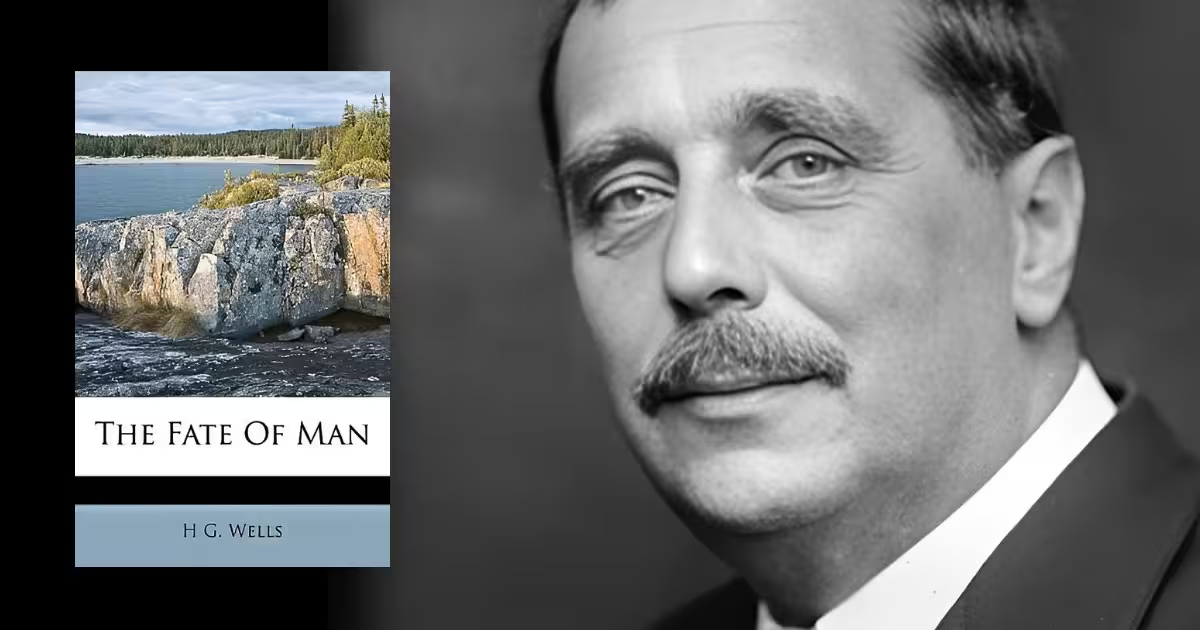
Why did a science fiction pioneer spend the last clear-headed years of his career writing a plain, joyless little book that begged the world to grow up before it was too late? That is the question I kept returning to while reading H.G. Wells’s The Fate of Man, and it is the reason I think more people should know this book exists.
Wells finished it in the summer of 1939, weeks before Hitler invaded Poland, and he was not guessing. He was doing arithmetic, and the arithmetic terrified him.
The Fate of Man (1939), published in the UK as The Fate of Homo Sapiens, is H.G. Wells’s last serious attempt to say, without any of his famous fictional dressing, exactly what he thought was about to happen to the human species.
He argues that we are an animal like any other, bound by the same rules of adaptation that govern every living thing, and that our nationalism, our religions, and our war habits had fallen dangerously out of step with the destructive power we had built for ourselves. He predicts a second world war within two or three years.
He was right within weeks. It is a strange, angry, occasionally offensive, and genuinely important book, and almost nobody reads it anymore.
Species that fail to adapt to a changed environment go extinct, and Wells’s whole argument is that human institutions, nations, churches, and empires included, are subject to that exact same law, with the difference that in 1939 we had just handed ourselves weapons capable of finishing the job in years instead of millennia.
Table of Contents
Preferred readers
The Fate of Man is best for readers of Yuval Noah Harari’s Sapiens and Homo Deus who want to see where the big think-piece about the whole human species genre actually started; anyone who enjoys political nonfiction in the vein of Orwell or Hannah Arendt; students of interwar history who want a primary source written by someone watching the catastrophe arrive in real time; and readers who like their authors blunt, cranky, and unwilling to soften a diagnosis.
Not for anyone looking for Wells the novelist, there is no plot and no Martians here; readers who want a tidy, comforting book, because this one ends in genuine despair; and readers who are not prepared to sit with some genuinely dated and, in places, offensive passages about Jewish people and colonized peoples, which I address directly and without softening later in this piece.
Introduction
The Fate of Homo Sapiens: An Unemotional Statement of the Things that are Happening to Him Now, and of the Immediate Possibilities Confronting Him is a work of nonfiction by H.G. Wells, published in London by Secker and Warburg in August 1939.
An American edition appeared the same year under the title The Fate of Man, from Alliance Book Corporation and Longmans, Green and Co. Wells was 72 years old and one of the most famous writers alive, best known then as now for The Time Machine and The War of the Worlds.
The Fate of Man has nothing to do with either. It is a work of social and political argument, 26 short numbered sections running to roughly 330 pages, in which Wells tries to say, without a story to hide behind, exactly what he thinks is wrong with the world and how little time is left to fix it.
Background
By the time Wells sat down to write this book, he had spent nearly fifty years trying to get people to think seriously about the future.
He had written Anticipations in 1900, The Outline of History in the early 1920s (a book he reports, in his own account, sold in the millions and was translated into nearly every major language), The Science of Life with Julian Huxley and his own son G.P. Wells, and World Brain in 1938, which proposed a permanent, freely accessible encyclopedia of human knowledge.
None of it, in his own telling, had moved the needle fast enough.
The world around him in 1938 and 1939 was collapsing in a specific, dated way that the book carries on every page. Hitler had annexed Austria and the Sudetenland. Kristallnacht had happened the previous November.
Wells himself had just returned from a lecture tour of Australia and New Zealand, where, in a Melbourne newspaper interview in January 1939, he called Hitler “a certified lunatic” and dismissed Mussolini in similarly unflattering terms, a remark blunt enough that Australian Prime Minister Joseph Lyons, a supporter of the appeasement policy toward Germany, publicly said his government would not be associated with it.
Wells wrote much of The Fate of Man with that controversy still fresh, and its chapter on what he calls the Nazi religion repeats the insanity charge almost word for word. Seven months after the book reached shops, Germany invaded Poland.
The Fate of Man Full Summary
What follows is a complete walk through Wells’s case, section by section, including exactly where he lands at the end, so you will know the whole shape of the book whether or not you go on to read it yourself.
How Wells builds the case. Wells opens with a long, personal introduction describing his own upbringing in a poor London household, his scientific training under the biologist T.H. Huxley at the Royal College of Science, and how that training convinced him that human beings are not a special exception to the natural world.
From there he lays out, plainly and repeatedly, what he considers indisputable biology: every species either adjusts to a changing environment or it dies out, and the fossil record is mostly a record of failure rather than success. Cold-blooded animals survive mainly on fixed instinct; mammals, with their larger brains, survive by learning.
Human beings are the most extreme version of the learning animal there is, so much so that Wells argues most of what makes up an individual person, their habits, laws, loyalties, and beliefs, is really a kind of social inheritance layered on top of a fairly ordinary ape.
He then applies this directly to history. For most of human existence, he argues, young men were a society’s chronic surplus problem, too many of them, not enough land or work, and war was the ugly but functional way that surplus got managed, generation after generation.
What changed, and changed almost overnight in evolutionary terms, is that industrial invention multiplied the power available to any one country by a factor Wells compares to a ship whose engines have been secretly supercharged a thousandfold, with nobody retraining the crew. War used to be a controlled bleed.
By the twentieth century it had become a mechanism capable of erasing whole cities and, Wells increasingly suspected, the species itself.
Can the damage be undone? Having established the danger, Wells asks whether humanity can adapt fast enough, and answers that only a total mental reorganization, a new, shared, scientific outlook on the world, offers any hope at all.
He is scathing about Clarence Streit‘s then-popular proposal, in the book Union Now, for an immediate federal union of Western democracies, arguing that most of the states on Streit’s list are not meaningfully democratic to begin with.
That sends Wells into his own extended definition of democracy, which he insists must mean three things at once: government bound by law rather than by any one ruler’s whim, an economy organized for the common good rather than private profit (in effect, socialism), and a genuinely worldwide, cosmopolitan outlook rather than national loyalty.
By that standard, he concludes, not one existing government, Britain, France, or the United States included, actually qualifies.
Wells uses himself as evidence. In one of the book’s strangest and most memorable stretches, Wells turns the argument on himself, walking through his own fifty-year career, from The Time Machine through Anticipations, The Outline of History, and World Brain, as a case study in how slowly even a genuinely future-minded person comes to take the future seriously.
He recalls giving lectures in Australia in 1938 that were warmly applauded and then completely ignored, and he coins, or rather recycles from an earlier book of his, the line that human prospects amount to a race between education and catastrophe.
By 1939, he admits candidly, he no longer believed education was winning that race, and he is unusually open about his own exhaustion, his declining health, and a kind of personal despair he says has settled in during the previous half-dozen years of watching the news.
A tour of the world’s belief systems. The middle third of the book is a country-by-country, religion-by-religion survey of the forces Wells believes are blocking the reorganization he wants, and it takes up eleven of the book’s 26 sections.
He starts with organized Judaism, and this is the chapter I discuss at length in the Themes and Evaluation sections below, because it is genuinely one of the most troubling parts of the book: Wells blames the idea of a divinely chosen people for provoking the antisemitism aimed at Jewish communities, even as, in the very same pages, he describes the persecution of Jewish refugees under Nazi rule with real and evident horror.
From there he moves to Christianity, treating Roman Catholicism and Protestantism as two separate case studies.
He calls the Roman Catholic Church the single largest obstacle to the kind of world reorganization he wants, tracing its history from a Jewish sect through the Council of Nicaea to what he sees as centuries of accumulated superstition, and he argues that Protestantism, followed to its logical end, stops being religious belief at all and becomes plain atheism.
Next comes the Nazi movement, then Italian Fascism, then the British aristocracy that Wells says still quietly runs the supposedly democratic British Empire from behind a screen of parliamentary language.
He is unsparing about all three.
He is particularly harsh on Britain, calling it a crowned oligarchy that traces an unbroken line from Magna Carta’s barons to the same handful of families, the Church, and the officer class that he says handed Neville Chamberlain effective dictatorial powers without anyone ever voting for it. From there Wells travels east, describing Japan’s state religion of Shinto in some detail, including its founding myth of the god Izanagi and the sun goddess, and predicting, correctly as it turned out within a decade, that a defeated Japanese army returning home in humiliation could easily topple its own imperial system the way a defeated Russian army had toppled the Tsar in 1917.
His chapter on China treats it as the most promising country on Earth precisely because its traditions are, in his view, already dissolving, leaving what he calls the most changeable mass of people anywhere.
A short, uncomfortable chapter on the colonized peoples of Africa and India follows, one where Wells’s paternalism toward populations under British and other colonial rule is on full display even where his stated politics are anti-imperial.
He then turns to Soviet Communism and the legacy of Karl Marx personally, and here his contempt is entirely personal rather than structural: he accuses Marx of inventing an imaginary, all-solving proletariat instead of doing the harder work of planning what should actually happen after a revolution succeeds, while holding out real hope that ordinary Russians, whom he describes as naturally less obedient than Germans, might eventually shrug off the Communist Party altogether.
The survey closes with American culture, which Wells treats more sympathetically than almost anything else in The Fate of Man, praising its comparatively open press and its habit of free argument, while warning that the whole apparent unity of Franklin Roosevelt’s America is more personal and accidental than it looks, and could just as easily collapse into regional chaos once Roosevelt himself is gone.
A short chapter then steps back to argue that every person alive, not just every nation, is torn between three competing impulses: a comfortable pull toward familiar tradition, a harder-won pull toward genuine change, and a third, entirely amoral impulse toward simple self-interest that Wells says takes over whenever the first two cancel each other out and social discipline breaks down.
Wells closes with three short, bleak sections.
In “Summary,” he compares the world’s competing belief systems to a city collapsing in a landslide, with everyone still clinging to whichever building they were born in even as the walls come down.
In “Impossibility of Utopianism,” he refuses to describe what a successful, adapted human future might actually look like in any detail, arguing that it is essentially unimaginable from where we stand, the way a fish could not describe what walking feels like.
And in the final section, “Decadent World,” he lays out, with startling confidence, exactly what he expects instead: a second global war within two or three years, shorter and far more destructive than the first because both sides will start it already fully armed; a punitive peace that solves nothing, just as Versailles solved nothing; the likely breakup of the British Empire; continued instability in Germany, Russia, China, and Japan regardless of who wins; and a long, grinding decline into a new, technologically armed dark age, in which knowledge survives in fragments, cities become dangerous, and a handful of strongmen impose local order through fear and revived religion.
The very last words of the book state his whole argument in three words: adapt or perish.
He offers no comfort that we will choose the first option.
The Fate of Man Analysis
Key Figures and Voices in The Fate of Man
Adolf Hitler appears as Wells’s central case study in how a damaged individual and a damaged nation can lock together. Wells calls him insane in almost clinical language, a claim that had already gotten him publicly rebuked by an Australian prime minister only months earlier, and argues that Hitler’s specific madness happened to fit Germany’s post-Versailles resentment so precisely that some version of Nazism was probably inevitable with or without him.
Benito Mussolini gets a lighter, almost mocking treatment by comparison, Wells calls him vain and ridiculous more than dangerous, though he does not let him off the hook for Abyssinia or for political murders carried out under his regime.
Karl Marx functions as Wells’s intellectual rival more than a political figure. Wells’s dislike of him is personal and long-standing, and he uses Marx mainly to argue that revolutionary anger without a workable plan for the aftermath is worse than useless.
Clarence Streit, author of the real 1939 bestseller Union Now, is used as an example of well-meaning shallow thinking, a proposal for uniting the democracies that Wells says never actually defines what a democracy is.
Neville Chamberlain, though never flattered, is treated mostly through his policies, and Wells accuses the British establishment of having effectively handed Chamberlain dictator-like power through inaction rather than force.
Themes and Symbolism
Adapt or perish. Every argument in the book runs back to this one biological rule, that a species out of step with its environment either changes or disappears, and Wells applies it to nations, religions, and economic systems with total consistency.
It gives The Fate of Man its spine, but it also flattens a lot of genuinely different political and moral questions into a single ecological metaphor, which is both the book’s most powerful trick and its biggest weakness.
The supercharged engine. Wells’s most vivid image, used to describe how industrial power outran human self-control, compares humanity to a ship whose engines have been made a thousand times more powerful without retraining the crew or reinforcing the hull. War used to be survivable friction between nations. In an age of aircraft and high explosives, Wells argues, it becomes something closer to species-level self-harm.
The race between education and catastrophe. This phrase, which Wells had used in an earlier book and repeats here, is the closest the book comes to a thesis statement in six words. Nearly everything he does, from the plea for a “World Encyclopedia” to the long autobiographical digression about his own career, is really an argument about which side of that race is currently winning, and by 1939 he clearly believed it was catastrophe.
Democracy redefined. Wells refuses to let “democracy” mean simply voting or free speech. He insists it has to mean government under law, economic organization for the common good, and a fully worldwide rather than national outlook, all at once, and then uses that definition to argue that essentially no country on Earth, including the ones about to fight for it, actually qualifies.
It is a deliberately uncomfortable rhetorical move, aimed as much at British and American self-satisfaction as at the dictatorships.
Reason versus tribal loyalty. Running under everything is Wells’s lifelong argument that religion, nationalism, and inherited tradition survive mainly because they are comforting and familiar, not because they are true or useful, and that a species capable of building weapons this powerful can no longer afford comforting fictions.
This is also where The Fate of Man is at its most quietly radical and, in the chapters on Judaism and colonized peoples especially, at its most damaging, since Wells’s contempt for “tribal” loyalty slides at points into contempt for the actual people holding onto it.
The Fate of Man Evaluation
I will say plainly what I think: The Fate of Man is a genuinely important document of its moment, written with real intellectual courage and real personal exhaustion, and it is also, in places, a hard book to like.
Strengths. The core argument, biological, plainly stated, and refusing any comforting exception for human beings, is still bracing to read today, and Wells’s prose, short sentences, direct address, almost no decoration, moves faster than a lot of contemporary political nonfiction twice its length.
The autobiographical sections, where he holds himself up as evidence rather than lecturing from above, are the best writing in the book.
And the final chapter’s of The Fate of Man forecast of a short, brutally destructive second world war followed by a punitive, unstable peace reads, from where we now stand, as close to prophecy as nonfiction political writing gets.
Weaknesses. The Fate of Man‘s biggest flaw is not stylistic, it is moral, and I do not want to soften it.
The chapter on Jewish identity is genuinely antisemitic by any reasonable standard, arguing that the idea of a “Chosen People” is itself close to a conspiracy against the rest of humanity and that Jewish tradition bears real responsibility for provoking the hatred directed at it, even while, a few pages later, Wells describes the persecution of Jewish refugees under Nazi rule with real and evident horror.
Scholars who study Wells’s writing on this subject, notably the literary historian Bryan Cheyette, have documented this contradiction in detail: a lifelong opponent of Nazism who nonetheless imagined a future world state with no real room for a distinct Jewish culture.
The chapter on colonized peoples in Africa and India is similarly dated, treating whole populations mainly in terms of what they might one day contribute to Wells’s imagined “World Brain,” a framing that is paternalistic even where it is meant kindly.
And his description of Hitler leans on outdated, offensive pop-psychiatric language about mental illness and race that reads as genuinely uncomfortable today. None of this is a footnote. It sits inside the same 330 pages as some of Wells’s clearest thinking, and a fair review has to hold both things at once.
Impact and controversy
The Fate of Man landed exactly as its argument predicted it would.
Contemporary reviewers took it seriously without much enthusiasm, a 1939 notice in the science journal Nature treated it as a significant if grim contribution to the debate over science’s social responsibility, and a 1940 review in the Dominican journal Blackfriars called The Fate Of Homo Sapiens “a pedestrian effort” as prose while conceding it was, in effect, the closest thing to an official summary of Wells’s entire worldview.
Weeks after publication, its central prediction, a second world war, arrived on schedule, which retroactively turned a work of argument into something closer to a diagnosis.
Comparison with similar works
Readers who found this piece through an interest in Yuval Noah Harari’s Sapiens or Homo Deus, both of which I have reviewed elsewhere on this site, are in for a genuine surprise: eighty years before “Homo sapiens” became a publishing brand, Wells was already asking the same species-level question, and answering it far less comfortably than Harari does.
Readers of George Orwell’s Nineteen Eighty-Four or Hannah Arendt’s The Origins of Totalitarianism, both covered in our roundup of the most consequential political books ever written, will recognize the same interwar dread here in nonfiction form rather than fiction or philosophy.
And Wells’s own later book, Mind at the End of Its Tether (1945), written after the war he predicted had actually happened, is worth reading as a kind of grim sequel, since it is, if anything, even darker than this one.
Lessons for Today
Reading an 86-year-old warning about a war that already happened could easily feel like a museum exercise, so here are five ways I think it still bites.
First, Wells’s central complaint, that our institutions upgrade far slower than our technology does, is arguably truer now than it was in 1939, given how quickly artificial intelligence and biotechnology have outrun the laws and norms meant to govern them.
Second, his insistence that “democracy” is meaningless unless it is precisely defined, rather than treated as a comfortable label everyone assumes they already have, is a useful discipline for any current political argument, left or right.
Third, his race between education and catastrophe reads today almost exactly like the modern argument about climate change and public understanding, the facts have been available for decades, and the slow part has always been getting societies to act on them in time.
Fourth, The Fate of Man is a genuinely useful case study in how a thinker can be right about the big structural danger of his moment, industrial warfare, while being badly, damagingly wrong about a specific group of people, a caution worth keeping in mind whenever a confident public intellectual claims to have the whole picture figured out.
Fifth, Wells’s own admission that he had grown tired and pessimistic, rather than performing false confidence, is a small but real model for how to write honestly about a frightening subject without either despair or empty reassurance.
The Fate of Man Quotes
1. The Race Between Education and Catastrophe
“The outlook for mankind, I had written—I think in The Salvaging of Civilisation—is ‘a race between education and catastrophe.'”
Context: Wells reflects on his earlier prophetic statement, noting that catastrophe is advancing quickly while education “seems still unable to get started.”
Significance: This is arguably the most famous and frequently cited passage from the entire book—a concise summary of Wells’s central thesis that humanity’s survival depends on whether we can educate ourselves fast enough to avoid destruction.
2. The Biological Fate of the Species
“Either life is just beginning for him or it is drawing very rapidly to its close.”
Context: The concluding lines of The Fate of Man, summarizing the existential choice facing humanity.
Significance: This stark binary framing captures Wells’s ultimate message—there is no middle ground. The species must either achieve a fundamental mental transformation or face extinction.
3. Adapt or Perish
“Adapt or perish, that is and always has been the implacable law of life for all its children.”
Context: Immediately preceding the above quote, this restates the core biological principle applied to human civilization.
Significance: This phrase distills the ecological argument that runs throughout the book—humanity is subject to the same laws as any other species.
4. The Surplus of Young Men
“The essential fact is the accumulating tension of unsatisfied youth, and these isms are mere formulae of relief.”
Context: Wells argues that ideologies (Nazism, Fascism, Communism, etc.) are surface phenomena; the deeper cause is the buildup of restless, unemployed young men with no productive outlet.
Significance: This is one of Wells’s most original and influential arguments—the “Youth Pressure Theme” he identifies as one of three driving forces shaping history.
5. The Changing Nature of War
“In the past it was a corrective and almost tonic process. Now it has become a rapid wasting disease, a galloping consumption of the human species.”
Context: Contrasting traditional warfare (which served as a population release valve) with modern industrial warfare.
Significance: Wells argues that technological change has transformed war from a manageable social mechanism into an existential threat.
6. The Illusion of Human Uniqueness
“The species Homo sapiens is no privileged exception to the general conditions that determine the destinies of other living species.”
Context: Wells insists that humans are subject to the same ecological laws as all other species.
Significance: This rejection of human exceptionalism underlies the entire book’s argument.
7. The Fundamental Problem of Youth
“From the point of view of the biologist Homo sapiens was making an almost excessive success. He was repeating the exuberance of the great Mesozoic reptiles… The front of its biological advance was this surplus of young men.”
Context: Wells compares human population expansion to the over-success of species that later went extinct.
Significance: The biological analogy suggests that human “success” (population growth) contains the seeds of its own destruction.
8. The World Brain Concept
“The creation of a greater mental superstructure to reorient the mind of the world is an entirely practicable proposal.”
Context: Wells’s proposal for a permanent World Encyclopaedia—a “mighty super-university” to coordinate global knowledge.
Significance: This is the positive solution Wells offers: organized, accessible knowledge as the only path to survival.
9. The Abolition of Distance
“Now that distance has been abolished, he lives with increasing restlessness cheek by jowl with all the rest of mankind.”
Context: Wells describes the technological unification of the world through communication and transport.
Significance: The compression of space creates new pressures that existing social systems cannot handle.
10. The Failure of Education
“Education still seems unable to get started, has indeed not even readjusted itself to start.”
Context: Wells’s pessimistic assessment that educational systems have not adapted to meet the crisis.
Significance: This is the negative counterpart to the “race between education and catastrophe” passage.
Conclusion
The Fate of Man is not a book I can recommend without real caveats, and I have tried to give you all of them plainly rather than burying them in a footnote.
But I do think it deserves to be read, both for what it gets right, the mechanics of how a technologically advanced, poorly governed species can talk itself into catastrophe, and for what it gets badly wrong, since the same book that horrifies at Nazi persecution also traffics in genuinely antisemitic argument a few chapters earlier. It is a document written by a frightened, exhausted, brilliant man watching the war he had spent two decades warning against arrive exactly on schedule.
If you have read Harari’s Sapiens, Orwell’s 1984, or Arendt’s Origins of Totalitarianism, this is the missing, messier ancestor of that entire shelf, and it is worth an afternoon of anyone’s time who wants to understand how it felt to see 1939 coming and be unable to stop it.







