
Have you ever felt that the world’s most cherished beliefs—about God, about morality, about how to raise children and run nations—rest on nothing more than inherited prejudice and convenient fiction?
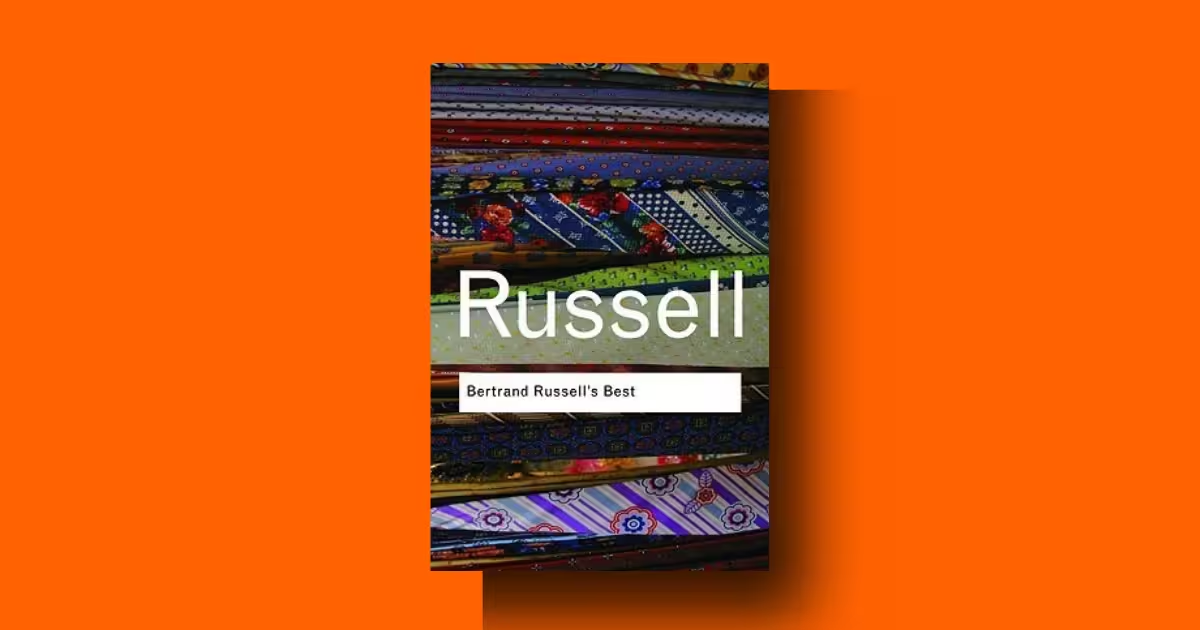
If so, Bertrand Russell’s Best is the book that will make you feel both validated and thoroughly unsettled. This isn’t just a collection of clever one-liners from a dead philosopher. It’s a surgical strike against every form of dogmatic authority that has kept humanity fearful, ignorant, and at each other’s throats.
Table of Contents
Overview
Bertrand Russell’s Best (Routledge Classics, 2009; first published 1958) is a curated anthology of the philosopher’s sharpest, funniest, and most devastating passages on psychology, religion, sex and marriage, education, politics, and ethics. Edited by Professor Robert E. Egner, the book distills more than seventy years of Russell’s writing—over seventy books and countless articles—into 144 pages of pure intellectual napalm.
What makes this collection unique isn’t just Russell’s legendary wit. It’s the deadly serious purpose beneath the laughter.
As the Times Educational Supplement observed, these are “pungent quotations that underlie Lord Russell’s views on dogmatic authority as one of the greatest obstacles to human advancement”. Russell himself warned in his preface: “I should not wish to be thought in earnest only when I am solemn”. The humour is a weapon, not a distraction.
Bertrand Russell’s Best’s core thesis is simple yet radical: almost everything we treat as sacred—religious dogma, conventional morality, patriotic fervour, educational coercion—is actually harmful nonsense that keeps us from building a world guided by love and knowledge.
Russell summarised his entire ethical philosophy in one sentence: “the good life is one inspired by love and guided by knowledge”. Everything else, he argues, is either superstition or self-deception.
Reader recommendation
Bertrand Russell’s Best is recommended for:
- Readers who enjoy intellectual provocation and don’t mind having their sacred cows slaughtered
- Philosophy beginners who want an accessible, entertaining entry point to one of the 20th century’s greatest minds
- Skeptics, agnostics, and atheists looking for articulate, witty ammunition against religious dogma
- Anyone frustrated by political hypocrisy, educational authoritarianism, or sexual prudery
- Lovers of Voltairean satire who appreciate wit as a vehicle for serious social criticism
Bertrand Russell’s Best is not recommended for:
- Those who prefer their philosophy solemn, jargon-filled, and safely academic—Russell is anything but
- Devout believers in any orthodox religion who aren’t prepared to have their faith vigorously challenged
- Readers seeking systematic philosophical arguments rather than pungent aphorisms and excerpts
- People who believe that “sacred” truths should be immune from scrutiny
- Those who confuse seriousness with solemnity—Russell is deeply serious but rarely solemn
1. Introduction
Title and Author Information
Book Title: Bertrand Russell’s Best
Author: Bertrand Russell (1872–1970)
Edition: Routledge Classics (2009)
First Published: 1958
Publisher: Taylor & Francis/Routledge
Pages: 144
Language: English
Bertrand Russell needs no introduction to anyone with even a passing interest in modern thought. Born in 1872 into British aristocracy—he would become the 3rd Earl Russell in 1931—he lived until 1970, publishing more than 70 books and some 2,000 articles across an astonishing range of subjects.
He was a founding figure in analytic philosophy, co-author with Alfred North Whitehead of the monumental Principia Mathematica, and recipient of the Nobel Prize for Literature in 1950 “in recognition of his varied and significant writings in which he champions humanitarian ideals and freedom of thought”.
But Russell was no ivory-tower academic.
He was imprisoned twice for his pacifist activism—once in 1918 for six months, during which he wrote Introduction to Mathematical Philosophy—and again in 1961 at the age of 89 for leading anti-nuclear protests.
In 1940, he was famously denied a professorship at the City College of New York after a court declared him “unfit” to teach, thanks to a campaign by religious conservatives who called him “the devil’s minister of men” and described his works as “sexual filth”. John Dewey called the affair “a scar on our repute and fair play.”
Context
Bertrand Russell’s Best is an anthology of excerpts from Russell’s vast body of work, selected and edited by Professor Robert E. Egner. First published in 1958, it was revised and reissued by Routledge Classics in 2009 with a new preface by Russell himself, written just weeks before his death at age 97.
Bertrand Russell’s Best covers six major themes: Psychology, Religion, Sex and Marriage, Education, Politics, and Ethics. Each chapter collects Russell’s most pungent observations on that subject, drawn from works spanning his entire career—from his early philosophical writings to his later social and political essays.
What makes this collection particularly valuable is its accessibility. Russell was one of the few major philosophers who could write lucid, engaging prose for a general audience.
As one reviewer put it, “He is a joy to read when you find yourself bogged down in the endless jargon of more modern philosophers”. The Evening News called it “the cream of the great man’s satire, witty, pungent quotes from a variety of writings”.
Purpose
Bertrand Russell’s Best’s central purpose is stated explicitly in Russell’s preface: to demonstrate that wit is “the best weapon” against solemnity, which he saw as “frequently a cloak for a humbug”.
Russell believed that “what is most lacking in the modern world is genial, good-natured tolerance; and what is most hostile to this is a harsh and dogmatic morality which condemns the majority of the human race as reprobates.”
But Bertrand Russell’s Best has a deeper purpose: to show that dogmatic authority in all its forms—religious, political, educational, moral—has been “one of the great obstacles to human advancement”.
Russell wasn’t merely attacking religion or conservatism for the sake of being provocative. He believed that humanity’s survival and flourishing depended on replacing fear-based, authoritarian thinking with scientific inquiry, rational scepticism, and genuine compassion.
As the editor, Robert E. Egner, puts it in his introduction: “Lord Russell was mainly concerned with showing how dogmatic authority in its innumerable forms has been, and still remains, one of the great obstacles to human advancement, in terms of an increase in scientific knowledge on the one hand and a decrease in human misery on the other.”
2. Background
To appreciate Bertrand Russell’s Best, you need to understand something about the man who wrote it. Russell wasn’t just a philosopher; he was a public intellectual in the truest sense—a man who engaged with the most pressing issues of his time and paid a heavy price for his honesty.
Born into the British aristocracy in 1872, Russell was orphaned by age six and raised by his grandmother, Countess Russell, in an atmosphere of “puritan piety and austerity”.
Family prayers at 8 a.m., Spartan food, cold baths year-round, piano practice from 7:30 in unheated rooms—this was the world that produced one of the most iconoclastic minds of the 20th century.
Russell’s intellectual journey began early. At age 11, he discovered Euclidean geometry, an experience he later described as “as dazzling as first love” because it introduced him to the possibility of certain, demonstrable knowledge. But this initial excitement gave way to scepticism when his brother told him that axioms “can’t be proved” but “have to be assumed”.
Russell’s reaction—“But why should I admit these things if they can’t be proved?”—foreshadowed a lifetime of questioning every unquestioned assumption.
By age 15, Russell had abandoned the Christian faith in which he was raised. He never looked back. Throughout his long life, he remained one of the most articulate critics of organised religion, not because he was hostile to spirituality but because he believed that faith—defined as “a firm belief in something for which there is no evidence”—was intellectually dishonest and morally dangerous.
Russell’s political activism began during World War I, when he was imprisoned for pacifist propaganda. He later reflected: “I was much cheered on my arrival by the warder at the gate, who had to take particulars about me. He asked my religion, and I replied ‘agnostic.’
He asked how to spell it, and remarked with a sigh: ‘Well, there are many religions, but I suppose they all worship the same God.’ This remark kept me cheerful for about a week”.
The 1940 New York controversy remains one of the most notorious episodes in American academic history.
A Brooklyn taxpayer, Mrs. Jean Kay, sued to block Russell’s appointment to the City College of New York, arguing that his views on sex and marriage would have “an immoral influence on the children of New York”. A judge ruled in her favour, and Russell was denied the position without ever being allowed to speak in his own defence.
In 1950, the same man who had been denounced as “the devil’s minister of men” received the Nobel Prize for Literature. The Swedish Academy praised his “varied and significant writings in which he champions humanitarian ideals and freedom of thought.” The irony was not lost on Russell.
3. Bertrand Russell’s Best Summary
Bertrand Russell’s Best is divided into six thematic chapters, each containing a series of excerpts from Russell’s published works. The excerpts range from a few sentences to several paragraphs, and each is carefully chosen to illustrate Russell’s wit, wisdom, and relentless critique of dogmatic thinking.
Chapter 1: Psychology
Russell begins Bertrand Russell’s Best by examining the fundamental motives that drive human behaviour. He identifies four primary drives: acquisitiveness, vanity, rivalry, and love of power.
On vanity: “Vanity is a motive of immense potency. Anyone who has much to do with children knows how they are constantly performing some antic, and saying, ‘Look at me.’ ‘Look at me’ is one of the fundamental desires of the human heart”.
He illustrates this with a story about two Esthonian girls who, despite having plenty to eat after being rescued from famine, spent their leisure “visiting neighbouring farms and stealing potatoes, which they hoarded”—a behaviour he compares to Rockefeller’s lifelong accumulation of wealth.
On boredom and excitement: “Human beings show their superiority to the brutes by their capacity for boredom”.
Russell notes that when white men first contact “unspoilt races of savages,” the one gift they truly value is “intoxicating liquor, which enables them for the first time in their lives to have the illusion, for a few brief moments, that it is better to be alive than dead”.
On the love of excitement: “Civilised life has grown altogether too tame, and, if it is to be stable, it must provide harmless outlets for the impulses which our remote ancestors satisfied in hunting”.
Russell’s proposed solution is characteristically sardonic: “I think every big town should contain artificial waterfalls that people could descend in very fragile canoes, and they should contain bathing pools full of mechanical sharks. Any person found advocating a preventive war should be condemned to two hours a day with these ingenious monsters”.
On the psychology of persecution: Russell notes that in Lisbon, when heretics were publicly burned, spectators became furious if a penitent was granted the mercy of strangulation before being burned. “The spectacle of the writhing torments of the victim was, in fact, one of the principal pleasures to which the populace looked forward to enliven a somewhat drab existence”.
On self-esteem and prejudice: “In order to be happy we require all kinds of supports to our self-esteem. We are human beings; therefore human beings are the purpose of creation. We are Americans; therefore America is God’s own country. We are white; and therefore God cursed Ham and his descendants who were black”.
On the futility of cruelty: Russell notes that until the late 18th century, insanity was attributed to demonic possession, and the “cure” was to beat the patient so severely that the demons would flee. “It is a curious and painful fact that almost all the completely futile treatments that have been believed in during the long history of medical folly have been such as caused acute suffering to the patient”.
Chapter 2: Religion
This is the chapter of Bertrand Russell’s Best that made Russell famous—and infamous. His views on religion remained remarkably consistent from age 15 until his death.
On the definition of faith: “We may define ‘faith’ as a firm belief in something for which there is no evidence. Where there is evidence, no one speaks of ‘faith.’ We do not speak of faith that two and two are four or that the earth is round. We only speak of faith when we wish to substitute emotion for evidence”.
On the argument from design: “If everything must have a cause, then God must have a cause. If there can be anything without a cause, it may just as well be the world as God, so that there cannot be any validity in that argument.
It is exactly of the same nature as the Indian’s view, that the world rested upon an elephant and the elephant rested upon a tortoise; and when they said, ‘How about the tortoise?’ the Indian said, ‘Suppose we change the subject’”.
On the problem of evil: “I do not understand where the ‘beauty’ and ‘harmony’ of nature are supposed to be found. Throughout the animal kingdom, animals ruthlessly prey upon each other. Most of them are either cruelly killed by other animals or slowly die of hunger. For my part, I am unable to see any very great beauty or harmony in the tapeworm”.
On the history of religious cruelty: “Dark terrors and misfortunes in the life to come oppressed the Egyptians and Etruscans, but never reached their full development until the victory of Christianity. Gloomy saints who abstained from all pleasures of sense, who lived in solitude in the desert, denying themselves meat and wine and the society of women, were, nevertheless, not obliged to abstain from all pleasures. The pleasures of the mind were considered to be superior to those of the body, and a high place among the pleasures of the mind was assigned to the contemplation of the eternal tortures to which the pagans and heretics would hereafter be subjected”.
On religious opposition to medicine: When anaesthetics were discovered for childbirth, clergy objected on the grounds that God said to Eve: “In sorrow shalt thou bring forth children.” Simpson, the discoverer, “succeeded in proving that there was no harm in giving anaesthetics to men, because God put Adam into a deep sleep when He extracted His rib. But male ecclesiastics remained unconvinced as regards the sufferings of women, at any rate in childbirth”.
On the cowardice of faith: “I say people who feel they must have a faith or religion in order to face life are showing a kind of cowardice, which in any other sphere would be considered contemptible. But when it is in the religious sphere it is thought admirable, and I cannot admire cowardice whatever sphere it is in”.
On all religions being harmful: “I think all the great religions of the world—Buddhism, Hinduism, Christianity, Islam and Communism—both untrue and harmful. It is evident as a matter of logic that, since they disagree, not more than one of them can be true”.
On Christ and hell: “There is one very serious defect to my mind in Christ’s moral character, and that is that He believed in Hell. I do not myself feel that any person who is really profoundly humane can believe in everlasting punishment”
On being an agnostic vs. atheist: “I think that in philosophical strictness at the level where one doubts the existence of material objects and holds that the world may have existed for only five minutes, I ought to call myself an agnostic; but, for all practical purposes, I am an atheist. I do not think the existence of the Christian God any more probable than the existence of the Gods of Olympus or Valhalla”.
Chapter 3: Sex and Marriage
This chapter contains some of Russell’s most controversial material—and it was this chapter, more than any other, that got him banned from New York in 1940.
On the double standard: “Men have from time immemorial been allowed in practice, if not in theory, to indulge in illicit sexual relations. It has not been expected of a man that he should be a virgin on entering marriage, and even after marriage, infidelities are not viewed very gravely if they never come to the knowledge of a man’s wife and neighbours. The possibility of this system has depended upon prostitution”.
On St Paul’s view of marriage: “St Paul makes no mention whatever of children; the biological purpose of marriage appears to him wholly unimportant. This is quite natural, since he imagined that the Second Coming was imminent and that the world would soon come to an end”. Russell compares Paul’s recommendation of marriage to a doctor recommending acid drops to someone trying to quit smoking: “It is in this spirit that St Paul recommends marriage. He does not suggest that it is quite as pleasant as fornication, but he thinks it may enable the weaker brethren to withstand temptation”.
On the Catholic view of sex: “Not only is sexual intercourse only legitimate within marriage, but even between husband and wife it becomes a sin unless it is hoped that it will lead to pregnancy… If the wife hates sexual intercourse, if she is likely to die of another pregnancy, if the child is likely to be diseased or insane, if there is not enough money to prevent the utmost extreme of misery, that does not prevent the man from being justified in insisting on his conjugal rights, provided only that he hopes to beget a child”.
On the ignorance of the young: “The view of the orthodox moralist… on the question of sex knowledge may, I fancy, be fairly stated as follows. There is no doubt that sexual misconduct is promoted by sexual thoughts, and that the best road to virtue is to keep the young occupied in mind and body with matters wholly unconnected with sex. They must, therefore, be told nothing whatever about sex; they must as far as possible be prevented from talking about it with each other, and grown-ups must pretend that there is no such topic”.
On the absurdity of obscenity laws: “It is permissible with certain precautions to speak in print of coitus, but it is not permissible to employ the monosyllabic synonym for this word… The consequence is that, while it is permissible to teach birth control to the well-to-do, it is criminal to teach it to wage-earners and their wives”.
On the effects of Puritan education: “Very few men or women who have had a conventional upbringing have learnt to feel decently about sex and marriage. Their education has taught them that deceitfulness and lying are considered virtues by parents and teachers; that sexual relations, even within marriage, are more or less disgusting, and that in propagating the species men are yielding to their animal nature while women are submitting to a painful duty”.
Chapter 4: Education
Russell was not only a philosopher but also an educational reformer who ran an experimental school with his second wife from 1927 to 1932. His views on education are radical, humane, and devastatingly critical of traditional methods.
On the purpose of education: “The prevention of free inquiry is unavoidable so long as the purpose of education is to produce belief rather than thought, to compel the young to hold positive opinions on doubtful matters rather than to let them see the doubtfulness and be encouraged to independence of mind. Education ought to foster the wish for truth, not the conviction that some particular creed is the truth”.
On faith-based education: “If you think that your belief is based upon reason, you will support it by argument, rather than by persecution, and will abandon it if the argument goes against you. But if your belief is based on faith, you will realise that argument is useless, and will therefore resort to force either in the form of persecution or by stunting and distorting the minds of the young in what is called ‘education.’ This last is peculiarly dastardly, since it takes advantage of the defencelessness of immature minds”.
On the harm of making children memorise Shakespeare: “Children are made to learn bits of Shakespeare by heart, with the result that ever after they associate him with pedantic boredom. If they could meet him in the flesh, full of jollity and ale, they would be astonished… But if at school they had been inoculated against him, they will never be able to enjoy him”.
On educational indoctrination: “It is not altogether true that persuasion is one thing and force is another. Many forms of persuasion—even many of which everybody approves—are really a kind of force. Consider what we do to our children. We do not say to them: ‘Some people think the earth is round, and others think it flat; when you grow up, you can, if you like, examine the evidence and form your own conclusion.’ Instead of this we say: ‘The earth is round.’ By the time our children are old enough to examine the evidence, our propaganda has closed their minds”.
On the demand for certainty: “The demand for certainty is one which is natural to man, but is nevertheless an intellectual vice. If you take your children for a picnic on a doubtful day, they will demand a dogmatic answer as to whether it will be fine or wet, and be disappointed in you when you cannot be sure… To endure uncertainty is difficult, but so are most of the other virtues. For the learning of every virtue there is an appropriate discipline, and for the learning of suspended judgment the best discipline is philosophy”.
On scientific method: “Scientific method, although in its more refined forms it may seem complicated, is in essence remarkably simple. It consists in observing such facts as will enable the observer to discover general laws governing facts of the kind in question. A scientific opinion is one which there is some reason to believe true; an unscientific opinion is one which is held for some reason other than its probable truth. When a man tells you that he knows the exact truth about anything, you are safe in inferring that he is an inexact man”.
Chapter 5: Politics
Russell’s political writings span two world wars, the rise of fascism and communism, and the nuclear age. His critiques of political power are as relevant today as when they were written.
On the absurdity of government propaganda: “I am persuaded that there is absolutely no limit in the absurdities that can, by government action, come to be generally believed. Give me an adequate army, with power to provide it with more pay and better food than falls to the lot of the average man, and I will undertake, within thirty years, to make the majority of the population believe that two and two are three, that water freezes when it gets hot and boils when it gets cold, or any other nonsense that might seem to serve the interest of the State”.
On the psychology of nationalism: “We love those who hate our enemies, and if we had no enemies there would be very few people whom we should love”.
On vanity in politics: “One of the troubles about vanity is that it grows with what it feeds on. The more you are talked about, the more you will wish to be talked about. The condemned murderer, I am told—I have had no personal experience—who is allowed to see the account of his trial in the Press is indignant if he finds a newspaper which has reported it inadequately”.
On the limits of democracy: “Stalin could neither understand nor respect the point of view which led Churchill to allow himself to be peaceably dispossessed as a result of a popular vote. I am a firm believer in democratic representative government as the best form for those who have the tolerance and self-restraint that is required to make it workable. But its advocates make a mistake if they suppose that it can be at once introduced into countries where the average citizen has hitherto lacked all training in the give-and-take that it requires”.
On the nuclear peril: “At first I imagined that the task of awaking people to the dangers of the Nuclear Peril should not be very difficult. I shared the general belief that the motive of self-preservation is a very powerful one which, when it comes into operation, generally overrides all others… I found that this is a mistake. There is a motive which is stronger than self-preservation: it is the desire to get the better of the other fellow”.
On military thinking: “I have found that military men think that Christian belief is very important in the contest with Eastern powers, and they think that if you are not a Christian you will not be so vigorous about it. Well, I read the Sermon on the Mount over again and I could not find a word in it to encourage the H-bomb—not a word”.
Chapter 6: Ethics
The final chapter of Bertrand Russell’s Best gathers Russell’s reflections on morality, sin, and the good life.
On the concept of sin: “The whole conception of ‘sin’ is one I find very puzzling, doubtless owing to my sinful nature. If ‘sin’ consisted in causing needless suffering, I could understand, but on the contrary, sin often consists in avoiding needless suffering”. He illustrates this with the example of euthanasia: when a bill was introduced to legalise euthanasia in cases of painful and incurable disease, the Archbishop of Canterbury opposed it because “the patient’s consent turns euthanasia into suicide, and suicide is sin.”
Russell responds: “I find difficulty in the conception of a God who gets pleasure from contemplating such tortures; and if there were a God capable of such wanton cruelty, I should certainly not think Him worthy of worship”.
On taboo morality: “If throughout your life you abstain from murder, theft, fornication, perjury, blasphemy, and disrespect towards your parents, your Church, and your king, you are conventionally held to deserve moral admiration even if you have never done a single kind of generous or useful action. This very inadequate notion of virtue is an outcome of taboo morality, and has done untold harm”.
On the psychology of moralists: “Most stern moralists are in the habit of thinking of pleasure as only of the senses, and, when they eschew the pleasures of sense, they do not notice that the pleasures of power, which to men of their temperament are far more attractive, have not been brought within the ban of their ascetic self-denial. It is the prevalence of this type of psychology in forceful men which has made the notion of sin so popular, since it combines so perfectly humility towards heaven with self-assertion here on earth”.
On the futility of religious morality: “The view that modern Christians for the most part do not believe in the Bible does not seem to me quite valid. For example, the Anglican Communion still demands a fundamentalist attitude to the Bible.
Many Christians do not seem to know that in the service for the Ordering of Deacons the Bishop says: ‘Do you unfeignedly believe all the Canonical Scriptures of the Old and New Testament?’ And the Ordinand has to answer: ‘I do believe them.’ You may say, no doubt, that this does not matter, since no one expects a parson to speak the truth about important matters on solemn occasions. But, for my part, I think it a pity that people who are intended to stand for virtue have to begin their career by a solemn lie”.
On the good life: Russell’s ethical philosophy is summed up in two passages. The first, from the editor’s introduction: “The Good life he summed up in a single phrase: ‘the good life is one inspired by love and guided by knowledge’”.
The second, from his autobiography: “Three passions, simple but overwhelmingly strong, have governed my life: the longing for love, the search for knowledge, and unbearable pity for the suffering of mankind… I have lived in the pursuit of a vision, both personal and social. Personal: to care for what is noble, for what is beautiful, for what is gentle; to allow moments of insight to give wisdom at more mundane times. Social: to see in imagination the society that is to be created, where individuals grow freely, and where hate and greed and envy die because there is nothing to nourish them. These things I believe, and the world, for all its horrors, has left me unshaken”.
4. Bertrand Russell’s Best Analysis
What I Learned from This Book
Reading Bertrand Russell’s Best is like having a brilliant, cantankerous, and fiercely honest uncle sit you down and explain why almost everything you’ve been taught is nonsense—but in a way that makes you laugh rather than cry.
Bertrand Russell’s Best’s greatest strength is its relentless clarity. Russell never obscures his meaning behind jargon or pretension. When he wants to say that religious faith is intellectually dishonest, he says it directly: “We only speak of faith when we wish to substitute emotion for evidence”.
When he wants to expose the hypocrisy of sexual morality, he does so with devastating simplicity: “The consequence is that, while it is permissible to teach birth control to the well-to-do, it is criminal to teach it to wage-earners and their wives”.
Another major strength is Russell’s moral seriousness beneath the wit. As he warned in his preface, “I should not wish to be thought in earnest only when I am solemn”. The humour is not a distraction from his arguments; it is the argument. By making his readers laugh, Russell disarms their defences and makes them more receptive to uncomfortable truths.
The Evening News rightly called it “the cream of the great man’s satire”.
Bertrand Russell’s Best also excels at connecting the personal to the political. Russell never forgets that abstract philosophical issues have concrete human consequences. When he attacks religious dogma, he’s not just scoring intellectual points; he’s thinking about the real people who suffer because of it—the women denied anaesthetics in childbirth, the heretics burned at the stake, the children indoctrinated with fear and guilt.
The editing is superb. Professor Egner has selected excerpts that are both representative of Russell’s thought and consistently entertaining. The thematic organisation makes it easy to dip in and out, and the brief introductions to each chapter provide helpful context without being intrusive.
However, the book is not without its limitations.
The excerpt format necessarily sacrifices depth for breadth. You get Russell’s best lines, but you don’t always get the full argument that gives them their force. A reader who only encounters these snippets might miss the rigorous philosophical reasoning that underlies them.
Some of Russell’s views have not aged well. As one LibraryThing reviewer notes, “Some of the firm pronouncements have not stood the test of time (notably those about ‘sex and marriage’)”. Russell was writing in the 1920s and 1930s, and some of his assumptions about gender and sexuality reflect the prejudices of his era. That said, he was remarkably progressive for his time, and his basic arguments—against hypocrisy, against prudery, against the subordination of women—remain compelling.
Bertrand Russell’s Best can be relentlessly negative. Russell spends most of his energy attacking what he opposes—religious dogma, political authoritarianism, sexual hypocrisy—rather than building a positive vision of what he supports. This is partly intentional; as he said, “Against solemnity, the best weapon is wit”. But readers looking for a systematic ethical philosophy may find the book unsatisfying.
Russell’s confidence can be off-putting. He rarely expresses doubt about his own positions. As he himself noted, “subjective certainty is inversely proportional to objective certainty”. By that measure, Russell was sometimes more certain than the evidence warranted. But this is also what makes him so readable; he writes with the authority of someone who has thought deeply and come to firm conclusions.
5. Strengths and Weaknesses
Strengths
Unmatched wit and clarity. Russell is one of the few philosophers who can make you laugh out loud while making you think. His prose is a model of direct, vigorous English.
Fearless intellectual honesty. Russell never flinched from unpopular conclusions. He paid for this honesty with imprisonment, professional ostracism, and public vilification—but he never backed down.
Timely relevance. Written mostly in the mid-20th century, Russell’s critiques of religious dogmatism, political propaganda, and educational indoctrination are more relevant than ever in an age of fake news, culture wars, and resurgent authoritarianism.
Accessible introduction to a major thinker. For readers intimidated by Russell’s more technical works, this collection offers an inviting entry point.
Thematic organisation. The six-chapter structure makes it easy to find Russell’s views on specific topics.
Humanity beneath the satire. Despite his reputation as a cold rationalist, Russell’s writing is suffused with genuine compassion. His “unbearable pity for the suffering of mankind” is the emotional engine of everything he wrote.
Weaknesses
Lack of depth. Excerpts, by their nature, cannot capture the full nuance of Russell’s arguments. Serious students of philosophy will need to go to the original sources.
Some dated views. Russell’s assumptions about gender and sexuality, while progressive for his time, can feel dated to modern readers.
Over-reliance on negation. Russell is better at attacking bad ideas than at constructing positive alternatives. His ethical vision—“love guided by knowledge”—is inspiring but underdeveloped.
Occasional over-confidence. Russell sometimes asserts positions with more certainty than the evidence warrants.
The “greatest hits” problem. By selecting only Russell’s wittiest passages, the book can create a misleading impression that he was primarily a satirist rather than a serious philosopher.
6. Comparison with Similar Works
Bertrand Russell’s Best belongs to a tradition of philosophical wit that includes Voltaire’s Philosophical Dictionary, Nietzsche’s Thus Spoke Zarathustra, and Hitchens’ The Portable Atheist. Like Voltaire, Russell uses humour as a weapon against dogmatic authority.
Like Nietzsche, he is willing to challenge the most sacred assumptions of his culture. Like Hitchens, he writes with a polemical energy that is both exhilarating and exhausting.
However, Russell differs from these figures in important ways. Unlike Voltaire, he was also a world-class mathematician and logician; his philosophical credentials are unimpeachable. Unlike Nietzsche, he never abandoned a belief in objective truth or moral progress. Unlike Hitchens, his satire is more often genial than vitriolic; he rarely descends to personal abuse.
Bertrand Russell’s Best also invites comparison with other collections of Russell’s writing, such as The Basic Writings of Bertrand Russell (also edited by Egner) and Unpopular Essays. Bertrand Russell’s Best is more focused on wit and accessibility; the other collections are more comprehensive but less entertaining.
7. Conclusion
Final Verdict
Bertrand Russell’s Best is a book that every thinking person should read—and re-read. It is not a systematic philosophical treatise; it is a collection of intellectual grenades, each designed to blow up some cherished piece of nonsense. Russell throws these grenades with surgical precision, and the explosions are both illuminating and deeply satisfying.
Bertrand Russell’s Best’s central message is that we have been sold a bill of goods. Religion, conventional morality, patriotism, educational authoritarianism—these are not sacred truths but human inventions, and bad ones at that. They have made us fearful, hateful, and stupid.
They have prevented us from building the world we could build: a world guided by love and knowledge, not by fear and dogma.
Russell was not a utopian.
He knew that human beings are fallible, that progress is slow, and that the forces of reaction are powerful. But he never gave up hope. “Neither misery nor folly seems to me any part of the inevitable lot of man,” he wrote. “And I am convinced that intelligence, patience, and eloquence can, sooner or later, lead the human race out of its self-imposed tortures provided it does not exterminate itself meanwhile”.
That “provided” is the crux. Russell wrote these words before the nuclear age had fully revealed its horrors. Today, the threat of extermination is more immediate than ever. But the solution Russell proposed remains the same: replace dogma with inquiry, fear with courage, hatred with compassion.
Who Should Read This Book?
Bertrand Russell’s Best is for:
Anyone who has ever doubted the received wisdom of their culture and wondered if they were alone
Students of philosophy who want an engaging, accessible entry point to one of the 20th century’s greatest minds
Skeptics and atheists looking for articulate, witty arguments against religious dogmatism
Parents and educators who want to think more deeply about what education should actually achieve
Citizens of any nation who are tired of political propaganda and want to think for themselves
Anyone who believes that laughter can be a weapon against tyranny
The book is not for:
- Those who prefer their philosophy solemn and jargon-filled
- Devout believers who are not prepared to have their faith challenged
- Readers seeking a systematic ethical philosophy rather than a collection of provocative insights
Epilogue
Russell died on February 2, 1970, at the age of 97. He had lived through two world wars, the rise and fall of fascism, the advent of the nuclear age, and the first stirrings of the civil rights movement.
He had been honoured with the Nobel Prize and reviled as “the devil’s minister of men.” Through it all, he never stopped writing, never stopped fighting, never stopped believing that humanity could do better.
Bertrand Russell’s Best is his legacy in miniature: a collection of the sharpest, funniest, and most devastating critiques of human folly ever written.
It is a book that will make you laugh, make you think, and—if you let it—make you angry enough to do something about the world’s self-imposed tortures.
As Russell himself wrote in his final postscript: “I have lived in the pursuit of a vision, both personal and social. Personal: to care for what is noble, for what is beautiful, for what is gentle; to allow moments of insight to give wisdom at more mundane times.
Social: to see in imagination the society that is to be created, where individuals grow freely, and where hate and greed and envy die because there is nothing to nourish them. These things I believe, and the world, for all its horrors, has left me unshaken”.
That is the spirit that animates every page of this remarkable book. Read it. Laugh at it. Argue with it. But above all, let it shake you out of your complacency. The world needs more people who are willing to question everything—and Russell shows us how.







