
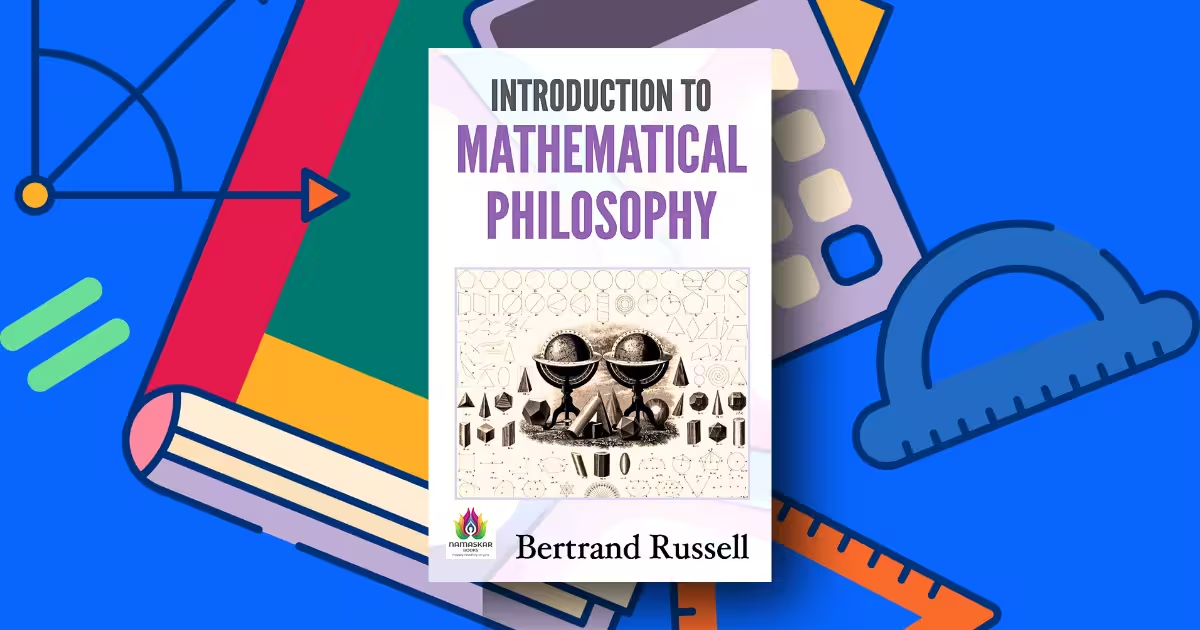
Why does a book Bertrand Russell wrote from inside a prison cell still turn up on philosophy reading lists more than a hundred years later? I picked up Introduction to Mathematical Philosophy expecting a dry logic textbook. Instead, I got the book that finally made me understand what a number actually is, and it took me three separate attempts to get through it.
Overview
Bertrand Russell wrote Introduction to Mathematical Philosophy in 1918 and 1919, largely while serving six months in Brixton Prison for his anti-war writing, as a plain-language companion to his and Alfred North Whitehead’s dense Principia Mathematica.
Across 18 short chapters, he tries to build the whole of mathematics, numbers, order, infinity, classes, out of pure logic, and argues by the end that mathematics and logic are, in truth, one subject wearing two names (p. 184).
It contains some of Russell’s most quoted lines: his own definition of number, his firsthand account of discovering the paradox that now carries his name, and his joke about the “advantages of theft over honest toil” (p. 68).
It is short (227 pages in the 2023 Routledge Classics edition), free of equations you cannot follow, and genuinely readable line by line. It is also dense enough that you will reread paragraphs, sometimes whole pages, more than once.
Table of Contents
Reader Recommendation
Introduction to Mathematical Philosophy is best for:
- Readers who enjoyed one philosophy or logic class and want to go a level deeper without enrolling in a mathematics degree.
- Anyone curious about where set theory, formal logic, and modern computer science trace their roots.
- Fans of Russell’s more popular writing, such as The Problems of Philosophy, who have not yet tried his technical side.
Introduction to Mathematical Philosophy is not a good read for:
- Someone chasing Russell’s politics, ethics, or memoirs. This book stays inside logic and mathematics from the first page to the last.
- Anyone who needs real-world stakes or narrative on every page. There is no plot here, only argument.
- Readers hoping for a basic arithmetic refresher. “Introduction” means an introduction to the philosophy behind mathematics, not to mathematics itself.
Introduction
Introduction to Mathematical Philosophy by Bertrand Russell was first published in 1919 by George Allen & Unwin. I worked from the 2023 Routledge Classics edition (ISBN 978-1-032-31227-9, paperback), 227 pages, which adds a new foreword by Cambridge philosopher Michael Potter and folds in corrections made to the original text by Kevin Klement, credited in the publisher’s acknowledgement.
This is nonfiction: specifically, philosophy of mathematics and logic. Bertrand Russell (1872 to 1970) was a British philosopher, logician, and mathematician who co-wrote the three-volume Principia Mathematica with Alfred North Whitehead, is generally credited as one of the founders of analytic philosophy, and won the Nobel Prize in Literature in 1950.
Introduction to Mathematical Philosophy is his own accessible walkthrough of the ideas buried inside Principia Mathematica‘s wall of symbols, aimed at readers who have neither advanced mathematics nor training in symbolic logic.
Russell states his purpose directly in the Preface: he wants to set out results that were, until then, “only available to those who have mastered logical symbolism, in a form offering the minimum of difficulty to the beginner.”
The thesis that develops across all 18 chapters, and that he states outright in the final one, is that mathematics and logic are not two separate subjects but one continuous field, with logic as its early, simple stage and mathematics as its later, more elaborate one.
As he puts it in the Preface, in the very line Routledge chose as the pull quote for this edition’s own cover copy: a book covering the more settled parts of that project “may, therefore, claim to be an introduction to mathematical philosophy.”
Background
Russell wrote most of Introduction to Mathematical Philosophy somewhere you would not expect: a cell in Brixton Prison.
According to Michael Potter’s foreword to the Routledge Classics edition, Russell had spent most of the First World War on pacifist campaigning, which cost him his lectureship at Trinity College, Cambridge, and eventually earned him a six-month sentence in 1918 for publishing material the authorities judged prejudicial to Britain’s relations with the United States.
Because he was held in the prison’s “first division,” he was excused hard labor and allowed books and writing paper in his cell. He used the time to turn an earlier lecture course into what he called, in his own letters as Potter recounts them, a “textbook on Principia.”
Writing paper reached his cell partway through May 1918, and within about eleven days he had gone from roughly 20,000 words to a nearly finished 70,000-word manuscript, a pace Potter calculates at close to 5,000 words a day.
That speed matters for how you should read Introduction to Mathematical Philosophy, and I will come back to it in the Weaknesses section below.
The deeper background is Russell’s lifelong logicist project: the attempt, alongside Whitehead, Gottlob Frege, and Giuseppe Peano, to show that arithmetic could be built entirely out of logic, with nothing borrowed unexamined from intuition or physical experience.
Frege had already given the modern definition of number back in 1884, in a short and, at the time, largely ignored book called Grundlagen der Arithmetik.
Russell tells readers plainly that Frege’s answer “remained practically unknown until it was rediscovered by the present author in 1901.” That same year, while stress-testing this whole project, Russell found a contradiction hiding inside naive set theory: a paradox that now carries his name, and one he narrates firsthand in Chapter 13.
Understanding that Introduction to Mathematical Philosophy sits at the intersection of a prison sentence, a forgotten German pamphlet, and a paradox that shook the foundations of mathematics makes the next 18 chapters read less like a textbook and more like a field report from the edge of what logic could do in 1919.
Introduction to Mathematical Philosophy Summary
Here is what each chapter actually argues, so you walk away with the whole shape of the book, not just the famous bits.
Chapters 1 to 3: What a Number Actually Is
Russell opens with a simple observation: mathematics can be studied in two directions. The familiar one builds up, moving from whole numbers toward fractions, real numbers, and calculus. The other direction, the one he calls mathematical philosophy, works backward, asking what more basic ideas the familiar starting points can be defined in terms of.
He picks the second direction and starts the whole book with the series of natural numbers, 0, 1, 2, 3, and so on, noting along the way that 0 itself is “a very recent addition” to mathematics, since the Greeks and Romans had no such digit.
Chapter 2 is where Introduction to Mathematical Philosophy earns its reputation. Russell walks through Gottlob Frege’s 1884 answer to the question “What is a number?”, crediting Frege by name and admitting the idea sat forgotten for close to twenty years before he rediscovered it himself in 1901.
The route runs through “one-one” relations (his example, dated by today’s standards, is monogamous marriage, where every husband has exactly one wife and vice versa) and “similarity” between classes, meaning any two classes that can be paired off one to one.
From there he lands on Introduction to Mathematical Philosophy‘s most quoted line: “The number of a class is the class of all those classes that are similar to it” (p. 18).
In plain terms, the number 2 is not some separate abstract entity floating apart from the world; it simply is the class made up of every possible pair that exists.
It sounds strange on a first read. Russell admits it is strange, then spends the rest of the chapter showing why it holds up better than the alternatives.
Chapter 3 supplies the tool that makes all of this provable: mathematical induction. Russell defines a “hereditary” property as one that, if it belongs to a number n, automatically belongs to n + 1, then defines the natural numbers themselves as “the posterity of 0 with respect to the relation ‘immediate predecessor'” (p. 23).
That one sentence does the same job as the familiar domino-chain explanation of induction from school, except built entirely out of logical relations rather than assumed as self-evident.
Chapters 4 to 7: Order, Relations, and Real Numbers
Chapter 4 tackles something we normally take for granted: why the natural numbers come in a specific order, and what “order” even means in strict logical terms. Russell shows that order depends on relations that are asymmetrical and transitive, not on any property of the numbers themselves.
Chapters 5 and 6 broaden this into a general theory of relations, covering “one-many” and “many-one” relations (his running example is “the father of x,” which behaves logically just like “the logarithm of x”), and then relation-numbers, a way of asking when two relations share the same structure even if their terms are completely different.
Chapter 7 is where Introduction to Mathematical Philosophy gets genuinely fun. Building rational, real, and complex numbers out of simpler material requires plugging gaps that show up once you study fractions closely (there is no rational number whose square is exactly 2, for instance). Russell rejects the shortcut of just assuming an irrational number exists to fill that gap, calling it a form of “postulating.”
His verdict, in one of the most quoted lines in analytic philosophy: “The method of ‘postulating’ what we want has many advantages; they are the same as the advantages of theft over honest toil. Let us leave them to others and proceed with our honest toil” (p. 68).
He then does the honest toil, building real numbers out of Dedekind cuts of rational numbers instead of simply assuming they exist.
Chapters 8 to 12: Into the Infinite
This stretch of Introduction to Mathematical Philosophy applies everything built so far to infinite collections, drawing on the work of Georg Cantor. Chapter 8 introduces infinite, or “transfinite,” cardinal numbers and the “axiom of infinity,” the assumption, which Russell is honest about being unable to prove, that infinite collections actually exist.
Chapter 9 separates ordinal numbers (which track position in a sequence) from cardinal numbers (which track sheer quantity), a distinction that barely matters for finite sets but becomes essential once you are counting infinities. Chapters 10 and 11 define limits and continuity purely in terms of order and boundaries, following the rigorous approach pioneered by Karl Weierstrass, so that calculus no longer needs to lean on vague talk of quantities “approaching” or “becoming” something.
Chapter 12 covers selections (what modern readers would call choice functions) and the multiplicative axiom, better known today as the axiom of choice, including a nod to Ernst Zermelo’s related theorem.
Chapters 13 to 15: The Paradox and the Machinery of Logic
Chapter 13 is the emotional center of the book, even though Russell’s prose stays perfectly calm. He walks through his own discovery, in 1901, of a contradiction at the heart of naive set theory: “When I first came upon this contradiction, in the year 1901, I attempted to discover some flaw in Cantor’s proof that there is no greatest cardinal… Applying this proof to the supposed class of all imaginable objects, I was led to a new and simpler contradiction” (p. 130).
That simpler contradiction is now called Russell’s paradox: take the class of all classes that are not members of themselves, and ask whether it is a member of itself.
Either answer contradicts itself. Russell’s proposed fix, the theory of logical types, sorts classes into a strict hierarchy so that a class can never sensibly be asked whether it belongs to itself in the first place.
Chapters 14 and 15 back up to lay the groundwork the paradox chapter needed: the theory of deduction (truth-functions, and the American logician Henry Sheffer’s discovery that a single connective can generate the whole of propositional logic) and propositional functions, which Russell defines as “an expression containing one or more undetermined constituents, such that, when values are assigned to these constituents, the expression becomes a proposition” (p. 149).
In plainer language, a propositional function is a sentence with a blank in it, like “x is a man,” which only becomes a true or false statement once you fill in x.
Chapters 16 to 18: Descriptions, Classes, and the Case for Logicism
Chapter 16 covers Russell’s theory of descriptions, first developed in his 1905 essay “On Denoting” and still taught in introductory logic courses today. His famous test case: “the present King of France is bald.” Since no such king exists, Russell argues the sentence is not meaningless, and not mysteriously “about” some non-existent king, but simply false, once you unpack “the present King of France” as a disguised claim that exactly one such person exists and is bald (p. 170).
The same chapter tackles the puzzle of why “Scott is the author of Waverley” feels informative while “Scott is Scott” does not, even though Scott and the author of Waverley are, as a matter of fact, the same person.
Chapter 17 turns to classes themselves, and Russell makes a move that still divides logicians: he argues classes are not real objects at all but “logical fictions,” convenient shorthand that can, in principle, be translated away into talk about propositional functions instead. He justifies this with a direct nod to a much older idea: “This is an example of Occam’s razor, namely, ‘entities are not to be multiplied without necessity'” (p. 175).
Chapter 18, finally, makes the case promised since page one: that mathematics and logic are “one,” differing “as boy and man: logic is the youth of mathematics and mathematics is the manhood of logic” (p. 184 to 185).
Introduction to Mathematical Philosophy closes on a modest, almost gentle note, hoping only that “if any student is led into a serious study of mathematical logic by this little book, it will have served the chief purpose for which it has been written” (p. 195).
That is the whole architecture: numbers, order, and relations first; real and infinite numbers next; then the paradox, the logical machinery, descriptions, and classes; and finally the payoff argument that ties mathematics back to logic. You genuinely do not need to hunt down a second summary after reading the above; the ideas above are the ideas in the book, just without the notation.
Introduction to Mathematical Philosophy Analysis
Here is my honest read, not a paraphrase of the back cover. Russell is trying to do two things at once in this book: teach you a specific body of results (what a number is, how infinity works, why his paradox matters) and defend a specific philosophical thesis (that mathematics reduces to logic).
On the first goal, he mostly succeeds, and succeeds remarkably given he wrote a 70,000-word technical book in a matter of days from a prison cell.
The chapters on number, induction, and the paradox are still some of the clearest non-symbolic explanations of these ideas you can find, over a century later.
On the second goal, the philosophical thesis, I think Russell’s own foreword writer for this edition, Michael Potter, has the more accurate read. Potter, a Cambridge philosopher, is generous about the book’s achievement but direct about its flaws, and because he cites specific pages throughout, you can check every one of his claims against the text yourself.
He points out that the speed of composition shows: key terms go undefined (Russell never actually explains what he means by calling a class “apparent,” despite leaning on the term), and whole arguments get rushed. Russell dismisses the American logician C. I. Lewis’s rival approach to modal logic in barely two pages, a treatment Potter calls too swift to count as a real refutation.
Russell’s own text admits that traditional philosophy “fall[s] into hopeless confusions” over necessity and possibility (p. 157), yet by Potter’s account Russell’s alternative account of quantifiers has its own real gap: he never clearly explains the notion of “scope,” the very thing needed to make his celebrated Scott-and-Waverley argument fully work.
The final chapter’s headline claim, that logic and mathematics are simply “one,” is the part I found least convincing on a second read. Russell’s actual argument is that no one can point to the exact spot where logic stops and mathematics starts, so the two must be continuous.
Potter’s foreword makes a sharp counter-point I could not shake once I read it: there is no identifiable point where boyhood becomes manhood either, but that does not make boys and men the same thing. It is a smooth argument, and Russell writes it beautifully, but it is not, on inspection, a tight one.
Worth knowing for context, since Russell could not have known it in 1919: the broader logicist and formalist projects this book belongs to were significantly complicated twelve years later.
Kurt Gödel’s 1931 incompleteness theorems showed that any sufficiently powerful, consistent formal system (including the very system of Principia Mathematica that this book popularizes) cannot prove its own consistency from within, and cannot capture all mathematical truths as provable theorems.
Historians of logic generally treat this as the result that undercut the more ambitious versions of Hilbert’s formalism and Russell’s logicism, without erasing the lasting value of the technical machinery, the theory of types, the theory of descriptions, the analysis of classes, that Russell built along the way and that this book still explains better than almost anything else written for a general reader.
Strengths and Weaknesses
What I loved:
The prose. Russell writes technical philosophy in short, direct sentences, and he is genuinely funny in small doses (the “theft over honest toil” line made me laugh out loud on a train).
The “aha” moments land hard. The chapter on the definition of number, and the chapter where Russell narrates discovering his own paradox, are two of the best pieces of expository writing about mathematics I have read anywhere.
It respects the reader. Russell keeps his promise from the Preface and never once hides behind symbolic notation to dodge a hard explanation.
What frustrated me:
The density. Even at a plain-prose level, some paragraphs pack in three or four new definitions at once, and I had to slow to a crawl in Chapters 8 through 13.
A few examples have aged badly, most obviously the marriage-based illustrations of one-one, one-many, and many-one relations in Chapter 2, which reflect early-20th-century assumptions about marriage rather than anything essential to the logic.
As the foreword lays out with page numbers to check, some of the philosophical argument (modal logic, the scope of quantifiers, the final “logic equals mathematics” claim) is thinner than the confident tone suggests, a fair price for a book written at roughly 5,000 words a day.
Comparison with Similar Works
If you want more of this “hard classic, worth the climb” experience, Probinism’s guide to Kant’s Critique of Pure Reason covers a book with a similar reputation for difficulty, though Kant is working in metaphysics and epistemology rather than mathematics, and his prose is far less forgiving than Russell’s. For a completely different register within the same tradition, our review of Nietzsche’s Beyond Good and Evil shows what happens when a philosopher trades Russell’s careful, step-by-step method for aphorism and provocation.
If Russell’s brand of rigorous, argument-by-argument philosophy appeals to you but the math still feels heavy, Probinism’s rundown of Mortimer Adler’s Ten Philosophical Mistakes tackles classic philosophical errors in plainer, math-free language.
And if you are simply building a reading list, our Top 20 Philosophy Books roundup is a reasonable next stop for deciding what to read once you have finished this one. Outside our own archive, readers who enjoy the paradox chapter here often move on to Douglas Hofstadter’s Gödel, Escher, Bach, which picks up the story of formal logic’s limits roughly where Russell leaves off.
Conclusion
I would recommend Introduction to Mathematical Philosophy to any reader who wants to understand where modern logic and analytic philosophy actually began, and who is willing to reread a paragraph now and then.
It is not for someone wanting a beginner’s math refresher, and it is not the place to go for Russell’s politics or personal life. But as a compact, honest, occasionally funny account of one of the most consequential intellectual projects of the twentieth century, written by the person who lived it, from a prison cell, in a matter of days, it earns its place on any serious philosophy shelf.
General readers with some patience will get real value from it; specialists in logic or the philosophy of mathematics will want it as a clearly written companion to the far denser Principia Mathematica, not a replacement for primary research.







