
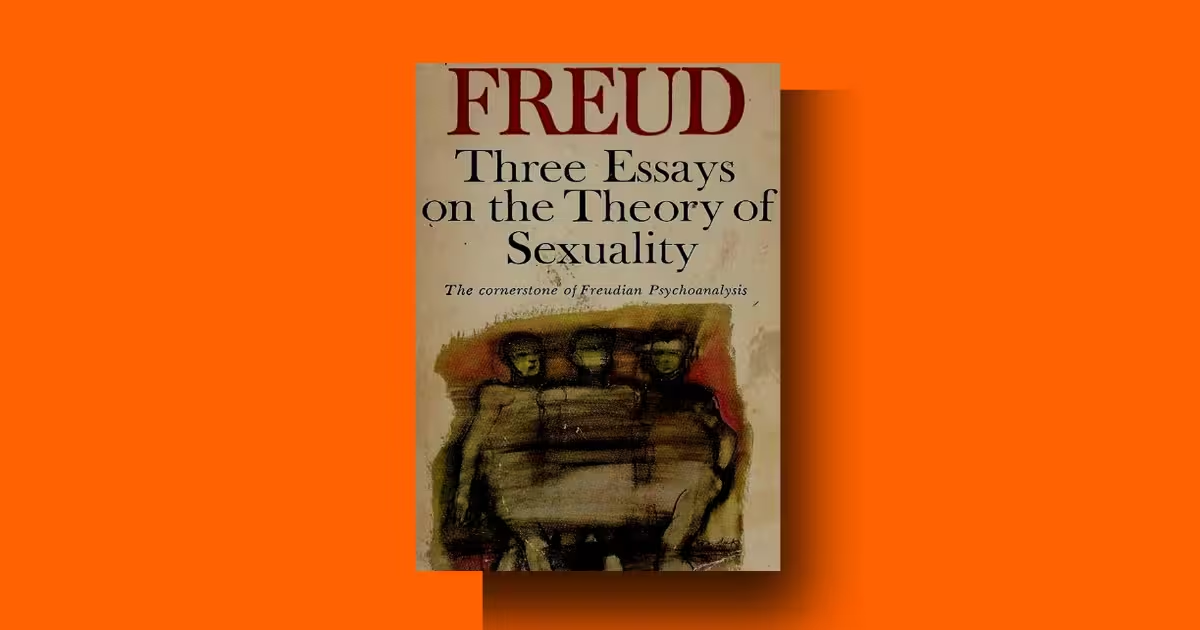
Why does your deepest sense of self—your desires, anxieties, and even your moral compass—seem tethered to experiences you cannot remember from your earliest years? Sigmund Freud’s Three Essays on the Theory of Sexuality forces you to confront this unsettling question head-on, challenging everything you thought you knew about childhood, desire, and what it means to be “normal.”
Overview
Three Essays on the Theory of Sexuality (1905) is Sigmund Freud’s revolutionary work that fundamentally redefined human sexuality. Freud argues that sexual instinct exists from birth, develops through distinct phases (oral, anal, phallic), and that adult sexuality—whether “normal” or perverse—is shaped by childhood experiences.
The book introduces concepts that remain central to psychology: infantile sexuality, the Oedipus complex, the latency period, and the idea that neuroses are “the negative of perversions”.
Despite being over a century old, this work continues to provoke, inform, and challenge our understanding of human nature.
Reader suggestion
Three Essays on the Theory of Sexuality is best for :
- Psychology students and professionals seeking foundational psychoanalytic texts
- Anyone interested in understanding the origins of modern sexual theory
- Readers curious about why childhood experiences shape adult behavior
- Those exploring the history of ideas about human development
- Individuals questioning conventional wisdom about sexuality
Three Essays on the Theory of Sexuality is not for:
- Readers seeking a contemporary, biologically-grounded theory of sexuality
- Those uncomfortable with explicit discussions of childhood sexuality
- Anyone looking for easy answers or quick self-help guidance
- Readers who prefer purely empirical, data-driven approaches to psychology
Table of Contents
1. Introduction
Three Essays on the Theory of Sexuality by Sigmund Freud
- First published: 1905 in Leipzig and Vienna by Deuticke
- Final revised edition: 1925 (sixth edition)
- English translation: James Strachey (1949, revised for Standard Edition)
- Pages: 133 (English translation)
- Genre: Psychoanalytic theory, psychology, philosophy of mind
Context
This book stands alongside Freud’s The Interpretation of Dreams as his most significant contribution to human knowledge.
When first published in 1905, it represented a radical departure from prevailing Victorian views that childhood was a period of sexual innocence.
Freud drew upon his clinical observations of neurotic patients, self-analysis, and extensive reading of contemporary sexological literature (including the works of Krafft-Ebing and Havelock Ellis) to construct a comprehensive theory of sexual development.
The book underwent substantial revision over twenty years, with major additions in 1915 (including sections on sexual theories of children and pregenital organizations) and 1920 (including revisions to the libido theory). This evolutionary nature makes it a fascinating document of Freud’s intellectual development.
Purpose
The central thesis of Three Essays on the Theory of Sexuality is that human sexuality is not a sudden arrival at puberty but a complex developmental process beginning in infancy. Freud argues that:
- Sexual instinct exists from birth – “germs of sexual impulses are already present in the new-born child”
- Childhood sexuality is “polymorphously perverse” – children possess an innate disposition toward all forms of sexual pleasure
- Adult sexuality represents a specific organization of these early impulses under the “primacy of the genital zones”
- Neuroses represent the “negative of perversions” – symptoms express repressed sexual impulses
2. Background
To understand the revolutionary nature of this work, we must consider the intellectual climate of 1905. Victorian society viewed children as asexual beings, innocent of sexual desire. Childhood sexuality, when observed, was dismissed as “precocious depravity” or evidence of degeneracy. Freud’s claim that “not a single author has clearly recognized the regular existence of a sexual instinct in childhood” was not hyperbole—it was a direct challenge to established medical and cultural orthodoxy.
The book emerged from Freud’s clinical work with hysterical patients. Through psychoanalysis, he discovered that their symptoms often traced back to early childhood sexual experiences and fantasies. Initially, Freud believed these were actual seductions (the “seduction theory”), but by 1897 he recognized that the experiences were often fantasies rooted in universal childhood desires—including the Oedipus complex.
As Freud wrote in his preface to the fourth edition (1920): “If mankind had been able to learn from a direct observation of children, these three essays could have remained unwritten”. The book was necessary because adult resistance to recognizing childhood sexuality made direct observation nearly impossible.
3. Book Content Summary
Essay I: The Sexual Aberrations
Freud begins by establishing a framework for understanding sexuality. He introduces two key concepts:
The Sexual Object – “the person from whom sexual attraction proceeds”.
The Sexual Aim – “the act towards which the instinct tends”
Deviations in Respect of the Sexual Object
Inversion (Homosexuality): Freud identifies three types of inverts: absolute (exclusively same-sex), ambigonic (both sexes), and contingent (situational). He rejects both simple “innate” and “acquired” explanations, arguing instead that inversion represents a disturbance in sexual development influenced by constitutional factors and early experiences.
Significantly, Freud insists that “all human beings are capable of making a homosexual object-choice and have in fact made one in their unconscious”. He warns against separating homosexuals from “the rest of mankind as a group of a special character”.
This remarkably progressive view—that heterosexual attraction itself “is also a problem that needs elucidating and is not a self-evident fact”—was decades ahead of its time.
Sexually Immature Persons and Animals: Freud notes that “the sexual instinct permits of so much variation in its objects and such a cheapening of them”. He observes that child abuse is “found with uncanny frequency among school teachers and child attendants, simply because they have the best opportunity for it”. This leads to a crucial insight: “the impulses of sexual life are among those which, even normally, are the least controlled by the higher activities of the mind”.
Deviations in Respect of the Sexual Aim
Freud examines how sexual activity can extend beyond genital union:
Anatomical Extensions: He discusses the sexual use of the mouth and anus, noting that disgust—which opposes these practices—is “often purely conventional”. A man “who will kiss a pretty girl’s lips passionately, may perhaps be disgusted at the idea of using her toothbrush”, revealing the arbitrary nature of such boundaries.
Fetishism: Freud describes how “some part of the body (such as the foot or hair) or some inanimate object” can replace the sexual object. He notes that “a certain degree of fetishism is thus habitually present in normal love”.
Sadism and Masochism: These represent “the most common and the most significant of all the perversions”. Freud observes that “a sadist is always at the same time a masochist”, linking this to the broader principle of bisexuality.
The Sexual Instinct in Neurotics
This section contains one of the book’s most important claims: “neuroses are, so to say, the negative of perversions”. Freud explains that neurotic symptoms express the same impulses that appear directly in perversions, but these impulses have been “repressed” and diverted into symptom formation.
Component Instincts and Erotogenic Zones
Freud introduces the concept of “component instincts” —the building blocks of sexuality that combine in normal development but separate in perversions. He defines “erotogenic zones” as organs whose excitation lends an instinct its sexual character. This framework explains why any part of the body can become sexualized.
The Infantile Character of Sexuality
Freud concludes Essay I with a crucial insight: “A formula begins to take shape which lays it down that the sexuality of neurotics has remained in, or been brought back to, an infantile state”. This sets the stage for Essay II.
Essay II: Infantile Sexuality
The Period of Sexual Latency
Freud argues that sexual development follows a distinctive pattern: “germs of sexual impulses are already present in the new-born child” but after an initial period of development, they are “overtaken by a progressive process of suppression”. This suppression creates the “latency period” (roughly ages 6 to puberty), during which “mental forces which are later to impede the course of the sexual instinct” are built up—“disgust, feelings of shame and the claims of aesthetic and moral ideals”.
These forces emerge “at the cost of the infantile sexual impulses themselves” through a process Freud calls “sublimation” —”the diversion of sexual instinctual forces from sexual aims and their direction to new ones”.
The Manifestations of Infantile Sexuality
Thumb-Sucking: Freud uses thumb-sucking (which he calls “sensual sucking”) as a model for infantile sexuality. He identifies three essential characteristics:
- It attaches to a vital somatic function (feeding)
- It is auto-erotic (seeks satisfaction from the child’s own body)
- Its sexual aim is dominated by an erotogenic zone (the lips)
Freud famously observes: “No one who has seen a baby sinking back satiated from the breast and falling asleep with flushed cheeks and a blissful smile can escape the reflection that this picture persists as a prototype of the expression of sexual satisfaction in later life”.
Anal Zone: Freud describes how children derive pleasure from defecation, noting that “children who are making use of the susceptibility to erotogenic stimulation of the anal zone betray themselves by holding back their stool”. This becomes significant for character development: “The contents of the bowels… are clearly treated as a part of the infant’s own body and represent his first ‘gift'”.
Genital Zone: Freud notes that “it is scarcely possible to avoid the conclusion that the foundations for the future primacy over sexual activity exercised by this erotogenic zone are established by early infantile masturbation, which scarcely a single individual escapes” .
Polymorphously Perverse Disposition
Freud makes a crucial claim: under seduction, “children can become polymorphously perverse” , revealing “that an aptitude for them is innately present in their disposition”. He concludes that “this same disposition to perversions of every kind is a general and fundamental human characteristic”.
The Sexual Researches of Childhood
Between ages three and five, children’s “instinct for knowledge” becomes “attracted unexpectedly early and intensively to sexual problems”. Children develop theories about birth: “people get babies by eating some particular thing… and babies are born through the bowel like a discharge of faeces”.
Freud identifies the “castration complex” as central to boys’ development: “This conviction [that everyone has a penis] is energetically maintained by boys, is obstinately defended against the contradictions which soon result from observation, and is only abandoned after severe internal struggles”. For girls, seeing boys’ genitals leads to “envy for the penis—an envy culminating in the wish… to be boys themselves”.
Phases of Development
Freud describes “pregenital” organizations of sexuality:
- Oral or cannibalistic phase – “The sexual aim consists in the incorporation of the object”
- Sadistic-anal phase – “The activity is put into operation by the instinct for mastery”
- Phallic phase (added later) – characterized by “the primacy of the phallus”
Essay III: The Transformations of Puberty
The Primacy of the Genital Zones
At puberty, “the sexual instinct has hitherto been predominantly auto-erotic; it now finds a sexual object”. “All the component instincts combine to attain it, while the erotogenic zones become subordinated to the primacy of the genital zone”.
Freud introduces the concept of “fore-pleasure” —the pleasure derived from preparatory acts (kissing, touching)—which must lead to “end-pleasure” —the satisfaction of discharge. If fore-pleasure becomes too great, “the whole path is cut short” leading to perversion.
The Libido Theory
Freud defines libido as “a quantitatively variable force which could serve as a measure of processes and transformations occurring in the field of sexual excitation”. He distinguishes “ego-libido” (narcissistic) from “object-libido” (directed toward others), with the former as “the great reservoir from which the object-cathexes are sent out”.
The Differentiation between Men and Women
Freud argues that “the sexuality of little girls is of a wholly masculine character” because the clitoris functions like the penis. At puberty, girls must transfer sensitivity from the clitoris to the vagina—”a new leading zone”. This transfer, combined with “a fresh wave of repression,” makes women “more prone to neurosis and especially to hysteria”.
The Finding of an Object
Freud traces object-choice back to infancy: “At a time at which the first beginnings of sexual satisfaction are still linked with the taking of nourishment, the sexual instinct has a sexual object outside the infant’s own body in the shape of his mother’s breast”. This is why “a child sucking at his mother’s breast has become the prototype of every relation of love. The finding of an object is in fact a refinding of it”.
The Oedipus complex—”the child’s sexual impulses towards his parents”—must be overcome through “detachment from parental authority”. Failure to achieve this detachment leads to neurosis in adult life.
4. Analysis
Why This Book Matters
Three Essays on the Theory of Sexuality is nothing less than a groundbreaking work that fundamentally altered how we understand human development. Its central insight—that childhood sexuality is normal, universal, and formative—remains one of the most important discoveries in psychology.
Freud’s argument that “the sexual instinct is in the first instance independent of its object” —that desire precedes its target—anticipates later theories of attachment and object relations. His recognition that “all human beings are capable of making a homosexual object-choice” was remarkably progressive for 1905 and remains relevant today.
The concept of sublimation—the diversion of sexual energy into cultural achievement—provided a framework for understanding art, creativity, and civilization itself. As Freud wrote, “powerful components are acquired for every kind of cultural achievement by this diversion of sexual instinctual forces from sexual aims”.
The Book’s Enduring Value
The Three Essays remains valuable for several reasons:
1. Historical Significance: It represents the birth of psychoanalytic thinking about sexuality. Understanding Freud’s original arguments is essential for grasping subsequent developments in psychology, psychiatry, and cultural theory.
2. Conceptual Framework: Concepts like the Oedipus complex, castration anxiety, penis envy, and the latency period continue to influence how we think about development—even when we reject Freud’s specific conclusions.
3. Intellectual Courage: Freud dared to challenge Victorian pieties about childhood innocence. He insisted that “the beginnings of human sexual life… can only be confirmed by investigators who have enough patience and technical skill to trace back an analysis to the first years of a patient’s childhood”.
Limitations and Criticisms
1. Speculative Nature: Much of the book is based on inference rather than direct observation. As Freud admitted, “the account… was founded for the most part on the results of psycho-analytic research upon adults”.
2. Biological Speculation: Freud’s chemical theory of sexuality (“substances of a peculiar kind arise from the sexual metabolism” ) was remarkably prescient but scientifically unsubstantiated at the time.
3. Gender Bias: Freud’s views on female sexuality—particularly the idea that women must transfer sensitivity from clitoris to vagina and that penis envy is universal—have been heavily criticized by feminist scholars.
4. Cultural Specificity: Freud’s theories reflect the specific cultural context of fin-de-siècle Vienna. His emphasis on repression and civilization’s constraints may not apply equally across cultures.
5. Lack of Empirical Evidence: Modern psychology demands empirical verification that Freud’s theories often lack. His “clinical evidence” was based on a small number of patients and remains difficult to replicate.
The Evolution of the Text
One of the most fascinating aspects of this book is its evolution. As the editor’s note explains: “The present edition differs in an important respect from all previous editions… it indicates, with dates, every alteration of substance that has been introduced into the work since its first issue”.
The entire sections on sexual theories of children and pregenital organizations were added in 1915, ten years after the book’s first publication. The libido theory section was also added in 1915. These additions show Freud’s willingness to revise his thinking—and the extent to which his ideas continued to develop.
5. Strengths and Weaknesses
Strengths
1. Revolutionary Insight: The recognition that childhood sexuality is normal and universal remains Freud’s most important contribution. As Steven Marcus notes in his introduction, “In its disclosure to the world of the universality and normality of infantile and childhood sexuality… the Three Essays was bringing to a close that epoch of cultural innocence”.
2. Conceptual Richness: The book introduces a vocabulary for discussing sexuality that remains useful: libido, erotogenic zones, component instincts, sublimation, fore-pleasure.
3. Developmental Framework: Freud’s staging of sexual development—oral, anal, phallic, genital—provided a template for subsequent developmental theories.
4. Integration of Perversion and Normality: By showing that “no healthy person… can fail to make some addition that might be called perverse to the normal sexual aim” , Freud normalized what had been pathologized.
5. Progressive Views on Homosexuality: Freud’s insistence that homosexual object-choice is universal and that “the exclusive sexual interest felt by men for women is also a problem that needs elucidating” was remarkably ahead of its time.
Weaknesses
1. Speculative Overreach: Many of Freud’s claims lack empirical support. His theories of infantile sexuality, while suggestive, remain difficult to verify.
2. Gender Essentialism: Freud’s views on female sexuality reflect the biases of his era. The idea that women must “change their leading erotogenic zone” has been rightly criticized.
3. Biological Reductionism: Despite his psychological focus, Freud often falls back on biological speculation that now seems outdated.
4. Heteronormative Assumptions: Despite his progressive views on homosexuality, Freud ultimately assumes heterosexuality as the “normal” outcome of development.
5. Lack of Direct Observation: As Freud admitted, his theories were based primarily on adult patients, not direct observation of children.
6. Comparison with Similar Works
Richard von Krafft-Ebing, Psychopathia Sexualis (1886)
Krafft-Ebing’s encyclopedic work catalogued sexual perversions but offered little explanation. Freud goes beyond mere description to propose a developmental theory. Where Krafft-Ebing saw pathology, Freud saw variations in normal development.
Havelock Ellis, Studies in the Psychology of Sex (1897-1928)
Ellis provided extensive ethnographic and clinical data on sexuality. Freud’s work is more theoretical and psychoanalytic, focusing on unconscious processes rather than surface behaviors.
Carl Jung, The Psychology of the Unconscious (1912)
Jung later diverged from Freud on the nature of libido, arguing it was a general psychic energy rather than specifically sexual. Freud insisted that “the distinguishing of the sexual instinctual impulses from the rest… receives strong support from the assumption… that there is a special chemistry of the sexual function”.
Alfred Kinsey, Sexual Behavior in the Human Male (1948)
Kinsey’s empirical approach represents a very different tradition. Where Freud inferred from clinical cases, Kinsey surveyed thousands of individuals. The contrast highlights the limitations of Freud’s method—and its enduring insights.
7. Conclusion
Final Verdict
Three Essays on the Theory of Sexuality is an essential work for anyone interested in the history of psychology, the development of psychoanalytic thought, or the enduring questions of human nature.
While many of Freud’s specific claims have been challenged or abandoned, his fundamental insights—that sexuality begins in childhood, that it shapes adult personality, and that “normal” and “abnormal” exist on a continuum—remain foundational.
As Freud himself wrote, “The unsatisfactory conclusion… is that we know far too little of the biological processes constituting the essence of sexuality to be able to construct from our fragmentary information a theory adequate to the understanding alike of normal and of pathological conditions”.
This humility, combined with intellectual daring, makes the book a model of scientific inquiry.
Recommendation
Who should read this book:
- Psychology and psychiatry students
- Anyone interested in the history of ideas about sexuality
- Readers seeking to understand psychoanalytic theory
- Those curious about why childhood experiences matter
- Individuals questioning conventional wisdom about human development
Who should avoid it:
- Readers seeking contemporary, evidence-based sexual science
- Those uncomfortable with explicit discussions of childhood sexuality
- Anyone looking for simple answers or self-help guidance
Final Thought
More than a century after its publication, Three Essays on the Theory of Sexuality continues to provoke, challenge, and illuminate. Its central message—that human sexuality is complex, developmental, and rooted in our earliest experiences—remains as relevant today as in 1905.
As Steven Marcus writes, “Nothing has come along in seventy years that remotely resembles it in explanatory power, coherence, and integrity”. This is a book that demands to be read—and debated.







