
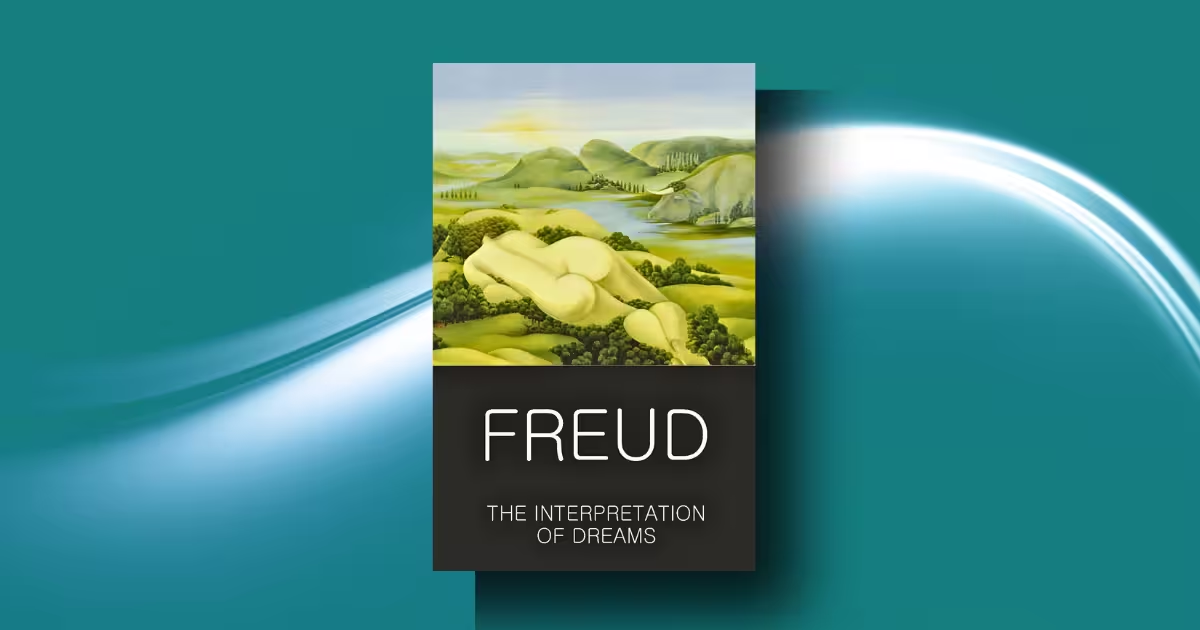

Do you ever wake up puzzled by a bizarre dream and wonder what your unconscious mind was trying to tell you? Sigmund Freud’s The Interpretation of Dreams (original German title: Die Traumdeutung) offers a groundbreaking answer to this universal human question.
First published in November 1899 (though dated 1900 on the title page), this monumental work forever changed how we understand the human mind.
Overview
The Interpretation of Dreams argues that dreams are not random nonsense but meaningful psychological events—specifically, disguised fulfillments of repressed, unconscious wishes.
Freud introduces a revolutionary method of dream interpretation based on free association and unveils the complex “dream-work” (condensation, displacement, and symbolism) that transforms hidden desires into the bizarre narratives we remember upon waking.
The Interpretation of Dreams is the foundational text of psychoanalysis and arguably the most influential work in the history of psychology.
Preferred readers
The Interpretation of Dreams is highly suggested for:
- Students and scholars of psychology, philosophy, and literary theory
- Anyone curious about the origins of psychoanalysis and Freudian thought
- Readers interested in self-exploration and understanding the hidden motives behind their own behavior
- Those who enjoy deep, challenging, and historically significant texts
Not for:
- Readers seeking a simple, step-by-step manual for decoding dreams (this is not a “dream dictionary”)
- Those who prefer strictly empirical, scientifically validated theories
- Individuals easily put off by dense, academic prose or lengthy case studies
- Anyone uncomfortable with extensive discussions of sexuality and the Oedipus complex
Table of Contents
1. Introduction
The Interpretation of Dreams (German: Die Traumdeutung) by Sigmund Freud (1856–1939), the Austrian neurologist and founder of psychoanalysis. The definitive English translation, edited by James Strachey, was published in 1955 and remains the standard edition.
Context of The Interpretation of Dreams
This book is the cornerstone of psychoanalytic theory.
Before Freud, dreams were largely dismissed by the scientific community as meaningless byproducts of sleep—”nothing but the unregulated sounds that rise from a musical instrument struck by the blow of some external force instead of by a player’s hand,” as Freud himself summarized the prevailing view.
Freud radically challenged this notion, arguing that dreams are “psychical phenomena of complete validity” with profound meaning.
Purpose of The Interpretation of Dreams
The central point of The Interpretation of Dreams is that every dream is the fulfilment of a wish—specifically, a wish that originates in the unconscious and is often repressed or unacceptable to the conscious mind.
However, because these wishes are forbidden, they are subjected to a “censorship” that distorts them, transforming their true meaning into the often-strange manifest content we recall upon waking.
Freud’s purpose is twofold: to provide a scientific method for interpreting dreams and to use this method as a “royal road to a knowledge of the unconscious activities of the mind”.
2. Background
Freud began formulating his dream theory in the mid-1890s, a period of intense personal and professional development.
He had been collaborating with Josef Breuer on studies of hysteria and had become convinced that unconscious memories and wishes played a crucial role in mental illness.
The pivotal moment came on July 24, 1895, when Freud analyzed his own dream of “Irma’s injection.” In a letter to his friend Wilhelm Fliess, he described this as the moment he discovered the wish-fulfilling function of dreams.
However, he delayed publishing the book for several years, partly due to self-doubt and partly due to the sheer scope of the work.
The book’s publication history is itself a remarkable story of initial failure followed by monumental success. The first edition, dated 1900, had a print run of only 600 copies, and it took eight years to sell them all.
In the first six years, it sold just 351 copies. It received almost no reviews and was largely ignored by the scientific community.
Yet, Freud continued to revise and expand the work through eight editions during his lifetime, and it eventually became one of the most influential texts of the 20th century.
3. The Interpretation of Dreams Summary
Reading The Interpretation of Dreams is not just an intellectual exercise; it is an unsettling and profound journey into the hidden recesses of the self.
Freud does not simply present a theory; he forces you to confront the possibility that your conscious mind is not the master of your own house. Here is a comprehensive breakdown of the key arguments and concepts I took away from this monumental work.
The Fundamental Premise: Dreams Have Meaning
Freud opens by declaring war on the scientific orthodoxy of his time, which viewed dreams as “somatic processes” with no psychological significance.
He argues that dreams are “psychical phenomena of complete validity” that can be “inserted into the chain of intelligible waking mental acts”. This is the bedrock of his entire theory. He asserts that every dream, no matter how absurd or distressing, has a hidden meaning that can be uncovered through proper interpretation.
Key Quote: “When the work of interpretation has been completed, we perceive that a dream is the fulfilment of a wish“.
The Method: Free Association
Freud’s method for interpreting dreams is a radical departure from the symbolic decoding of ancient dream books. Instead of assigning fixed meanings to dream symbols (e.g., a snake = danger), he asks the dreamer to free associate—to say whatever comes to mind in relation to each element of the dream, without censorship or critique.
As he explains, “It is necessary to insist explicitly on his renouncing all criticism of the thoughts that he perceives… he must adopt a completely impartial attitude to what occurs to him”.
This technique reveals the latent content of the dream—the hidden, unconscious thoughts and wishes that lie behind the manifest content (the dream as we remember it). The manifest content is merely a distorted “transcript” of the latent dream-thoughts.
The Dream-Work: The Engine of Distortion
The transformation of latent thoughts into the manifest dream is accomplished by a process Freud calls the dream-work. This is the core machinery of the book, and it operates through several key mechanisms:
✅ Condensation: The dream compresses a vast amount of unconscious material into a brief, often fragmented, narrative. “Dreams are brief, meagre and laconic in comparison with the range and wealth of the dream-thoughts”.
For example, a single figure in a dream might represent multiple people or ideas, a process Freud illustrates with his analysis of the dream of “Irma’s injection,” where the figure of Irma becomes a “collective image” representing several different individuals.
✅ Displacement: The dream shifts emotional intensity from a significant, but forbidden, idea to a trivial or indifferent one. This is how the dream disguises its true meaning. “The consequence of the displacement is that the dream-content no longer resembles the core of the dream-thoughts”. A powerful unconscious wish might be represented by a seemingly insignificant detail from the previous day.
✅ Representability: The dream translates abstract thoughts into concrete, visual images—a process Freud compares to a rebus or picture puzzle. Since dreams “think essentially in images,” the dream-work must find a way to make abstract ideas representable. This often involves using symbols.
✅ Secondary Revision: The final stage of the dream-work is a kind of “editing” process that imposes a superficial coherence and logic on the dream’s fragmented elements, making it more like a narrative we can remember. This is why our recollections of dreams often seem more logical than the raw material from which they were constructed.
Symbols: The Language of the Unconscious
Freud devotes a significant portion of the book to dream symbolism, arguing that many symbols have universal, often sexual, meanings. He notes that “the majority of the dreams of adults deal with sexual material and give expression to erotic wishes”. He provides extensive lists of common symbols:
✅ Male Genitals: “All elongated objects, such as sticks, tree-trunks and umbrellas… all long, sharp weapons, such as knives, daggers and pikes”.
✅ Female Genitals: “Boxes, cases, chests, cupboards and ovens represent the uterus, and also hollow objects, ships, and vessels of all kinds”.
✅ The Sexual Act: “Steps, ladders or staircases, or, as the case may be, walking up or down them, are representations of the sexual act”.
✅ The Oedipus Complex: Dreams of the death of a parent, particularly of the same sex, are often disguised expressions of the universal childhood wish to eliminate the rival parent and possess the other. Freud famously states: “Being in love with the one parent and hating the other are among the essential constituents of the stock of psychical impulses which is formed at that time”.
Typical Dreams: Common Themes
Freud analyzes several categories of “typical” dreams that many people experience:
✅ Embarrassing Dreams of Being Naked: These stem from childhood memories of exhibitionism, “the unashamed period of childhood” which “seems to us a Paradise”. The shame in the dream is a reaction from the censorship against the revival of this infantile wish.
✅ Dreams of the Death of Loved Ones: These are often wish-fulfillments, albeit of childhood wishes. Freud shows that “a child’s death-wishes against his brothers and sisters are explained by the childish egoism which makes him regard them as his rivals”. The Oedipus complex explains death-wishes against parents.
✅ Examination Dreams: These are dreams of having failed an exam, despite being long past such events. They are “dreams of consolation” that arise when we face a new challenge or feel anxious. The dream says, in effect: “Don’t be afraid of tomorrow! Just think how anxious you were before your Matriculation, and yet nothing happened to you”.
✅ Flying and Falling Dreams: These originate from childhood games of being tossed in the air or swung around. They are “reproductions of impressions of childhood” and represent the “delight taken by young children in games of this kind”.
The Psychology of the Dream-Process: The Architecture of the Mind
In the final, and most abstract, chapter, Freud attempts to construct a “schematic picture” of the mind, dividing it into systems: the Conscious (Cs.), the Preconscious (Pcs.), and the Unconscious (Ucs.).
He argues that dreams originate in the Ucs., driven by the “primary process” of wish-fulfillment. The Pcs., governed by the “secondary process” of logic and reality-testing, acts as a censor.
The state of sleep weakens this censorship, allowing unconscious wishes to push for expression, but they must do so regressively, transforming into the sensory images that constitute the dream.
Key Quote: “The interpretation of dreams is the royal road to a knowledge of the unconscious activities of the mind“.
4. The Interpretation of Dreams Analysis
The Interpretation of Dreams is not merely a scientific treatise; it is a work of profound intellectual courage and personal confession.
Freud lays bare his own psyche, analyzing his dreams—including intimate details about his family, his ambitions, and his professional insecurities—to build his theory. This self-analysis gives the book a raw, almost novelistic quality, but it also raises questions about its scientific objectivity.
What makes this book a masterpiece is its explanatory power. Before Freud, dreams were a mystery. After Freud, they became a window into the soul. His concepts—the unconscious, repression, the Oedipus complex, wish-fulfillment—have become part of our cultural DNA. As The Economist noted, it is an “epoch-making book”.
However, the book is deeply flawed. Freud’s reliance on his own dreams and those of his patients (many of whom were upper-class Viennese women) introduces a significant bias. Critics have long argued that his theory is overly deterministic, reducing all human motivation to sexual and aggressive drives.
Modern neuroscience has largely rejected the specific neurological model Freud proposed, and many psychologists question the scientific validity of his interpretive method, which can seem to allow for almost any interpretation.
Yet, despite these criticisms, the book endures because it touches on something fundamentally true about human experience. We do have hidden motives. We do repress uncomfortable thoughts. Our dreams do often reflect our deepest desires and fears. Freud may have been wrong about the details, but he was right about the big picture.
As Psychology Today put it, “Freud has been a dominant force in Western thinking and here’s the book that started it all”.
5. Strengths and Weaknesses
Strengths
Groundbreaking Thesis: The idea that dreams are meaningful psychological events was revolutionary and remains one of the most important contributions to psychology.
Comprehensive Framework: Freud provides a complete, if controversial, model of the mind, explaining not just dreams but also neuroses, jokes, and slips of the tongue.
Introspective Depth: The use of Freud’s own dreams makes the theory tangible and deeply personal, inviting readers to engage in their own self-analysis.
Cultural Impact: The book’s influence extends far beyond psychology, shaping literature, art, film, and philosophy throughout the 20th and 21st centuries.
Weaknesses
Lack of Empirical Evidence: Much of the theory is based on clinical observation and subjective interpretation rather than controlled scientific experiments.
Overemphasis on Sexuality: Freud’s tendency to trace nearly everything back to sexual drives is a major point of contention.
Dense and Repetitive Prose: The book is notoriously difficult to read, with long, convoluted sentences and extensive footnotes that can interrupt the flow.
Methodological Issues: The technique of free association can be criticized for leading to confirmation bias, where the analyst finds what they are looking for.
6. Comparison with Similar Works
Compared to other foundational texts in psychology, The Interpretation of Dreams stands alone in its ambition and scope.
While William James’s Principles of Psychology (1890) offers a comprehensive overview of the field, it does not propose a single, unified theory of the mind in the way Freud does.
Carl Jung’s later work, such as Man and His Symbols (1964), builds on Freud’s ideas but places less emphasis on sexuality and more on a collective unconscious and archetypes—a significant departure that reflects Jung’s disagreement with his mentor.
More recent popular works on dreams, like those by Robert Moss or Patricia Garfield, offer practical guides to dream interpretation but lack the theoretical depth and historical significance of Freud’s work.
In terms of its cultural and intellectual impact, The Interpretation of Dreams is more akin to Darwin’s On the Origin of Species—a book that fundamentally shifted the way we understand ourselves.
7. Conclusion
The Interpretation of Dreams is a difficult, frustrating, and often infuriating book. It is also one of the most important books ever written. To read it is to engage with a mind of extraordinary brilliance and ambition—a mind that dared to ask the questions no one else would and to propose answers that changed the world.
Who Should Read This Book? Anyone interested in the history of ideas, the origins of modern psychology, or the hidden depths of the human mind. It is essential reading for students of psychology, philosophy, and literature.
But even for a general reader, The Interpretation of Dreams offers a fascinating, if challenging, journey into the unconscious. Just be prepared to have your assumptions about yourself—and your dreams—thoroughly unsettled.
Final Verdict: A flawed, brilliant, and indispensable masterpiece. As the author himself wrote, “Insight such as this falls to one’s lot but once in a lifetime”.