
Do you trust your instinct when meeting someone new, only to discover later that your first impression was completely off the mark?
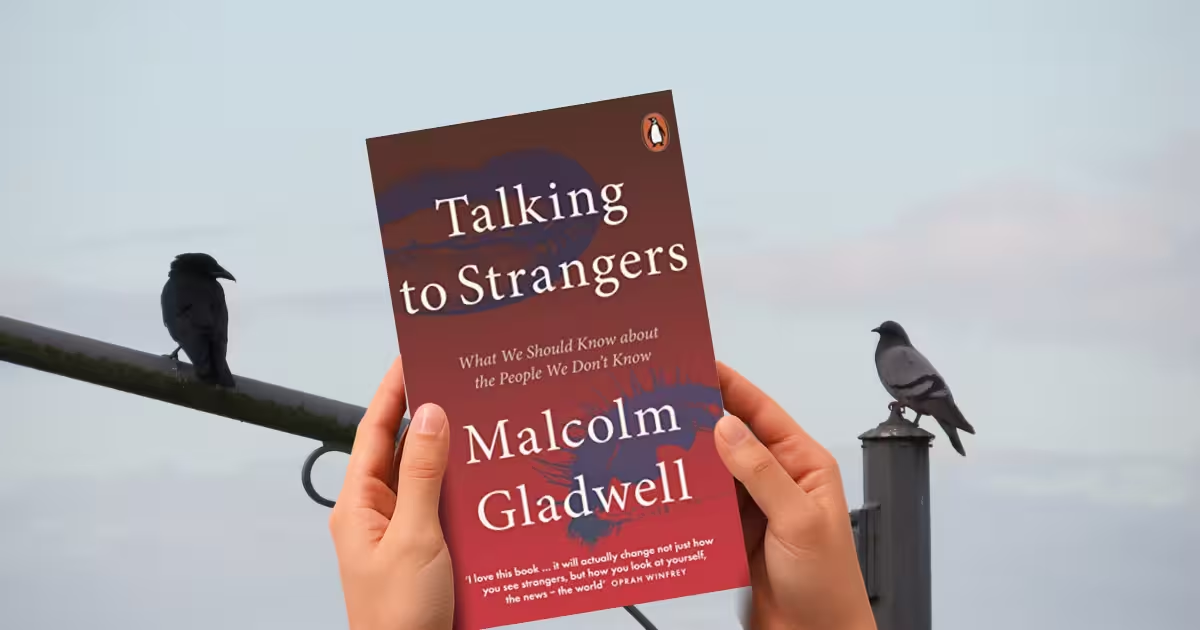
That nagging feeling of having misjudged someone isn’t just a personal quirk—it’s a fundamental flaw in how our brains are wired. In Talking to Strangers: What We Should Know about the People We Don’t Know, Malcolm Gladwell takes us on a gripping journey through some of the most infamous misunderstandings in recent history, from the CIA being fooled by Cuban spies to a routine traffic stop in Texas that ended in tragedy.
Table of Contents
Overview
Published on September 10, 2019, Talking to Strangers quickly became a #1 New York Times bestseller. The book argues that we are fundamentally terrible at understanding people we don’t know, and this failure has catastrophic consequences.
Gladwell identifies three core problems that lead us astray:
Default to Truth – We naturally assume people are telling the truth, which makes us vulnerable to deception.
The Illusion of Transparency – We believe we can read people’s intentions from their demeanor, but emotional expression isn’t universal or reliable.
Coupling – We ignore how tightly behavior is tied to specific contexts and environments.
Through high-profile cases—Sandra Bland, Bernie Madoff, Amanda Knox, Jerry Sandusky, Sylvia Plath, and even Neville Chamberlain‘s meeting with Hitler—Gladwell demonstrates how these three failures combine to create tragedy after tragedy.
The audiobook version, which Gladwell describes as a fusion of podcast and traditional audiobook, became one of the most pre-ordered audiobooks in history. It features interviews, court transcripts brought to life through re-enactments, and even a theme song—Janelle Monáe’s “Hell You Talmbout”.
Reader recommendation
Talking to Strangers is perfect for:
- Anyone who’s ever wondered why they misjudged someone
- Professionals who interview, hire, or evaluate people (HR, managers, recruiters)
- Law enforcement officers and legal professionals
- People interested in psychology, sociology, and behavioral science
- Fans of Gladwell’s previous work (The Tipping Point, Blink, Outliers)
Talking to Strangers is not a good read for:
- Readers looking for a traditional self-help book on “how to talk to strangers”
- Those who prefer dry, academic writing over narrative-driven storytelling
- People who dislike Gladwell’s signature style of weaving together disparate anecdotes
- Readers seeking definitive answers rather than provocative questions
Introduction
Talking to Strangers: What We Should Know about the People We Don’t Know is Malcolm Gladwell’s seventh book, following his #1 bestseller David and Goliath. It was published by Little, Brown and Company in hardcover on September 10, 2019, with a paperback edition released on September 28, 2021.
Talking to Strangers spans 400 pages and has been named a Best Book of the Year by The Financial Times, Bloomberg, the Chicago Tribune, and the Detroit Free Press.
Gladwell, a staff writer at The New Yorker and host of the podcast Revisionist History, has described Talking to Strangers as his “angriest work to date”. This isn’t the Gladwell of The Tipping Point, who seemed fascinated by how small things create big changes.
This is a Gladwell who is genuinely frustrated—frustrated by a system that repeatedly fails the most vulnerable, by institutions that refuse to learn, and by our collective refusal to acknowledge how bad we are at understanding strangers.
Context of Talking to Strangers
The book was inspired by one particularly lethal conversation between strangers: that between Sandra Bland, a 28-year-old African-American woman who died in a Texas jail cell in 2015, and Brian Encinia, the white police officer who pulled her over for failing to signal a lane change.
Gladwell writes in the introduction:
“Sandra Bland was not someone Brian Encinia knew from the neighborhood or down the street. That would have been easy: Sandy! How are you? Be a little more careful next time. Instead you have Bland from Chicago and Encinia from Texas, one a man and the other a woman, one white and one black, one a police officer and one a civilian, one armed and the other unarmed.
They were strangers to each other.”
This opening sets the tone for the entire book. Gladwell isn’t just writing an academic treatise on miscommunication. He’s trying to understand why a routine traffic stop escalated into an arrest, and why a woman who had just landed her dream job ended up dead three days later.
Purpose of Talking to Strangers
The central argument of Talking to Strangers is that we rely on flawed strategies to make sense of people we don’t know, and these strategies lead us to misunderstand strangers in ways that can have devastating consequences.
Gladwell writes:
“If I can convince you of one thing in this book, let it be this: Strangers are not easy.”
The book has three main objectives:
- To demonstrate how our default assumption that people are truthful makes us vulnerable to deception
- To show that our belief in transparency—that we can read people’s intentions from their behavior—is an illusion
- To argue that behavior is tightly coupled to specific contexts, and ignoring this leads to error
Background
The seeds of Talking to Strangers were planted during what Gladwell calls “a strange interlude in American public life”—the period between 2014 and 2016 when police violence against Black Americans dominated the news.
Gladwell writes:
“The debate spawned by that string of cases was deeply unsatisfying. One side made the discussion about racism—looking down at the case from ten thousand feet. The other side examined each detail of each case with a magnifying glass. What was the police officer like? What did he do, precisely? One side saw a forest, but no trees. The other side saw trees and no forest.”
Gladwell wanted to find a third way—one that acknowledged both systemic issues and individual behavior, but went deeper to understand the psychological mechanisms that make these encounters so prone to disaster.
He found his framework in the work of psychologist Tim Levine, whose “Truth-Default Theory” provided the first piece of the puzzle. Levine’s research showed that humans are naturally inclined to believe others, and we only stop believing when doubts become overwhelming.
The second piece came from the work of psychologists like Carlos Crivelli and Sergio Jarillo, who demonstrated that emotional expressions aren’t universal—they’re culturally constructed. This undermined the assumption that we can read strangers’ intentions from their faces.
The third piece came from criminologists like David Weisburd and Lawrence Sherman, who showed that crime is concentrated in tiny pockets of cities, not spread evenly across neighborhoods. This “Law of Crime Concentration” demonstrated how behavior is coupled to specific places.
Talking to Strangers Summary
Part One: Spies and Diplomats – Two Puzzles
The book opens with two seemingly unrelated puzzles that set up the entire argument.
Puzzle One: The Cuban Spy Who Fooled the CIA
Florentino Aspillaga was a high-ranking Cuban intelligence officer who defected to the United States in 1987. When he was debriefed, he dropped a bombshell: the entire network of CIA spies inside Cuba were actually double agents working for Havana.
Gladwell writes:
“He continued on like that until he had listed dozens of names—essentially the entire U.S. roster of secret agents inside Cuba. They were all working for Havana, spoon-feeding the CIA information cooked up by the Cubans themselves.”
The CIA had been completely fooled. When Fidel Castro heard what happened, he released an eleven-part documentary on Cuban television showing exactly how the CIA had been duped.
Gladwell asks: “If the CIA’s best can be misled so completely, so many times, then what of the rest of us?”
Puzzle Two: Neville Chamberlain and the Hitler Problem
In September 1938, British Prime Minister Neville Chamberlain flew to Germany to meet Adolf Hitler. He believed that by meeting Hitler face-to-face, he could assess the man’s character and intentions.
Chamberlain wrote to his sister:
“In spite of the hardness and ruthlessness I thought I saw in his face I got the impression that here was a man who could be relied upon when he had given his word.”
Of course, Chamberlain was catastrophically wrong. Hitler invaded the rest of Czechoslovakia in March 1939 and Poland in September 1939, plunging the world into war.
The puzzle is that the people who met Hitler personally—Chamberlain, Lord Halifax, Ambassador Neville Henderson—all misread him completely. Meanwhile, Winston Churchill, who had never met Hitler, saw him clearly from the start.
Gladwell asks: “How is it that meeting a stranger can sometimes make us worse at making sense of that person than not meeting them?”
Part Two: Default to Truth
The Queen of Cuba
Ana Montes was a rising star at the Defense Intelligence Agency. She was so highly regarded that her nickname inside the intelligence community was the “Queen of Cuba”.
She was also a Cuban spy.
For years, Montes passed secrets to Havana while her colleagues praised her work. When counterintelligence officer Scott Carmichael finally investigated her, she passed a polygraph test with flying colors. She had no red flags.
Carmichael interviewed Montes and found her answers plausible. He writes:
“What’d I have? I didn’t have anything. Oh well.”
Montes wasn’t caught because someone spotted a tell or noticed suspicious behavior. She was caught because the NSA cracked Cuban codes and found references to a spy codenamed “Agent S”.
Gladwell uses this story to illustrate Levine’s Truth-Default Theory. We default to believing people are telling the truth because, most of the time, they are. As Levine puts it:
“Sure, we get deceived once in a while. That is just the cost of doing business.”
The Holy Fool
Harry Markopolos was the one person who saw through Bernie Madoff’s $65 billion Ponzi scheme. He was a “Holy Fool”—someone outside the system who could see what insiders couldn’t.
Markopolos tried repeatedly to warn the SEC. He says:
“I gift-wrapped and delivered the largest Ponzi scheme in history to them, and somehow they couldn’t be bothered to conduct a thorough and proper investigation.”
The problem is that we can’t all be Holy Fools. If everyone was as suspicious as Markopolos, society couldn’t function. Markopolos himself became so paranoid that he armed himself and installed a high-tech alarm system in his home.
Gladwell writes:
“We need Holy Fools in our society, from time to time. They perform a valuable role. That’s why we romanticize them. Harry Markopolos was the hero of the Madoff saga. Whistleblowers have movies made about them. But the second, crucial part of Levine’s argument is that we can’t all be Holy Fools. That would be a disaster.”
The Boy in the Shower
Jerry Sandusky, the Penn State football coach, was convicted of sexually abusing young boys. The question is: why did it take so long for anyone to stop him?
In 2001, graduate assistant Mike McQueary walked into a locker room and saw Sandusky in the shower with a young boy. He reported it to his boss, Joe Paterno, who reported it to athletic director Tim Curley and university president Graham Spanier.
But nothing happened for nearly a decade.
The problem was that the case was filled with ambiguity. McQueary couldn’t say for certain what he saw. The boy in the shower later denied anything happened, then said something did happen, then couldn’t remember.
Gladwell argues that Spanier and the other administrators defaulted to the most innocent explanation:
“Curley and Schultz then call the university’s outside counsel. But McQueary hasn’t given them much. They instinctively reach—as we all do—for the most innocent of explanations: Maybe Jerry was just being goofy Jerry.”
Part Three: Transparency
The Friends Fallacy
We believe we can read people’s emotions from their faces. This is the “Friends Fallacy”—named after the TV show where actors make sure every emotion is perfectly displayed on their faces.
But real life isn’t like Friends.
Gladwell describes the work of Carlos Crivelli and Sergio Jarillo, who traveled to the Trobriand Islands and found that people there couldn’t identify emotions from facial expressions the way Westerners can. When shown a picture of a fearful face, the Trobrianders thought it was a threat.
“The sensation of fear, for a Trobriand Islander, is not any different from the fear that you or I feel. They get the same sick feeling in the pit of their stomach. But for some reason they don’t show it the same way we do.”
Even within Western cultures, people don’t show surprise on their faces the way we think they do. In one experiment, people rated their surprise at 8.14 out of 10, but only 5% actually showed the classic surprised expression.
Gladwell concludes:
“Transparency is a myth—an idea we’ve picked up from watching too much television and reading too many novels.”
The Amanda Knox Case
Amanda Knox was convicted of murdering her roommate, Meredith Kercher, largely because she didn’t act like an innocent person.
Knox was “mismatched”—she behaved in ways that seemed suspicious to investigators. She bought red underwear days after the murder (because her house was a crime scene and she couldn’t access her clothes). She did a split in the police station while waiting to be interviewed. She snapped at a friend who expressed sympathy.
The lead investigator said:
“We were able to establish guilt by closely observing the suspect’s psychological and behavioral reaction during the interrogation. We don’t need to rely on other kinds of investigation.”
But Knox was innocent. She had been wrongfully convicted because her behavior didn’t match investigators’ expectations.
Gladwell writes:
“From Bernard Madoff to Amanda Knox, we do not do well with the mismatched.”
The Fraternity Party
The Brock Turner case at Stanford University is a textbook example of how alcohol complicates the already difficult task of understanding strangers.
Turner was convicted of sexually assaulting an unconscious woman behind a dumpster. But the case wasn’t simple. Both parties were extremely drunk. The woman had consumed four shots of whiskey, a glass of champagne, and three to four shots of vodka. Turner had consumed five beers and Fireball whiskey.
Gladwell explains the concept of “alcohol myopia”—alcohol doesn’t reveal who you really are; it transforms you. It narrows your focus to immediate experiences and makes you unable to consider long-term consequences.
He quotes the legal ruling in a similar British case:
“Both were adults. Neither acted unlawfully in drinking to excess. They were both free to choose how much to drink, and with whom. Both were free, if they wished, to have intercourse with each other. There is nothing abnormal, surprising, or even unusual about men and women having consensual intercourse when one, or the other, or both have voluntarily consumed a great deal of alcohol.”
Part Four: Lessons
KSM and the Problem of Coerced Confessions
Khalid Sheikh Mohammed, the mastermind of 9/11, was subjected to “enhanced interrogation techniques” including waterboarding. Eventually, he confessed to everything.
But was his confession true? Some experts doubted it. One target he listed—the Plaza Bank building in Seattle—wasn’t even founded until years after his arrest.
Gladwell uses this case to illustrate the limits of interrogation. The harder we work to get strangers to reveal themselves, the more elusive they become.
He quotes neuroscientist Shane O’Mara:
“Extended sleep deprivation ‘might induce some form of surface compliance’—but only at the cost of ‘long-term structural remodeling of the brain systems that support the very functions that the interrogator wishes to have access to.'”
Part Five: Coupling
Sylvia Plath and the Problem of Context
Sylvia Plath committed suicide in 1963 by putting her head in a gas oven. At the time, this was a common method—in 1962, 44.2% of suicides in England and Wales were by gas poisoning.
But then Britain switched from toxic town gas to natural gas, which doesn’t contain carbon monoxide. The result? Suicide rates plummeted.
Gladwell writes:
“[Town] gas had unique advantages as a lethal method. It was widely available (in about 80 percent of British homes) and required little preparation or specialist knowledge, making it an easy choice for less mobile people and for those coming under sudden extreme stress.”.
This is “coupling”—behavior is tightly connected to specific circumstances. People who would have killed themselves with gas didn’t simply switch to another method. They didn’t kill themselves at all.
The Kansas City Experiments
In the 1970s, the Kansas City Police Department ran an experiment showing that preventive patrol—having police cars drive randomly around the city—did nothing to reduce crime.
Twenty years later, they tried again. This time, they focused on a small, high-crime area called District 144. Officers were instructed to stop anyone who looked suspicious and search for guns.
The result? Gun crimes in District 144 dropped by half.
But here’s the crucial detail: the officers only stopped people in the hot spots, and only at night. When this strategy spread to the rest of the country, that crucial nuance was lost. Police departments started stopping everyone, everywhere—leading to the kind of over-policing that contributed to Sandra Bland’s death.
Sandra Bland
Gladwell returns to the case that inspired the book.
Officer Brian Encinia stopped Bland for failing to signal a lane change. He was a textbook example of a proactive police officer—the kind trained to go “beyond the ticket” and look for “curiosity ticklers”.
Encinia noticed Bland was agitated and concluded something was wrong. He saw her moving in her car and worried she might be reaching for a weapon. When she refused to put out her cigarette, he ordered her out of the car.
The interaction escalated rapidly. Bland was arrested, and three days later, she committed suicide in her cell.
Gladwell argues that Encinia wasn’t a bad cop—he was doing exactly what he was trained to do. The problem was systemic:
“Someone wrote a training manual that foolishly encouraged Brian Encinia to suspect everyone, and he took it to heart. Somebody else higher up in the chain of command at the Texas Highway Patrol misread the evidence and thought it was a good idea to have him and his colleagues conduct Kansas City stops in a low-crime neighborhood.”
Talking to Strangers Analysis
What Works
Gladwell is a master storyteller, and Talking to Strangers showcases his skills at their best. The book weaves together seemingly unrelated stories—spies, pedophiles, poets, and traffic stops—into a coherent argument about human nature.
His use of Tim Levine’s Truth-Default Theory is particularly effective. The idea that we default to believing others because, most of the time, it’s the efficient thing to do, explains so much about why we’re vulnerable to deception. As Levine puts it:
“Being deceived once in a while is not going to prevent us from passing on our genes or seriously threaten the survival of the species. Efficient communication, on the other hand, has huge implications for our survival. The trade-off just isn’t much of a trade-off.”.
The book’s exploration of coupling is also valuable. The idea that behavior is tightly connected to context—whether it’s suicide and gas ovens or crime and specific street corners—is a powerful corrective to the tendency to see behavior as purely the result of individual character.
Gladwell’s anger is palpable throughout the book, and it’s justified. The Sandra Bland case is a tragedy that shouldn’t have happened. The Sandusky case is a tragedy that shouldn’t have happened. The Amanda Knox case is a tragedy that shouldn’t have happened.
Gladwell is right to be angry that our collective failure to understand strangers leads to so much unnecessary suffering.
What Doesn’t Work
Critics have pointed out several problems with the book.
Oversimplification
The Telegraph review called the book “tastelessly galumphing over complex questions”. Gladwell has been accused of simplifying complex situations to fit his narrative.
For example, the Amanda Knox case was more complicated than Gladwell suggests. Italian prosecutors had physical evidence linking Knox to the crime, even if that evidence was later shown to be flawed. Gladwell’s argument that Knox was convicted solely because of her demeanor ignores the full complexity of the case.
Selective Evidence
Gladwell’s critics argue that he cherry-picks evidence that supports his thesis while ignoring evidence that contradicts it. For instance, his chapter on alcohol and sexual assault has been criticized for suggesting that alcohol, rather than perpetrators, is the primary problem.
The “Gladwell Formula”
Some readers are tired of Gladwell’s signature style—presenting a surprising idea, supporting it with engaging anecdotes, and seasoning it with “studies have shown”. The Telegraph review notes that Gladwell has become “perhaps the most serially debunked writer of modern times”.
A Personal Reflection
Reading Talking to Strangers made me reconsider countless interactions I’ve had with strangers. How many times have I thought I could read someone’s intentions from their body language? How many times have I defaulted to assuming someone was telling the truth when they weren’t?
The book also made me more sympathetic to people who make mistakes in high-pressure situations. Graham Spanier, the Penn State president, wasn’t a monster—he was a man who defaulted to the most innocent explanation and was punished for it.
Scott Carmichael, the counterintelligence officer who interviewed Ana Montes, wasn’t incompetent—he was a man who couldn’t bring himself to believe that a respected colleague was a spy.
Strengths and Weaknesses
Strengths
Compelling storytelling: Gladwell’s ability to weave together disparate stories into a coherent narrative is unmatched.
Provocative ideas: The concepts of “default to truth,” “transparency,” and “coupling” provide a useful framework for understanding why interactions with strangers go wrong.
Timely subject matter: The book addresses issues—police violence, sexual assault, institutional failure—that are central to contemporary public discourse.
Immersive audiobook: The audiobook version, with its interviews, sound bites, and re-enactments, is a genuinely innovative experience.
Personal investment: Gladwell’s anger and frustration are palpable, making the book feel more personal than his previous work.
Weaknesses
Oversimplification: Complex cases are reduced to fit Gladwell’s framework, sometimes at the expense of nuance.
Selective evidence: Critics argue that Gladwell cherry-picks evidence that supports his thesis.
Problematic chapters: The chapter on alcohol and sexual assault has been criticized for shifting blame away from perpetrators.
Lack of solutions: The book diagnoses the problem but offers few concrete solutions.
Gladwell fatigue: Some readers are tired of his signature style.
Comparison with Similar Works
1. Blink (2005) by Malcolm Gladwell
Blink argued that our snap judgments are often more accurate than we think. Talking to Strangers takes the opposite position: our judgments of strangers are often wrong. The two books represent a significant evolution in Gladwell’s thinking.
2. The Power of Habit (2012) by Charles Duhigg
Like Gladwell, Duhigg is a journalist who writes about psychology and behavior. Both books use compelling anecdotes to illustrate scientific concepts. However, Duhigg focuses more on individual change, while Gladwell focuses on systemic failures.
3. Thinking, Fast and Slow (2011) by Daniel Kahneman
Kahneman’s book is a more rigorous, academic treatment of how our brains make decisions. Gladwell’s book is more accessible but less scientifically precise. Kahneman won a Nobel Prize; Gladwell writes for The New Yorker.
4. The Stranger in the Woods (2017) by Michael Finkel
Both books explore how we misunderstand people who are different from us. Finkel’s book is a more focused exploration of one individual—a man who lived alone in the Maine woods for 27 years—while Gladwell’s book is broader in scope.
Conclusion
Talking to Strangers is a provocative, frustrating, and ultimately important book. It won’t teach you how to talk to strangers—the title is somewhat misleading in that regard. But it will make you question everything you think you know about how you understand other people.
Who will benefit most from reading this book:
Police officers and legal professionals: The book offers a powerful critique of how law enforcement is trained to interact with strangers.
HR professionals and hiring managers: The book’s argument that face-to-face interviews can be misleading is directly relevant to hiring decisions.
Anyone who has ever been wrong about someone: Which is all of us.
Students of psychology, sociology, and criminology: The book provides accessible introductions to important concepts like Truth-Default Theory and the Law of Crime Concentration.
People who feel frustrated by current events: The book offers a framework for understanding why seemingly inexplicable tragedies happen.
Who should skip it:
- Readers looking for a traditional self-help book on communication skills.
- People who prefer rigorous academic analysis over narrative-driven storytelling.
- Those who dislike Gladwell’s signature style.
- Readers who want definitive answers rather than provocative questions.
Final Verdict
Talking to Strangers is an important book, but it’s also a frustrating one. Gladwell’s arguments are compelling, but they’re also oversimplified. His stories are gripping, but they’re also selective. His anger is justified, but it sometimes overwhelms his analysis.
The book succeeds in its primary goal: making us question our assumptions about how we understand strangers. It fails in its secondary goal: providing clear solutions to the problems it identifies.
But perhaps that’s the point. Perhaps the first step to solving a problem is recognizing that you have one. And Talking to Strangers makes that recognition impossible to ignore.







