
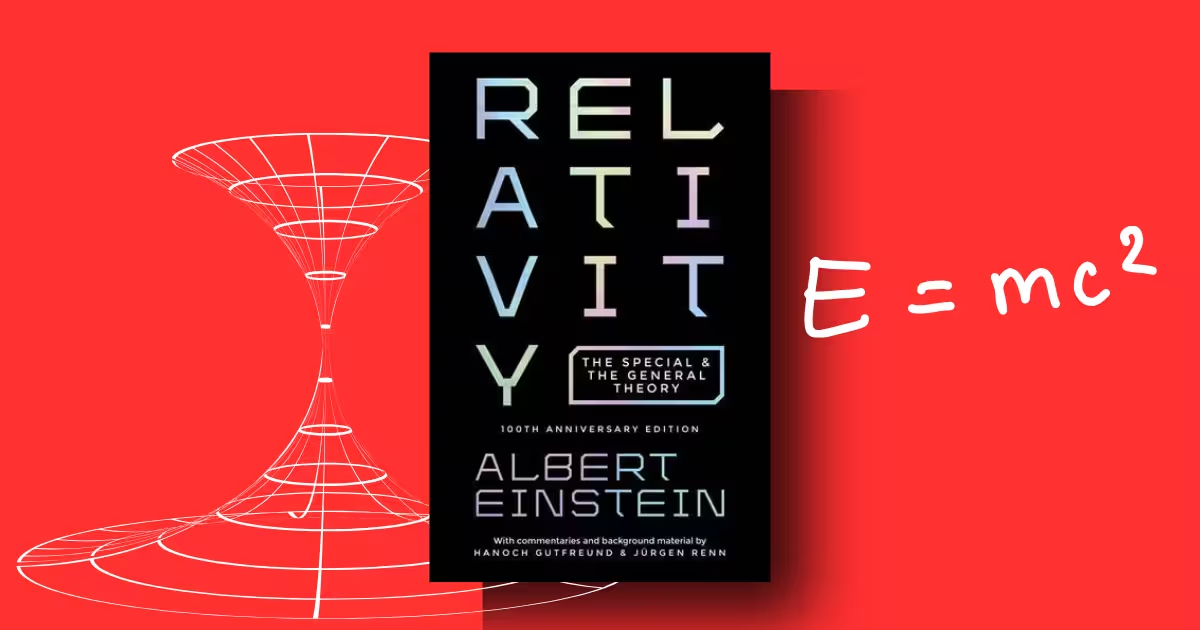
Why does a beam of light hit two different observers at exactly the same speed, no matter how fast either one is moving? I sat with Einstein’s own answer to that question for three weeks, in his own words, and it left me more confused, then far more certain, than any physics lecture ever managed.
If you have ever wanted to hear relativity explained by the man who built it, this is the book, and this is everything I found inside it.
Table of Contents
Overview
Relativity: The Special and the General Theory is Albert Einstein’s own popular account of the two theories that carry his name, written for readers who have no interest in wading through tensor calculus but still want the real argument, not a watered-down version of it.
Einstein wrote the original German text, Über die spezielle und die allgemeine Relativitätstheorie, in 1916, barely a year after he finished the general theory itself. Physicist Robert W. Lawson translated it into English in 1920, and that authorized translation, published by Methuen in London and Henry Holt in New York, is still the version almost every English reader encounters today.
The edition I worked from is the 2005 Pi Press “Masterpiece Science Edition” (ISBN 0-13-186261-8, Pearson Education, 289 pages), which pairs Einstein’s original 32 sections and three appendices with a new introduction by Nobel laureate physicist Roger Penrose, a section-by-section commentary by University of Chicago general relativity theorist Robert Geroch, and a historical essay on the cultural legacy of relativity by Hofstra University science historian David C. Cassidy, a former associate editor of The Collected Papers of Albert Einstein.
That is not a small amount of scholarly weight sitting around one short book, and it changes what the book can do for a modern reader. More on that later.
Einstein states his own goal in the preface, dated December 1916, better than any reviewer could summarize it. As he puts it, the book aims to give readers who are not trained in theoretical physics a genuine grasp of relativity, without pretending the subject is simple.
He even tells you upfront that he is borrowing a line from physicist Ludwig Boltzmann, insisting that matters of elegance ought to be left to the tailor and to the cobbler.
In other words, he is warning you that this will be repetitive, plain, and occasionally hard going, because he cared more about you actually understanding the idea than about impressing you with how gracefully he could phrase it. I respect that kind of honesty in a science writer, and it set my expectations correctly before I had even reached chapter one.
Reader recommendation
Relativity: The Special and the General Theory rewards a fairly specific kind of reader, so let me be direct about who gets the most out of it.
Relativity: The Special and the General Theory is highly recommended for:
- Readers who want the primary source, not a paraphrase, and are willing to reread a paragraph twice to get there
- Anyone with roughly a high-school or first-year-university grip on algebra and geometry, since Einstein does use both
- Students of the history and philosophy of science who want to see how a working physicist thought through his own discovery in real time
Relativity: The Special and the General Theory is not recommended for:
- Readers who want zero math; Part I is manageable, but the later sections lean on algebraic derivations that Einstein does not soften
- Anyone hunting for a full account of modern cosmology, black holes, or quantum theory, none of which existed yet in 1916
- Readers who prefer a warm, story-driven narrator; Einstein’s tone here is closer to a patient professor than a memoirist
- People who only have an afternoon, since the general theory chapters genuinely reward slow, repeated reading
Background
Einstein finished the special theory of relativity in 1905, the same extraordinary year that also produced his papers on the photoelectric effect and Brownian motion.
He completed the far more demanding general theory a decade later, publishing his field equations in November 1915 and the fuller account in 1916. What is genuinely striking, and Penrose says as much in his introduction to this edition, is how fast Einstein turned around and wrote a plain-language account for the public.
He had barely finished the hardest physics of his career, and he immediately sat down to explain it to people who had never seen a tensor in their lives.
That timing matters for tone.
Germany in 1916 was two years into a war that had already reshaped the country, and Einstein was writing during a period when scientific communication between nations, particularly Germany and Britain, had mostly broken down. Against that backdrop, a physicist trying to hand his most difficult idea to ordinary readers, in clear prose, reads as a genuinely generous act, not just an academic exercise.
This particular edition also adds something the 1916 original never had: hindsight. Penrose’s introduction openly credits the physicists whose work fed into special relativity before Einstein arrived, among them Hendrik Lorentz, Henri Poincaré, and later Hermann Minkowski, while still making the case for why Einstein’s own contribution, especially the general theory, was the truly original leap.
Geroch’s commentary translates Einstein’s occasionally dense derivations into plainer modern language, chapter by chapter.
Cassidy’s closing essay traces what happened to relativity in the century after publication, including its distortion by Nazi-era “German physics” propagandists who tried to dismiss it as “Jewish science.” None of that appears in Einstein’s own 1916 text, and I found it changed how I read the main book.
Relativity: The Special and the General Theory Summary
Einstein splits the book into three parts, and I am going to walk through what each one actually argues, because that is the part most reviews skip.
Part I: The Special Theory of Relativity (Sections 1 to 17)
Einstein does not open with light or motion. He opens with geometry, asking what it even means to call a geometrical statement “true.” His answer, in short, is that geometry only becomes physics once you tie its abstract points and lines to real, measurable objects like rigid rods.
That sounds like a detour, but it is the foundation for everything that follows, because relativity is ultimately a theory about how we measure space and time, not just a theory about fast-moving trains.
From there he builds up classical, Galilean relativity, the ordinary idea that the laws of mechanics look the same whether you are standing on a platform or riding in a smoothly moving carriage.
Then he introduces the problem that breaks that comfortable picture: the speed of light in a vacuum is measured as the same constant value by every observer, regardless of how fast that observer is moving relative to the light source.
Classical velocity addition, the everyday rule where speeds simply add up, cannot explain that. Something else has to give, and Einstein argues it has to be our assumptions about time.
This is where his most famous thought experiment lives, in the chapter titled “The Relativity of Simultaneity.” Picture a very long train moving along an embankment. Lightning strikes the track at two points, A and B, at what an observer standing on the embankment judges to be exactly the same moment.
Einstein then asks whether a passenger riding the train, moving toward one flash and away from the other, would agree that the two strikes were simultaneous.
He walks through the logic and arrives at no, they would not, because the passenger is racing toward the light from one strike and retreating from the light of the other.
Two events that are simultaneous for one observer are not simultaneous for another observer in relative motion. That is the relativity of simultaneity, and once Einstein establishes it, absolute, universal time quietly disappears from physics.
From there he derives the Lorentz transformation, the mathematical machinery that replaces the old, simpler equations for switching between moving reference frames, and uses it to explain length contraction (a fast-moving rod measures shorter along its direction of travel) and time dilation (a fast-moving clock runs slower, as judged from a stationary frame).
He also works through the velocity-addition problem properly, checking his new formula against Hippolyte Fizeau’s real 1851 experiment on the speed of light in moving water, and finds that relativity, not classical mechanics, matches the measured result.
Part I closes with the section that gave the world its most recognizable equation. Einstein shows that a body’s inertial mass is not fixed; it increases with the energy it absorbs. As he puts it, in his own words, the inertial mass of a body is not a constant.
That single idea, spelled out here in ordinary algebra rather than the compressed symbol most people know, is the seed of E = mc². Part I then ends by introducing Hermann Minkowski’s four-dimensional space-time, the framework that treats time as a fourth coordinate alongside the familiar three of space, which Einstein himself admits took him a while to fully appreciate.
Part II: The General Theory of Relativity (Sections 18 to 29)
If Part I is demanding, Part II is where the book earns its reputation for difficulty, and Einstein does not pretend otherwise. He opens by asking why relativity should be restricted to observers moving at constant velocity, and argues it should extend to accelerated frames too.
To make that case, he offers his own version of what is now called the equivalence principle, using a thought experiment about a large closed chest, floating in empty space, being pulled upward by a rope at constant acceleration.
A person inside that chest, he argues, would feel pressed against the floor exactly as if standing in a gravitational field, with no experiment able to tell the two situations apart. Gravity and acceleration, he concludes, are physically indistinguishable. This single idea, which Einstein once described elsewhere as the happiest thought of his life, is the hinge the entire general theory swings on.
From the equivalence principle, Einstein argues that gravity bends the paths of light rays and warps the geometry of space itself, which means ordinary flat, Euclidean geometry can no longer be assumed to hold everywhere.
He works through non-Euclidean geometry and Gaussian coordinates, the mathematical tools needed to describe curved space without relying on a fixed, rigid grid, and uses them to build the space-time continuum of general relativity as an extension of Minkowski’s flat-space picture.
By the end of Part II, gravity has stopped being a force that pulls objects around and has become a description of the shape of space-time itself; a planet does not get pulled into orbit, it simply follows the straightest available path through curved space.
Part III: Considerations on the Universe as a Whole (Sections 30 to 32)
The shortest part of the book is also its most speculative. Einstein points out a real problem with the old Newtonian picture of an infinite universe filled with stars: the physics does not actually support it cleanly.
He proposes instead that the universe could be finite in volume yet still have no edge or boundary, the way the surface of a sphere is finite in area but has no edge you can walk off.
He works out that a universe with a genuinely non-zero average density of matter would have to be curved back on itself in this way, what he calls a quasi-spherical structure, rather than stretching out flat and empty forever.
The Three Appendices
Appendix 1 gives a cleaner, more direct derivation of the Lorentz transformation than the one buried in Part I. Appendix 2 expands on Minkowski’s four-dimensional formalism.
Appendix 3, “The Experimental Confirmation of the General Theory of Relativity,” is where the book stops being theoretical and starts reporting evidence, and it is the section I found most moving to read. Einstein lays out three tests.
First, the anomalous advance of Mercury’s perihelion, the slow, extra rotation of Mercury’s orbital ellipse that astronomers Urbain Le Verrier (1859) and Simon Newcomb (1895) had measured but could not fully explain with Newton’s laws; general relativity predicts an extra 43 seconds of arc per century, matching the observed anomaly.
Second, the deflection of starlight by the sun’s gravity, which Einstein calculates at 1.7 seconds of arc for light grazing the solar limb. Third, the gravitational redshift of spectral lines, still unconfirmed at the time of writing.
The light-deflection prediction is the one with the best story attached. Two British expeditions, organized by Astronomer Royal Frank Dyson, traveled to Sobral in Brazil and the island of Príncipe off West Africa to photograph the total solar eclipse of 29 May 1919.
Arthur Eddington and Edwin Cottingham led the Príncipe team; Andrew Crommelin and Charles Davidson led the Sobral team.
As Einstein reports it, the results of the measurements confirmed the theory in a thoroughly satisfactory manner, and the announcement, delivered at a joint Royal Society and Royal Astronomical Society meeting that November, turned Einstein into a household name almost overnight.
I should add one honest caveat here, since accuracy matters more than a tidy story: later historians of science, notably in a widely cited paper by John Earman and Clark Glymour, questioned whether Eddington selectively favored the cleaner Príncipe data over the noisier Sobral plates.
More recent scholarship, particularly Daniel Kennefick‘s detailed 2012 reassessment, has largely defended the original team’s judgment, concluding the discarded Sobral plates were genuinely compromised by heat distortion in the telescope mirror rather than dropped to fit the answer Eddington wanted.
The theory held up either way. I mention the controversy because a good science book review should not flatten a real historical debate into a clean legend.
Relativity: The Special and the General Theory Analysis
Does Einstein actually deliver on the promise in his own preface, an exact, non-technical grasp of relativity that never needs the mathematical apparatus of theoretical physics? Partly, and I want to be honest about where the partly kicks in.
Part I earns its reputation. The train-and-embankment argument for the relativity of simultaneity is one of the clearest pieces of physics writing I have ever read, and I say that as someone who came into this book already accepting relativity as fact without ever having worked through why it has to be true. Einstein does not ask you to trust him.
He walks the logic in front of you, step by step, and lets you arrive at the strange conclusion yourself. That is genuinely rare in popular science writing, where authors often state the weird result and move straight to the implications.
Part II is a different experience. The prose stays plain, but the ideas stop being intuitive the moment non-Euclidean geometry and Gaussian coordinates show up, and Einstein’s own algebra gets denser than his preface led me to expect.
I do not think this is a failure on Einstein’s part so much as an honest limit on how far plain language can carry a reader through curved-space mathematics.
This is exactly where Geroch’s added commentary earns its place in this particular edition. His explanation of mass-energy equivalence, using the image of weighing a brick before and after baking it in an oven, or noting that a rabbit sprinting across a field is technically converting a tiny sliver of its own mass into kinetic energy, does more to make E = mc² feel tangible than anything in Einstein’s original derivation.
Reading Einstein and Geroch side by side, in the same volume, is genuinely the best way I have found to get both the authenticity of the primary source and the clarity a century of teaching experience can add on top of it.
Cassidy’s closing essay pushes the book somewhere Einstein’s own text never goes: culture.
He traces how relativity got dragged into ideological fights it had nothing to do with, particularly the Nazi-era campaign to brand it “Jewish physics” and discredit it on political rather than scientific grounds.
That context does not change a single equation in Part I or Part II, but it reframes why Einstein’s insistence on plain, public explanation mattered so much.
A theory this widely misunderstood needed a clear popular account from its own author, and that is exactly what this book set out to be.
Strengths and Weaknesses
What worked for me:
The directness. There is no ghostwriter smoothing Einstein’s voice, and you can feel his priorities in the writing itself, especially his admitted preference for clarity over elegance
The train-and-embankment simultaneity argument in Part I, still one of the most effective physics explanations I have read anywhere, in any book
Appendix 3’s experimental evidence section, which grounds two full parts of pure theory in actual, checkable astronomical measurements
In this particular edition, Geroch’s commentary and Penrose’s historical framing genuinely add value rather than padding
What did not work as well for me:
Part II moves faster than its own preface promises, and readers without any algebra background will likely need a companion guide
The original 1916 diagrams are minimal; Eddington’s Space, Time and Gravitation, published just four years later, uses far more visual scaffolding to carry the same ideas
Nothing here touches quantum mechanics, black holes, gravitational waves, or dark energy, since none of that existed as physics yet when Einstein wrote this
A few sections, particularly the Gaussian coordinates chapter, repeat themselves in ways that feel more like Einstein thinking out loud than a polished explanation
Comparison With Similar Works
If you want the emotional and historical companion piece to this book, read Arthur Eddington’s Space, Time and Gravitation, which I reviewed here on Probinism.
Eddington was the astronomer who led the 1919 Príncipe expedition described in Einstein’s own Appendix 3, and his book covers the same physics with noticeably more analogy, more narrative, and considerably more visual imagination, at the cost of being one step removed from the source.
If you want a more contemporary, less mathematical entry point into these same ideas, Stephen Hawking’s A Brief History of Time covers relativity as a launching pad into black holes and cosmology, territory Einstein’s 1916 book could not have reached.
Hawking is the friendlier read; Einstein is the more rigorous one. I would not skip either, but I would read Einstein first, precisely because everything written about relativity since 1916 is, in some sense, a response to this book.
Conclusion
I would recommend Relativity: The Special and the General Theory to any general reader who genuinely wants to understand relativity rather than just nod along at a documentary description of it, provided they bring some patience and a willingness to reread Part II more than once.
It is not the easiest introduction to relativity available today, and I would not hand it to someone who has never encountered basic algebra.
But for readers who want the actual argument, built by the person who built the theory, in his own words, backed in this edition by a Nobel laureate’s framing, a University of Chicago physicist’s plain-language commentary, and a science historian’s honest account of what happened to this theory in the century since, I have not found a better single volume.
It earned its place on my shelf, and it changed how carefully I now think about the word “simultaneous.”







