
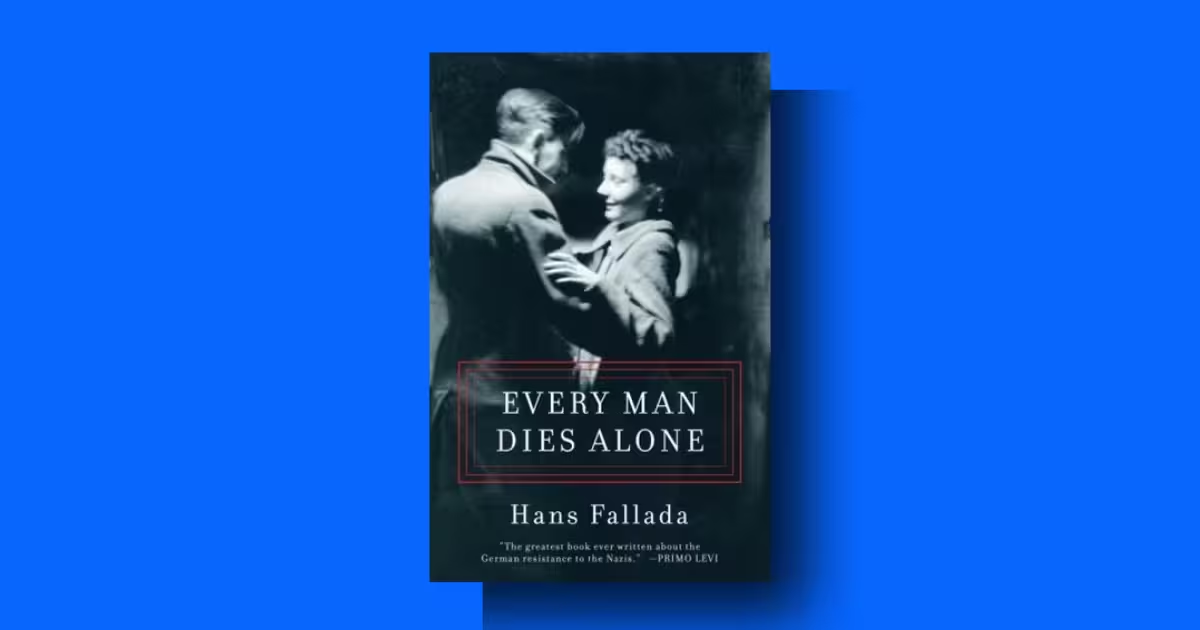
Did you know that a single, ordinary couple managed to terrify the entire Gestapo apparatus in Berlin for over two years, using nothing but handwritten postcards? That’s the true story behind Hans Fallada’s Every Man Dies Alone, a novel that Italian chemist Primo Levi called “the greatest book ever written about the German resistance to the Nazis”.
I first picked up this book thinking I knew what to expect from a World War II novel, but I was wrong.
Table of Contents
Overview
Every Man Dies Alone is a visceral, emotionally devastating novel based on the true story of Otto and Elise Hampel, a working-class Berlin couple who launched a solitary postcard campaign against Hitler after their son was killed in France.
Written in just 24 days by a broken man who died before its publication, this 1947 masterpiece captures the suffocating fear, moral compromises, and quiet acts of defiance that defined life in Nazi Germany.
It’s a book about what happens when ordinary people decide they can no longer remain silent—even when speaking up means certain death.
Reader recommendation
When a working-class couple loses their only son to Hitler’s war, they transform their grief into a quiet, desperate rebellion—not to win, but to prove that not everyone in Germany had surrendered their conscience.
Every Man Dies Alone is recommended for:
Readers who appreciate unflinching historical fiction with moral complexity; fans of The Nightingale, All the Light We Cannot See, or George Orwell’s 1984; anyone interested in everyday life inside Nazi Germany rather than battlefield heroics.
Every Man Dies Alone can not be recommended tothose seeking a light or uplifting read; readers sensitive to detailed depictions of torture, execution, and psychological despair; anyone expecting a conventional resistance thriller with a triumphant ending.
1. Introduction
Every Man Dies Alone (original German title: Jeder stirbt für sich allein) is a 1947 novel by German author Hans Fallada.
The book remained untranslated into English for over six decades until Melville House published Michael Hofmann’s translation in 2009. Its belated arrival in the English-speaking world was hailed by The New York Times as “a signal literary event”.
What makes this novel extraordinary isn’t just its literary quality—though that is considerable. It’s the story behind the story. Fallada wrote the book in a staggering 24 days while hospitalized, using Gestapo files given to him by a friend. He died on February 5, 1947, just weeks before publication.
The novel was one of the first anti-Nazi novels published by a German after World War II.
2. Background
The Author’s Tumultuous Life
Hans Fallada was the pen name of Rudolf Ditzen. His life reads like one of his novels: as a young man, he killed a friend in a duel that was actually a suicide pact, spent time in asylums, embezzled money to fund a morphine habit, and served prison sentences. During the Nazi years, he remained in Germany, a decision he later struggled with, and was repeatedly persecuted by the regime. By war’s end, he was a shattered man, struggling with addiction and poor health.
The True Story Behind the Novel
The novel is based on the real-life case of Otto and Elise Hampel, a working-class couple with no prior political involvement. After Elise learned that her brother had been killed in France in 1940, she and her husband began writing anti-Nazi messages on postcards.
They left hundreds of these cards in apartment stairwells and mailboxes across Berlin, urging people to resist the regime. Their campaign continued for over a year until they were betrayed, arrested, tried by the notorious Nazi judge Roland Freisler, and executed in Plötzensee Prison in 1943.
The Hampels were poorly educated—their cards contained spelling mistakes and clumsy handwriting. Yet their simple, heartfelt messages were powerful enough to terrify those who found them. Fallada took their story and transformed it into a sweeping portrait of an entire society living under tyranny.
3. Every Man Dies Alone Plot Summary
Part One: The Quangels
The novel opens on a Tuesday in 1940, shortly after France’s capitulation to Germany. Postwoman Eva Kluge climbs the stairs of 55 Jablonski Strasse, dreading the delivery she must make to the Quangels on the second floor. In her bag is a typed letter from the front—the kind that always brings bad news.
Otto Quangel, a foreman in a furniture factory, takes the letter without a word and hands it to his wife Anna. She tears it open, and the smile on her face vanishes. Their only son, Ottochen, has been killed in action.
Anna’s grief explodes into fury. She accuses her husband: “Me and your Führer?” she screams. “Since when is he my Führer?” This moment shatters the careful silence that has defined their marriage for decades.
The Birth of a Rebellion
Otto Quangel is a man who has always valued peace and quiet above all else. He’s never joined the Nazi Party, but he’s never opposed it either—he’s simply kept his head down and worked. But Anna’s accusation stings. And something else is happening inside him.
When he visits his son’s former fiancée, Trudel Baumann, to break the news, he discovers she’s part of a secret resistance cell at her factory. Trudel tells him about the “good seeds in a field of weeds”, the idea that a few decent people can spread their influence even in the worst circumstances.
Meanwhile, the Quangels’ neighbor, the elderly Jewish woman Frau Rosenthal, is hiding in terror after her husband was taken by the Gestapo. Anna secretly shelters her, but Otto—fearing the consequences—forces her out. The old woman eventually falls into the hands of the Gestapo and jumps from a window to her death.
Otto makes a decision. He will resist. Not with grand gestures or violence, but with something small and personal: postcards. Every Sunday, he and Anna sit together in their parlor, slowly crafting messages in block capitals—“Mother! The Führer has murdered my son”. Otto’s hands are clumsy with a pen; he’s a carpenter, not a writer. But he writes anyway.
The Drops
The Quangels begin dropping their postcards in office buildings across Berlin. Otto is methodical and cautious. But the cards keep getting found and handed over to the police. We learn that of the 285 postcards the Quangels write, 267 end up in Gestapo hands. Their resistance is, in practical terms, a failure.
But they don’t know that. They believe their cards are being passed from hand to hand, that Berlin is beginning to hum with talk of these mysterious rebels.
Part Two: The Gestapo
On the other side of the investigation is Inspector Escherich, a gray, colorless man who treats his work like a game of patience. He pins red flags on a map of Berlin marking every location where a postcard has been found. He’s convinced that eventually the writer will make a mistake.
Escherich arrests a pathetic little gambler named Enno Kluge, who has nothing to do with the postcards but is forced to sign a false confession. Escherich then murders Kluge to cover up his deception—a decision that will haunt him.
Part Three: Things Begin to Go Against the Quangels
The Quangels’ luck begins to turn. Trudel Hergesell (now married to Karl Hergesell) spots Otto dropping a card and confronts him. Otto warns her to forget she ever knew them.
Then comes the fatal Monday. Anna is sick with flu, and Otto takes the postcards to work. The cards fall out of his satchel onto the factory floor. He tries to cover his tracks by reporting them himself—but it’s too late.
Inspector Escherich arrives at the factory. He compares the list of employees to his map of Berlin. When he learns that Otto Quangel lives on Jablonski Strasse—the one street on the map with no flags—he knows he’s found his man.
The Arrest and Trial
Anna is arrested in her sickbed. The Gestapo searches the apartment and finds an unfinished postcard hidden inside their son’s radio manua.
The trial before Judge Freisler is a grotesque farce. Freisler, a man “incapable of speaking coolly and dispassionately,” hacks at the Quangels with vicious sarcasm. Anna is sentenced to death. Otto is sentenced to death.
The Death House
Otto is moved to the death house in Plötzensee Prison. He shares a cell with Dr. Reichhardt, a musician who teaches him to play chess and hum melodies. Otto, who has spent his life in silence, begins to see the richness he’s missed.
Old Judge Fromm—a neighbor from Jablonski Strasse—smuggles cyanide capsules to both Otto and Anna. Otto keeps his in his mouth, ready to bite down at any moment. The vial makes him free: he can choose his own death, on his own terms.
Anna, meanwhile, struggles with the same decision. She nearly destroys her capsule, then nearly uses it. In the end, she decides to wait—to see Otto one last time.
The Execution
On the morning of his execution, Otto is calm. He refuses the chaplain’s prayers. He shakes hands with the executioner. As he lies on the guillotine table, he bites down on the cyanide capsule—but vomit washes it from his mouth. He waits too long. The blade falls.
Anna never learns of Otto’s death. The warders protect her from the truth, passing along false greetings from him. She continues to knit socks for soldiers, dreaming of their reunion. During an air raid, a bomb destroys her cell. She dies instantly, still dreaming of Otto.
The Ending
The novel doesn’t end with death. It ends with life.
Eva Kluge, the postwoman who delivered the fateful letter, has left Berlin and settled in the countryside. She’s married a kind schoolteacher named Kienschaper and adopted a troubled teenage boy named Kuno. Kuno—who is actually the son of the criminal Emil Borkhausen—has been washed clean, both literally and metaphorically.
In the final scene, Kuno encounters his biological father, who tries to wheedle his way back into Kuno’s life. Kuno refuses. He threatens the man with a whip and sends him away. “I’ve got no father!” he shouts. “I’ve got a mother, and I’m starting afresh”.
The novel’s closing line: “Because it is written that you reap what you sow, and the boy had sown good corn”.
4. Every Man Dies Alone Analysis
4.1. Characters
Otto Quangel is the novel’s moral center—a man who has spent his life avoiding trouble, only to find himself in the greatest trouble of all. He’s described as having a “sharp, birdlike face” and “thin lips”.
He’s not naturally brave or charismatic. He’s stubborn, miserly, and set in his ways. But when his son dies, something shifts. He realizes that his silence has been a form of complicity. His resistance is small—just postcards—but it’s real. He never expects to win. He simply can’t live with himself if he does nothing.
Anna Quangel is Otto’s partner in everything. She’s more emotional than her husband, more given to outbursts of grief and rage. But she’s also tougher than she looks.
When the Gestapo interrogates her, she tries to take all the blame onto herself to protect Otto. She’s the one who nearly succumbs to despair in prison—but she ultimately finds the strength to wait for Otto, even without the cyanide capsule.
Inspector Escherich is one of the novel’s most complex figures. He starts as a cold, methodical detective who treats his job like a crossword puzzle. But over the course of the novel, he’s forced to confront the moral emptiness of his work. After torturing and murdering Enno Kluge, he begins to crack.
When he finally arrests Otto Quangel, he’s shaken by Otto’s quiet dignity. “You’re working in the employ of a murderer,” Otto tells him. Escherich can’t argue. He shoots himself that night.
Dr. Reichhardt is Otto’s cellmate in the death house—a musician who has also been condemned to death. He introduces Otto to chess, music, and the idea that resistance matters even when it fails. “Nothing in this world is done in vain,” he tells Otto. Reichhardt is the novel’s voice of hope, even in the darkest circumstances.
Eva Kluge represents the possibility of renewal. She’s the postwoman who delivers the news of Ottochen’s death, and her own life is shattered by the war: her husband is a wastrel, one son is a monster, another dies in combat. But Eva refuses to give up.
She leaves the Nazi Party, moves to the countryside, and builds a new life. She adopts Kuno and gives him the chance to become something better than his origins.
Judge Fromm is the quiet conscience of Jablonski Strasse. He’s a retired judge who still believes in justice, even under a regime that has abolished it. He shelters Frau Rosenthal, smuggles cyanide to the Quangels, and risks his own life to help others.
His fate is left ambiguous, but we learn that he dies in an air raid—a reminder that even the good don’t always survive.
4.2. Every Man Dies Alone Themes and Symbolism
The Banality of Good
Hannah Arendt famously wrote about “the banality of evil.” Fallada, in this novel, explores the banality of good. The Quangels aren’t heroes in the traditional sense. They’re ordinary, flawed, unremarkable people. Their resistance is small and ineffective.
But it’s still meaningful.
The novel argues that decency itself is a form of resistance—that refusing to participate in evil is a moral act, even when it changes nothing.
Fear and Complicity
Fallada depicts a society paralyzed by fear. Everyone is terrified—of the Gestapo, of their neighbors, of saying the wrong thing. This fear doesn’t just silence opposition; it turns people into informers.
The novel is full of characters who betray others to save themselves. But it also shows that fear can be overcome. The Quangels are afraid, but they act anyway.
The Power of Small Acts
The Quangels’ postcards are, objectively, a failure. Almost all of them are handed over to the Gestapo. But the novel suggests that failure isn’t the same as meaninglessness.
The act of writing the cards changes Otto and Anna. It gives their lives purpose. And it inspires others: Escherich, the Gestapo inspector, is ultimately converted by Otto’s example. He shoots himself not because he’s caught, but because he can no longer live with what he’s become.
Solitude and Connection
The title Every Man Dies Alone suggests isolation. And indeed, the novel is full of characters who face death alone: Otto on the guillotine, Anna in a bombed cell, Trudel jumping from a prison balcony. But the novel also suggests that we don’t have to live alone.
The Quangels’ marriage deepens through their shared resistance. Eva finds a new family. Kuno is saved by love. Even in death, there’s connection: Anna dies still dreaming of Otto.
The Seeds of Renewal
The novel’s final image is agricultural: Kuno has “sown good corn.” This echoes Trudel’s earlier image of the “good seeds in a field of weeds.” The novel suggests that even in the darkest times, small acts of goodness can take root and grow. The future belongs not to the Nazis, but to those who refused to become like them.
5. Every Man Dies Alone Evaluation
Every Man Dies Alone is an extraordinary, harrowing, and deeply humane novel. It’s not an easy read—the bleakness is unrelenting, and the violence is graphic. But it’s also strangely hopeful. Fallada never lets us forget that decency, courage, and love exist even in the worst circumstances.
Strengths
Historical Authenticity: The novel is grounded in real events—the Hampel case, the Gestapo’s methods, the atmosphere of fear in wartime Berlin. Fallada’s attention to detail is remarkable.
Character Depth: Every character, no matter how minor, feels fully realized. Fallada understands that even villains are human—and that even heroes have flaws.
Pacing: Despite its length, the novel moves at a thriller-like pace. The tension is almost unbearable at times.
Moral Complexity: This isn’t a simple story of good vs. evil. It’s about the gray areas—the compromises people make to survive, the small acts of resistance that feel meaningless, the guilt of those who remained silent.
Weaknesses
Bleakness: The novel is unrelentingly dark. Some readers may find it overwhelming.
Length: At over 500 pages, it’s a commitment. Some sections—particularly the extended trial scenes—could have been tightened.
Pacing Issues: The trial scenes, while powerful, can feel drawn out.
Impact
This book stayed with me long after I finished it. I found myself thinking about the Quangels—their courage, their stubbornness, their quiet dignity.
I thought about the choices we make in difficult times. Would I have the courage to resist, or would I keep my head down? The novel doesn’t offer easy answers.
Comparison with Similar Works
Every Man Dies Alone is often compared to other World War II novels like The Nightingale by Kristin Hannah or All the Light We Cannot See by Anthony Doerr.
But it’s darker and more morally complex than either of those books. It’s closer in spirit to George Orwell’s 1984—a portrait of a society where fear is the primary currency and betrayal is normalized.
6. Personal Insight with Contemporary Relevance
Five Lessons from Every Man Dies Alone
1. Silence Is Complicity
Otto Quangel spends most of his life keeping his head down. He doesn’t join the Nazi Party, but he doesn’t oppose it either. It’s only when his son dies that he realizes his silence has been a form of agreement. The novel forces us to ask: in the face of injustice, what does it mean to do nothing?
2. Small Acts Matter
The Quangels’ postcards are almost completely ineffective. But they matter—not because they change the world, but because they change the people who write them.
The act of resistance transforms Otto and Anna. It gives their lives meaning. The novel suggests that we don’t have to be heroes to make a difference. We just have to act.
3. Fear Is the Enemy
The Nazis ruled through fear—fear of the Gestapo, fear of neighbors, fear of saying the wrong thing. The novel shows how fear paralyzes people, turns them into informers, and destroys communities. But it also shows that fear can be overcome. The Quangels are afraid, but they act anyway.
4. Decency Is a Form of Resistance
In a world where everyone is compromised, simply refusing to participate in evil is a radical act. The novel’s title suggests isolation, but its message is the opposite: we are connected to each other, and our choices matter.
5. Hope Survives
The novel ends with Eva and Kuno, building a new life in the countryside. The Nazis are gone. The war is over. The future belongs to those who refused to become like their oppressors. The novel is dark, but it’s not nihilistic. It believes in the possibility of renewal.
7. Every Man Dies Alone Quotes
“Mother! The Führer has murdered my son. Mother! The Führer will murder your sons too, he will not stop till he has brought sorrow to every home in the world.”
This is the first postcard the Quangels write. It’s raw, emotional, and devastatingly simple. It captures everything the novel is about: grief, rage, and the refusal to remain silent.
“It doesn’t matter if one man fights or ten thousand; if the one man sees he has no option but to fight, then he will fight, whether he has others on his side or not.”
Otto says this to Escherich during his interrogation. It’s the novel’s central thesis: resistance is a moral imperative, not a strategic calculation.
“We live not for ourselves, but for others. What we make of ourselves we make not for ourselves, but for others.”
Dr. Reichhardt says this to Otto in the death house. It’s a reminder that even in the most isolated circumstances, we are connected to each other.
“But we don’t want to end this book with death, dedicated as it is to life, invincible life, life always triumphing over humiliation and tears, over misery and death.”
The novel’s final message. It’s not about death. It’s about life.
8. Conclusion
Every Man Dies Alone is not a comfortable book. It’s long, dark, and unflinching in its depiction of Nazi Germany. But it’s also a book of extraordinary power and humanity. It reminds us that ordinary people can make extraordinary choices—that even in the darkest times, decency, courage, and love endure.
I recommend this book to anyone interested in World War II history, resistance movements, or the moral complexities of life under tyranny. It’s not an easy read, but it’s an essential one. As Ian McEwan said, it’s “a wonderful novel. Compelling”.
If you’ve read The Nightingale or All the Light We Cannot See and want something more challenging, more morally complex, and more historically grounded, pick up Every Man Dies Alone. It will stay with you long after you’ve turned the last page.







