
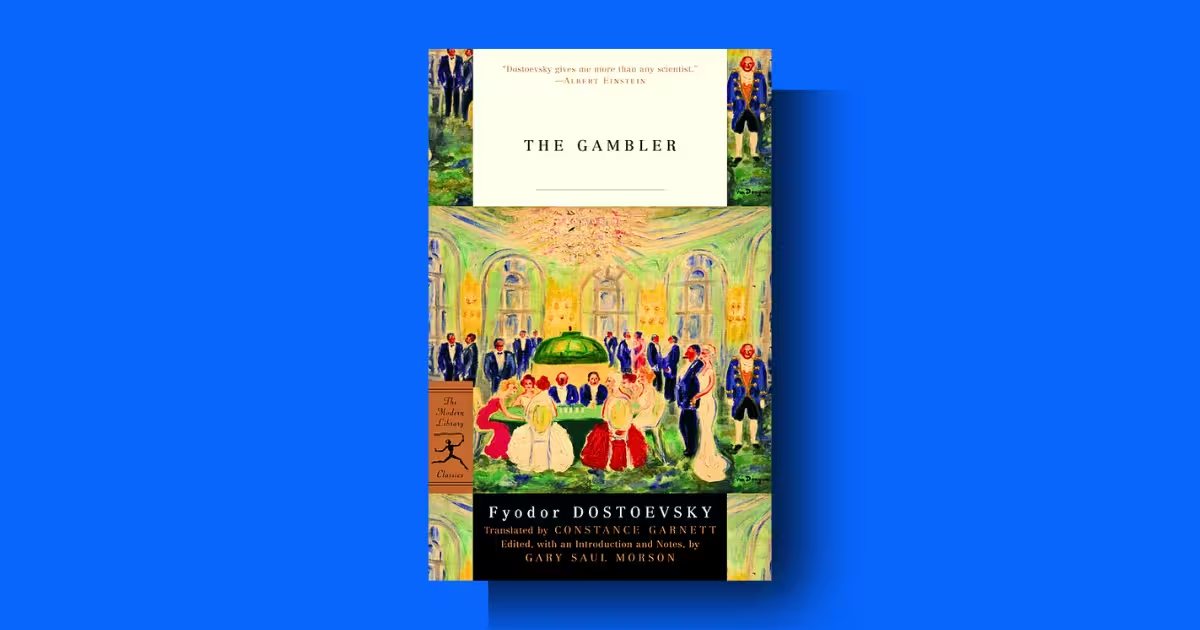
Have you ever felt the terrifying pull of a gamble—not just with money, but with your entire future? Fyodor Dostoevsky’s The Gambler isn’t merely a novel about roulette; it’s a psychological autopsy of human obsession that feels like it was written yesterday, not in 1866.
When I first picked up this book, I expected a period piece about Russian aristocrats frittering away their fortunes in European casinos. What I found instead was a mirror held up to modern society—our addiction to quick wealth, our desperate need for validation, and the terrifying ease with which we can destroy everything we love.
Overview
The Gambler exposes how the thrill of risk and the illusion of control can consume a person entirely, turning love, dignity, and moral compass into collateral damage in the pursuit of a single winning spin.
The Gambler is perfect for readers who appreciate psychological depth, character-driven narratives, and unflinching examinations of human weakness. Also essential for anyone interested in addiction literature or Dostoevsky’s broader body of work.
The Gambler may disappoint those seeking light entertainment, straightforward romance, or tidy resolutions. The novel offers no easy answers and leaves you sitting with uncomfortable truths.
Table of Contents
Introduction
Title: The Gambler (Russian: Игрок)
Author: Fyodor Dostoevsky
Published: 1866
Translator (this edition): C.J. Hogarth
Original Language: Russian
The Gambler occupies a fascinating place in literary history. Dostoevsky wrote it under extraordinary pressure—he had signed a contract with his publisher that required him to deliver a new novel by November 1, 1866, or forfeit the rights to his entire collected works for nine years.
To meet this impossible deadline, he hired a stenographer, Anna Grigoryevna Snitkina (who would later become his second wife), and dictated the entire novel in just 26 days.
The result is a work of breathtaking urgency, written by a man who intimately understood gambling addiction—Dostoevsky himself had been a compulsive gambler for years, often losing everything he had at European casinos. This personal experience gives The Gambler an authenticity that no amount of research could replicate.
Background: The Man Behind the Obsession
Dostoevsky’s relationship with gambling wasn’t merely academic. He had been gambling since his twenties, and by the time he wrote The Gambler, he had accumulated massive debts that would haunt him for the rest of his life. In 1865, while in Wiesbaden, he lost everything at the roulette table and had to beg friends for money to return home.
The novel was partly an act of financial desperation—he needed to produce something quickly to escape his creditors. Yet ironically, this rushed creation became one of his most psychologically acute works. The speed of composition forced him to rely on raw emotion rather than elaborate plotting, and the result is a narrative that pulses with nervous energy.
Interestingly, Dostoevsky completed the novel in October 1866, just two months after beginning it. Anna Grigoryevna, his stenographer, later recalled how he would pace the room dictating scenes while she transcribed at remarkable speed—a collaboration that would transform both their lives.
The Gambler Plot Summary
Let me walk you through the entire story, because The Gambler is a novel that rewards understanding its full arc.
Part One: Arrival in Roulettenberg
The story opens with Alexei Ivanovich, a young tutor, returning from leave to find his employers—a Russian general and his family—already settled in the German spa town of Roulettenberg. The General is in a precarious financial position, deeply in debt to a Frenchman named Monsieur de Griers, and desperately hoping for news that his wealthy aunt (affectionately called “Grandmamma” by the family) has died, leaving him her fortune.
We quickly learn that Alexei is hopelessly in love with Polina Alexandrovna, the General’s stepdaughter. Their relationship is toxic and confusing—she treats him with cold contempt one moment, then relies on him the next. When Polina gives Alexei money to gamble on her behalf, he wins significantly but feels uneasy about playing for someone else. His first attempt nets 800 gilden from a 100 gilden stake, but he tells Polina he won’t play for her again.
“I am not unwilling so to do, but in all probability I should lose.” — Alexei Ivanovich
Part Two: The Intrigues Begin
The household is in turmoil. The General is infatuated with Mlle. Blanche de Cominges, a Frenchwoman of dubious reputation who clearly only wants his money. Everyone is waiting for Grandmamma to die so the inheritance can flow. De Griers, who has loaned the General a significant sum, is pulling strings behind the scenes.
Mr. Astley, an Englishman who has befriended Alexei, is quietly in love with Polina. He seems to know more about the family’s affairs than he lets on, including the fact that Mlle. Blanche has a scandalous past in Roulettenberg—she was previously expelled from the casino at the Baroness Burmergelm’s request.
Alexei’s obsession with Polina reaches fever pitch. During a walk, he tells her he would jump from the Shlangenberg mountain if she asked him to. She tests him by ordering him to insult the Baron and Baroness Burmergelm, a powerful German couple. In what can only be described as a spectacularly stupid act of devotion, Alexei does exactly that—approaching the Baroness and declaring “Madame la Baronne, j’ai l’honneur d’être votre esclave”.
This incident gets Alexei fired from his tutoring position, but he doesn’t seem to care. His love for Polina has become all-consuming and self-destructive.
Part Three: Grandmamma Arrives
Everything changes when the supposedly dying Grandmamma—Antonida Vassilievna Tarassevitcha—arrives in Roulettenberg in person, carried in an armchair and very much alive. She has seen through the family’s schemes and knows about the telegrams they’ve been sending to Moscow trying to confirm her death.
The old lady, far from being the frail invalid they expected, is sharp-tongued, imperious, and utterly unimpressed by the General’s machinations. She immediately takes charge and demands to see the roulette tables.
“This is the woman whom they had thought to see in her grave after making her will!… Good Lord! what is going to become of us now?” — Alexei Ivanovich
Part Four: The Gambling Descends
Grandmamma’s first foray into gambling is spectacularly successful. She wins 4,200 gilden in her first session, with Alexei serving as her guide and stake-placer. She returns the next day, determined to repeat her success.
But gambling doesn’t work that way. She loses the 4,200 gilden, then loses more—ultimately dropping 15,000 roubles in a single day. The Poles who offer to “help” her play are actually swindlers, and she ends up losing everything she brought with her.
“I have fooled away fifteen thousand roubles.” — Grandmamma
The old lady’s gambling spree demonstrates precisely what Dostoevsky understood about addiction: initial success is the most dangerous thing of all. It creates an illusion of control that makes the subsequent losses feel like temporary setbacks rather than inevitable outcomes.
Part Five: The Fallout
After the Grandmamma’s losses, the family’s carefully laid plans collapse. De Griers reveals his true colors by writing Polina a cold, businesslike letter explaining that he’s leaving and that he’s transferring the General’s debts back to him—effectively abandoning her.
Polina, humiliated and devastated, comes to Alexei’s room in the middle of the night. For the first time, she seems vulnerable and lost. She tells him she knew De Griers would betray her all along—she had been waiting to see what he would do, hoping he would prove her wrong.
Part Six: The Gambler’s Revenge
In a moment of mad inspiration, Alexei rushes to the casino with his last remaining money—200 gilden. He begins playing with reckless abandon, staking everything on a single number. Against all odds, he wins. And wins again. And again.
The scene is electrifying in its intensity:
“It was as in a fever that I moved the pile, en bloc, on to the red… For with horror I had realised that I must win, and that upon that stake there depended all my life.” — Alexei Ivanovich
By the time he stops, Alexei has won 100,000 florins—approximately 200,000 francs. He returns to his room in a daze, money bulging from every pocket, and throws it all on the table in front of Polina.
The Ending
But the money doesn’t solve anything. Polina, believing Alexei is trying to buy her love just like De Griers, picks up the money and throws it in his face. She leaves his room, and he never sees her again.
The novel’s final chapters follow Alexei to Paris, where he spends the next month squandering his winnings on Mlle. Blanche, the very woman the General had been pursuing. He gives her 50,000 francs, then another 50,000, then watches as she marries the General for his pension and connections.
“I lived my life with lackeys! … I have ruined myself—that is all.” — Alexei Ivanovich, from his concluding notes
The epilogue reveals Alexei’s further descent: he serves as a valet to a minor official, saves 70 gulden, returns to gambling, and loses everything again. The final line of the novel is a desperate cry: “Tomorrow all shall be ended!”—but the reader knows it won’t be. The cycle will continue.
The Gambler Analysis
The Gambler Characters
Alexei Ivanovich: The Self-Destructive Gambler
Alexei is one of Dostoevsky’s most psychologically complex creations. He’s intelligent, observant, and capable of deep feeling—yet he’s driven by an almost suicidal compulsion. He knows gambling is destroying him, knows Polina doesn’t love him (at least not in any healthy way), yet he can’t stop.
What makes Alexei fascinating is his self-awareness. He articulates his own downfall with remarkable clarity:
“I have not a single human thought in my head. For a long while I have been ignorant of what is going on in the world—here or in Russia… You know the cause of my obsession.” — Alexei
His relationship with Polina is a form of gambling in itself—he stakes everything on winning her love, even though the odds are against him. When she tests him (the Baron incident, the Shlangenberg challenge), he complies not because he’s weak, but because he’s already bet everything on her.
Polina Alexandrovna: The Proud Victim
Polina is enigmatic and often frustrating—she seems to despise Alexei one moment, then rely on him the next. She’s proud, intelligent, and deeply wounded. De Griers has used her, and she knows it. But her pride prevents her from admitting vulnerability, even to herself.
When she throws the money in Alexei’s face, it’s not just rejection—it’s a refusal to be bought. De Griers tried to buy her with promises; Alexei tries to buy her with roulette winnings. She won’t accept either transaction.
“I am not going to take your money… Because I am not in the habit of receiving money for nothing.” — Polina
Her ultimate fate—moving to England with Mr. Astley’s family and inheriting 7,000 pounds—suggests she finally found some peace, but only after being completely broken by the experience.
The General: The Fool in Love
The General is almost a tragicomic figure—a man of nearly 60 who’s fallen helplessly in love with a woman who clearly only wants his money. He mortgages everything for Mlle. Blanche, abandons his children, and ends up dying of a stroke in Paris while she spends his inheritance.
His weakness is pathetic but also pitiable. He represents what happens when love (or what passes for love) meets desperate need. He’s willing to sacrifice everything for the illusion of happiness.
Grandmamma: The Unstoppable Force
Antonida Vassilievna is one of literature’s great elderly characters—sharp, commanding, and utterly unwilling to be manipulated. She arrives expecting to find her relatives mourning her, finds them scheming instead, and proceeds to do exactly what she wants:
“I am very much alive, though, as you may see.” — Grandmamma
Her gambling spree is both tragic and darkly comic. She loses everything, but she does it on her own terms. She never gives the General a penny, seeing through his schemes with contemptuous clarity.
De Griers: The Calculating Villain
De Griers is a more subtle villain than he first appears. He’s not openly cruel—he’s cold and calculating. His letter to Polina is a masterpiece of bureaucratic cruelty:
“I have decided to absolve him from a certain moiety of the mortgages on his property, in order that you may be in a position to recover of him what you have lost, by suing him in legal fashion.” — De Griers
He dresses up betrayal in the language of honor and legality, which makes his actions even more repellent.
The Gambler Themes and Symbolism
Addiction and Compulsion
The most obvious theme is gambling addiction itself. Dostoevsky understood this intimately—he’d lost everything at roulette tables across Europe. The novel shows how addiction creates its own logic:
“In the flow of fortuitous chances there is, if not a system, at all events a sort of order.” — Alexei
Alexei convinces himself he can beat the odds through understanding the system—a classic gambler’s fallacy. This is the lie that keeps addicts playing: the belief that they’re different, that they’ve cracked the code.
Love as Gambling
The love story (if we can call it that) between Alexei and Polina mirrors the roulette table. Alexei stakes everything on Polina’s love, even though the odds are terrible. He throws away his dignity, his position, and eventually his fortune, all in the hopes of winning her affection.
“I love without hope, and know that hereafter I shall love you a thousand times more.” — Alexei to Polina
This is the gambler’s mindset applied to romance—the conviction that one big win (one grand gesture) will change everything.
The Illusion of Control
One of the novel’s most powerful insights is how gamblers convince themselves they control random events. Alexei observes the roulette table and imagines he sees patterns:
“I deduced from the scene one conclusion which seemed to me reliable—namely, that in the flow of fortuitous chances there is, if not a system, at all events a sort of order.” — Alexei
This is the gambler’s essential self-deception: the belief that random chance can be understood and mastered.
Class and Morality
Dostoevsky also examines how gambling reveals class pretensions. The “gentleman” gambler is supposed to play calmly, without caring about wins or losses:
“A gentleman may stake, say, five or ten louis d’or—seldom more… but, he must do this simply for the love of the game itself—simply for sport.” — Alexei
But this is a fiction. Everyone cares about winning, no matter how they pretend otherwise. The novel strips away these pretensions to show how desperate everyone really is.
Russian National Character
Dostoevsky uses Alexei’s gambling to make broader points about Russian identity. Alexei contrasts Russian recklessness with German methodicalness:
“Not only is the Russian incapable of acquiring capital, but also he exhausts it wantonly and of sheer folly… we Russians often need money; wherefore, we are glad of, and greatly devoted to, a method of acquisition like roulette.” — Alexei
This is the novel’s most provocative argument: that Russians are natural gamblers because they lack the bourgeois virtues of thrift and patience.
Evaluation: My Personal Response
The Gambler is a masterpiece of psychological compression—a novel written in white-hot urgency that somehow achieves the depth of works composed over years. It’s also deeply uncomfortable reading, because Alexei’s self-destruction is so recognizable.
Strengths
Psychological authenticity: Dostoevsky’s firsthand experience with gambling addiction gives the novel an almost documentary quality. The descriptions of the casino, the fever of winning, and the despair of losing are viscerally real.
Narrative urgency: Written in 26 days, the novel has a breathless quality that suits its subject. The prose crackles with nervous energy, mirroring Alexei’s state of mind.
Complex characterization: Even minor characters like Grandmamma and Mr. Astley are fully realized. No one is purely good or evil—they’re all driven by understandable (if not always admirable) motivations.
The casino scene: The climactic gambling sequence is one of the most thrilling passages in all of Dostoevsky. You feel every spin of the wheel as if you were standing at the table yourself.
Weaknesses
Pacing issues: The novel takes a while to get going. The early sections are heavy on exposition and character introduction.
Polina’s underdevelopment: For a character who’s supposed to be the object of Alexei’s obsession, Polina remains somewhat opaque. We understand her motivations less clearly than we might like.
Abrupt ending: The jump to Alexei’s later life feels rushed compared to the detailed treatment of the Roulettenberg events.
Gender dynamics: Modern readers may find the treatment of female characters dated. Polina’s choices seem constrained by 19th-century conventions in ways that can feel frustrating.
Comparison with Similar Works
The Gambler shares DNA with several other Dostoevsky novels:
Crime and Punishment: Both feature protagonists who believe they’re exceptional and can transcend ordinary morality. Raskolnikov’s “extraordinary man” theory is a cousin to the gambler’s belief that he can beat the system.
The Idiot: Prince Myshkin’s innocence contrasts sharply with Alexei’s self-destructive intensity. Both novels explore how idealism can be crushed by reality.
Notes from Underground: The Underground Man’s spiteful self-destructiveness anticipates Alexei’s compulsion. Both are narrators who understand their own failings but can’t change.
Among other authors, the novel shares themes with:
- Balzac’s The Gambler: Another French novel about obsessive gambling.
- Fitzgerald’s The Great Gatsby: Both feature protagonists who believe money can buy love and self-worth.
- Nabokov’s Lolita: The obsessive pursuit of an unattainable woman drives both novels.
Adaptations
The Gambler has been adapted for film and television multiple times:
- 1914: A silent Russian film (now lost).
- 1938: A French film directed by Louis Daquin.
- 1958: A French-Italian co-production.
- 1974: A TV film starring Anthony Hopkins as Alexei.
- 1997: A Polish film directed by Krzysztof Krauze.
- 2014: An American film starring Mark Wahlberg, though this adaptation moved the setting to modern times and took significant liberties with the source material.
None of these adaptations fully capture the novel’s psychological intensity, perhaps because the interior experience of gambling is so difficult to translate to screen.
5 Personal Insights: Contemporary Lessons from The Gambler
1. The Danger of the “First Win”
The most dangerous moment for any gambler is the first win. Grandmamma’s initial success at roulette doesn’t make her happy—it makes her obsessed. She chases the feeling of that first victory for the rest of her stay, losing everything she’s won and more.
“She had won! … She could no longer sit still, and actually struck the table with her fist.” — Alexei, describing Grandmamma’s first win
This pattern is tragically familiar in the modern world. The rise of sports betting apps and cryptocurrency trading has made gambling more accessible than ever. According to the National Council on Problem Gambling, approximately 2 million U.S. adults meet criteria for severe gambling problems, with another 4-6 million experiencing mild or moderate issues.
The dopamine hit of that first win creates a neurological trap. Our brains are wired to remember successes more vividly than failures, which makes us overestimate our chances of winning again.
2. Love Can’t Be Bought
Alexei believes that if he can just win enough money, Polina will love him. It’s the same delusion that drives the General to mortgage everything for Mlle. Blanche. But Polina doesn’t want to be purchased—she’s already been bought by De Griers and knows how empty that transaction feels.
When Alexei offers her the money, her response is devastating:
“Buy me, would you, would you? Would you buy me for fifty thousand francs as De Griers did?” — Polina
This is the novel’s most powerful insight about love and money. You can’t trade one for the other, and trying to do so only reveals how little you understand the person you claim to love.
3. Self-Awareness Isn’t Self-Control
Alexei knows exactly what he’s doing. He can explain his own psychology, diagnose his own addiction, and predict his own downfall. None of it helps.
“I agree that I have none, nor yet any dignity… I have not a single human thought in my head.” — Alexei
This is the most unsettling aspect of the novel. Knowing you have a problem doesn’t mean you can solve it. Self-awareness without action is just self-flagellation.
4. The Illusion of Control Is Everywhere
Alexei’s belief that he can spot patterns in roulette is the same delusion that drives stock market speculation, sports betting, and even some forms of investment. We want to believe that random events are predictable if we’re smart enough to see the pattern.
The modern equivalent might be the belief that you can “time” cryptocurrency markets or “beat” sports betting algorithms. The house always wins in the long run—but the gambler convinces himself he’ll be the exception.
5. Class Doesn’t Protect You
The “gentleman gambler” who plays for sport and the desperate gambler who plays for survival are the same person at different stages of addiction. Class status, education, and self-awareness offer no protection against compulsion.
Alexei goes from tutor to valet to prison to freedom and back again. His intelligence doesn’t save him—it only helps him articulate his own destruction.
The Gambler Quotes
Here are the passages that lingered with me longest:
On gambling as Russian destiny:
“Not only is the Russian incapable of acquiring capital, but also he exhausts it wantonly and of sheer folly… we Russians often need money; wherefore, we are glad of, and greatly devoted to, a method of acquisition like roulette—whereby, in a couple of hours, one may grow rich without doing any work.” — Alexei
On the gambler’s self-awareness:
“I have not a single human thought in my head. For a long while I have been ignorant of what is going on in the world.” — Alexei
On the thrill of the gamble:
“It was as in a fever that I moved the pile, en bloc, on to the red… For with horror I had realised that I must win, and that upon that stake there depended all my life.” — Alexei
On the impossibility of buying love:
“Buy me, would you, would you? Would you buy me for fifty thousand francs as De Griers did?” — Polina
On Grandmamma’s defiant spirit:
“I am very much alive, though, as you may see.” — Grandmamma
On the inevitability of loss:
“I have fooled away fifteen thousand roubles.” — Grandmamma
On the futility of hope:
“Tomorrow all shall be ended!” — Alexei
Conclusion
The Gambler is a book that should come with a warning label. It’s not comfortable reading, and it’s not supposed to be. Dostoevsky wrote it from personal experience—the shaky hands, the racing heart, the desperate belief that this time it will be different.
What makes the novel so powerful is its refusal to offer solutions. Alexei doesn’t get better. Polina doesn’t forgive him. The cycle doesn’t break. The book ends with the same obsessive hope that began it: “Tomorrow all shall be ended!”—but we know it won’t be.
This honesty is what separates The Gambler from more comforting works of fiction. Dostoevsky doesn’t pretend addiction has easy answers or that love can save us from ourselves. He simply shows us the wreckage and asks us to look clearly at what we see.
Who should read this book?
- Fans of psychological fiction and character-driven narratives
- Anyone interested in addiction literature or the psychology of risk
- Readers who appreciate Dostoevsky’s other works
- Those who want to understand the 19th-century European context of Russian literature
Who should avoid this book?
- Those seeking light entertainment or easy answers
- Readers who prefer plot-driven fiction
- Anyone currently struggling with gambling addiction (the book could be triggering)
Ultimately, The Gambler is a work of profound insight wrapped in a deceptively simple narrative. It’s a book that rewards rereading, because each time you return to it, you notice new layers in Alexei’s self-deception and new details in Dostoevsky’s portrait of compulsion.
As a reader, I found myself both horrified and fascinated by Alexei’s inability to change. He’s not a villain—he’s a warning. And the warning is as relevant today as it was in 1866.







