
Have you ever walked into a room and felt instantly that something was wrong, only to brush it off as “being paranoid”? Or ignored a nagging feeling about someone because you didn’t want to seem rude?
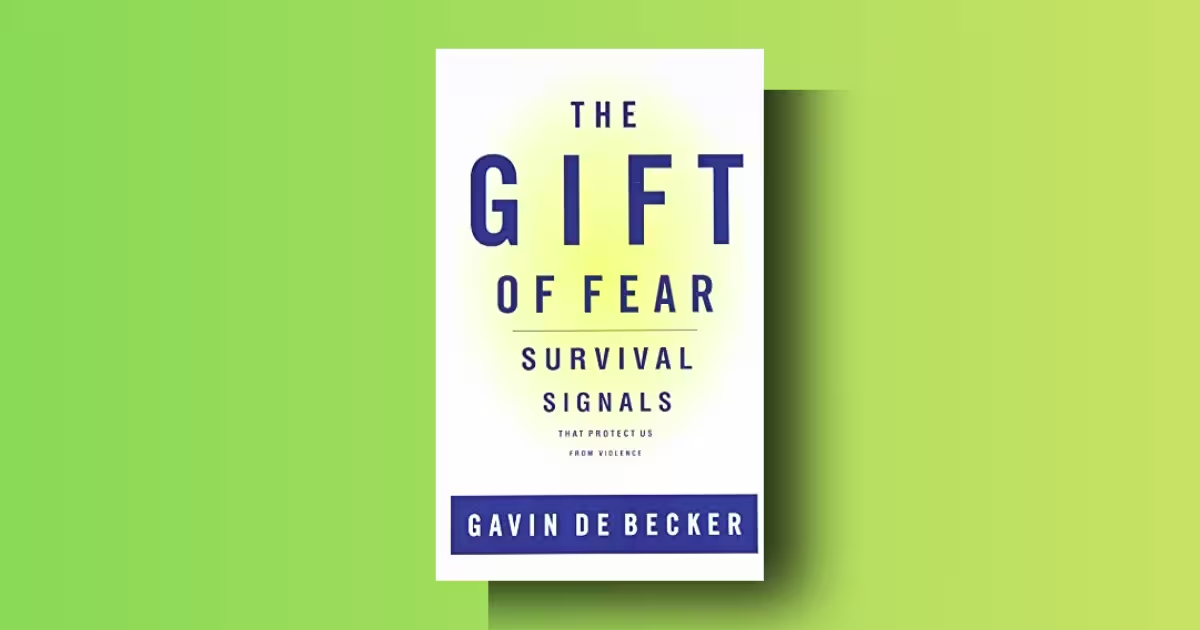
I’ll be honest: before picking up Gavin de Becker’s The Gift of Fear: Survival Signals That Protect Us from Violence, I was exactly that person. I’d rationalize away my discomfort, tell myself I was overthinking, and prioritize politeness over self-preservation.
What I didn’t realize was that I was actively training myself to ignore one of the most sophisticated survival mechanisms nature ever gave me.
Published in 1997 by Dell Publishing, this #1 national bestseller spent four months on The New York Times Bestseller List and has been translated into 25 languages. But what makes it remarkable isn’t its commercial success—it’s the uncomfortable truth at its core: violence is predictable, and you already have the tools to see it coming.
Overview
The Gift of Fear argues that your intuition is not some mystical, unreliable “feminine” thing; it’s your brain processing information faster than your conscious mind can keep up. De Becker, who has spent decades protecting everyone from Hollywood stars to Supreme Court justices, argues that we’ve been conditioned to override our survival instincts in favor of social niceties.
The result? We walk into danger with our eyes wide open, telling ourselves “it’s probably nothing.”
The book breaks down the predictable patterns of violent behavior, gives you specific signals to watch for (what he calls “pre-incident indicators”), and offers practical strategies for everything from dealing with persistent pursuers to recognizing when a seemingly “nice” person is actually dangerous.
What I learned changed how I move through the world—and I suspect it will do the same for you.
Reader recommendation
The Gift of Fear is for anyone who has ever felt unsafe but doubted themselves. Women, especially, will find it invaluable—de Becker notes that “at core, men are afraid women will laugh at them, while at core, women are afraid men will kill them”.
If you’ve ever been told you’re “too paranoid” or “overreacting,” this book will validate what you already knew. Parents, employers, and anyone who interacts with strangers regularly will also benefit enormously.
The Gift of Fear is probably not for readers looking for a quick, feel-good read. De Becker doesn’t sugarcoat reality. The case studies are disturbing—he draws from real murders, rapes, and stalking cases.
If you’re prone to anxiety, some sections might be genuinely unsettling. Also, if you’re expecting a traditional self-help book with gentle affirmations, this isn’t it. It’s more like a fire drill: uncomfortable but potentially life-saving.
Table of Contents
The Gift of Fear Summary
Intuition Isn’t Magic: It’s Your Brain on Overdrive
De Becker opens with a simple but profound observation: “Intuition is the journey from A to Z without stopping at any other letter along the way. It is knowing without knowing why”.
This isn’t some new-age concept. The root of the word intuition comes from the Latin tueri, which means “to guard, to protect.” Your intuition is literally designed to keep you safe.
Think about that for a moment. Every time you’ve felt that prickle on the back of your neck, that sudden urge to leave, that inexplicable discomfort—your brain was doing exactly what it evolved to do.
Here’s the problem: we’ve been trained to ignore it. De Becker points out that “No animal in the wild, suddenly overcome with fear, would spend any of its mental energy thinking, ‘It’s probably nothing.'” Yet that’s exactly what we do. We prioritize being “nice” over being safe. We worry about hurting someone’s feelings while ignoring the possibility that they might hurt us.
The Survival Signals: What to Watch For
De Becker identifies several specific manipulation tactics that predators use. Once you know them, you’ll start seeing them everywhere. Here are the key ones:
Forced Teaming: When a stranger implies you’re in the same boat. “We’ve got a hungry cat up there,” or “We’re both in the same situation.” The word “we” is a red flag when it comes from someone you don’t know. De Becker writes: “Forced teaming is not about coincidence; it is intentional and directed.” The defense? A clear refusal: “I did not ask for your help and I do not want it.”
Too Many Details: Liars over-explain. When someone is telling the truth, they don’t feel the need to convince you with excessive details. De Becker notes: “When people are telling the truth, they don’t feel doubted, so they don’t feel the need for additional support in the form of details. When people lie, however, even if what they say sounds credible to you, it doesn’t sound credible to them, so they keep talking.”
Typecasting: A mild insult designed to make you engage. “You’re probably too snobbish to talk to me” or “You don’t look like someone who reads.” The trap is that you want to prove them wrong by engaging. The defense? Silence. Don’t take the bait.
Loan Sharking: Unsolicited help that creates a sense of obligation. When a stranger offers “help” you didn’t ask for, they’re creating a debt you never agreed to. De Becker’s advice: remember two things—they approached you, and you didn’t ask for anything.
The Unsolicited Promise: “I promise I’ll leave you alone after this” or “I promise I won’t hurt you.” De Becker writes: “The unsolicited promise is one of the most reliable signals because it is nearly always of questionable motive.” Why? Because the person making the promise can see your doubt—and they’re trying to override it.
Discounting the Word “No”: This is perhaps the most important signal of all. De Becker emphasizes: “‘No’ is a word that must never be negotiated, because the person who chooses not to hear it is trying to control you.” If someone ignores your “no” on something small, they’ll ignore it on something big.
The Statistics That Made Me Sit Up
De Becker doesn’t just offer theories, he backs them up with sobering statistics that put the reality of violence in perspective:
1. In the two years before The Gift of Fear‘s publication, more Americans died from gunshot wounds than during the entire Vietnam War.
2. Homicide is the leading cause of death for women in the workplace.
3. If a full jumbo jet crashed into a mountain every month, the number of people killed still wouldn’t equal the number of women murdered by their husbands and boyfriends each year.
4. About 90 percent of murdered women, 80 percent of rape victims, and 90 percent of female stalking victims are victimized by someone they know—usually a spouse, ex-spouse, lover, or family member.
These numbers aren’t meant to scare you—they’re meant to wake you up. Violence isn’t something that happens to “other people” in “other neighborhoods.” It happens in homes, in workplaces, in schools. And it’s almost always preceded by warning signs.
The JACA Framework: How to Predict Violence
One of the most practical tools de Becker offers is the JACA framework, which helps you assess whether someone might become violent:
Justification: Does the person feel justified in using violence? This could be as simple as feeling provoked or as complex as a lifetime of resentment.
Alternatives: Does the person perceive any alternatives to violence? If they feel trapped, with no other options, violence becomes more likely.
Consequences: How does the person view the likely consequences of violence? If they have little to lose, or if they believe the consequences will be favorable (attention, revenge, etc.), the risk increases.
Ability: Does the person believe they can successfully commit the violent act? Previous violence, access to weapons, and other factors contribute to this perception.
De Becker explains: “A person (or an animal) who feels there are no alternatives will fight even when violence isn’t justified, even when the consequences are perceived as unfavorable, and even when the ability to prevail is low”.
The Restraining Order Controversy
One of the most provocative sections of The Gift of Fear challenges conventional wisdom about restraining orders. De Becker argues that these court orders can actually make things worse in certain cases—particularly with estranged husbands who have made significant emotional investments.
He writes: “Since so many women die as a result of this type of careless thinking, and because most of those deaths are preventable, I am going to go several layers deeper into the topic”.
The problem? A restraining order can feel like a declaration of war to someone who already feels rejected and humiliated. De Becker cites multiple cases where women were murdered at courthouses while seeking protection orders, or shortly after obtaining them.
His advice? Ask yourself: “Will a restraining order help or hurt in my particular case?” If you believe the person will honor it and leave you alone, it might work. If you’re getting it to stop someone from committing murder, you’ve probably applied the wrong strategy.
The Author’s Personal Stake
What gives The Gift of Fear its power is that de Becker isn’t writing from an ivory tower. His childhood was marked by violence: his mother was a heroin addict who physically abused him and his sister, once shooting his stepfather while de Becker was present. She committed suicide when he was sixteen.
He writes: “My childhood wasn’t a movie, of course, though it did have chase sequences, fight scenes, shoot-outs, skyjacking, life-and-death suspense, and suicide. The plot didn’t make much sense to me as a boy, but it does now.”
This personal experience is why the book resonates so deeply.
De Becker isn’t theorizing about violence—he survived it. His expertise comes not just from decades of protecting celebrities and government officials, but from being a child who had to predict his mother’s next violent outburst just to survive.
The Hidden Cost of Denial
One of the book’s most important insights is about how denial keeps us unsafe. De Becker writes: “Denial has an interesting and insidious side effect.
For all the peace of mind deniers think they get by saying it isn’t so, the fall they take when victimized is far, far greater than that of those who accept the possibility.”
He uses the example of China Leonard, whose son Richard died during minor ear surgery. The anesthesiologist, Dr. Joseph Verbrugge Jr., had a reputation for being inattentive, colleagues had reported him sleeping during surgeries. China felt a strong intuitive impulse to cancel the operation but suppressed it, telling herself: “Don’t be silly. St. Joseph’s is one of the best hospitals in the state”.
Richard died during the procedure.
De Becker’s point isn’t that every uneasy feeling is accurate—it’s that we should investigate them rather than dismiss them. “The words ‘I know it’ are more valuable than the words ‘I knew it,'” he writes.
The Gift of Fear vs. The Curse of Worry
Perhaps the most transformative part of The Gift of Fear is de Becker’s distinction between fear and worry. He writes: “Fear is a survival signal that sounds only in the presence of danger, yet unwarranted fear has assumed a power over us that it holds over no other creature on earth.”
Fear is a gift. It’s your intuition screaming at you that something is wrong right now. It’s specific, urgent, and—crucially—brief.
Worry is a curse. It’s manufactured anxiety about things that might happen. De Becker notes that the word “worry” originally meant “to harass, strangle, or choke”. Worry doesn’t protect you—it paralyzes you.
His three rules for managing fear:
- When you feel fear, listen.
- When you don’t feel fear, don’t manufacture it.
- If you find yourself creating worry, explore and discover why.
What I found most liberating was his observation that “the very fact that you fear something is solid evidence that it is not happening.” You can’t fear what’s already occurring, you can only fear what might occur. So when you feel fear, recognize that it’s a signal, not a sentence.
The Gender Divide
De Becker addresses the different worlds men and women inhabit when it comes to safety. He writes: “At core, men are afraid women will laugh at them, while at core, women are afraid men will kill them”.
This isn’t hyperbole. When de Becker asks men when they last felt afraid of being harmed by another person, many can’t recall an incident within years. Ask women the same question, and most will give you a recent example—”Last night,” “Today,” or even “Every day”.
He points out that women are constantly told they’re “overreacting” when they express safety concerns. His advice to women who face this dismissal: “Tell Mister I-Know-Everything-About-Danger that he has nothing to contribute to the topic of your personal security. Tell him that your survival instinct is a gift from nature that knows a lot more about your safety than he does.”
What The Gift of Fear Doesn’t Tell You
I want to be honest about the book’s limitations. First, it can be repetitive. De Becker makes his points thoroughly—sometimes exhaustively. Several reviewers have noted that the book could have been shorter.
Second, some of the advice feels dated. The book was published in 1997, and while the core principles remain valid, the cultural context has shifted. Social media stalking, for example, isn’t addressed in the depth it would warrant today.
Third, the book’s emphasis on individual responsibility can feel uncomfortable. De Becker’s message is essentially: “You can predict violence if you pay attention.” While this is empowering, it can also feel like blame when things go wrong. He addresses this directly, writing: “I don’t believe that violence is a fair penalty for bad choices. But I do believe they are choices”.
Books like The Gift of Fear
If you’ve read The Gift of Fear, you might also appreciate:
Predicting Violent Behavior by John Monahan: A more academic treatment of the same subject. Monahan’s work heavily influenced de Becker’s thinking.
Without Conscience by Robert D. Hare: Focuses specifically on psychopaths and how to recognize them. De Becker draws on Hare’s framework in his discussion of manipulative behavior.
The Sociopath Next Door by Martha Stout: Another examination of how people without empathy operate in everyday life.
What sets de Becker apart is his practical, case-study-driven approach. He’s not a psychologist theorizing about behavior, he’s a security expert who has literally saved lives.
Final Verdict: Should You Read It?
Yes. Unequivocally, yes.
“The Gift of Fear” is one of those rare books that genuinely changes how you see the world. After reading it, I found myself noticing things I’d previously ignored—the extra details in someone’s story, the unsolicited promise, the refusal to hear “no.” More importantly, I started trusting myself when something felt off.
De Becker writes: “When you accept the survival signal as a welcome message and quickly evaluate the environment or situation, fear stops in an instant. Thus, trusting intuition is the exact opposite of living in fear”.
That’s the paradox at the heart of The Gift of Fear. By learning to listen to fear, you become less afraid. By trusting your intuition, you gain confidence. By accepting that violence is predictable, you stop being its victim.
If you’re a woman, read this book. If you’re a parent, read this book. If you’ve ever felt unsafe and doubted yourself, read this book. And then give it to someone you love.
As one reviewer put it: “This book should be required reading, especially for women”. Another said it “has saved me from very dangerous situations”.
I can’t promise you’ll never feel fear again. But I can promise you’ll understand it better—and that understanding might just save your life.







