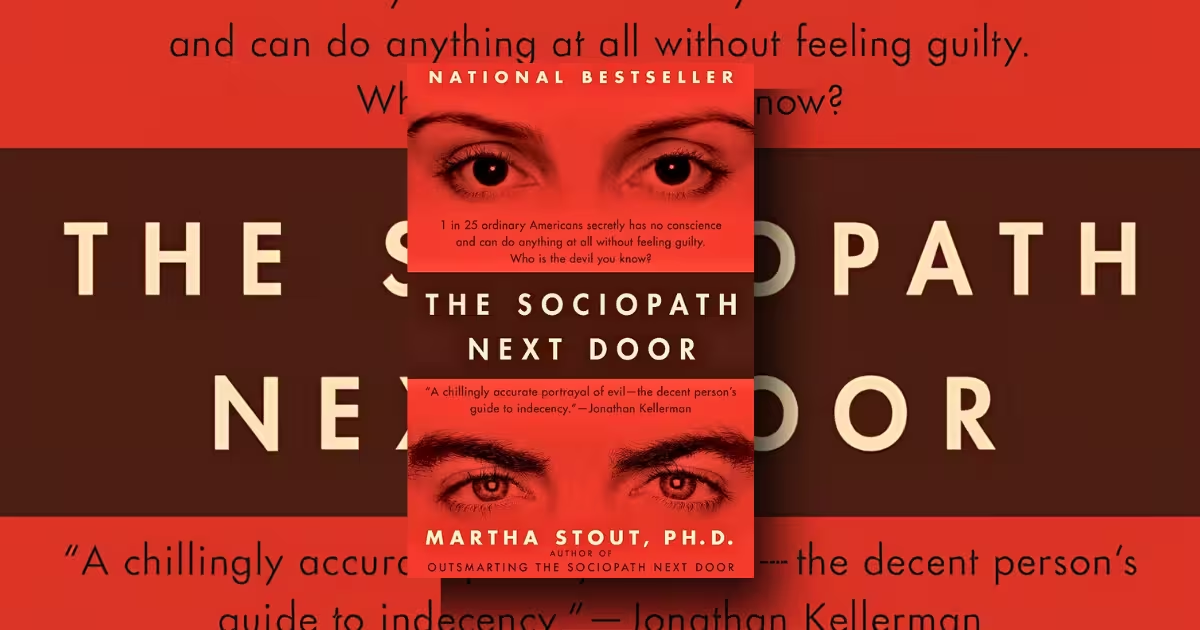

Did you know that one out of every twenty-five people walking around you right now literally has no conscience, and feels absolutely nothing when they lie, cheat, or destroy someone else’s life? Martha Stout’s The Sociopath Next Door will forever change how you see the people around you.
Overview
The Sociopath Next Door: The Ruthless Versus the Rest of Us by Martha Stout, Ph.D., is a chilling yet essential exploration of sociopathy in everyday life. Drawing from her twenty-five years as a clinical psychologist on the faculty of Harvard Medical School, Stout reveals that approximately 4 percent of the population—one in twenty-five people—are sociopaths who possess no conscience, no guilt, and no genuine emotional attachment to others.
This isn’t a book about serial killers or violent criminals. Instead, Stout focuses on the nonviolent sociopaths who hide in plain sight: the charming colleague who sabotages your career, the manipulative partner who drains your bank account, the corporate executive who lies without hesitation, or even the seemingly “nice” person who turns out to be utterly remorseless.
The book’s central argument is both simple and profound: conscience is a seventh sense, an intervening sense of obligation based in our emotional attachments to others. Those who lack this sense are not merely “bad people”; they are psychologically different from the rest of us. Stout doesn’t just describe the problem; she provides thirteen practical rules for recognizing and protecting yourself from sociopaths in everyday life.
What makes this book genuinely unique is its celebration of conscience. Rather than viewing conscience as a weakness or a burden, Stout argues that it is “Mother Nature’s better bargain”, the very thing that gives our lives meaning, connection, and happiness.
The book is equal parts warning, education, and love letter to the 96 percent of us who can feel guilt, remorse, and love.
Reader recommendation
The Sociopath Next Door is perfect for:
- Anyone who has ever felt confused or gaslit by someone else’s behaviour. If you’ve wondered “Why would they do that?” and couldn’t find an answer, this book will give you clarity.
- People who have been victims of manipulation, emotional abuse, or betrayal and need to understand what happened.
- Parents, educators, and managers who want to recognize sociopathic traits in others and protect themselves and those they care about.
- Readers interested in psychology, human behavior, and the nature of good versus evil.
- Anyone who wants practical, actionable advice on how to deal with difficult, manipulative people.
The Sociopath Next Door is not for:
- Readers looking for a sensationalized true-crime book about serial killers or violent psychopaths, Stout explicitly focuses on the nonviolent sociopaths who are far more common and harder to detect.
- Those seeking clinical diagnostic criteria or a purely academic textbook, the book is written for a general audience.
- People who prefer a neutral, detached exploration of the topic: Stout is unapologetically on the side of conscience and doesn’t pretend otherwise.
- Readers who are easily disturbed or anxious about the prevalence of sociopathy, the statistics and case studies can be unsettling.
Table of Contents
Background
Martha Stout is not some armchair theorist or pop psychologist. She completed her professional training at the prestigious McLean Psychiatric Hospital and earned her Ph.D. from Stony Brook University. She served on the clinical faculty of Harvard Medical School for over twenty-five years and was a clinical associate at Massachusetts General Hospital in Boston.
She has also taught at The New School for Social Research, the Massachusetts School of Professional Psychology, and Wellesley College.
Stout specializes in the treatment of psychological trauma survivors, people who have been shattered by the actions of others.
In The Sociopath Next Door, she draws on her decades of clinical experience working with hundreds of patients who have been psychologically destroyed by sociopaths, often sociopathic parents, relatives, siblings, or colleagues.
Her previous book, The Myth of Sanity, explored dissociative states and trauma recovery. With The Sociopath Next Door, Stout turned her attention to the perpetrators themselves, the people without conscience who cause so much of the trauma she has spent her career treating.
The Sociopath Next Door Summary
The Alarming Statistic That Changes Everything
The book opens with a staggering claim: one in twenty-five ordinary Americans secretly has no conscience. To put this in perspective, Stout compares this rate to other conditions we consider “epidemic”: anorexia affects about 3.43 percent of the population, schizophrenia affects about 1 percent, and colon cancer affects about 40 per 100,000, one hundred times lower than the rate of antisocial personality.
According to the book: “The prevalence rate for anorexic eating disorders is estimated at 3.43 percent, deemed to be nearly epidemic, and yet this figure is a fraction lower than the rate for antisocial personality. The high-profile disorders classed as schizophrenia occur in only about 1 percent of us, a mere quarter of the rate of antisocial personality”.
This isn’t a problem that happens to other people. Statistically, every one of us knows multiple sociopaths. They are our coworkers, neighbors, family members, and even our partners. And the most frightening part? We seldom recognize them.
What Is a Sociopath, Really?
Stout defines sociopathy (also called antisocial personality disorder or psychopathy) as the absence of conscience, an “intervening sense of obligation based in our emotional attachments to others”. But this isn’t just a philosophical or moral failing. Sociopathy involves a neurological difference in how the brain processes emotional information.
According to the book: “Sociopathy is an aberration in the ability to have and to appreciate real (noncalculated) emotional experience, and therefore to connect with other people within real (noncalculated) relationships”.
Stout explains that sociopaths can “know the words but not the music” when it comes to emotions. They learn to mimic emotional responses through observation and practice, much like learning a second language. They can say “I love you” convincingly, but they feel nothing. They can appear charming, sympathetic, or even tearful, but it’s all an act.
The book outlines the clinical criteria for antisocial personality disorder from the Diagnostic and Statistical Manual of Mental Disorders IV:
- Failure to conform to social norms
- Deceitfulness and manipulativeness
- Impulsivity and failure to plan ahead
- Irritability and aggressiveness
- Reckless disregard for safety of self or others
- Consistent irresponsibility
- Lack of remorse after having hurt, mistreated, or stolen from another person
Stout also notes additional characteristics observed by researchers: a glib and superficial charm, grandiose sense of self-worth, greater-than-normal need for stimulation, pathological lying, and a “breathtaking callousness”.
The Sociopaths Among Us: Case Studies
Stout brings these clinical descriptions to life through compelling, often horrifying case studies drawn from her practice. Each case illustrates a different type of sociopath and the devastating impact they have on the people around them.
Skip: The Corporate Superstar
Skip is brilliant, handsome, and wealthy. As a child, he entertained himself by capturing bullfrogs, stuffing fireworks into their mouths, and watching them explode. He enticed his six-year-old sister to watch, she screamed and ran away.
As an adult, Skip became CEO of a mining equipment company, married a billionaire’s daughter, and continued his pattern of manipulation and exploitation. When a secretary complained he had broken her arm, the company settled out of court for fifty thousand dollars and a gag order.
According to the book: “Skip is intellectually gifted, and he is fabulous at the gamesmanship of business. But by far his most impressive talent is his ability to conceal from nearly everyone the true emptiness of his heart”.
Skip represents the high-functioning sociopath, the one who achieves immense success and power precisely because he has no conscience to hold him back.
Doreen: The Covetous Sociopath
Doreen worked as a psychologist at a psychiatric hospital for fourteen years. There was just one problem: she wasn’t actually a psychologist. She had faked her credentials entirely. But that wasn’t the worst of it. Doreen’s real pleasure came from destroying the reputations and careers of colleagues she envied. In one particularly chilling incident, she told a paranoid schizophrenic patient that his beloved therapist, Dr. Jackie Rubenstein, had secretly said he was “much too dangerous” to treat as an outpatient. The patient suffered a severe relapse and was transferred to a locked unit.
According to the book: Doreen represents a “covetous psychopath”, someone who “thinks that life has cheated her somehow, has not given her nearly the same bounty as other people, and so she must even the existential score by robbing people”.
When Doreen was finally exposed by a consumer advocate, the hospital quietly let her go rather than face public embarrassment. She simply drove away, likely to practice fraudulently somewhere else.
Luke: The Parasitic Sociopath
Luke married Sydney for her house and her swimming pool. He quit his job as soon as she was pregnant, assuming she would be trapped and forced to support him. He ignored their son entirely, treating the baby as an “annoying little bundle of rags.” When Sydney finally tried to make him leave, he used their son as a tool, crying in front of the child and manipulating the boy’s sympathy.
According to the book: Luke “had no intervening sense of obligation to other people, and his behavior, though not physically violent, reflected this dangerous fact”.His predominant ambition was “to be inert, to avoid work, and to have someone else provide a comfortable lifestyle”.
Hannah’s Father: The Killer Next Door
Perhaps the most disturbing case study is Hannah’s father, a beloved high school principal who shot and killed a burglar in his front yard. At first, the story seems straightforward: a man protecting his family. But as Hannah tells more about her father, a different picture emerges. He was emotionally cold, controlling, and sexually inappropriate with students. When Hannah visited him in prison and asked if he had ever killed anyone else, he replied, “I plead the Fifth”.
According to the book: “By the time he was fifty, he had forfeited his job, his position in the community, his beautiful wife, and his loving daughter, all for the exhilaration of being a minor player in the heroin game”.
Why Conscience Is Partially Blind
One of the most valuable sections of the book explains why good people are so bad at recognizing sociopaths. Stout identifies several reasons:
The Pity Play: The most reliable sign of a sociopath is the constant appeal for sympathy. Sociopaths know that good people will let pathetic individuals “get by with murder.” As one incarcerated sociopath told Stout: “What I like better than anything else is when people feel sorry for me. The thing I really want more than anything else out of life is people’s pity”.
The Gaslighting Effect: When you try to expose a sociopath, you will be made to feel like you’re going crazy. Stout references the 1944 film Gaslight, in which a husband systematically convinces his wife she’s losing her mind.
Similarly, when Jackie Rubenstein confronted Doreen about what she had done to the patient, she was told she was “drawn into her patient’s paranoia” and warned she would damage her career if she told anyone else.
Charm and Seduction: Sociopaths are often extraordinarily charming. Stout compares sociopathic charm to “the animal charisma of other mammals who are predators”. This charm, combined with our own “mild affinity for danger,” makes us susceptible to their manipulation.
The Role Problem: We associate the qualities of a role (doctor, priest, parent, CEO) with the individual who holds it. We are far less likely to question someone called “Dr. Littlefield” than we would be to question someone named “Doreen”.
Moral Exclusion: When we decide someone is “not human” (an “it”), conscience no longer applies. This is how ordinary people can participate in atrocities, they exclude the victims from their moral universe.
The Milgram Obedience Study
Stout draws heavily on Stanley Milgram’s famous obedience experiments to explain how authority can override conscience. In the experiments, subjects were told to administer electric shocks to a “learner” (actually an actor) who screamed in pain. 62.5 percent of subjects continued to administer shocks all the way to 450 volts—labeled “DANGER—SEVERE SHOCK”—simply because a man in a lab coat told them to.
According to the book: Milgram concluded that “a substantial proportion of people do what they are told to do, irrespective of the content of the act and without limitations of conscience, so long as they perceive that the command comes from a legitimate authority”.
This has profound implications for how sociopaths can manipulate groups and institutions. Sociopaths are drawn to positions of authority, and once there, they can command obedience from people who would never otherwise participate in their schemes.
What Causes Sociopathy?
Stout examines the nature-versus-nurture question in detail. Research suggests that sociopathy is about 50 percent heritable; it has a genetic component. Twin studies show that identical twins are twice as likely to share sociopathic traits as fraternal twins. The Texas Adoption Project found that adopted children resemble their birth mothers (whom they have never met) more than their adoptive parents in terms of sociopathic traits.
According to the book: “A predisposition for the characteristic is present at conception, but the environment regulates how it is expressed”.
The neurological basis appears to involve altered processing of emotional stimuli in the cerebral cortex. Studies show that sociopaths process emotional words (like love, hate, pain) no differently from neutral words (table, chair). In brain imaging, sociopaths show increased blood flow to the temporal lobes when processing emotional words, the same pattern normal people show when solving intellectual problems.
According to the book: “Sociopathy is the inability to process emotional experience, including love and caring, except when such experience can be calculated as a coldly intellectual task”.
However, environment matters too. Stout notes that sociopathy appears to be far less common in certain East Asian cultures (Japan, China, Taiwan) where the prevalence is 0.03 to 0.14 percent, compared to the Western average of 4 percent. She suggests that cultures emphasizing interconnectedness and group harmony may help individuals with sociopathic predispositions to compensate cognitively for what they lack emotionally.
The Thirteen Rules
The book concludes with Stout’s practical “Thirteen Rules for Dealing with Sociopaths in Everyday Life”:
1. Accept that some people literally have no conscience. They don’t look like monsters, they look like us.
2. Trust your instincts over someone’s role or title. A doctor, teacher, or parent is not automatically a good person.
3. Practice the Rule of Threes. One lie might be a misunderstanding; two might be a mistake; three lies means you’re dealing with a liar.
4. Question authority. At least 60 percent of people will blindly obey an authority figure, even to the point of harming others.
5. Suspect flattery. Extreme flattery is almost always manipulation.
6. Redefine your concept of respect. Don’t mistake fear for respect.
7. Do not join the game. Don’t try to outsmart a sociopath—you’ll only get dragged into their world.
8. Avoid them. The only effective way to deal with a sociopath is to refuse all contact.
9. Question your tendency to pity too easily. The pity play is the sociopath’s most effective tool.
10. Do not try to redeem the unredeemable. Second chances are for people with conscience.
11. Never help a sociopath conceal their true character. Other people deserve to be warned.
12. Defend your psyche. Don’t let sociopaths convince you that humanity is a failure.
13. Living well is the best revenge.
The Sociopath Next Door Analysis
The Central Thesis: Conscience Is a Seventh Sense
Stout’s most important contribution is reframing conscience as a sense, something we feel, not something we think or choose. This is crucial because it explains why sociopaths can be so hard to recognize. We assume everyone has the same internal experience we do. We can’t imagine what it would feel like to have no conscience, so we explain away sociopathic behavior as eccentricity, depression, or simple meanness.
According to the book: “Conscience is not a behavior at all, not something that we do or even something that we think or mull over. Conscience is something that we feel”.
This isn’t just semantics. By defining conscience as an emotion rooted in attachment, Stout explains why sociopaths can be so successful in business, politics, and other power professions, they aren’t held back by guilt or remorse.
But she also explains why they inevitably self-destruct: without love and connection, life becomes a meaningless game of domination, and boredom becomes a constant companion.
The Difference Between Sociopathy and Narcissism
One of the most helpful distinctions Stout makes is between sociopaths and narcissists. Narcissists can feel emotions, including guilt and love; they just can’t understand what other people are feeling. They lack empathy, not conscience. This is why narcissists sometimes seek therapy; they miss the people they’ve alienated.
According to the book: “Unlike sociopaths, narcissists often are in psychological pain, and may sometimes seek psychotherapy. When a narcissist looks for help, one of the underlying issues is usually that, unbeknownst to him, he is alienating his relationships on account of his lack of empathy with others, and is feeling confused, abandoned, and lonely”.
Sociopaths, in contrast, don’t care about other people at all. They don’t miss anyone. They can “know the words but not the music” when it comes to emotions.
The Evolutionary Argument: Why Conscience Exists
Stout addresses the evolutionary puzzle of conscience: why would natural selection produce beings that limit their own self-interest? She explains that evolution operates on multiple levels, genes, individuals, and groups. At the group level, a population of cooperative individuals will out-survive a population of ruthless individualists.
According to the book: “A group composed of individuals who cooperate and take care of one another is much more likely to survive as a group than a collective of individuals who can only compete with or ignore one another”.
This means the 4 percent of sociopaths in our population may actually be adaptive at the individual level, they can sometimes succeed at the expense of others. But at the group level, they are a liability. And eventually, they self-destruct.
The Spiritual Dimension
Perhaps surprisingly, Stout argues that conscience is where psychology and spirituality meet. She points out that all the major religious traditions agree: having a strong conscience is advantageous, and lacking one leads to disaster. The Golden Rule appears in some form in virtually every major religion.
According to the book: “Behavioral science, evolutionary psychology, and all traditional theologies agree that having a strong conscience is extremely advantageous, and that not having one at all most commonly leads to disaster, for groups and also for individuals”.
Stout quotes the Dalai Lama, who describes sociopaths as “people who don’t have well-developed human lives”. In this view, sociopathy is not just a psychological disorder, it’s a failure to develop full humanity.
Strengths and Weaknesses
Strengths
Compelling Case Studies: The real-world examples are vivid, memorable, and deeply unsettling. They make the abstract concept of sociopathy concrete and personal.
Practical Advice: The thirteen rules are genuinely useful. They offer clear guidance for people who may be dealing with sociopaths in their own lives.
Accessible Writing: Stout writes in plain English without dumbing down the material. The book is accessible to general readers while still being informative.
The Optimistic Core: Despite the unsettling subject matter, the book is ultimately optimistic. Stout celebrates conscience and argues that most people are fundamentally good. This is a welcome counterbalance to the alarming statistics.
Authoritative Credentials: Stout’s Harvard Medical School affiliation and decades of clinical experience give the book credibility.
Weaknesses
Repetitiveness: Some readers have noted that the book can be repetitive, making the same points multiple times.
Limited Research Depth: Some critics argue that Stout relies too heavily on anecdotal case studies and doesn’t engage deeply enough with academic research.
The “Sociopath” Label: Some readers feel Stout is too quick to label difficult people as sociopaths, potentially pathologizing ordinary bad behavior.
Fear-Mongering Concerns: A few critics have accused the book of being alarmist. However, Stout’s message is actually cautionary rather than fear-based: she wants people to be vigilant, not terrified.
Lack of Nuance on Treatment: Stout is clear that sociopathy is “incurable” and that sociopaths almost never seek treatment. Some readers might find this pessimistic, though it reflects the clinical consensus.
Comparison with Similar Works
The Psychopath Test by Jon Ronson
Ronson’s book is a journalistic exploration of psychopathy, filled with dark humor and memorable characters. Stout’s book is more clinical and practical, offering direct advice for protecting yourself. Ronson focuses on the spectacle of psychopathy; Stout focuses on the everyday reality.
Without Conscience by Robert Hare
Hare is the leading researcher on psychopathy and developed the Psychopathy Checklist used by clinicians worldwide. His book is more academic and research-focused. Stout draws on Hare’s work but writes for a general audience and emphasizes nonviolent sociopaths.
The Mask of Sanity by Hervey Cleckley
This 1941 classic is the foundational text on psychopathy. It’s essential reading for professionals but dense and dated. Stout updates Cleckley’s insights for a modern audience and focuses on the “sociopath next door” rather than institutionalized psychopaths.
Conclusion
The Sociopath Next Door is an essential read for anyone who has ever been confused, hurt, or manipulated by someone else’s behavior and couldn’t understand why.
It’s also valuable for parents who want to teach their children to recognize manipulation, for managers who need to deal with difficult employees, and for anyone who wants to be more vigilant in a world where 1 in 25 people have no conscience.
The book won’t tell you how to “cure” sociopaths, because they can’t be cured. But it will give you the tools to recognize them, avoid them, and protect yourself from their damage.
More importantly, the book will make you grateful for your own conscience. Stout argues persuasively that conscience is not a weakness but a gift, the very thing that gives life meaning, connection, and joy. Without it, we would be like Skip, Doreen, or Luke: successful perhaps, but hollow, bored, and ultimately self-destructive.
According to the book: “Conscience blesses our individual lives with just this kind of meaning every day. Without it, we would be emotionally hollow and bored, and would spend our days pursuing repetitive games of our own misguided creation”.
As Stout writes in her closing lines: “For most of us, most of the time, conscience is so ordinary, so daily, and so spontaneous that we do not even notice it. But conscience is also much larger than we are. It is one side of a confrontation between an ancient faction of amoral self-interest that has always been doomed, both psychologically and spiritually, and a circle of moral minds just as ageless”.
In a world that sometimes feels like it’s run by the ruthless, The Sociopath Next Door reminds us that the people with conscience, the ones who love, who care, who feel guilty when they hurt others, are not the losers. They are the ones who are truly winning at the game of life.