
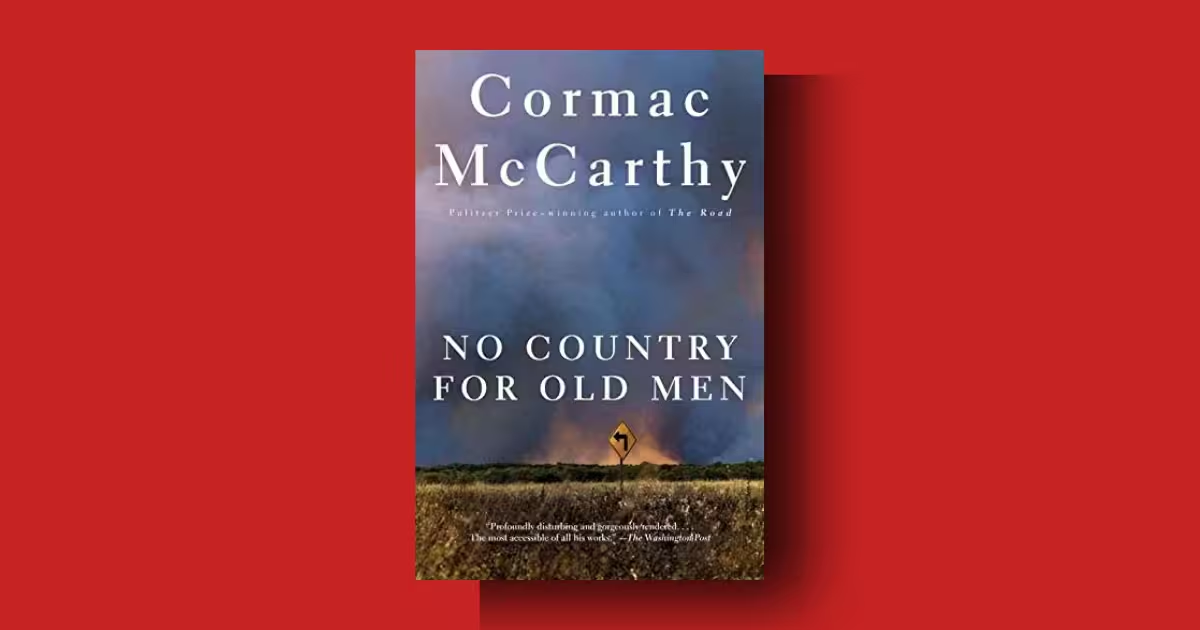
What happens when the rules you’ve lived by your entire life suddenly stop applying to the world around you? That’s the question that kept me turning pages long after I finished Cormac McCarthy’s No Country for Old Men.
This isn’t just a crime novel; it’s a chilling exploration of a world where violence is random, evil is methodical, and the good guys don’t always win. If you’ve ever felt like the ground is shifting beneath your feet, this book will hit you right where you live.
Table of Contents
1. Overview
No Country for Old Men is Cormac McCarthy’s 2005 neo-Western crime thriller about a welder who stumbles upon $2.4 million in drug money, a psychopathic hitman who will stop at nothing to get it back, and an aging sheriff who realizes he’s no match for the new kind of evil stalking his county.
It’s a brutal, philosophical, and deeply unsettling story about fate, chance, and the obsolescence of traditional morality.
The book is sparse, violent, and unforgettable.
2. Reader recommendation: No Country for Old Men
No Country for Old Men is perfect for readers who appreciate literary fiction that doesn’t pull punches. Fans of noir, Westerns, and philosophical thrillers. Anyone who loved the Coen brothers’ film adaptation and wants to explore the source material. People who enjoy stories about moral complexity, fate, and the failure of justice.
No Country for Old Men cannot be suggested to readers looking for a feel-good story or a neat, satisfying ending. Those who are sensitive to graphic violence. Anyone who prefers traditional punctuation and dialogue formatting, McCarthy doesn’t use quotation marks.
If you need heroes who triumph and villains who get their comeuppance, this book will leave you frustrated.
3. Introduction
No Country for Old Men is a novel by Cormac McCarthy, published in 2005 by Alfred A. Knopf. McCarthy, born Charles Joseph McCarthy Jr. on July 20, 1933, was an American writer who authored twelve novels, two plays, and five screenplays.
He won the Pulitzer Prize for Fiction in 2007 for The Road and is widely regarded as one of the greatest American novelists of his generation. He passed away on June 13, 2023, at the age of 89.
No Country for Old Men was adapted into a critically acclaimed film in 2007 by Joel and Ethan Coen. The film starred Tommy Lee Jones, Javier Bardem, and Josh Brolin, and it won four Academy Awards, including Best Picture, Best Director, Best Adapted Screenplay, and Best Supporting Actor for Bardem.
It grossed over $171 million worldwide against a budget of $25 million.
4. Background
McCarthy wrote No Country for Old Men after a long hiatus from the Western genre. The novel is set in 1980 along the Texas-Mexico border, a region that had become a battleground for the burgeoning drug trade.
At the time, the War on Drugs was in full swing, and the violence associated with cartels was spilling over into American communities. McCarthy taps into this anxiety, presenting a world where law enforcement is outgunned and outmatched by a new breed of criminal.
The title is drawn from the opening line of W.B. Yeats’s 1928 poem “Sailing to Byzantium”: “That is no country for old men.” The poem deals with aging, mortality, and the desire to escape the physical world—themes that resonate deeply with Sheriff Bell’s character arc. McCarthy’s novel updates this anxiety for a late-20th-century context, asking what happens when the world changes so drastically that the old ways no longer apply.
5. No Country for Old Men Summary
Part I: The Discovery
The novel opens with Sheriff Ed Tom Bell reflecting on a young man he sent to the gas chamber in Huntsville. “I sent one boy to the gaschamber at Huntsville. One and only one,” he says.
The boy had killed a fourteen-year-old girl and told Bell he’d been planning to kill someone for as long as he could remember. Bell is haunted by this encounter, sensing that something new and terrifying is emerging in the world. He describes the boy as “some new kind” of person and admits, “I wont push my chips forward and stand up and go out to meet him”.
This opening monologue sets the tone for the entire novel: a meditation on evil, aging, and the limits of courage.
Meanwhile, in the desert outside of Sanderson, Texas, Llewelyn Moss is hunting antelope with a .270 rifle. He spots a group of vehicles from a ridge and goes to investigate. What he finds is a massacre: several dead men, a wounded Mexican begging for water, and a satchel containing $2.4 million in cash.
Moss takes the money, setting off a chain of events that will cost him everything.
Moss is a Vietnam veteran and a welder by trade. He’s practical, resourceful, and not easily spooked. But he knows he’s in over his head. He hides the money in his trailer, but that night, he can’t sleep.
He drives back to the scene of the crime to bring water to the dying man, only to find that someone else has already been there. He’s spotted by men in a truck and forced to flee across the Rio Grande into Mexico, wounded and bleeding.
Part II: The Hunter
Anton Chigurh is the novel’s antagonist, and he’s unlike any villain I’ve ever encountered. He’s a hitman who uses a captive bolt pistol, a device used to slaughter cattle, to kill his victims. He’s methodical, emotionless, and guided by a twisted personal code.
Early in the novel, he escapes custody by killing a deputy in a gruesome scene: “He dropped his cuffed hands over the deputy’s head and leaped into the air and slammed both knees against the back of the deputy’s neck and hauled back on the chain”.
He then steals a car, killing the driver with his stun gun.
Chigurh is tracking Moss through a transponder hidden in the satchel of money. He’s relentless, leaving a trail of bodies behind him. He kills a gas station attendant in a scene that has become iconic: he flips a coin to decide the man’s fate. “What’s the most you ever saw lost on a coin toss?” he asks.
When the man calls it correctly, Chigurh lets him live, but the encounter leaves the man shaken. Chigurh’s philosophy is that chance, not morality, governs the universe.
Part III: The Sheriff
Sheriff Ed Tom Bell is the moral center of the novel. He’s a good man trying to do his job in a world that no longer makes sense to him. He investigates the massacre in the desert and the subsequent murders, but he’s always one step behind Chigurh. Bell is haunted by the violence he sees and by his own sense of inadequacy. He reflects on his career, his family, and the changing nature of crime.
Bell’s monologues, which appear at the beginning of each chapter, are some of the most powerful passages in the book.
He talks about the old-timers who didn’t even carry guns, about the respect people once had for the law, and about the new generation of criminals who have no regard for human life. He tells a story about a woman who put her baby in a trash compactor and wonders, “Who would think of such a thing?”. He’s grappling with a world that has become incomprehensible.
Part IV: The Chase
Moss, wounded and on the run, hides the money in a motel room in Del Rio. He buys a shotgun, saws off the barrel, and prepares to defend himself. But Chigurh is always close behind. He finds Moss’s wife, Carla Jean, in Odessa and threatens her. Moss calls her and tells her to leave, but it’s too late.
Carson Wells, a bounty hunter hired by the same people who employed Chigurh, enters the picture. He finds Moss in a hospital in Piedras Negras and offers him a deal: give up the money, and he’ll make Chigurh go away. Moss refuses. Wells is killed by Chigurh in a chilling scene.
Chigurh tells Wells, “If the rule you followed led you to this of what use was the rule?”. It’s a devastating indictment of Wells’s life and choices.
Moss continues to run. He retrieves the money from the motel and heads to El Paso. He picks up a teenage hitchhiker and spends the night with her in a motel. But Chigurh is still tracking him. In Van Horn, a Mexican hitman finds Moss and shoots him and the girl. Moss is killed, and the money is taken.
Part V: The Ending
Chigurh arrives at the motel after the shooting and finds the money in the air duct. He returns it to his employer, a man who runs a criminal enterprise out of a high-rise office in Houston. Chigurh establishes himself as a reliable and terrifying asset.
But the novel’s true ending belongs to Sheriff Bell.
He drives to El Paso to tell Carla Jean that her husband is dead. She’s devastated. Later, Chigurh finds Carla Jean at her mother’s house and gives her the same choice he gave the gas station attendant: call the coin toss. She refuses at first, but eventually calls “heads.” It comes up tails. Chigurh shoots her.
The novel’s final chapter is a monologue from Bell. He visits his uncle Ellis, who is confined to a wheelchair. They talk about family, the past, and the nature of violence. Bell tells Ellis about his experience in World War II, when he abandoned his post and left his men to die.
He’s been carrying that guilt for decades. Ellis tells him, “You wear out, Ed Tom. All the time you spend tryin to get back what’s been took from you there’s more goin out the door”.
The book ends with Bell describing two dreams he had about his father. In the second dream, he’s riding through a mountain pass on horseback. His father rides past him, carrying fire in a horn.
Bell says, “I knew that he was goin on ahead and that he was fixin to make afire somewhere out there in all that dark and all that cold and I knew that whenever I got there he would be there”. The novel ends with these words: “And then I woke up.” It’s a quiet, haunting conclusion to a brutal story.
6. No Country for Old Men Analysis
6.1 Characters
Sheriff Ed Tom Bell is the heart of the novel. He’s a man who has spent his life trying to do good, but he’s confronted with evil that he can’t comprehend or defeat. Bell is not a coward, he’s been in shootouts and faced down armed criminals.
But he recognizes that the world has changed. He tells his wife, “I think now that maybe I never would” put his soul at hazard. Bell’s tragedy is that he’s a good man in a world where goodness no longer matters. He’s the “old man” for whom this country is no longer suitable.
Anton Chigurh is one of the most terrifying villains in modern literature. He’s not motivated by greed or revenge. He kills because it’s his job, and he does it with a cold, philosophical detachment. Chigurh believes in fate and chance. He tells the gas station attendant, “You’ve been putting it up your whole life. You just didn’t know it”.
He sees himself as an agent of destiny, not a murderer. His signature weapon, the captive bolt pistol, reinforces his dehumanizing approach to killing.
He treats people like cattle.
Llewelyn Moss is the novel’s protagonist, but he’s not a hero. He’s a practical man who makes a series of bad decisions. He takes the money because he sees it as his only chance to escape a life of hard work. But he’s in over his head from the start.
He’s resourceful and brave, but he’s also arrogant. He tells Chigurh, “I’m going to bring you somethin all right. I’ve decided to make you a special project of mine”. It’s a fatal miscalculation. Moss’s death is abrupt and undignified, a reminder that in McCarthy’s world, there are no guarantees.
Carla Jean Moss is the novel’s most sympathetic character. She’s caught in a situation she didn’t create and can’t control. She loves her husband and tries to protect her mother. Her death is the novel’s most devastating moment.
Chigurh gives her the coin toss, but it’s a cruel joke. She tells him, “The coin didn’t have no say. It was just you”. She’s right, but it doesn’t matter. Chigurh kills her anyway.
6.2 No Country for Old Men Themes and Symbolism
Fate and Chance are central to the novel. Chigurh’s coin toss is the most obvious symbol of this theme. He flips a coin to decide whether people live or die, but he insists that he’s not the one making the choice, the coin is. This is a convenient fiction that allows him to avoid responsibility for his actions. The coin toss also represents the randomness of life. Bad things happen to good people for no reason. There’s no cosmic justice.
The Changing Nature of Evil is another key theme. Bell reflects on the criminals he’s dealt with over the years. He says, “I used to say they were the same ones we’ve always had to deal with.
Same ones my grandaddy had to deal with. Back then they was rustlin cattle. Now they’re runnin dope. But I dont know as that’s true no more. I’m like you. I aint sure we’ve seen these people before”.
Chigurh represents a new kind of evil, one that is not motivated by greed or passion, but by a cold, impersonal logic. He’s a psychopath who has elevated his violence to a philosophy.
Obsolescence is the novel’s overarching theme. Bell is an old man in a country that no longer has a place for him. He’s outgunned, outmatched, and out of touch. He can’t compete with the new breed of criminals. His monologues are filled with nostalgia for a simpler time when sheriffs didn’t even carry guns. But that time is gone. The novel suggests that traditional morality and justice are inadequate for the modern world. We’re left with the haunting question: what do we do when the old rules no longer apply?
Violence is depicted in a stark, unflinching manner. McCarthy doesn’t glamorize it. It’s sudden, brutal, and often meaningless. The novel’s violence is a reflection of the world it depicts—a world where human life is cheap and death can come at any moment.
7. No Country for Old Men Evaluation
My Opinion
No Country for Old Men is an outstanding and unforgettable work of literature. It’s a book that gets under your skin and stays there. McCarthy’s prose is sparse and powerful, and his characters are unforgettable. The novel is a meditation on evil, fate, and the human condition that is as relevant today as it was in 2005.
Strengths
McCarthy’s prose is a major strength. He writes without quotation marks, which can be disorienting at first, but it forces the reader to pay close attention. His dialogue is terse and realistic, and his descriptions of the Texas landscape are evocative and haunting.
The characters are complex and memorable. Chigurh is one of the great villains of modern literature, and Bell is a tragic figure who you can’t help but root for. Moss is a flawed protagonist who makes you question your own moral compass.
The thematic depth is remarkable. The novel grapples with big questions about morality, fate, and the nature of evil. It doesn’t offer easy answers, but it forces you to think.
Weaknesses
The violence is extreme and can be off-putting. McCarthy doesn’t shy away from graphic descriptions of death and injury. Some readers may find it gratuitous.
The minimalism can be challenging. McCarthy’s prose is sparse, and he leaves a lot unsaid. Some readers may find the book cold or emotionally distant.
The ending is deliberately unsatisfying. Bell’s monologues are powerful, but they don’t provide closure. The novel ends on a note of quiet despair.
Comparison with Similar Works
No Country for Old Men can be compared to other works of American literature that explore similar themes. It shares DNA with James M. Cain’s The Postman Always Rings Twice and Jim Thompson’s The Killer Inside Me in its depiction of amoral characters and bleak worldview. It also echoes the Westerns of Larry McMurtry and the crime fiction of Elmore Leonard.
However, McCarthy’s novel is more philosophical than most crime fiction. It’s closer in spirit to Joseph Conrad’s Heart of Darkness or William Faulkner’s As I Lay Dying in its exploration of the human condition.
Adaptation
The 2007 film adaptation by the Coen brothers is one of the most faithful and successful adaptations of a literary work. The Coens captured the novel’s tone, characters, and themes with remarkable precision. Tommy Lee Jones’s portrayal of Bell, Javier Bardem’s Chigurh, and Josh Brolin’s Moss are all iconic.
The film won four Academy Awards, including Best Picture. It grossed $171.6 million worldwide.
The film is almost a scene-for-scene adaptation of the book, but there are some differences.
The novel’s structure, with Bell’s monologues at the beginning of each chapter, is mostly preserved in the film’s voiceover narration. The film also softens some of the novel’s violence and ambiguity. For example, the film ends with Bell’s dream monologue, but it’s more clearly framed as a moment of closure.
8. Personal Insight with Contemporary Educational Relevance
Why No Country for Old Men Matters Today
Reading No Country for Old Men in the 2020s feels eerily prescient. The novel’s central conflict, between an aging sheriff and a new kind of criminal, mirrors our own anxieties about a world that feels increasingly chaotic and incomprehensible.
We’re living through a time of rapid technological change, political polarization, and cultural upheaval. Many of us, like Sheriff Bell, feel like we’re no longer equipped to understand the world around us.
Theme: The Failure of Traditional Institutions
Bell represents traditional institutions—law enforcement, community, family. He’s a good man who has spent his life trying to do the right thing. But he’s powerless against Chigurh, who operates outside the bounds of conventional morality.
This reflects a broader crisis of confidence in institutions. According to a 2023 Pew Research Center survey, trust in the federal government is near historic lows, with only 16% of Americans saying they trust the government to do what is right “just about always” or “most of the time.” Bell’s sense of defeat resonates with a public that feels betrayed by its leaders.
Theme: The Randomness of Evil
Chigurh’s coin toss is a powerful symbol of the randomness of evil. Bad things happen to good people for no reason. This is a difficult truth to accept, but it’s one that we’re confronted with every day. Mass shootings, terrorist attacks, and natural disasters remind us that we are not in control. The novel forces us to confront this uncomfortable reality.
Theme: The Burden of the Past
Bell is haunted by his past: by the war, by the criminals he’s encountered, by his own failures. He carries this guilt with him, and it weighs him down. This is a universal human experience. We all have regrets and mistakes that we can’t undo. The novel suggests that we have to find a way to live with them.
Five Lessons from No Country for Old Men
The world is not fair. Good people die, and bad people prosper. There’s no cosmic justice. This is a hard lesson, but it’s one that we all have to learn.
You can’t outrun your past. Bell tries to escape his guilt, but it follows him everywhere. The only way to deal with the past is to confront it.
Chance plays a larger role in our lives than we’d like to admit. Chigurh’s coin toss is a reminder that our lives can change in an instant based on factors beyond our control.
Traditional morality is not always enough. Bell’s sense of right and wrong is inadequate for dealing with Chigurh. We need new ways of thinking about ethics and justice.
There is dignity in carrying on, even when you know you’re going to lose. Bell doesn’t give up. He continues to do his job, even though he knows he can’t win. There’s something heroic about that.
9. No Country for Old Men Quotes
Here are some of the most powerful and memorable passages from the book:
Bell on the changing nature of evil: “I used to say they were the same ones we’ve always had to deal with. Same ones my grandaddy had to deal with. Back then they was rustlin cattle. Now they’re runnin dope. But I dont know as that’s true no more. I’m like you. I aint sure we’ve seen these people before. Their kind.”
Chigurh on the coin toss: “You’ve been putting it up your whole life. You just didn’t know it.”
Chigurh to Wells: “If the rule you followed led you to this of what use was the rule?”
Chigurh to Carla Jean: “The coin didn’t have no say. It was just you.”
Bell’s closing dream:
> “I knew that he was goin on ahead and that he was fixin to make afire somewhere out there in all that dark and all that cold and I knew that whenever I got there he would be there.”
10. Conclusion
No Country for Old Men is a modern masterpiece that deserves its place in the canon of American literature. It’s a brutal, philosophical, and deeply unsettling novel that will stay with you long after you’ve finished it. McCarthy’s prose is sparse and powerful, his characters are unforgettable, and his themes are timeless.
This book is not for everyone. It’s violent, bleak, and offers no easy answers. But if you’re willing to engage with its darkness, you’ll be rewarded with a profound meditation on evil, fate, and the human condition.
I recommend this book to fans of literary fiction, crime novels, and Westerns. If you loved the film adaptation, you owe it to yourself to read the source material. And if you’re new to McCarthy, this is a great place to start.
Ultimately, No Country for Old Men is a book about what happens when the old ways no longer work. It’s a book about the limits of justice and the power of chance. And it’s a book about the quiet dignity of carrying on, even when you know you’re going to lose.







