
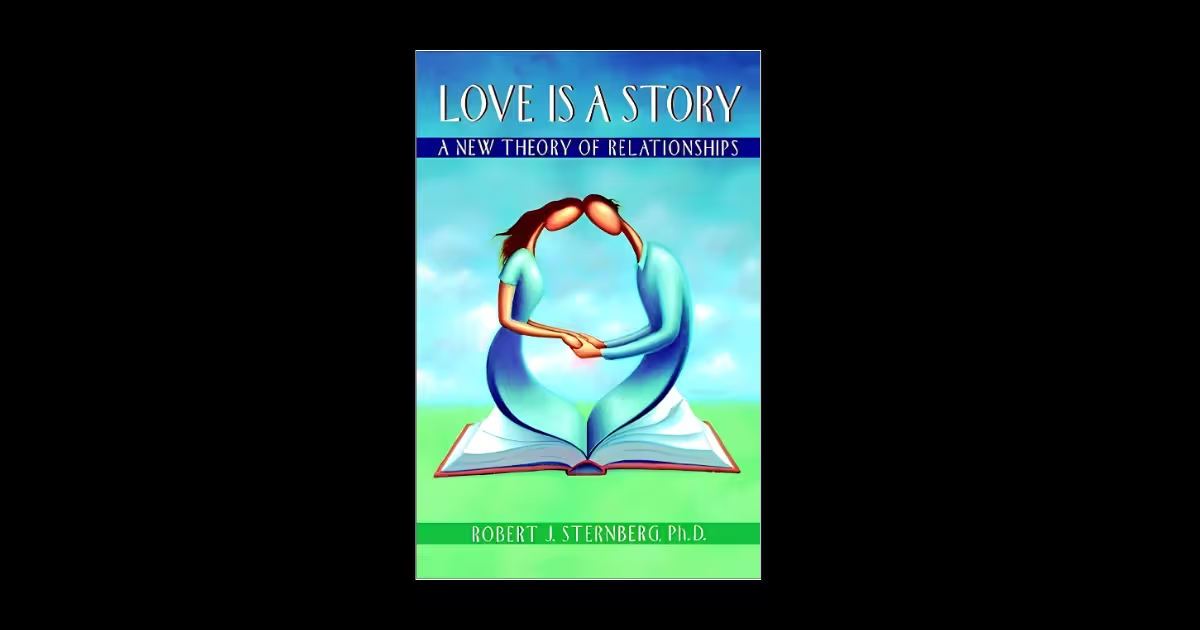
Robert Sternberg’s Love Is a Story: A New Theory of Relationships argues that we don’t fall in love with people; we fall in love with the stories we tell ourselves about those people.
After years of developing his famous Triangular Theory of Love (intimacy, passion, commitment), Sternberg realized something was missing: that theory explained what love is made of, but not why we choose one person over another.
The answer, he discovered, lies in the 26 distinct love stories we carry inside us, largely unconscious narratives that dictate who we’re drawn to, why some relationships flourish while others implode, and why couples that look perfect on paper often fail while seemingly dysfunctional pairs stay together for decades.
This isn’t your typical self-help book with seven steps to a better relationship. It’s something far more unsettling: a mirror held up to your unconscious patterns, showing you exactly why you keep making the same romantic mistakes.
Reader Recommendation: Who Will Actually Love Love Is a Story
Read Love Is a Story if:
- You’ve ever wondered why you keep dating the same “type” of person
- Your relationships follow a pattern you can’t seem to break
- You’re in a relationship that looks good on paper but feels wrong
- You’re a counselor, therapist, or coach working with couples
- You enjoy psychology that actually explains human behavior rather than just describing it
Skip Love Is a Story if:
- You want a simple checklist for finding “The One”
- You’re not interested in examining your own unconscious patterns
- You prefer advice that tells you what to do rather than why you do it
Kirkus Reviews called it “a terrifically interesting and enjoyable book, one that will probably be read by married and unmarried couples, singles, and the counselors who work with them”. One Goodreads reviewer wrote: “I have never encountered a more realistic, insightful explanation of how and why people choose the partners they do and why the specific flavors of relationship issues vary so much between couples”.
Table of Contents
1. Introduction
Love Is a Story: A New Theory of Relationships
Author: Robert J. Sternberg, Ph.D.
Publisher: Oxford University Press
Publication Date: February 12, 1998
Context of Love Is a Story
Robert J. Sternberg is one of America’s most distinguished psychologists. He’s a former President of the American Psychological Association and has spent decades researching intelligence, creativity, and, most relevant here, love.
Before Love Is a Story, Sternberg had already made waves with his Triangular Theory of Love, which broke love down into three components: intimacy, passion, and commitment.
Different combinations of these three elements produce different kinds of love, romantic love is intimacy plus passion, fatuous love is passion plus commitment without intimacy, and consummate love requires all three.
But Sternberg wasn’t satisfied. His triangular theory explained the structure of love but not its origins. It couldn’t answer the question that haunted him, and probably haunts you too: Why do we fall in love with one person and not another?
Purpose of Love Is a Story
The central thesis of Love Is a Story is deceptively simple: We don’t fall in love with people. We fall in love with our stories about them.
“We tend to fall in love with people whose stories are the same as or similar to our own, but whose roles in these stories are complementary to ours.”
Sternberg identifies 26 distinct love stories, narratives we carry inside us, often unconsciously, that shape who we’re attracted to, how we behave in relationships, and whether those relationships succeed or fail. These aren’t just metaphors; they’re the actual frameworks through which we interpret every interaction, every gesture, every word from our partner.
“Once we have a story, we can interpret almost any events as confirming it, elaborating on the story as we see fit.”
2. Background
Before diving into the 26 stories, it’s worth understanding where this theory came from. Sternberg didn’t just wake up one day with a brilliant insight. He’d spent years wrestling with love as a research subject, first with a psychometric approach (trying to identify love’s “building blocks”), then with the triangular theory.
Each theory taught him something, but each also left him unsatisfied. The building-block approach described love’s elements without explaining why we love specific people.
The triangular theory systematized different kinds of love but still couldn’t answer the fundamental question of romantic choice.
Then, in the mid-1990s, Sternberg had a realization: the stories he heard people tell about their relationships differed wildly, not just between relationships, but sometimes within them. Two partners might have completely different stories about the same relationship, and when those stories diverged too far, satisfaction plummeted.
“I realized that I needed to understand and systematize the many stories I had heard about relationships.”
This wasn’t just academic curiosity. Sternberg had been trying to understand his own relationships too, and even his own theories hadn’t given him the answers he was looking for. Love Is a Story is, in some ways, Sternberg trying to solve his own puzzle.
3. Love Is a Story Summary
The Core Argument: Love as Narrative
The book opens with a provocative claim: there’s no such thing as an objective “truth” about a relationship. As Sternberg writes, drawing on Immanuel Kant:
“If there is an objective reality, it is unknowable. All we can know is the reality we construct. That reality takes the form of a story.”
This isn’t philosophical navel-gazing. It has practical, painful consequences. Consider the case of Tyrone and Samantha. Tyrone was convinced Samantha was cheating on him. Samantha wasn’t seeing anyone else. They both believed they were telling the truth, because they were, from within their respective stories. Tyrone’s story (shaped by past betrayals) interpreted innocent behavior as evidence of infidelity. Samantha’s story interpreted his accusations as delusional paranoia.
“As we begin to get to know people, we start to project our own thoughts and feelings, the wisdom we’ve acquired as well as the emotional baggage of our past, onto them.”
This is the book’s first uncomfortable truth: we don’t really get to know our partners. We get to know our stories about them.
The 26 Love Stories
The heart of the book is Sternberg’s taxonomy of 26 love stories, grouped into five categories. Each story comes with a diagnostic questionnaire, case studies of real (or composite) couples, and an analysis of the story’s advantages and pitfalls.
Category 1: Asymmetrical Stories
These are stories where power, knowledge, or sacrifice is unequally distributed between partners.
The Teacher-Student Story (pp. 49-55): One partner provides wisdom, guidance, and structure; the other receives it. These relationships can work when both partners enjoy their roles, but they often founder when the “student” outgrows the role or the “teacher” becomes condescending.
The Sacrifice Story (pp. 55-60): One partner consistently sacrifices for the other. This sounds noble, but Sternberg notes a dark undercurrent: sacrificers often don’t experience their behavior as a choice. They have to sacrifice, it’s their story of what love is. When the relationship becomes equitable, the sacrificer may actually become uncomfortable.
The Government Story (pp. 60-68): Relationships centered on power distribution. These can be autocratic (one partner rules), democratic (power shared), or anarchic (no one takes responsibility). The danger, Sternberg notes, is that power issues can consume the entire relationship. As he writes: “If power corrupts, and absolute power corrupts absolutely, then couples in an autocratic relationship are at great risk.”
The Police Story (pp. 68-75): One partner monitors and enforces rules on the other. Named after Javert from Les Misérables, these relationships involve unremitting surveillance and a black-and-white worldview. The “police officer” sees themselves as morally justified, even when their behavior becomes abusive.
The Pornography Story (pp. 75-82): Love as degradation and debasement. Sternberg notes that while few people admit to this story, the thriving market for pornography and related content suggests it’s more common than we’d like to think.
The Horror Story (pp. 82-89): One partner terrorizes the other. This is perhaps the least adaptive story, prone to escalation and physical danger. Sternberg is clear: “The horror story probably is the least adaptive and advantageous of the stories considered in this book.”
Category 2: Object Stories
In these stories, the partner or the relationship itself is valued as a means to an end rather than for its own sake.
The Science-Fiction Story (pp. 90-96): The partner is valued for their strangeness or incomprehensibility. The “human” partner is drawn to the “alien” partner precisely because they don’t understand them. The danger? Eventually, incomprehensibility becomes frustrating rather than intriguing.
The Collection Story (pp. 96-102): Partners are collected like objects, one person fulfills one need, another fulfills another. This is the most explicitly polygamous story, and collectors rarely stay satisfied with just one partner.
The Art Story (pp. 102-108): The partner is valued primarily for physical appearance. Sternberg cites research by Judith Langlois showing that what we find most attractive is actually the “average” face, a composite of many faces. The danger, of course, is that beauty fades, and the “art collector” may trade in their partner for a newer model.
The House and Home Story (pp. 109-115): The relationship is centered on creating and maintaining a beautiful home. This can be adaptive, a comfortable home reduces stress, but it can also become a displacement of affection. When the home becomes more important than the partner, the relationship is in trouble.
The Recovery Story (pp. 115-121): The relationship is a vehicle for recovering from trauma or addiction. This is what Abraham Maslow called “deficiency love”, seeking in another person what you can’t find in yourself. The irony: if the person actually recovers, the relationship may lose its reason for existing.
The Religion Story (pp. 121-127): The relationship is infused with religious meaning, or the relationship itself becomes a kind of religion. When love becomes salvation, it’s risky; salvation probably can’t come successfully from another person.
The Game Story (pp. 127-134): Love is a competition with winners and losers. These relationships can be exciting, but the competitive dynamic is fundamentally at odds with intimacy.
Category 3: Coordination Stories
These stories emphasize partners working together to create or maintain something.
The Travel Story (pp. 135-141): Love is a journey. The destination matters less than the experience of traveling together. These relationships tend to be dynamic and future-focused, but they’re at risk if partners start wanting to travel in different directions.
The Sewing and Knitting Story (pp. 141-147): Love is whatever partners make it. These couples reject convention and create their own unique relationship patterns. The danger? Two “knitters” might want to create very different garments.
The Garden Story (pp. 147-152): Relationships need to be nurtured and cared for like a garden. This is one of the most adaptive stories, relationships usually do benefit from attention and care. The danger is smothering or boredom from too much routine.
The Business Story (pp. 152-157): Love is a business partnership. These relationships tend to be warm rather than hot, companionate rather than passionate. They work well for practical concerns but can become dull.
The Addiction Story (pp. 157-164): One partner is addicted to the other. Loss of the partner produces withdrawal symptoms. This is passion without the equilibrium that normally develops in healthy relationships.
Category 4: Narrative Stories
These stories are guided by an external “text” that prescribes how the relationship should proceed.
The Fantasy Story (pp. 165-171): The fairy tale, prince meets princess, they live happily ever after. This is the story that sells movies and novels, but it’s hard to maintain when you have to pay bills and raise children.
The History Story (pp. 171-179): The relationship is defined by its past. These couples are record-keepers, valuing anniversaries, photographs, and shared memories. The danger: past grievances can be dragged up forever.
The Science Story (pp. 179-185): Love can be understood through analysis and dissection. These couples are constantly analyzing their relationship, which can lead to insight or to a loss of spontaneity.
The Cookbook Story (pp. 185-192): There’s a recipe for relationship success, and if you follow it correctly, you’ll be happy. This is the story that fuels the self-help industry. The danger: rigidity. What worked at one stage of a relationship may not work later.
Category 5: Genre Stories
These stories are defined by a dominant mode of being in the relationship.
The War Story (pp. 193-198): Love is a series of battles. To outsiders, these couples seem miserable. To insiders, the fighting is what keeps the relationship alive. As Sternberg notes, Zach and Tammy (from the opening vignette) have a war story, and it works for them.
The Theater Story (pp. 198-204): One or both partners are acting out roles. The danger: when the “audience” discovers they’ve been watching a performance, trust can shatter.
The Humor Story (pp. 204-209): Jokes and lightheartedness dominate. Humor can defuse conflict and create intimacy, or it can be used to avoid intimacy and mask cruelty.
The Mystery Story (pp. 209-215): One partner is shrouded in mystery. The relationship is sustained by the other partner’s attempts to uncover the mystery. The danger: there may be nothing to uncover, or the mystery may hide something genuinely harmful.
The Research Behind the Theory
Sternberg doesn’t just theorize, he tests. Along with colleagues Mahzad Hojjat and Michael Barnes, he conducted empirical studies to validate the story framework.
In one study with 60 undergraduates, they found significant sex differences in story preferences: men were more likely to endorse the Art, Collectibles, and Pornography stories, while women were more likely to endorse the Travel story. The Horror story was the least popular overall; the Gardening story was the most popular.
In another study with 43 couples, they found that partners generally had similar story profiles, people tend to end up with partners who share their stories. More importantly: the more discrepant the profiles of stories of the couple were, the less happy the couple was in the relationship.
Certain stories were associated with lower relationship satisfaction: Business, Collection, (autocratic) Government, Horror, Mystery, Police, Recovery, Science Fiction, and Theater. None of the stories guaranteed happiness, compatible stories facilitate happiness without guaranteeing it.
Where Do Stories Come From?
Sternberg argues that our love stories emerge from the interaction between our personalities and our experiences. Childhood experiences, adolescent rejections, cultural messages, and media all shape the stories we carry.
“The themes stem from our childhoods, from interactions with parents, siblings, and friends; they come, too, from our adolescent interactions (often the most painful ones). But they never leave us.”
This is why we keep making the same mistakes. Without understanding our stories, we’re doomed to repeat them.
“As long as we remain oblivious to the role our stories play, we are likely to repeat the same mistakes again and again.”
Can Stories Change?
Yes, but it’s hard. Sternberg notes two psychological phenomena that make stories resistant to change:
The negative information effect: Negative information is much more powerful than positive information. One piece of negative information can do more harm than a hundred pieces of positive information can do good.
The fundamental attribution error: We view our partner’s bad behavior as caused by their character, but our own bad behavior as caused by the situation.
“If our partner shouts, it is because she or he is an inherently ill-tempered person; if we shout, it is because we were provoked or are in a bad mood.”
Despite these obstacles, stories can change, but only if we become conscious of them first. Sternberg suggests using the diagnostic questionnaires in the book to identify your own story profile, then actively working to “replot” stories that aren’t working.
4. Love Is a Story Analysis
My Assessment
Love Is a Story is a genuinely important book, not because it gives you a checklist for finding love, but because it forces you to examine the unconscious patterns that drive your romantic choices. Sternberg writes with the clarity of a top-tier psychologist and the accessibility of someone who’s actually been in relationships himself.
That said, the book has limitations. It’s “a little too schematic”. The 26 stories are presented as distinct categories, but real relationships are messier; people blend stories, switch between them, and sometimes find themselves trapped between incompatible narratives.
Some readers have found the case studies “slightly too cheesy and simplistic”. The couples in the book often feel like archetypes rather than real people, which is the point, but it can make the reading experience feel a bit like a psychology textbook with better anecdotes.
There’s also a notable gap: all of Sternberg’s case studies come from heterosexual relationships. There’s no discussion of whether gay and lesbian couples have distinctive stories, or how race and ethnicity might shape love narratives.
Does It Fulfill Its Purpose?
Yes. Sternberg set out to answer the question his triangular theory couldn’t, why we choose certain partners and not others, and he succeeds. The story framework provides a powerful lens for understanding relationship patterns, both our own and others’.
One reviewer put it well: “It isn’t as black and white as the Triangular Theory, and I can understand why Sternberg felt the latter to be an insufficient framework. … Wake me when there’s a better explanation, I’ll wait. For now, I’m going with Love Is a Story.”
5. Strengths and Weaknesses
What Works
The framework is genuinely useful. Understanding that you have a “Police” or “Recovery” or “Mystery” story gives you something concrete to work with. You’re not just “bad at relationships”, you’re acting out a narrative that’s been running your love life for years.
The diagnostic questionnaires are practical. Each chapter includes questions you can answer to identify your own story preferences. This isn’t just theory, it’s a tool you can actually use.
The case studies bring the theory to life. Even if some feel a bit contrived, they illustrate the stories in a way that abstract descriptions never could.
The research backing is solid. Sternberg doesn’t just assert his theory, he tests it. The studies showing that story compatibility predicts relationship satisfaction are compelling.
What Doesn’t
The taxonomy is too neat. Real relationships don’t fit neatly into 26 categories. People blend stories, shift between them, and sometimes find themselves in stories they never consciously chose.
The book is dated. Published in 1998, it predates much of the current research on attachment styles, non-monogamy, and LGBTQ+ relationships.
It can feel deterministic. The emphasis on unconscious stories can make it seem like we’re prisoners of our narratives. Sternberg does argue that we can change our stories, but the book spends more time diagnosing problems than solving them.
Some readers find it judgmental. One reviewer described it as “Genuinely offensive if you’re not the MOST boring sort of white straight person” and noted “Extremely shaming about sex”. Your mileage may vary.
6. Comparison with Similar Works
Love Is a Story sits in a unique space between academic psychology and popular self-help. It’s more rigorous than most relationship books, but more accessible than academic journals.
Compared to Sternberg’s own The Triangle of Love (1988), Love Is a Story is the more mature work. The triangular theory explained the structure of love; the story theory explains its origins and dynamics.
Compared to John Gottman’s work: Gottman focuses on observable behaviors that predict divorce (criticism, contempt, defensiveness, stonewalling). Sternberg focuses on the narratives that drive those behaviors. They’re complementary rather than competing.
Compared to attachment theory: Attachment theory (popularized by Levine and Heller’s Attached) explains relationship patterns through early childhood experiences. Sternberg’s story theory is broader, it includes attachment but also incorporates cultural narratives, media influences, and personal history.
Compared to Alain de Botton’s The Course of Love: De Botton takes a more literary, philosophical approach to love. Sternberg is more empirical and systematic. Both are worth reading.
7. Conclusion
Love Is a Story is one of those rare books that changes how you see the world, and yourself. It won’t give you a seven-step plan for finding love, and it won’t promise you a happily-ever-after. What it will do is show you the hidden patterns that have been running your love life, often without your knowledge.
The book’s central insight, that we fall in love with our stories about people, not with the people themselves, is both unsettling and liberating. Unsettling because it means we can never fully know another person. Liberating because it means we can change the story.
“Love really is a story, then, only we, rather than William Shakespeare or Gabriel García Márquez or Erich Segal or Barbara Cartland, are the authors.”
Who Should Read Love Is a Story
Anyone who’s ever wondered why they keep making the same romantic mistakes. This book will show you the pattern, and give you the tools to break it.
Couples in therapy or considering it. Understanding your respective stories can be more useful than arguing about whose behavior is “right.”
Therapists and counselors. The story framework is a powerful tool for helping clients understand their relationship patterns.
Anyone who’s ever been told they have “bad taste” in partners. You don’t have bad taste, you have a story that’s guiding your choices. Understanding that story is the first step to changing it.
“That love is a story closes off no options to us; instead, it makes us aware of the infinite options we can create as we write the stories of our lives and loves.”







