
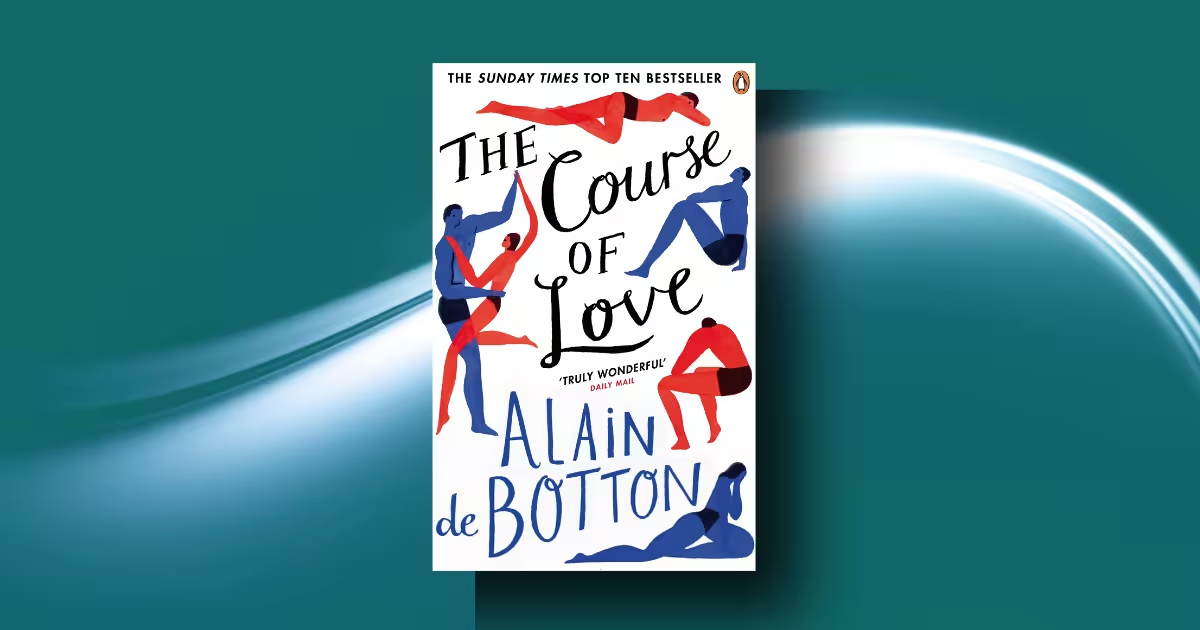
Does it ever strike you as strange — maybe even a little frightening — that the love stories we grow up with almost always end the moment two people decide to stay together? What if the real story of love, the one nobody bothers to tell, is everything that comes after the last page?
The Course of Love argues, through the lived experience of one marriage, that love is not an emotion you feel but a skill you must deliberately and repeatedly choose to learn.
The Course of Love is best for married couples who feel obscurely lost; anyone who has ever confused boredom with incompatibility; readers who want philosophy embedded in story; fans of Julian Barnes, Nick Hornby, or Rachel Cusk; people in therapy, or who probably should be; anyone who found Alain de Botton’s essays life-changing.
Not for readers seeking plot-driven drama or surprise twists; those who want their romantic fiction to comfort rather than challenge; anyone allergic to italicised philosophical interjections mid-narrative.
Table of Contents
1. Introduction
Title: The Course of Love
Author: Alain de Botton
Publisher: Simon & Schuster
First Published: June 14, 2016 (US hardcover); April 2016 (UK, Penguin Books)
The Course of Love is the second novel by the Swiss-British philosopher and author Alain de Botton, and it arrives more than two decades after his debut fiction, On Love (published in the UK as Essays in Love, 1993).
In between, de Botton built an extraordinary body of essayistic non-fiction — How Proust Can Change Your Life (1997), The Architecture of Happiness (2006), Status Anxiety (2004), Religion for Atheists (2012) — and founded The School of Life, a global educational organisation dedicated to emotional intelligence.
His essay Why You Will Marry the Wrong Person, drawn from the ideas of this very novel and published in The New York Times on 28 May 2016, became the most emailed article on the site for several days, a startling confirmation that the questions this book asks are not merely literary — they are urgently, uncomfortably universal.
The novel is slim (240 pages) but dense with implication.
It is set in Edinburgh, Scotland, and follows a married couple — Rabih Khan, a Lebanese-born architect of modest standing, and Kirsten McLelland, a Scottish chartered surveyor — from their first meeting through infatuation, proposal, marriage, parenthood, near-dissolution by infidelity, couples therapy, and, finally, into something that de Botton calls maturity: a clear-eyed, unheroic, and genuinely courageous form of love.
2. Background
Alain de Botton was born in Zurich in 1969, raised across several countries, and educated at Cambridge.
He has long been preoccupied with what he calls “the philosophy of everyday life” — the idea that the insights of philosophers, novelists, and psychologists ought to be practical tools for navigating ordinary existence, not abstractions confined to seminar rooms.
The Course of Love is, in many ways, the culmination of a decades-long project.
His 1993 debut examined the euphoria and collapse of a single romantic episode; this novel asks the harder question: what happens to two people once the romance has declared its permanent intentions and moved into a terraced flat in Marchiston Avenue?
The novel’s intellectual scaffolding draws from John Bowlby’s attachment theory (developed in England in the 1950s), which traces relational tensions back to early childhood experiences of parental care, and from the broader tradition of what de Botton calls post-Romantic realism — the philosophical argument that the Romantic ideology of love (the soulmate myth, the idea that the right person completes you, that passionate feelings are sufficient guides to lifelong commitment) has done enormous and largely unacknowledged damage to modern intimate life.
Statistically, the backdrop is sobering.
In the United Kingdom, roughly 42% of marriages end in divorce. In the United States, the figure hovers between 40% and 50%. Yet we continue to build our most fundamental life decisions around a set of assumptions about love — that it should feel effortless, that compatibility is something you discover rather than construct, that desire should be perpetually renewable — that psychologists and thoughtful observers have long suspected are dangerously false.
The Course of Love is de Botton’s most sustained and emotionally persuasive attempt to replace those assumptions with something more useful, more honest, and, ultimately, more compassionate.
3. The Course of Love — Full Summary
Part One: Romanticism — The Falling
The Course of Love opens with a meditation on what de Botton calls Romanticism: the ideology, not the period.
Rabih Khan has spent his life falling into the particular kind of overwhelming, instantaneous love that Romantic culture trains us to regard as the only real kind.
At fifteen, on a family holiday, it is Alice Saure — a French girl on a deck chair whom he will never speak to. At twenty, it is a woman on the C train in Manhattan. At twenty-five, in a Berlin architectural office. The pattern is always the same: a stranger glimpsed, an entire inner life projected onto them, a story of completion imagined. “For the Romantic, it is only the briefest of steps from a glimpse of a stranger to the formulation of a majestic and substantial conclusion: that he or she may constitute a comprehensive answer to the unspoken questions of existence.”
Rabih is thirty-one and living in Edinburgh, recently arrived from London, when the actual love of his life materialises.
He has been assigned a commission — designing a roundabout on the A720. The client’s senior representative suffers a bereavement, and a junior colleague, Kirsten McLelland, steps in at the last moment.
They meet on a construction site on an overcast January morning. When it begins to pour, Kirsten suggests walking to a nearby café, the Taj Mahal on the high street.
Over tea and papadums, they talk about hiking, about Loch Carriagean, about her tent pitched in an isolated pine forest. She mentions, with a wry smile and a faintly asymmetrical tooth, that the thought of “happily ever after” has never really been her thing.
Rabih, who believes that cynics are merely idealists with unusually high standards, is not put off.
Weeks pass.
He watches for signals — she complimented his grey raincoat; she let him pay for their tea. One Saturday, on a visit to Edinburgh’s botanical gardens, he cuts her off mid-sentence as she reads from an information plaque about Alpine trees — “Alpine trees should never be confused with —” — takes her face in his hands, and kisses her.
She lets him.
At the garden gates, she tells him to call and admits she’ll be free any evening the following week. On his walk home through the Saturday crowds, “Rabih is thrilled enough to want to stop random strangers in order to share his good fortune with them.”
Their second date — a Thai restaurant on Howe Street — is awkward.
But it ends at her flat, where she has, she confesses with delightful candor, tried on pretty much everything she owns before deciding that life was too short. Intimacy follows, startling in its ease. She tells him exactly when she first noticed him (“I noticed you had a nice bum”).
De Botton frames this moment — the admission of desire without shame — as one of love’s most profound offerings: the end of the loneliness that propriety enforces.
De Botton weaves into this section his first extended argument: that the excitement of new love is not merely chemical but philosophical — it is “the idea of acceptance and the promise of an end to loneliness and shame.”
Rabih and Kirsten each carry histories of damage.
Rabih’s mother died of cancer when he was twelve, shortly after the family fled sectarian violence in Beirut for Barcelona. He has never properly grieved. Kirsten’s father left the family home when she was still young; she told no one at school, and stopped singing in the choir the day after he left. “At the center of Kirsten’s love,” de Botton writes, “is a desire to heal the wound of Rabih’s long-buried, largely unmentioned loss.”
And Kirsten’s own wound — the absence that made her so fiercely self-reliant and emotionally guarded — is exactly what draws Rabih to her.
Part Two: The Proposal — Jumping Off the Cliff
Six months into their relationship, on a train journey back from visiting Kirsten’s mother in Inverness, just past the village of Killiecrankie, after the ticket collector’s visit, Rabih turns to face Kirsten and asks — without preamble — if she will marry him.
Not necessarily right away, he adds, and not necessarily with any fuss.
She says yes.
She cries. She asks if he’s sure. He is not sure in any rational, defensible way — de Botton is explicit about this. “It isn’t disrespectful to Rabih to suggest that he doesn’t really know why he has asked her to marry him, know in the sense of being in command of a rationally founded, coherent set of motives.”
What he has instead of a rationale is feelings: the feeling of never wanting to let her go; the feeling that she is an answer to his incompleteness; the feeling that marriage might freeze this extraordinary sensation and make it permanent.
The novel’s great structural irony begins here.
The proposal is, de Botton argues, about what Rabih is running towards, but also what he is running away from — the loneliness of a string of empty Sundays, the image of a friend’s wife tucking a scarf tenderly around her husband’s neck in Victoria Street.
Modern marriage, the novel suggests, has replaced the marriage of reason (which was narrow, expedient, often abusive) with the marriage of feeling — and the marriage of feeling, magnificent as it sounds, has its own terrible vulnerability: it makes no provision for the moments when the feeling goes cold.
Part Three: Ever After — The Ordinary Reality of Marriage
The wedding is small.
They read Scottish government vows promising love, patience, forgiveness, and lifelong companionship. The government, de Botton notes drily, offers no further instructions on how to concretise these vows — though it does provide information on tax discounts for loft insulation.
Married life assembles itself, imperfect and entirely real.
They find a flat on Marchiston Avenue — Kirsten earns more, so the deposit is hers, which Rabih feels acutely. A visit to IKEA to buy glasses becomes a sustained study in marital warfare.
He wants the plain ones; she wants the Fabulés, with their swirling blobs of blue and purple. The argument that follows — petty by any objective measure, devastating in its particular fury — is de Botton’s first case study in what he calls the “loose threads” of everyday discord: “Their everyday disputes are the loose threads that catch on fundamental contrasts in their personalities.” The fight is not about glasses. It never is.
There is the question of the bedroom window.
Kirsten, raised in the stoic north of Scotland, believes fresh air is non-negotiable. Rabih, whose Beirut childhood treated drafts as equivalent to shelling, regards open windows in winter as a form of violence. There is the question of dinner party storytelling — Rabih prefers to get to the point, Kirsten elaborates.
There is the taxi ride home from a friend’s birthday dinner, in which the two of them sit at opposite ends of the back seat, unable to remember, by the following morning, quite what the fury was actually about.
De Botton names what he sees with wonderful directness: “The ordinary challenging relationship remains a strangely and unhelpfully neglected topic.” We have no cultural narrative for the marriage that is neither radiantly happy nor collapsing toward divorce.
The in-between — which is where most of us live — is, he says, the great unmapped territory.
Then come the sulks.
De Botton devotes an entire chapter to this underexamined phenomenon, and it is one of the novel’s best. A sulk, he argues, is a confusing mixture of intense anger and an equally intense desire not to communicate what one is angry about.
The sulker wants wordless understanding — a return to the womb-like state of being known without having to explain. “Sulking pays homage to a beautiful, dangerous ideal that can be traced back to our earliest childhoods: the promise of wordless understanding.”
Part Four: Children — Love Lessons and Sweetness
Three years into the marriage, Kirsten becomes pregnant.
Esther is born — screaming, magnificent, and entirely indifferent to her parents’ previous plans. Three years after Esther, William arrives, cheeky and winsome from his first hours, a boy who routinely offers to marry his sister with the earnestness of a medieval suitor.
Parenthood, in de Botton’s rendering, is simultaneously the most love-expanding and the most love-depleting experience a couple can share.
Rabih discovers he is a giant — terrifying to a small person — when the pretend lion he performs on the sitting-room carpet makes Esther dissolve in genuine terror. He learns to navigate the bath, the bedtime story, the school run. Kirsten sponsors an orphan in Malawi; remembers every spelling test; sews patches on uniform trousers.
They are, separately, tender and capable parents. Together, after the children are finally asleep, they are sometimes simply exhausted strangers.
A chapter called “Sweetness” captures, with extraordinary delicacy, the way children illuminate what adults have closed off. William’s uncensored curiosity — “Why is there dust?” “If you shaved a baby gorilla, would it look like a human baby?” — is not just funny; it is, for Rabih, a daily reproach and a daily gift. “It isn’t surprising if, as adults, when we first start to form relationships, we should devotedly go off in search of someone who can give us the all-encompassing, selfless love that we may once have known in childhood.”
The novel suggests, gently but firmly, that this is a search doomed to disappointment — not because the love isn’t real, but because no adult can be a parent to another adult without crushing both.
Sex and parenthood occupy a chapter of unusual frankness. Friday evenings are now officially designated; the calendar has become the last refuge of desire.
Kirsten, when Rabih touches her after a day of being pulled at and demanded of by small people, sometimes cannot bear another body’s claim on her own. “Until she has had sufficient chance to reacquaint herself with her own thoughts, she can’t even begin to take pleasure in gifting herself.”
Rabih, meanwhile, slips downstairs past midnight to visit an online chat room — not, de Botton is careful to say, out of indifference to Kirsten, but because there, the self-consciousness and weight of mutual history briefly lift. “The imaginary incidents on the trawler and in the chat room aren’t an indication that Rabih and Kirsten have ceased to love one another. They are signs that they are so engaged in each other’s lives that they sometimes no longer have the inner freedom to make love without self-consciousness.”
Part Five: Adultery — Berlin and Its Consequences
Rabih is invited to Berlin to speak at a conference on urban regeneration.
He changes planes in London, gives his talk with genuine passion, and at the welcome-drinks party meets Lauren, an American sociologist studying immigration in the San Bernardino Valley. She has shoulder-length brown hair and grey-green eyes. She quotes German opera under her breath. She reminds him of Alice Saure, and of every door he chose not to open since his wedding day.
The affair happens in one evening.
It happens — de Botton is honest enough to say this — not out of grandiose dissatisfaction with his marriage but out of something smaller and sadder: a longing to feel, just once more, like the person he was before life enclosed him. “It felt as if he had been granted access to a version of himself which he had long thought dead.”
In the morning, at the airport, they embrace with the particular warmth available only to people who know they will not see each other again. He cries a little, looking at a watch advertisement.
He comes home.
Nobody stares at him. Edinburgh is intact. The front door key still works. Kirsten is on the floor in the study, helping William with his homework at the seven-year-old’s imperious direction.
The subsequent weeks see de Botton’s most philosophically daring writing: a long, nocturnal interior monologue in which Rabih systematically questions every assumption modern society makes about monogamy, fidelity, and the meaning of betrayal.
It is a passage that will infuriate some readers and ring uncomfortably true to others. He does not defend what he has done, exactly — but he insists on questioning the framework by which it is condemned. “It’s rare to embark on an affair out of indifference to a spouse. One generally has to care quite a lot about a partner to bother to betray them.”
The novel is remarkable in that it does not let him off the hook, but it also refuses to let the hook be the whole story.
Then, in the middle of a manufactured argument about the car being serviced and the house being “policed,” Kirsten drops a name: Ben McGuire, a fellow surveyor from the Dundee Council. Rabih — who has been conducting a secret correspondence with Lauren via deleted texts — finds himself consumed by jealousy that he has absolutely no moral right to feel. When he asks Kirsten directly whether she has done anything with Ben McGuire, she snaps: “Yes, I’m fucking all the men on the team, every last one of them. I’m glad you finally asked; I thought you never would. At least they know how to be civil towards me.”
He is not sure whether she is serious. She probably is not, entirely. The tension between them has produced something that looks, from certain angles, almost like the truth.
De Botton’s conclusion to this section is one of the novel’s most quietly devastating: “Adventure and security are irreconcilable, he sees. A loving marriage and children kill erotic spontaneity, and an affair kills a marriage. A person cannot be at once a libertine and a married Romantic, however compelling both paradigms might be.”
He decides, out of what de Botton calls enlightened pessimism rather than conventional virtue, not to pursue Lauren further.
Not because the desire is gone, but because he now understands its cost clearly enough to choose.
He ends contact.
He tells Kirsten nothing. He will lie about Berlin forever, he decides — not to protect himself, but because telling the truth would create a greater falsehood: the impression that he doesn’t love her. “The truth risks distorting the relationship far more than the untruth.”
Part Six: Beyond Romanticism — Therapy, Maturity, and a Highland Hotel
They find a couples therapist through an online search — a sole practitioner, Dr. Joanna Fairbairn, with an office in central Edinburgh and a tightly enunciated upper-class accent.
The consulting room smells of something institutional and vaguely calming. Fifty minutes per session, £75. The clock is above the fireplace.
The therapy scenes are among the novel’s finest.
Mrs. Fairbairn is neither a magician nor a fraud; she is a professional doing the slow, unglamorous work of helping two people see each other slightly more clearly than their accumulated grievances will normally allow. She introduces them to attachment theory — developed by John Bowlby in the 1950s, later elaborated by Mary Ainsworth and others — which divides attachment styles into secure, anxious, and avoidant.
Rabih, as Mrs. Fairbairn gently excavates, is anxiously attached: when Kirsten goes quiet, he experiences it not as neutral behaviour but as abandonment, as imminent catastrophe. “Inside, anxiously attached people often feel as if they were fighting for their lives — though they are typically unable to explain their fragility to those around them.”
Kirsten, by contrast, is avoidantly attached: she withdraws from conflict precisely when Rabih most needs her to engage, pulling up the drawbridge just as he needs the gate opened. Each of their responses aggravates the other in what Mrs. Fairbairn calmly describes as “a spiral of declining trust.”
When Mrs. Fairbairn asks Rabih what he feels when Kirsten doesn’t say what he wants to hear, he first says “horrible” — and then, surprising himself, drops the rational brake entirely: “Scared. Abandoned. Helpless.” There is a silence in the room after he says this.
It is the kind of silence that means something has shifted.
Between sessions, Rabih begins to understand that he slept with Lauren not out of desire but out of anger — a sullen, repressed fury at feeling persistently unseen by his wife. He slept with Lauren because he had stopped being able to tell Kirsten that he felt let down. Which means, structurally, that if he can tell Kirsten he feels let down, the affair becomes redundant.
This is the painful, unglamorous mathematics of marriage.
Gradually, the therapeutic voice begins to colour their conversations at home. They start asking each other, silently or aloud: “What would Joanna say?” They do not become perfect. But they become a little more patient with the other’s imperfections.
A chapter called “Maturity” follows Rabih through a professional disappointment: a gymnasium he has spent months designing — his best work, he believes, with a system of skylights that would make the building luminous even in Edinburgh’s dullest weather — is cancelled by the education authority with a bluntness that suggests guilt rather than regret.
The not-sleeping begins.
In his nocturnal solitude, de Botton gives Rabih a remarkable passage of self-reckoning: “He is a collection of tissues and cells delicately and intricately conjoined and brought to life for only an instant.”
He sees his architectural ambitions for what they were — Grand Illusions of the kind nature plants in us so that we keep striving, regardless of the individual cost. He gives up on the fantasy of being another Louis Kahn. He becomes, in losing that fantasy, slightly kinder.
Kirsten’s mother falls ill — first her kidneys, then something graver.
On a Sunday visit to the Inverness hospital, Mrs. McLelland takes Rabih’s hand in hers and says: “Look after her, will you. If she lets you.” A forgiveness, of sorts, from the woman who was always quietly sceptical of this Lebanese architect.
Kirsten, normally so strong, is “ashen and lost.”
Part Seven: The Ending — Ready for Marriage
Thirteen years into the marriage, Rabih feels, for the first time, ready for it.
De Botton means something precise and somewhat paradoxical by this. “Given that marriage yields its important lessons only to those who have enrolled in its curriculum, it’s normal that readiness should tend to follow rather than precede the ceremony itself, perhaps by a decade or two.”
On Kirsten’s birthday, Rabih arranges for them to spend a night alone — no children — at a wildly expensive nineteenth-century castle hotel in the Highlands.
The children are deposited with a cousin in Fort William, protesting vigorously. Esther is certain they will be bored without her. William assures his sister that their parents can always find a games room.
In the vast, high-ceilinged hotel room, alone together for what feels like the first time in years, they are oddly formal with each other — more respectful, more solicitous, as if meeting again for the first time.
Kirsten asks Rabih what he’d like from the room-service tea menu; he runs her a bath. De Botton’s observation is exact: “The trick is perhaps not to start a new life but to learn to reconsider the old one with less jaded and habituated eyes.”
Over dinner, lubricated by recklessly expensive French wine, they actually talk — not about logistics, not about the children’s schedules or the household accounts, but about the things that have been waiting years to be said. Rabih tells Kirsten about his suppressed ambition to take up an instrument again, about wanting to take her to Beirut.
Kirsten, for the first time, speaks of her father — how she wonders, when she’s in a new place, whether he might be living somewhere nearby. How she wants to find him. How she is tired of being angry with him her whole life. How she would like him to meet his grandchildren and, she adds with a smile, “her horrible and peculiar Middle Eastern husband.”
When Rabih tells her how beautiful she looks, how wise her eyes are, how proud he is of her, and how sorry he is about everything — the word “everything” doing enormous, uncatalogued work — she does not deflect with one of her normal stoic remarks. She smiles: “a warm, wide, quiet smile.”
She says thank you.
She squeezes his hand. She may be starting to cry, just as the waiter arrives and asks if he can get Madam anything else. She replies, slurring slightly: “Just some more loveliness.” Then catches herself.
Back in Edinburgh, there is a final scene in the Highlands on a warm day — the warmest of the year — when Rabih, Kirsten, Esther, and William are together on the hillside. Esther runs barefoot along a stream. William tracks an ant colony. Rabih lies spread-eagled on the earth, watching a small, unthreatening cloud cross the blue sky.
“He knows that perfect happiness comes in tiny, incremental units only, perhaps no more than five minutes at a time. This is what one has to take with both hands and cherish.”
The novel ends not with resolution but with clear-eyed acceptance. “He has no right to call himself a happy man; he is simply an ordinary human being passing through a small phase of contentment.” He knows that struggles will return — one of the children will get ill, there will be another argument about the window, another evening of cold silence. But courage is required even within a circumscribed life. The courage not to be vanquished by anxiety, not to hurt others out of your own pain.
The ending is quietly radical: no revelation, no redemption arc, no Hollywood flourish — just two people, a little wiser and a little more kind, choosing to continue.
That, de Botton says, is enough. It may even be heroic.
4. The Course of Love Analysis
4.1 The Course of Love Characters
Rabih Khan is, in some ways, de Botton’s Everyman — but an Everyman with a specific cultural texture.
Born in Beirut to a Lebanese family, displaced by the civil war to Barcelona and then London, he is a man of genuine sensitivity and real limitations. He is an architect of modest achievement whose professional and personal dreams have both been scaled back by reality.
His grief for his mother — who died of cancer when he was barely twelve — is so buried that it surfaces only in his tendency to attach with almost desperate intensity to women who seem capable of understanding him wordlessly.
He is anxiously attached, as Mrs. Fairbairn eventually names it: he reads Kirsten’s silences as rejections; her self-sufficiency as abandonment. He is capable of tenderness that is genuinely touching, and of a self-serving rationalisation that is equally genuine.
The affair with Lauren is not portrayed as monstrous — which is itself a kind of moral realism. He is, in short, recognisably human: which makes him interesting rather than lovable.
Kirsten McLelland is, if anything, the more complex of the two, precisely because the novel is slightly more distant from her inner life. A Scottish chartered surveyor with a first-class degree from Aberdeen, she is extremely competent in the world and extremely guarded within it.
Her father’s departure when she was a child did not break her so much as harden her into a self-protective efficiency that can look, from the outside, like coldness.
She is avoidantly attached: when conflict comes, she withdraws; when Rabih needs reassurance most urgently, she provides it least. And yet she is the one who notices everything, who sponsors the orphan in Malawi, who remembers every spelling test, who has Coleridge and Burns in her head by heart.
Her reticence is not indifference — it is armour, and it was forged by something real.
The novel’s most moving character observation is its least dramatic: thirteen years into marriage, on a night in a Highland hotel when French wine has loosened the armour just slightly, Kirsten allows herself to cry. She is “brave enough to be weak.”
It is the most significant moment in the book, and it happens so quietly you might almost miss it.
Mrs. Fairbairn, the couples therapist, deserves mention as a minor but beautifully rendered figure.
She is not a sage.
She is a professional. She asks the same questions every week, notes every unkind remark and wounding brusqueness. She defuses bombs. “Thousands of years of halting steps towards civilization have at last led to a forum where two people can painstakingly discuss how hurtful one of them has been to the other about laying a table or saying something at a party or arranging a holiday, with neither side being permitted simply to get up, storm out, or swear.”
Her quiet, tightly enunciated presence in the novel is one of its most effective structural devices.
4.2 The Course of Love Themes and Symbolism
Love as a Skill, Not a Feeling
This is the novel’s central proposition, announced in its opening pages and illustrated in every subsequent chapter.
Romantic culture, de Botton argues, has trained us to believe that love is something you either feel or you don’t — that the right person will make it effortless, that difficulty is a sign you’ve chosen wrong.
The novel’s entire narrative arc is an extended refutation of this. Rabih and Kirsten are not wrong for each other.
They are simply unpracticed at the necessary skills: navigating conflict, tolerating imperfection, communicating need without disguising it as aggression, forgiving without keeping score.
The Romantic Myth
The novel’s two-part structure — “Romanticism” and “Beyond Romanticism” — is not accidental.
The Romantic ideology that de Botton identifies is not Keats or Byron but a cultural worldview: that love should feel overwhelming; that the right person should feel immediately familiar; that desire should persist without effort; that marriage should be the conclusion of the love story rather than its beginning.
The IKEA glasses fight, the bedroom window argument, the sulks — all of these are depicted as the ordinary consequences of two people whose internal models of love are radically incompatible with the reality of sharing a life.
Infidelity and Its Meaning
The affair with Lauren is the novel’s most controversial section and its most philosophically honest.
De Botton refuses the comfortable narrative in which adultery is simply a moral failure committed by weak or selfish people. He shows it, instead, as a symptom — of loneliness inside a marriage, of the human need for novelty and recognition that no long-term relationship can fully meet, of the cost of choosing security. He does not excuse Rabih.
But he does insist on understanding him. “It’s rare to embark on an affair out of indifference to a spouse. One generally has to care quite a lot about a partner to bother to betray them.”
Attachment Theory
The introduction of Bowlby’s attachment theory through Mrs. Fairbairn is not incidental. It is the novel’s structural key.
When Rabih says “scared, abandoned, helpless” in the therapist’s office, he is not confessing weakness — he is, for the first time, speaking the language underneath his behaviour.
And when Kirsten’s avoidance is named rather than simply experienced as cruelty, something in their dynamic becomes visible that was previously only felt. The novel argues implicitly that one of the most useful things a culture could do is make attachment theory as widely known as the rules of grammar.
Parenthood as Love’s Crucible
The children — Esther’s fierce competence, William’s disarming sweetness — are not background scenery.
They are the environment in which the marriage is tested most severely and most revealingly. They drain their parents’ emotional reserves dry. They insist on love at the exact moments when love is most exhausted.
And they illuminate, by their own utter dependency and unconditional need, how much the adults in their lives are still, at bottom, children themselves.
The Symbolism of Snowdrops
The novel’s penultimate image is Rabih, on his way home, stepping into a florist’s shop — “illuminated and filled with a variety of blooms.” His eye is drawn to the first native flowers of a tentative spring: snowdrops. He buys them for Kirsten. The elderly florist smiles: “For someone nice, I think?” He replies: “My wife.” “Lucky woman.”
He hopes to get home and prove the florist right. Snowdrops, the first flowers of a thawing winter, small and white and quietly insistent: de Botton could not have chosen a more precise emblem for what mature love finally looks like.
5. Evaluation
The Course of Love is one of those rare books that feels, when you close it, like a private conversation — as though the author had, somehow, attended several of your worst marital arguments and your most unexpectedly tender evenings and taken notes without your noticing.
It is poignant, occasionally brilliant, and profoundly useful. Whether it fully succeeds as a novel is a harder question. But as an act of philosophical generosity toward ordinary human confusion, it is virtually unmatched.
5.1 Strengths
The book’s greatest achievement is structural: the decision to alternate between narrative and italicised philosophical interjection is one that could easily become insufferable, and occasionally teeters, but mostly works because de Botton’s prose in those sections is genuinely sharp.
Lines like “Choosing a person to marry is hence just a matter of deciding exactly what kind of suffering we want to endure” are not cynical — they are, on reflection, among the most compassionate things anyone has written about marriage.
They remove the accusation of personal failure from what is, in fact, the universal human condition.
The Edinburgh setting is quietly perfect — its overcast skies and volcanic hills, its botanical gardens and High Street cafés, provide an appropriately unsentimental backdrop to a story about love stripped of its glamour.
The scenes of early courtship — the walk under Kirsten’s umbrella, the first kiss interrupting an information plaque about Alpine trees — are genuinely charming without being precious.
The chapter on sulking is extraordinary: funny, embarrassing, wholly recognisable, and illuminating in a way that years of relationship advice columns have never managed.
Similarly, the therapy sessions with Mrs. Fairbairn are written with a restraint and honesty that feels earned. De Botton has read Bowlby carefully and renders his insights through character rather than lecture.
5.2 Weaknesses
The novel’s most frequently noted flaw is also its most legitimate one: the characters, particularly Kirsten, can feel more like demonstration models than fully realised human beings.
We observe them; we rarely inhabit them. Kirsten especially — her interiority is glimpsed but never fully opened to us.
This is partly a narrative strategy (Rabih is the closer point-of-view), but it does mean that her arc — the cracking of the armour, the tears in the hotel room — carries somewhat less emotional weight than it might.
Some of the philosophical interjections, particularly in the middle sections, read more like lectures than like fiction — the novel’s essayistic DNA showing a little too clearly through the skin of the story. Readers who came for a novel will feel this more acutely than readers who came for philosophy.
The infidelity section, for all its moral complexity, resolves perhaps a little too cleanly. Real affairs leave more residue.
5.3 Impact / Controversy
The novel generated genuine debate, particularly around its treatment of infidelity.
Some reviewers felt de Botton was rationalising Rabih’s affair in a way that let him off too lightly; others found the lack of easy condemnation morally serious and refreshing.
The companion essay “Why You Will Marry the Wrong Person” — published in The New York Times and drawing directly from the novel’s ideas — became one of the most emailed articles the paper had ever published, suggesting that the book’s central arguments struck a nerve far wider than its readership.
People called it “an engrossing tale that provides plenty of food for thought” and named it a Best New Books pick. On Goodreads, with over 53,000 ratings, it holds a 4.2 average — with 76% of readers loving it.
5.4 Comparison with Similar Works
The closest literary relatives of The Course of Love are:
Nick Hornby’s About a Boy and High Fidelity: emotionally intelligent fiction about men learning to grow up, less philosophical but warmer in characterisation.
Julian Barnes’s The Sense of an Ending and Levels of Life: de Botton’s narrative restraint and philosophical density are temperamentally similar.
Rachel Cusk’s Outline trilogy: similarly interested in dismantling received narratives about intimate life, though stylistically far more radical.
Esther Perel’s Mating in Captivity (non-fiction): the most direct intellectual companion — Perel explores the tension between security and desire in long-term relationships with similar candour.
De Botton’s earlier Essays in Love (On Love) (1993) covers the infatuation-to-heartbreak arc; The Course of Love begins where that book ends and asks what happens next.
6. Personal Insight with Contemporary Educational Relevance: Five Lessons
Lesson 1: Love Is a Practice, Not a Discovery
In 2023, the American Psychological Association reported that approximately 40–50% of marriages in the United States end in divorce, with similar figures across Europe.
The rate is highest in the first five to seven years — precisely the period when, de Botton argues, we are most likely to confuse normal difficulty for the wrong choice. The novel’s most practical insight is that the skills required for lasting intimacy — managing conflict without contempt, expressing need without aggression, forgiving without compiling ledgers — are learnable.
They are not born in us.
This is an educational message with vast implications, and yet it remains almost entirely absent from how we prepare young people for adult relationships.
Lesson 2: Attachment Styles Shape Every Argument
John Bowlby’s attachment theory, popularised in clinical settings since the 1960s, has in recent years reached a broader public through researchers like Amir Levine and Rachel Heller (Attached, 2010).
Its central finding — that our earliest experiences of being cared for create internal working models of relationship that shape our adult attachments in predictable ways — is one of the most practically useful insights in modern psychology.
De Botton’s rendering of Rabih’s anxious attachment and Kirsten’s avoidant style is an accessible narrative illustration of what therapy can take months to name.
Studies suggest that approximately 20% of adults have anxious attachment, 25% avoidant, and 5% disorganised — which means that a majority of couples contain at least one insecure attachment style, shaping dynamics that neither party can fully see from the inside.
Lesson 3: The Hidden Cost of the Romantic Myth
In the 2020s, dating apps have globalised and accelerated the application of Romantic ideology to real relationships: the belief that somewhere in the database is the right person, and that the task is simply to find them.
According to data from Pew Research (2023), over 30% of US adults have used a dating app — yet satisfaction rates and marriage rates from app-sourced relationships remain highly variable.
De Botton’s argument is not that romantic love is fake but that our expectations of its permanence and effortlessness are. Lowering those expectations is not pessimism — it is the precondition for maturity.
Lesson 4: Infidelity is Rarely About the Other Person
Research by relationship psychologists and therapists, including Esther Perel (whose TED Talk “Rethinking Infidelity” has over 24 million views), consistently finds that affairs are less often about the third party than about something unspoken and unmet in the primary relationship.
De Botton’s rendering of Rabih’s Berlin night as an act of inarticulate anger — a way of saying, without saying it, that he feels unseen — is psychologically accurate in a way that conventional moral narratives about infidelity generally are not.
This does not excuse the act; it makes it understandable, which is a different and more useful thing.
Lesson 5: Maturity in Relationships Requires Accepting Incompatibility
The novel’s penultimate chapter, “Ready for Marriage,” is structured as a series of readiness tests, all of which Rabih now passes — not because he has found the right person but because he has understood that incompatibility is universal. “We will all by definition end up with that stock character of our nightmares, ‘the wrong person.'”
The genuinely useful insight — and it is one that couples therapy increasingly endorses — is that compatibility is not a fixed quantity to be discovered but a variable to be constructed, through negotiation, patience, and a willingness to be changed by another person.
7. The Course of Love Quotes
On romantic projection:
“For the Romantic, it is only the briefest of steps from a glimpse of a stranger to the formulation of a majestic and substantial conclusion: that he or she may constitute a comprehensive answer to the unspoken questions of existence.”
On falling in love:
“Love is a dividend of gratitude for our lover’s insight into our own confused and troubled psyche.”
On the proposal:
“Proposing has all the passionate allure of shutting one’s eyes and jumping off a steep cliff, wishing and trusting that the other will be there to catch one.”
On marriage:
“The marriage of reason was not, from any sincere perspective, reasonable at all; it was often expedient, narrow-minded, snobbish, exploitative, and abusive. Which is why what has replaced it — the marriage of feeling — has largely been spared the need to account for itself.”
On choosing a spouse:
“Choosing a person to marry is hence just a matter of deciding exactly what kind of suffering we want to endure rather than of assuming we have found a way to skirt the rules of emotional existence. We will all by definition end up with that stock character of our nightmares, ‘the wrong person.'”
On marital arguments:
“Their everyday disputes are the loose threads that catch on fundamental contrasts in their personalities.”
On sulking:
“Sulking pays homage to a beautiful, dangerous ideal that can be traced back to our earliest childhoods: the promise of wordless understanding.”
On infidelity:
“It’s rare to embark on an affair out of indifference to a spouse. One generally has to care quite a lot about a partner to bother to betray them.”
On secrets in marriage:
“No relationship could start without a commitment to wholehearted intimacy. But in order for love to keep going, it also seems impossible to imagine partners not learning to keep a great many of their thoughts to themselves.”
On readiness for marriage:
“They have been married for thirteen years and yet only now, a little late, does Rabih feel ready for marriage. It’s not the paradox it seems. Given that marriage yields its important lessons only to those who have enrolled in its curriculum, it’s normal that readiness should tend to follow rather than precede the ceremony itself, perhaps by a decade or two.”
On happiness:
“He knows that perfect happiness comes in tiny, incremental units only, perhaps no more than five minutes at a time. This is what one has to take with both hands and cherish.”
On ordinary courage:
“He has no right to call himself a happy man; he is simply an ordinary human being passing through a small phase of contentment. Very little can be made perfect; he knows that now. He has a sense of the bravery it takes to live even an utterly mediocre life like his own.”
On what stories of love need to do:
“Rather than split up, we may need to tell ourselves more accurate stories — stories that don’t dwell so much on the beginning, that don’t promise us complete understanding, that strive to normalise our troubles and show us a melancholy yet hopeful path through the course of love.”
8. Conclusion
The Course of Love is not the most comfortable book about marriage you’ll ever read. It will probably not reassure you that everything is fine.
What it will do — if you let it, and if you approach it in the spirit in which it was written — is make you feel less alone in the confusion and the difficulty and the occasional inexplicable beauty of sharing your life with another imperfect person. That is no small achievement.
De Botton writes with a philosopher’s clarity and a novelist’s feel for the telling detail — the lemon-yellow flip-flops, the box of chamomile tea, the slight asymmetry of Kirsten’s left front tooth, the snowdrops bought on a tentative spring morning. He earns his italicised generalisations because they are rooted in particular, credible human experience.
The Course of Love is significant not because it solves anything — it doesn’t, and it knows it doesn’t — but because it names, with unusual precision and compassion, the particular kind of difficulty that most long-term relationships quietly contain.
In a culture saturated with romantic beginnings and careful about romanticising endings, that naming feels, at times, like an act of grace.







