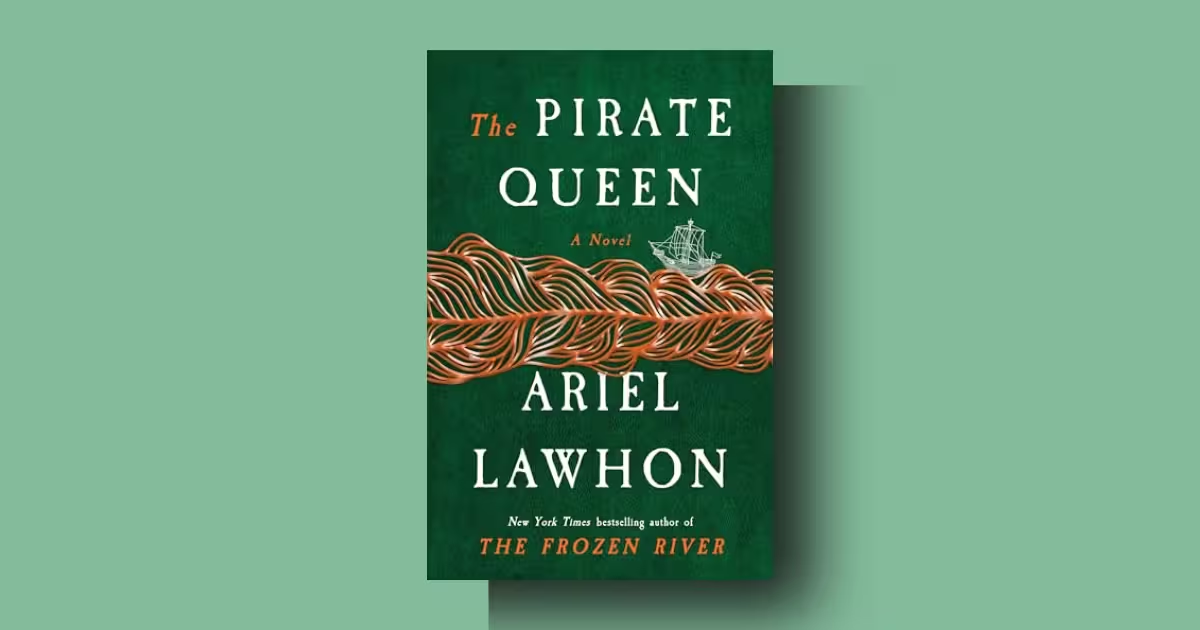

The Pirate Queen by Ariel Lawhon is the rare historical novel that feels like a storm at sea: loud, dangerous, and impossible to turn away from. It follows Grace O’Malley, the real 16th-century Irish chieftain, pirate, mother, and rebel who commanded her own fleet, buried a son, and faced Queen Elizabeth I without bowing.
If you loved The Frozen River, or you just want a fierce, bloody, deeply human story about a woman who refused to be written out of history, start here.
Table of Contents
Summary
The Pirate Queen by Ariel Lawhon is a sweeping historical novel about Grace O’Malley, the 16th-century Irish chieftain and sea captain who defied English rule, commanded a fleet, and met Queen Elizabeth I face to face.
Published in 2026 by Doubleday, the novel uses a unique tripartite structure-Maiden, Mother, Matriarch- to weave together three timelines of Grace’s life. Lawhon, known for The Frozen River and Code Name Hélène, delivers a portrait of a woman who was by turns a pirate, a mother, a rebel, and a survivor.
The book spans roughly 1535 to 1603, covering Grace’s childhood on Clare Island, her forced marriage to Donal O’Flaherty at sixteen, her love affair with Richard Bourke, her rise as de facto chieftain of the O’Flaherty and O’Malley clans, and her dramatic appeal to Elizabeth I in 1593.
If you love historical fiction with a fierce female lead, complex family dynamics, and visceral period detail, this one will stay with you.
Reader Recommendation
Who will love this book: Fans of Hilary Mantel’s Wolf Hall, readers who enjoyed Kristin Hannah’s The Nightingale, and anyone drawn to stories of women who refuse to be sidelined by history. If you appreciated the political intrigue of Philippa Gregory’s Tudor novels but wanted more swashbuckling, this is your book. People who love Ireland, maritime history, or stories about mothers protecting their children against impossible odds will find plenty to hold onto here.
Who might bounce: Readers looking for a straightforward, linear biography will struggle with the novel’s structure. The tripartite timeline jumps between Grace at five, at twenty, at thirty-five, and at fifty-six. If you need clear chronological flow, this will feel disorienting. Also, if you prefer your historical fiction with a lighter touch—less blood, fewer graphic descriptions of battle wounds and childbirth, this might be too visceral.
The book does not shy away from the brutal realities of 16th-century life.
Introduction
The Pirate Queen by Ariel Lawhon was published by Doubleday in 2026 and runs roughly 400 pages. Lawhon is the New York Times bestselling author of The Frozen River, Code Name Hélène, and I Was Anastasia. Her work tends to focus on real women whose stories have been overlooked or simplified by history, and Grace O’Malley fits that mold perfectly.
I picked this up because I’d heard Grace O’Malley mentioned in passing, always as a kind of Irish folklore figure, a pirate queen who was more legend than fact. I wanted to know who she actually was. Lawhon’s novel doesn’t pretend to be a biography. It’s fiction, and she says so in her author’s note.
But it’s fiction built on a real foundation, and the result is a book that made me feel like I was standing on the deck of a ship in the North Atlantic, salt spray in my face, watching a woman do what no one believed she could.
Background
Grace O’Malley was born around 1530 on Clare Island, off the west coast of Ireland. Her father, Eóin O’Malley, was chieftain of the O’Malley clan, a seafaring family that controlled Clew Bay and the surrounding waters. By the time Grace was in her twenties, she had become the de facto leader of the O’Flaherty clan after her first husband’s death, commanding ships, collecting rents, and defending her territory against rival clans and English incursions.
The 16th century in Ireland was a period of intense conflict. Henry VIII had declared himself King of Ireland in 1541, but English control was limited to the Pale, a small area around Dublin. Beyond that, Gaelic Irish chieftains ruled according to Brehon Law, an ancient legal system that allowed for divorce, property rights for women, and elected leadership.
The Tudor monarchs—Henry, Edward, Mary, and Elizabeth—spent decades trying to extend English authority over the whole island. This led to repeated rebellions, land confiscations, and the gradual erosion of Gaelic power.
Grace O’Malley lived through all of this. She was married twice, first to Donal O’Flaherty and later to Richard Bourke, both of whom were powerful chieftains. She bore four children. She fought in battles, sacked castles, and negotiated with queens.
By the time she died around 1603, she had outlived Elizabeth I, her great rival, by several months. The English State Papers describe her as “a woman who hath been the chief commander and director of thieves and murderers at sea.” The Irish, however, remembered her differently. In folklore, she became a hero, a symbol of resistance, a woman who refused to bow.
Lawhon takes these fragments—the English documents, the Irish legends—and builds a novel that tries to imagine the woman behind them.
The book does not claim to be a definitive history. It is, as Lawhon writes in her author’s note, “fiction that is built on a real foundation.” But it is fiction that takes its subject seriously, that tries to understand why Grace did what she did, and what it cost her.
The Pirate Queen Summary
The novel is divided into three sections: Maiden, Mother, and Matriarch. Each section contains chapters set at different points in Grace’s life. The Maiden chapters cover her childhood and adolescence, from age five to sixteen.
The Mother chapters follow her as a young wife and mother, from her marriage to Donal O’Flaherty through her second marriage to Richard Bourke. The Matriarch chapters show her in later life, as a widow and grandmother, fighting to protect her family and her legacy.
The novel opens in 1535. Grace is five years old. She wants to go to sea with her father, Eóin O’Malley, but he refuses. He tells her that her hair will get caught in the ropes. So Grace takes a knife and cuts off her braid. She throws it at her father as his ship leaves the harbor. The braid lands in the water and sinks. This is the first time Grace feels hatred, and it is directed at her father.
Her mother, Maeve, is furious with her. Maeve tells Grace that men will never respect her if she tries to be like them. Grace asks how she will earn their respect then. Maeve says they won’t respect her unless she makes them. This exchange becomes a kind of thesis statement for the novel.
Three years later, Eóin finally takes Grace to sea. He wants to scare her off the idea of becoming a sailor. He orders the crew to sail into a storm and to sing the filthiest limericks they know. Grace doesn’t cry. She doesn’t get sick. She stands in the prow of the ship, her hair whipping in the wind, and she laughs. Her brother Donal, who is four years older, is terrified. He vomits. He begs to go home. Eóin realizes that his daughter is the one who belongs on the water.
This trip also introduces the reader to Manannán, the Irish sea god. Grace hears his voice.
She feels a Sense—a kind of second sight that warns her of coming storms. The Sense sounds like horses running in the distance. It smells like wet earth. It is a gift that runs in her family, passed down through generations. Her father has it too, but not as strongly. Grace’s son Tibbot will inherit it.
The novel jumps forward. Grace is twenty years old. She has been married to Donal O’Flaherty for four years. Their marriage is miserable. Donal is often away, fighting and marauding. Grace is alone at Bunowen Castle, managing the estate, collecting rents, and slowly falling in love with Richard Bourke, a man she met during her fosterage at Rockfleet Castle.
Richard was not a choice her father would have approved. He is the second son of The MacWilliam, not the heir. Grace’s foster mother, Finola Bourke, tells her bluntly that if she wanted Richard, she should have seduced him sooner. But it’s too late. Grace is already married.
Donal O’Flaherty is a violent man. He kills Richard’s brother Walter at a gathering in Moycullen, on the orders of Finola Bourke, who wanted Richard to become The MacWilliam. Grace witnesses the aftermath. She confronts her husband. He hits her. She pulls a dagger on him—the dagger Richard gave her—and tells him to leave.
The novel then moves to Grace’s second marriage. She and Richard Bourke wed in a brehon ceremony in 1566. It is a trial marriage, one year and one day. Grace has been burned before. She insists on the brehon terms so that she can leave if Richard ever hurts her. He never does.
They live together as husband and wife for seventeen years, though they are technically divorced after the first year. They have one son, Tibbot, born in 1567 aboard Niamh, Grace’s flagship, during a battle with Algerian corsairs. Grace gives birth alone in her cabin, then walks out on deck and kills the enemy captain with a blunderbuss.
The novel spends much time on Grace’s life as a mother and chieftain. She raises three children from her first marriage—Young Eóin, Margaret, and Merrick—and one from her second, Tibbot. She manages estates, commands ships, and negotiates with English governors. She also makes enemies. Chief among them is Sir Richard Bingham, Governor of Connaught, who orders the murder of her eldest son Young Eóin in 1586. Bingham’s brother John stabs Young Eóin twelve times. Grace vows revenge.
The Matriarch section of the novel begins in 1586, with Grace at fifty-six, plotting to kill John Bingham. She is captured instead and thrown into Dublin Castle. She spends months in prison, watching as Bingham hangs her late husband’s nephews one by one.
She is eventually released through the intervention of Queen Elizabeth’s spymaster, Francis Walsingham, who believes Grace can be useful as a source of information on Spanish ship movements.
The novel then jumps ahead to 1593. Grace’s brother Donal and her son Tibbot have been arrested by Bingham on false charges. They are being held at Athlone Castle, awaiting execution. Grace travels to England to appeal directly to Queen Elizabeth I. She meets with William Cecil, Lord Burghley, who sends her a list of eighteen interrogatories, questions designed to trap her into confessing to piracy and treason. Grace answers them carefully, then meets the Queen in person.
The meeting between Grace and Elizabeth is the novel’s climax. The two women, both in their sixties, both survivors in a world ruled by men, face each other in the presence chamber at Greenwich Palace. Grace refuses to bow.
She speaks in Latin, the language of scholars, to show that she is not a mere pirate. Elizabeth is intrigued. She agrees to release Donal and Tibbot and to restore Grace’s lands to her sons. She does not remove Bingham from his position, but she orders him to cease his persecution of Grace. The two women part with a kind of mutual respect.
The novel ends with Grace’s death in 1603. She is seventy-three years old. She has outlived Elizabeth by three months. In her final moments, she hears Manannán’s horse one last time. She cuts off her silver braid and throws it into the sea, just as she did when she was five years old. It is a final act of defiance, a surrender that is also a reclaiming.
The Pirate Queen Analysis and Critique
Characters
Grace O’Malley is the center of the novel, and everything else orbits around her. Lawhon writes her as fierce, stubborn, and deeply emotional. She is not a saint. She kills men. She holds grudges. She makes mistakes with her children. But she is also capable of great love and great loyalty. Her relationship with her brother Donal is one of the most tender parts of the book.
Their bond survives her forced marriage, her husband’s violence, and the political machinations of their father. When Donal is arrested in 1593, Grace travels to England to save him, and the reader understands why. He is the one person who has always seen her as she is, without wanting to change her.
Richard Bourke is the great love of Grace’s life. He appears in the novel as a teenager, offering to teach Grace how to throw a knife. He is patient, loyal, and slightly mischievous. He waits for her for twenty years while she is married to another man. When they finally marry, he accepts her terms—a trial marriage, no church wedding—without complaint. He is not a passive figure, though.
He is a warrior, a chieftain, and a father. His death from illness in 1583 is one of the novel’s most affecting passages. Grace holds him as he dies, and he whispers “Ego te expectabo” (I will wait for you), the same words he spoke to her when they were young.
Donal O’Malley is Grace’s older half-brother. He is a musician, a dreamer, and the opposite of Grace in many ways. He hates the sea. He gets seasick. He would rather play his pipes than fight. Yet he is fiercely loyal to his sister. When Grace is attacked by a Portuguese sailor on Niamh, Donal kills the man. When Grace needs someone to protect her children, Donal is there. He becomes The O’Malley after their father’s death, but he knows that Grace is the one who truly leads the clan. Their relationship is one of mutual respect and affection, and it is the emotional heart of the novel.
Maeve O’Malley, Grace’s mother, is a complex figure. She is astute, loving, and frustrated by her daughter’s wildness. She wants Grace to be safe, to be proper, to fit into the role that society has assigned to her. She fails to understand that Grace cannot be tamed. But she never stops loving her. Her death, which occurs off-page between the Mother and Matriarch sections, is a quiet grief that Grace carries with her.
Sir Richard Bingham is the novel’s villain. He is petty, vengeful, and cruel. He kills Grace’s son. He imprisons her. He tries to destroy her family. Lawhon does not try to make him sympathetic. He is a force of English imperialism, a man who believes that the Irish are savages and that his violence is justified. His presence in the novel is a constant reminder of the political realities that Grace is fighting against.
Gutty, Ultan, and the Murray twins are fictional characters invented by Lawhon to flesh out Grace’s world. Gutty is an orphan who becomes Grace’s fire-keeper and later her loyal sailor.
Ultan is the son of Sivney, Eóin O’Malley’s first mate, and he becomes Grace’s first mate. The Murray twins are identical in appearance and name, both are called Finn, and they serve as Grace’s guards. These characters add warmth and humor to the novel.
They are not just servants. They are family.
The Pirate Queen Themes and Symbolism
The Sea as Freedom and Identity: For Grace, the sea is not just a place. It is who she is. She feels more at home on the water than on land. The novel opens with her trying to go to sea with her father.
It ends with her throwing her braid into the water. In between, the sea is a constant presence—a source of livelihood, a battleground, a place of joy. When Grace is imprisoned in Dublin Castle, she misses the sea more than anything else. When she gives birth to Tibbot on Niamh, she refuses to leave the ship. The sea is her true home.
The Sense as Inheritance: The Sense, the ability to feel storms coming, is a gift that Grace inherits from her father. It is also a curse. It marks her as different, as touched by Manannán. It sets her apart from other women, but it also puts her in danger.
When Grace realizes that her son Tibbot has inherited the Sense, she is both proud and afraid. She knows what it means. It means he will be in danger for the rest of his life. The Sense is a symbol of the burden of leadership, of the weight that comes with being chosen.
Motherhood as Power and Vulnerability: Grace is a mother four times over, and motherhood shapes every aspect of her life. Her children are her greatest joy and her greatest fear. She loses her eldest son to Bingham’s violence and spends the rest of her life seeking justice. She sends her other children away to fosterage, a decision that breaks her heart but that she knows is necessary.
She worries about Merrick, who is drawn to his father’s people and rejects her leadership. She loves Margaret, who laughs often and marries for love.
She protects Tibbot, who is the son of her heart. Motherhood makes Grace vulnerable, but it also makes her dangerous. She will do anything to protect her children.
Female Power in a Male World: Grace lives in a world where women are not supposed to lead.
The Brehon Law allows for female chieftains in theory, but in practice, women are excluded from power. Grace refuses to accept this. She leads her husband’s clan after his death. She commands ships. She negotiates with queens. She does not bow.
The novel is full of moments where Grace asserts her authority in the face of male resistance. She puts a knife to the steward’s throat when he tries to stop her from going to the beach. She refuses to marry Rory O’Flaherty when he demands it. She speaks to Queen Elizabeth as an equal. These moments are not just dramatic. They are political. Grace’s refusal to submit is an act of rebellion against the entire social order.
Ego Te Expectabo: The phrase “I will wait for you” appears multiple times in the novel. Richard Bourke says it to Grace when they are young. Grace says it to Richard when she is imprisoned. It is a promise that transcends time and circumstance. It is also a kind of motto for Grace’s life.
She waits for her father to take her to sea. She waits for Richard to come back to her. She waits for justice for her son. The novel is, in some ways, a story about waiting, and about what happens when you finally stop.
Evaluation
The Pirate Queen is an outstanding achievement. Lawhon has taken a figure who is more legend than fact and turned her into a breathing, bleeding, furious woman. The novel is not perfect. The tripartite structure, while elegant, can be confusing, and some of the supporting characters—particularly the Murray twins—blend together. But the emotional core of the book is so strong that these flaws barely matter. I cried three times while reading it. I also laughed. I felt like I was standing on the deck of Niamh, watching Grace do the impossible.
Strengths
The prose is vivid and immersive. Lawhon is a master of sensory detail. She makes you feel the spray of salt water, the sting of a cut, the warmth of a fire. The dialogue is sharp, particularly the exchanges between Grace and her men. The novel is also deeply researched. L
awhon spent time in Ireland and consulted historians and experts. The result is a book that feels authentic, not like a costume drama.
Weaknesses
The timeline jumps can be jarring. I found myself flipping back to remember which period I was in. The novel also rushes through some periods of Grace’s life while lingering on others.
I wanted more of Grace’s time as a young mother, and I would have liked more detail about her relationship with Merrick, which feels underdeveloped compared to her relationships with her other children.
Impact
This book made me angry. It made me angry at Bingham. It made me angry at the English. It made me angry at every man who ever told a woman she couldn’t do something.
But it also made me hopeful. Grace O’Malley was real. She did these things. She commanded ships and met queens and refused to bow. If she could do that in the 16th century, then what excuse do the rest of us have?
Comparison with Similar Works
The Pirate Queen is not quite like anything else I’ve read. It has the political complexity of Hilary Mantel’s Wolf Hall, the emotional intensity of Kristin Hannah’s The Nightingale, and the swashbuckling energy of Patrick O’Brian’s Aubrey-Maturin novels. But Grace O’Malley is a unique figure, and Lawhon’s treatment of her is unique as well. This is not a book about a woman who wants to be a man. It is a book about a woman who refuses to accept the limitations that men have placed on her.
Personal Insight with Contemporary Educational Relevance
The most important theme in this book, for me, is the way Grace uses her identity as a mother and a chieftain to justify her resistance. She is not fighting for abstract ideals. She is fighting for her children, for her brother, for her people. This has contemporary relevance. In 2023, the Irish government launched the “Gender Equality Index,” which measures gaps in employment, income, and representation between men and women. Ireland ranks seventh in the EU, which sounds good until you realize that women still hold fewer than 25% of seats in the Dáil. The struggle for female leadership is not over.
Five Lessons
Leadership is not about gender. Grace leads because she is competent, not because she is a woman. She earns the loyalty of her men through her actions, not her title.
Waiting is not passive. The phrase “Ego te expectabo” appears throughout the novel. Waiting for the right moment is a strategy, not a surrender.
Family is complicated. Grace’s relationship with Merrick is painful. She loves him, but she cannot reach him. The novel does not offer easy solutions.
History is written by the victors. The English State Papers describe Grace as a pirate. The Irish remember her as a hero. The truth is somewhere in between.
The sea belongs to those who sail it. Grace’s connection to the water is spiritual as well as practical. It is a reminder that some things cannot be owned, only experienced.
The Pirate Queen Quotes
“You said it was my hair.” – Grace, to her father
“If I care about them, I will be forced to stay in this wretched place.” – Grace, on her followers
“Then how will they respect me?” / “They won’t. Not unless you make them.” – Grace and Maeve
“I have been wrong and I am sorry. For hating you.” – Maeve, to Donal
“Ego te expectabo.” – Richard, to Grace
“I am not a cat. Nor some stray dog.” – Grace, to Donal O’Flaherty
“The sea belongs to me.” – Grace
“I have loved you since I was a boy.” – Richard, to Grace
“This is my fecking ship!” – Grace, to the Algerian corsairs
“Terra marique potens.” – The O’Malley motto
Conclusion
The Pirate Queen by Ariel Lawhon is a book I will be thinking about for a long time. It is not just a historical novel. It is a meditation on power, on motherhood, on the cost of resistance. Grace O’Malley was a real woman who did extraordinary things.
Lawhon has given her a voice. If you are looking for a book with a fierce female protagonist, a rich historical setting, and a story that will make you feel something, read this one. You will not be disappointed.