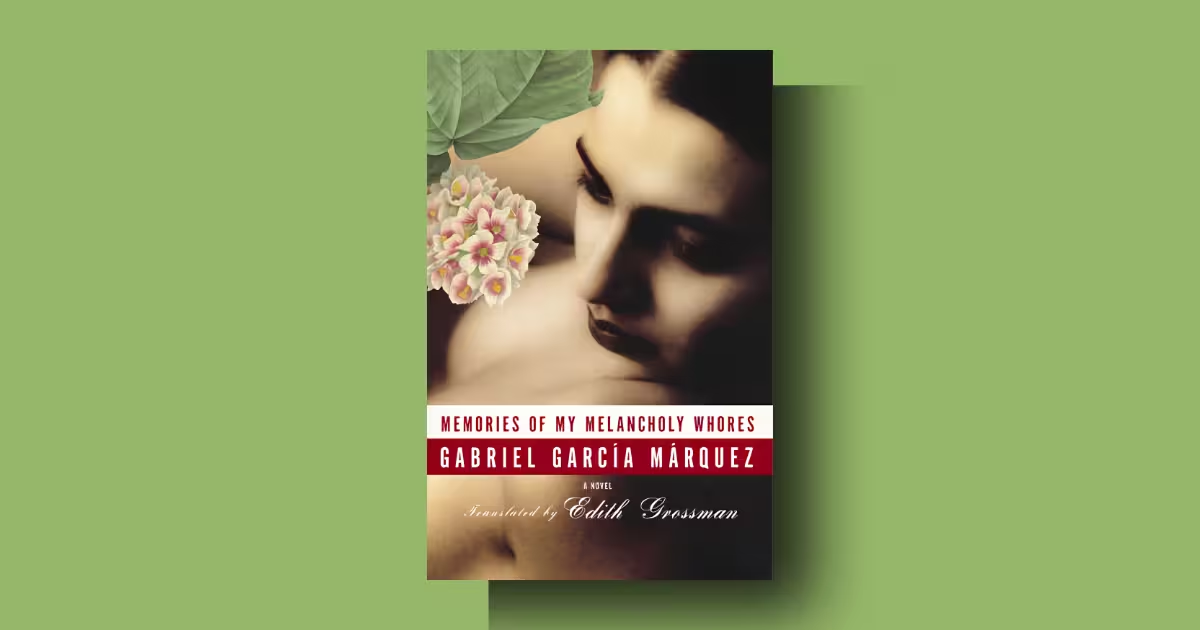

I finally read Gabriel García Márquez’s Memories of My Melancholy Whores, and I haven’t stopped thinking about it since. A 90-year-old man pays for a night with a 14-year-old virgin, then spends a year watching her sleep. It sounds like a scandal, but it’s actually a tender, uncomfortable, and unforgettable meditation on love and old age. Here’s my honest review.
Summary
Memories of My Melancholy Whores is Gabriel García Márquez’s final novella, published in Spanish in 2004 and in Edith Grossman’s English translation in October 2005. It’s a slim, 128-page book about a 90-year-old Colombian journalist who, on his birthday, arranges a night with a 14-year-old virgin. Instead of sex, he finds himself watching her sleep for a year, and he discovers love for the first time in his life.
The book was banned in Iran after selling 5,000 copies in three weeks.
A 2011 film adaptation by Danish director Henning Carlsen made $305,000 at the box office. It’s a polarizing work: John Updike called it “a velvety pleasure to read, though somewhat disagreeable to contemplate,” while Michiko Kakutani called it “a halfhearted exercise in storytelling.”
I found it to be a melancholic, beautifully written meditation on aging, memory, and the redemptive power of love, but its subject matter is genuinely uncomfortable and will not be for everyone.
Table of Contents
1. Reader Recommendation
Who will love Memories of My Melancholy Whores: Readers who appreciate lyrical, reflective prose about old age and love. Fans of García Márquez who want to see his signature style applied to a quieter, more intimate story.
Anyone interested in literary fiction that explores the psychology of loneliness and the fear of death without flinching. If you liked Love in the Time of Cholera but want something shorter and more ambiguous, this might work for you.
Who will bounce: Readers who cannot get past the premise of a 90-year-old man paying for a 14-year-old girl’s virginity. If the age gap and the transactional nature of the relationship make Memories of My Melancholy Whores impossible to enjoy, you are not alone.
Many readers and critics found the narrator’s actions and the book’s framing morally repugnant. Also, if you prefer plot-driven fiction, this novella is almost entirely internal and reflective.
2. Introduction
Title: Memories of My Melancholy Whores (Memoria de mis putas tristes)
Author: Gabriel García Márquez
Original Publication: 2004 (Spanish), 2005 (English, trans. Edith Grossman)
Publisher: Editorial Norma (Colombia), Alfred A. Knopf (US)
Pages: 128
Genre: Literary fiction, novella
Gabriel García Márquez won the Nobel Prize in Literature in 1982. Memories of My Melancholy Whores was his first work of fiction in a decade, following Of Love and Other Demons in 1994. It was published when he was 77 years old, and it reads like a meditation on his own mortality. The book is dedicated to his wife, Mercedes, and it carries the weight of a writer who knows he is near the end of his life.
3. Background
García Márquez wrote Memories of My Melancholy Whores in the early 2000s, when he was in his mid-70s. He had been diagnosed with lymphatic cancer in 1999, and while he survived, the experience shaped his later work. The book was published in October 2004, and a million copies went on sale in Latin America and Spain. A clandestine version had been circulating in Colombia before the official release, which the publishers celebrated outwitting.
The novella’s title in Spanish, Memoria de mis putas tristes, is more blunt and melancholic than the English. The English title, chosen by the publisher, preserves the awkwardness. The book was translated by Edith Grossman, who also translated Love in the Time of Cholera and Don Quixote. Her translation captures the narrator’s voice, which is formal, self-aware, and tinged with sadness.
One notable detail: the protagonist claims to have slept with 514 women by the time he was 50. This figure has been read by some critics as an echo of García Márquez’s own reputation as a womanizer, though the author never confirmed this.
4. Memories of My Melancholy Whores Summary
The narrator is an unnamed Colombian journalist who lives alone in a colonial house in an unnamed city (widely understood to be Barranquilla). He is 90 years old. He has never been married, never been in love, and has spent his entire life paying for sex. He has kept a record of his encounters: by the time he was 50, he had been with 514 women. He stopped counting when his body could no longer keep up.
The novella opens with the famous line: “The year I turned ninety, I wanted to give myself the gift of a night of wild love with an adolescent virgin.” He calls Rosa Cabarcas, the madam of a brothel he has known for decades. She tells him it’s impossible, but she calls back an hour later to say she has found the perfect girl.
The girl is 14 years old and works all day in a factory attaching buttons to support her family. Rosa gives her a mixture of bromide and valerian to calm her nerves. When the narrator arrives at 10 p.m., the girl is sound asleep.
He watches her. He doesn’t wake her. He contemplates her body, her face, her hands. He notices she is drenched in perspiration, that her skin is rough and mistreated, that her breasts are still like a boy’s. He says: “That night I discovered the improbably pleasure of contemplating the body of a sleeping woman without the urgencies of desire or the obstacles of modesty.” He spends the night beside her, and in the morning he leaves the money on the pillow and kisses her forehead. He names her Delgadina, after a character in a song he sings to her.
He returns night after night. He never wakes her. He brings her things: a fan, a painting, a record player, books. He reads to her while she sleeps. He tells her about his life. He begins to feel things he has never felt before. He writes his Sunday columns as love letters to her, though his readers don’t know it. He becomes famous as “the maestro of love.” His editor tells him: “Make no mistake: peaceful madmen are ahead of the future.”
The narrator’s life before this is sketched in fragments. He was a mediocre student, a mediocre journalist, a mediocre teacher. He was once engaged to a woman named Ximena Ortiz, but he left her at the altar. He has never had intimate friends. He has never traveled. He lives with his memories and his books and his cat.
He also begins to notice his own aging in ways he never did before. He realizes that his obsession with order and punctuality was “a complete system of pretense invented by me to hide the disorder of my nature.” He re-reads the classics and finds he can no longer bear them. He discovers that “the invincible power that has moved the world is unrequited, not happy love.”
Then disaster strikes. One night, one of Rosa Cabarcas’s important clients is stabbed to death in the brothel. The killer escapes. Rosa Cabarcas disappears. The narrator is terrified for Delgadina. He searches for her for weeks. He goes to the brothel, which has been sealed by the health department. He goes to the shirt factory where she works, but he can’t recognize her among the three hundred girls sewing buttons. He almost loses his mind. He stops eating, stops bathing, stops writing.
Rosa Cabarcas finally calls. She had been in Cartagena, hiding from the scandal. She tells him the girl is fine and available. He goes to see her. But when he arrives, Delgadina is transformed. She has grown. Her breasts have developed. She is wearing expensive clothes and jewelry. The narrator is blinded by jealousy. He assumes Rosa Cabarcas sold the girl’s virginity to another client. He screams “Whore!” and smashes the room: lamps, radio, fan, mirrors, pitchers, glasses. The girl curls up in terror but is unharmed.
Rosa Cabarcas appears in the doorway. She is not angry. She says: “My God! What I wouldn’t give for a love like this!” She takes him to her house and explains the truth. The girl’s fine clothes were rented. The jewels were fake. She had bathed her, dressed her, sent her to the hairdresser, all for him. The narrator doesn’t believe her. He screams “Damned whores!” and leaves, vowing never to return.
He spends months in agony. He loses weight. He can’t sleep. He can’t read. He can’t listen to music. He is dying of love. Then he runs into Casilda Armenta, an old prostitute he used to frequent. She is now married to a Chinese vegetable farmer and is content. She listens to his story and tells him: “Do whatever you want, but don’t lose that child. There’s no greater misfortune than dying alone.” She also tells him: “Don’t let yourself die without knowing the wonder of fucking with love.”
He calls Rosa Cabarcas. He apologizes. He asks for Delgadina. Rosa tells him the girl is working in a new job, better paid than sewing buttons. He is jealous again. But Rosa tracks her down, and the girl returns. The narrator kisses every inch of her body as penance. He promises to repeat the apology forever. He pawns his mother’s jewels to pay for the room’s repairs, only to discover that his mother had already replaced the real stones with fakes decades ago. He keeps them as a memento of a mother he never really knew.
The novella ends on the narrator’s 91st birthday. He has survived his 90th year. He tells Rosa Cabarcas he wants to buy the house, the shop, the orchard, everything, and leave it all to Delgadina. Rosa proposes a bet: whoever survives keeps everything. He refuses. He wants everything to go to the girl. Rosa agrees to take care of her.
The final lines: “I went out to the street, radiant, and for the first time I could not recognize myself on the remote horizon of my first century. My house, silent and in order at six-fifteen, began to enjoy the colors of a joyous dawn. Damiana was singing at the top of her voice in the kitchen, and the resuscitated cat twined his tail around my ankles and continued walking with me to my writing table.
I was arranging my languishing papers, the inkwell, the goose quill, when the sun broke through the almond trees in the park and the river mail packet, a week late because of the drought, bellowed as it entered the canal in the port.
It was, at last, real life, with my heart safe and condemned to die of happy love in the joyful agony of any day after my hundredth birthday.”
5. Memories of My Melancholy Whores Analysis
5.1. Characters
The Narrator: He is unnamed, which makes him both specific and universal. He is ugly, shy, anachronistic, and deeply lonely. He has spent his entire life avoiding intimacy by paying for sex. He says: “I have never gone to bed with a woman I didn’t pay.”
His transformation is the heart of the book. He doesn’t become a better person in any conventional sense. He doesn’t stop being selfish or petty. But he learns to love, and that love changes how he sees everything. His voice is formal, self-deprecating, and often funny. He is aware of his own absurdity. He calls himself “a bachelor without a future, a mediocre journalist” and “a favorite of caricaturists because of my exemplary ugliness.”
Delgadina: She is 14 years old. She works in a factory. She sleeps through almost the entire novella. She is more symbol than character, which is both the book’s strength and its weakness. She represents youth, beauty, possibility, and the narrator’s last chance at connection. She is also a real person with a real life that the narrator barely understands. She supports her family.
She has a disabled mother and younger siblings. She is exhausted. The narrator’s love for her is partly love for the idea of her, but it is also love for her specific body, her specific smell, her specific way of sleeping.
He notices the calluses on her hands from sewing buttons. He notices the thimble on her finger. He notices that she is “drenched in phosphorescent perspiration.”
Rosa Cabarcas: She is the madam of the brothel. She is old, fat, and pragmatic. She has known the narrator for decades. She is not sentimental, but she is not cruel either. She is a businesswoman. She tells the narrator: “Morality, too, is a question of time.” She is the one who arranges everything, who takes care of Delgadina, who protects the narrator from scandal. She is, in her own way, a kind of guardian angel.
She also has the best lines in the book. When the narrator smashes the room, she says: “My God! What I wouldn’t give for a love like this!” She is the only character who fully understands what is happening.
Damiana: The narrator’s housekeeper. She has worked for him for decades. She is almost a girl when she first appears, “Indianlike, strong, rustic, her words few and brusque.” The narrator has sex with her once, from behind, while she is doing the laundry. He tries to pay her, but she refuses. He raises her salary instead. Years later, when she is old and losing her sight, she tells him: “I cried over you for twenty-two years.”
And: “You won’t believe me but thanks be to God, I’m still a virgin.” She is a minor character, but she represents the life the narrator could have had, the love he ignored.
5.2. Memories of My Melancholy Whores Themes
Love and Late Life: The central theme is that love can arrive at any age, even when you have given up on it. The narrator has never been in love. He has confused sex with intimacy. He has paid for everything. But when he meets Delgadina, he discovers something new.
He says: “I was ignorant of the arts of seduction and had always chosen my brides for a night at random, more for their price than their charms, and we had made love without love, half-dressed most of the time and always in the dark, so we could imagine ourselves as better than we were.” Delgadina teaches him to see, to wait, to feel. He says: “Sex is the consolation you have when you can’t have love.” But he learns that love is something else.
Aging and Death: The narrator is obsessed with his own mortality. He measures his life in decades. He feels his body failing. He says: “I don’t have to say so because people can see it from leagues away: I’m ugly, shy, and anachronistic.”
He also says: “The truth is that the first changes are so slow they pass almost unnoticed, and you go on seeing yourself as you always were, from the inside, but others observe you from the outside.”
Memories of My Melancholy Whores is a meditation on what it means to be old in a world that values youth. The narrator finds unexpected freedom in old age. He says: “It is a triumph of life that old people lose their memories of inessential things, though memory does not often fail with regard to things that are of real interest to us.”
Memory and Imagination: The narrator’s love for Delgadina is inseparable from his memory of her. He says: “My only explanation is that just as real events are forgotten, some that never were can be in our memories as if they had happened.” He imagines her life. He imagines her thoughts. He imagines a whole domestic life with her that never happened. He says: “I had her in my memory with so much clarity that I could do what I wanted with her.” This is both beautiful and troubling. It raises questions about whether love can be real when it is so one-sided.
Prostitution and Intimacy: The book is full of prostitutes. The narrator has slept with hundreds. Rosa Cabarcas runs a brothel. Delgadina is sold for her virginity. But the book is not really about prostitution as a social issue. It is about what prostitution means for intimacy.
The narrator pays for sex because he is afraid of the alternative. He says: “I have never gone to bed with a woman I didn’t pay.” He doesn’t know how to be vulnerable. He doesn’t know how to be rejected. Paying is safe. But it is also lonely. Delgadina, ironically, is the first woman he doesn’t actually sleep with, and she is the first woman he truly loves.
The Sleeping Woman: Delgadina is almost always asleep. This is not an accident. The sleeping woman is a symbol of unattainable beauty, of innocence, of the narrator’s own passivity. He watches her. He doesn’t wake her. He says: “I preferred her asleep.” This is partly because he is afraid of what she would say if she woke. It is also because he can project onto her whatever he wants. She is a blank screen. She is a dream.
The book’s epigraph, from Yasunari Kawabata’s House of the Sleeping Beauties, makes this explicit: “He was not to do anything in bad taste, the woman of the inn warned old Eguchi. He was not to put his finger into the mouth of the sleeping girl, or try anything else of that sort.”
The Cat: The narrator adopts an old cat that the typographers give him. He doesn’t like cats. He says: “I have very bad chemistry with animals, just as I do with children before they begin to speak.” But he takes care of the cat anyway.
The cat becomes a mirror for the narrator. Both are old. Both are alone. Both are stubborn. The cat disappears and returns. The narrator spends the book learning to care for something other than himself.
6. Evaluation
This is a book I have not stopped thinking about since I finished it. It is short, but it is not slight. It is uncomfortable, but it is also tender.
It is, I think, a masterpiece of late style, a book written by an old man about what it feels like to be old, to be lonely, to be surprised by love when you have given up on it. Memories of My Melancholy Whores is a beautiful, aching, morally complicated novella that I found impossible to put down and impossible to forget.
6.1. Strengths / Positive Experiences
The prose is exquisite. García Márquez has always been a master of the sentence, and here he is at his most controlled. The book is full of images that stay with you: the girl “drenched in phosphorescent perspiration,” the narrator’s “horse’s face,” the room full of smashed lamps and mirrors. The narrator’s voice is one of the best things about the book.
He is funny, self-aware, and deeply sad. He says things like: “Shit, what can I do if you don’t love me?” And: “I’m really sorry I can’t oblige you.”
The book is also surprisingly funny, in a dark way. The scene where the narrator rides a bicycle in the store and sings at the top of his lungs is genuinely joyful.
6.2. Weaknesses / Negative Experiences
The premise is difficult. A 90-year-old man paying for a 14-year-old virgin is not an easy thing to read about, and the book does not always earn its own provocation.
Delgadina is barely a character. She is a symbol, a sleeping beauty, a projection. Some readers will find this dehumanizing. Michiko Kakutani, writing for The New York Times, called the book “a halfhearted exercise in storytelling” and criticized the narrative and protagonist as banal.
I don’t agree with her entirely, but I understand where she is coming from. The ending is also a bit too neat, a bit too redemptive. The narrator gets to die of “happy love,” while the girl’s future is left vague.
6.3. Impact / Controversy
Memories of My Melancholy Whores was banned in Iran after selling 5,000 copies in three weeks. It was published under the title Memories of My Melancholy Sweethearts, and when the censors realized the word “whores” had been sanitized, they banned it for immorality. This is a reminder that the book’s subject matter still has the power to shock. In the Spanish-speaking world, the book was a bestseller. A million copies went on sale in Latin America and Spain.
A 2011 film adaptation by Danish director Henning Carlsen, starring Emilio Echevarría, made $305,000 at the box office. It received the Special Young Jury Prize at the Málaga Spanish Film Festival.
6.4. Comparison with Similar Works
The book is often compared to Kawabata’s House of the Sleeping Beauties, which is also about an old man who watches young women sleep. But García Márquez’s book is warmer, funnier, and more hopeful. It is also compared to Love in the Time of Cholera, which is also about love in old age. But Love in the Time of Cholera is epic, spanning decades, while Memories of My Melancholy Whores is compressed, almost claustrophobic.
It is also, in some ways, a response to Lolita. Nabokov’s Humbert Humbert is a monster who knows he is a monster. García Márquez’s narrator is not a monster. He is a sad, lonely old man who stumbles into something like grace.
7. Personal Insight with Contemporary Educational Relevance
The most important theme in Memories of My Melancholy Whores, for me, is the idea that love can arrive at any age. This is not just a romantic notion. It is a lesson that has real-world implications, especially now, when loneliness is being called an epidemic.
According to a 2023 report from the World Health Organization, loneliness and social isolation affect a significant portion of older adults worldwide, and they are linked to increased risks of depression, cognitive decline, and even premature death. The narrator in Memories of My Melancholy Whores is a case study in what happens when someone avoids intimacy for a lifetime. He is not happy. He is not fulfilled.
He is, in his own words, “a bachelor without a future.” But he is also not beyond saving. His love for Delgadina, however problematic, gives him a reason to live. It gives him something to look forward to. It gives him a reason to fix his house, to re-read his books, to write his columns with passion. This is not a fairy tale. The narrator is still old. He is still going to die. But he dies of “happy love,” not of loneliness.
Five lessons I took from Memories of My Melancholy Whores:
- You are never too old to be surprised. The narrator thought his life was over. He was wrong.
- Paying for intimacy is not the same as intimacy. The narrator had 514 women and no love.
- Memory is not the same as reality. The narrator’s love for Delgadina is partly based on what he imagines, not what he knows.
- You can change your life at any age. The narrator does. He becomes a different man.
- Love is not a condition of the spirit but a sign of the zodiac. This is one of the narrator’s own lines, and I still don’t fully understand it, but I think it means that love is something that happens to you, not something you create.
8. Memories of My Melancholy Whores Quotes
- “The year I turned ninety, I wanted to give myself the gift of a night of wild love with an adolescent virgin.”
- “I discovered the improbably pleasure of contemplating the body of a sleeping woman without the urgencies of desire or the obstacles of modesty.”
- “Sex is the consolation you have when you can’t have love.”
- “Age isn’t how old you are but how old you feel.”
- “No matter what, nobody can take away the dances you’ve already had.”
- “Just as real events are forgotten, some that never were can be in our memories as if they had happened.”
- “I learned, in short, that love is not a condition of the spirit but a sign of the zodiac.”
- “Make no mistake: peaceful madmen are ahead of the future.”
- “In the end, it is impossible not to become what others believe you are.”
- “What matters in life is not what happens to you but what you remember and how you remember it.”
- “My only explanation is that just as real events are forgotten, some that never were can be in our memories as if they had happened.”
- “The truth is that the first changes are so slow they pass almost unnoticed, and you go on seeing yourself as you always were, from the inside, but others observe you from the outside.”
- “It is a triumph of life that old people lose their memories of inessential things, though memory does not often fail with regard to things that are of real interest to us.”
- “I have never gone to bed with a woman I didn’t pay.”
- “My God! What I wouldn’t give for a love like this!”
9. Conclusion
I don’t know if I can recommend Memories of My Melancholy Whores without reservations. It is not for everyone. The premise is difficult. The narrator is not always likable.
Delgadina is barely a character. But it is a beautiful book. It is a book that made me feel things I didn’t expect to feel. It made me think about my own life, my own fears, my own capacity for love. If you are a fan of García Márquez, you should read it.
If you are interested in literary fiction about aging and memory, you should read it. If you are looking for a short, intense, morally complex read that will stay with you for a long time, you should read it. But go in with your eyes open. This is not Love in the Time of Cholera. It is something smaller, stranger, and, in its own way, just as powerful.