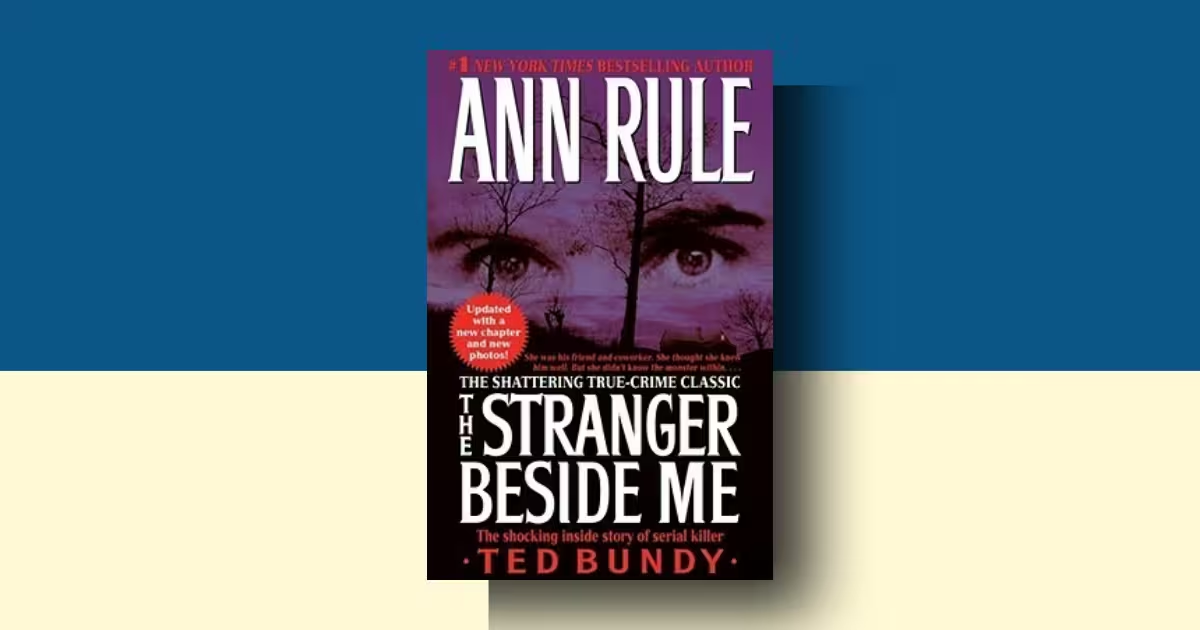

The Stranger Beside Me: Ted Bundy: The Shocking Inside Story by Ann Rule is one of the rare books that burrows into your consciousness and refuses to leave.
Published in 1980 and updated multiple times before Rule’s death in 2015, this book isn’t just about a serial killer. It’s about betrayal, friendship, and the terrifying realization that evil doesn’t always announce itself with horns and a pitchfork.
I first picked up this book expecting a straightforward true crime account. What I found instead was something far more unsettling: a firsthand memoir from a woman who considered Ted Bundy a close friend while he was simultaneously committing some of the most horrific murders in American history.
Ann Rule wasn’t just any true crime writer. Before becoming the genre’s most celebrated author, she was a Seattle policewoman in the 1950s and a volunteer at the Crisis Clinic in 1971. That’s where she met Ted Bundy. They worked the late-night shift together, answering calls from suicidal and desperate people. She was thirty-five, a mother of four, going through a divorce.
He was twenty-four, a psychology student who seemed destined for greatness.
Rule wrote this book from a place of genuine anguish. You can feel it on every page. She doesn’t approach Ted Bundy as an abstract monster. She writes about him as the charming young man who once brought her coffee, who listened to her problems, who seemed like “the perfect man” for any woman lucky enough to catch his attention.
That’s what makes this book so devastating. It’s not just a chronicle of murder. It’s a chronicle of a friendship that turned out to be built on a foundation of lies, manipulation, and blood.
Brief Summary
What is The Stranger Beside Me about?
Ann Rule’s 1980 true crime classic details her friendship with Ted Bundy, whom she worked with at a Seattle crisis hotline in 1971, and her gradual realization that her charming friend was a serial killer responsible for dozens of murders across multiple states.
Why should you read it?
This is the original insider account. Rule had access to Bundy’s letters, phone calls, and personal confessions that no other writer could match. She writes with both compassion and horror, creating a portrait of a killer that is far more nuanced than typical true crime fare.
Who was Ted Bundy?
Theodore Robert Bundy (1946-1989) was convicted of murdering at least thirty women and girls across Washington, Utah, Colorado, and Florida between 1974 and 1978. He was executed by electric chair in Florida on January 24, 1989.
Key takeaway:
Evil can wear a friendly face. The people closest to a predator may be the last to see the truth.
About the Author: Ann Rule’s Unique Credentials
Ann Rule brought something to this book that no other true crime writer could claim. She wasn’t just reporting on Ted Bundy from a distance. She was processing her own grief, guilt, and confusion about a man she genuinely cared about.
Her background gave her unique access to law enforcement. Rule had served as a Seattle policewoman in the 1950s and had spent years cultivating relationships with homicide detectives throughout the Pacific Northwest. By 1974, when the first Bundy victims began disappearing, she had already published over 800 articles in True Detective and similar magazines.
She also had degrees in creative writing, psychology, criminology, and penology from the University of Washington. Her education helped her understand the psychological dimensions of Bundy’s crimes in ways that other writers might have missed.
But the most important credential is emotional. Rule walked a tightrope for years. She was writing a book about the “Ted” murders while maintaining contact with Ted Bundy himself, often helping him financially and communicating with him regularly. She couldn’t tell him what she knew. She couldn’t warn him what the police suspected. She was trapped between her professional obligations and her loyalty to a friend who turned out to be a monster.
This tension gives the book its emotional power. Rule doesn’t pretend to be objective. She’s wrestling with her own complicity, her own blindness, her own failure to see what was right in front of her.
Background
Between January 1974 and June 1974, seven young women disappeared from Washington State. Lynda Ann Healy was the first. She vanished from her basement room near the University of Washington on January 31, 1974. Over the following months, Donna Manson, Susan Rancourt, Kathy Parks, Brenda Ball, Georgeann Hawkins, and finally Janice Ott and Denise Naslund disappeared.
The pattern was chilling. All the women were young, attractive, and had long hair parted in the middle. Most vanished from college campuses or areas near college campuses. There were no witnesses. No bodies. No physical evidence.
By the summer of 1974, the Seattle area was in a state of panic. Women stopped hitchhiking. Parents kept their daughters home after dark. The Tacoma News Tribune reported that “the reading public knew of the pattern of missing girls… And the public was terrified” (Page 116).
Then on July 14, 1974, something changed.
Two women vanished from Lake Sammamish State Park in a single afternoon. Janice Ott disappeared around 12:30 PM. Denise Naslund vanished around 4:30 PM. Witnesses saw a handsome man with his arm in a sling approaching women, asking for help loading a sailboat onto his car. He introduced himself as “Ted.”
Finally, police had a lead. They had a description, a name, and a composite sketch. But “Ted” vanished as mysteriously as he had appeared.
The Moment That Changed Everything
On September 25, 1975, Ann Rule received a phone call that would alter her life completely. Ted Bundy was in a Salt Lake City jail, arrested on kidnapping charges related to Carol DaRonch. He wanted Rule to find out why police were subpoenaing his law school records.
Rule called the King County Police. The response chilled her. A detective told her to tell Ted “he’s just one of 1,200 people being checked out, that it’s just a routine inquiry” (Page 194). But Rule knew better. She had worked with police long enough to know when they were bluffing.
She wrote in the book: “I felt a chill. Not even a television script could make it believable that a crime writer could sign a contract to write a book about a killer, and then have the suspect turn out to be her close friend. It wouldn’t wash” (Page 194).
This was the beginning of a nightmare that wouldn’t end until Ted Bundy was executed fourteen years later.
Reader Recommendations: Who Will Actually Love This Book
You’ll Love The Stranger Beside Me If:
- You’re interested in the psychology of serial killers, not just the gory details
- You want to understand how intelligent, charming people can commit horrific crimes
- You appreciate true crime written with emotional depth and moral complexity
- You’re fascinated by the ethical dilemmas journalists face when covering people they know
- You want to read the original source material that inspired countless other books, documentaries, and films
You Might Bounce If:
- You’re looking for a detached, objective analysis of Ted Bundy’s crimes
- You prefer true crime that focuses primarily on police procedures and forensic science
- You’re uncomfortable with a narrator who expresses sympathy for a serial killer
- You want definitive answers rather than ongoing questions about human nature
- You’re looking for a quick read. This book is dense and emotionally demanding
The Book’s Central Ideas: The Mask of Sanity
The most important argument Rule makes is that Ted Bundy was not an obvious monster. He was intelligent, charming, and handsome. He could be kind, thoughtful, and genuinely helpful. He worked at a suicide hotline saving lives while simultaneously taking them.
Rule quotes Dr. Herve Cleckley, an expert on antisocial personality disorder, who explained: “The observer is confronted with a convincing mask of sanity. We are dealing with not a complete man at all, but with something that suggests a subtly constructed reflex machine which can mimic the human personality perfectly” (Page 527).
This is the book’s enduring lesson. Ted Bundy fooled everyone. His own mother believed in his innocence until the end. His girlfriend Meg Anders stayed loyal despite mounting evidence. His friends and coworkers couldn’t believe the accusations.
Rule herself was fooled. She admits this openly and painfully. She writes about how Ted seemed “kind, considerate, and honest” when she knew him. She recalls thinking that “if I were younger and single or if my daughters were older, this would be almost the perfect man” (Page 67-68).
The fact that she could feel this way about a man who dismembered women and had sex with their corpses is the book’s most disturbing revelation. It forces readers to confront uncomfortable questions. How well can we really know anyone? What signs do we miss because we don’t want to see them?
Ted Bundy’s Trail of Terror: The Full Scope
One of the most valuable aspects of Rule’s book is its comprehensive accounting of Bundy’s crimes. Before his execution in 1989, Bundy confessed to at least thirty murders. Rule explores the full scope of his killing spree across seven states.
Washington State Victims
- Katherine Merry Devine (15): Disappeared November 25, 1973. Body found December 6, 1973, in McKenny Park near Olympia.
- Lynda Ann Healy (21): Vanished January 31, 1974, from her basement room in Seattle.
- Donna Gail Manson (19): Disappeared March 12, 1974, from Evergreen State College.
- Susan Elaine Rancourt (18): Vanished April 17, 1974, from Central Washington State College.
- Roberta Kathleen “Kathy” Parks (20): Disappeared May 6, 1974, from Oregon State University.
- Brenda Carol Ball (22): Vanished June 1, 1974, from a tavern in Burien.
- Georgeann Hawkins (18): Disappeared June 11, 1974, from an alley behind the University of Washington sorority row.
- Janice Anne Ott (23): Vanished July 14, 1974, from Lake Sammamish State Park.
- Denise Marie Naslund (19): Disappeared July 14, 1974, from the same park.
Utah Victims
- Nancy Wilcox (16): Disappeared October 2, 1974, from Holladay.
- Melissa Smith (17): Vanished October 18, 1974, from Midvale. Her father was the police chief.
- Laura Aime (17): Disappeared October 31, 1974, from Lehi.
- Debby Kent (17): Vanished November 8, 1974, from Bountiful, during a high school play.
- Carol DaRonch (18): Survived a kidnapping attempt on November 8, 1974. Her testimony convicted Bundy in 1976.
Colorado Victims
- Caryn Campbell (23): Disappeared January 12, 1975, from the Wildwood Inn in Aspen.
- Julie Cunningham (26): Vanished March 15, 1975, from Vail.
- Denise Oliverson (25): Disappeared April 6, 1975, from Grand Junction.
- Melanie Cooley (18): Vanished April 15, 1975, from Nederland.
- Shelley Robertson (24): Disappeared July 1, 1975, from Golden.
Florida Victims
- Margaret Bowman (21): Murdered January 15, 1978, at the Chi Omega sorority house at Florida State University.
- Lisa Levy (20): Murdered the same night at Chi Omega.
- Karen Chandler (21): Survived the Chi Omega attack with severe injuries.
- Kathy Kleiner (19): Survived the Chi Omega attack.
- Cheryl Thomas (21): Survived an attack at her duplex on Dunwoody Street.
- Kimberly Leach (12): Disappeared February 9, 1978, from Lake City. Body found April 7, 1978.
The sheer scope of these crimes is staggering. Rule’s book helps readers understand that Bundy wasn’t just a killer. He was a predator who moved across state lines, adapting his methods to avoid detection. He worked across multiple jurisdictions, making it nearly impossible for any single police department to connect the dots.
The Stranger Beside Me summary: What I Learned
The Compartmentalization of Evil
Ted Bundy lived multiple lives simultaneously. He had Meg Anders in Seattle, Stephanie Brooks in California, Sharon Auer in Utah, and Carole Ann Boone in Washington and Florida. None of these women knew about the others. He maintained a successful academic career, worked in Republican politics, and saved lives at a crisis hotline.
Rule writes: “Ted’s life was so carefully compartmentalized that he was able to be one person with one woman, and an entirely different man with another. He moved in many circles, and most of his friends and associates knew nothing of the other areas in his life” (Page 81).
This compartmentalization allowed Bundy to avoid detection. When one relationship became too complicated, he moved to another city, another identity, another woman. His crimes followed the same pattern.
The Role of Alcohol and Pornography
In his final interview with Dr. James Dobson just hours before his execution, Bundy blamed his crimes on pornography and alcohol. He claimed that exposure to violent sexual material as a young boy had warped his mind.
Rule is skeptical of this explanation. She points out that Bundy lied throughout his life and likely lied at the end. She writes: “I don’t think pornography caused Ted Bundy to kill thirty-six or one hundred or three hundred women. I think he became addicted to the power his crimes gave him” (Page 636).
This disagreement between Bundy’s final narrative and Rule’s interpretation is important. It shows how Bundy continued to manipulate people until the very end, crafting a narrative that would leave people debating his motives rather than focusing on his victims.
The Power of Denial
One of the most heartbreaking aspects of the book is watching the women who loved Bundy refuse to see the truth. Meg Anders turned him in to police but then took him back. Carole Ann Boone married him during his murder trial and gave birth to his child. His mother Louise never fully accepted his guilt.
Rule captures this dynamic perfectly: “I have been manipulated to suit Ted’s needs. I don’t feel particularly embarrassed or resentful about that. I was one of many, all of us intelligent, compassionate people who had no real comprehension of what possessed him” (Page 520).
This is a powerful reminder that intelligence doesn’t protect us from manipulation. Emotional needs can override rational judgment. Denial is a powerful force.
The Ethical Dilemma at the Heart of the Book
Rule faced an impossible situation. She had a book contract about the “Ted” murders months before Ted Bundy became a suspect. When she realized her friend might be the killer, she had to decide what to do.
She called Detective Dick Reed and asked him to run a check on Bundy’s vehicle registration. When it came back showing a bronze Volkswagen Bug, she felt sick. But she didn’t tell Ted what she knew. She didn’t warn him.
Instead, she continued writing to him. She sent him money. She maintained their friendship while privately believing he was guilty of unspeakable crimes.
She writes: “I didn’t know what I believed, and all my letters were couched in terms that were deliberately ambiguous. They contained information on what was appearing in the local press, details about what I was writing, and on calls from mutual friends. I tried to block the pictures that occasionally seized my mind and shook it” (Page 199).
This moral ambiguity is what makes the book so compelling. Rule isn’t a hero. She isn’t a villain. She’s a human being caught in an impossible situation, trying to balance her obligations to her family, her profession, and her friend.
The Stranger Beside Me Critical Analysis
What Works Brilliantly
Unmatched Access: No other writer had the access that Ann Rule had. She had Bundy’s letters, his phone calls, his confessions. She knew him before the crimes and after. She could track his psychological deterioration over time in ways that other writers could only guess at.
Emotional Honesty: Rule doesn’t pretend to be objective. She admits her confusion, her guilt, her anger. She writes about the dream she had in 1976 where she was trying to save a baby that turned out to be a demon. This dream perfectly captures her internal conflict.
Comprehensive Scope: The book covers all of Bundy’s known crimes across seven states. It provides details that are often missing from other accounts.
Historical Context: Rule explains the culture of the 1970s in ways that help readers understand why Bundy was able to operate for so long. Women were encouraged to be helpful and trusting. Hitchhiking was common. Police departments didn’t communicate well across jurisdictions.
Where the Book Struggles
Self-Indulgence: Some readers find Rule’s personal reflections excessive. She spends a lot of time on her own feelings and experiences. For readers who want a more straightforward true crime narrative, this can feel distracting.
Speculation: Rule sometimes speculates about Bundy’s mental state and motivations in ways that go beyond the evidence. She admits that she has no formal training in psychiatry, yet she offers diagnoses and psychological theories.
Incomplete Answers: Despite its length, the book leaves many questions unanswered. We never learn why Bundy became a killer. We never understand the full extent of his crimes. This is frustrating for readers who want closure.
Dated Perspectives: Some of Rule’s language about mental illness and sexuality reflects the era in which the book was written. Modern readers may find some passages uncomfortable.
The Stranger Beside Me in Context
The Deliberate Stranger by Richard W. Larsen (1980)
Larsen was a Seattle Times reporter who covered the Bundy case from the beginning. His book is more journalistic and less personal than Rule’s. It provides valuable information about the police investigation but lacks the emotional depth of The Stranger Beside Me.
The Only Living Witness by Stephen Michaud and Hugh Aynesworth (1983)
This book is based on extensive interviews with Bundy and is often considered the definitive account of his crimes. It’s more detailed about the murders themselves but lacks the insider perspective that Rule brings.
The Phantom Prince: My Life with Ted Bundy by Elizabeth Kendall (1981)
Meg Anders (real name Elizabeth Kendall) wrote her own memoir about her relationship with Bundy. It provides a complementary perspective, showing what it was like to love a man who turned out to be a monster. Rule references this book in her updates.
Ted Bundy: Conversations with a Killer by Stephen Michaud and Hugh Aynesworth (1989)
This is a transcript of the death row interviews that formed the basis for many later documentaries. It’s valuable as primary source material but lacks narrative structure.
The Legacy of The Stranger Beside Me
Since its publication in 1980, The Stranger Beside Me has sold millions of copies and been updated multiple times. It has been adapted into television movies and inspired countless other true crime books, podcasts, and documentaries.
But its influence extends beyond sales figures. The book helped establish the modern true crime genre. It showed that true crime could be literary, emotionally complex, and morally serious. Rule’s willingness to insert herself into the narrative paved the way for writers like Michelle McNamara, Robert Kolker, and countless others.
More importantly, the book has served as a warning. Rule has received letters from women who say they escaped dangerous situations because they read her book. She writes in the 2008 update: “I still want to save women’s lives… just one more would be important to me” (Page 13).
This is the book’s most important legacy. It’s not just a story about a killer. It’s a survival guide disguised as a memoir.
Conclusion: Why This Book Still Matters
The Stranger Beside Me is not an easy book to read. It’s long, dense, and emotionally exhausting. It forces you to confront uncomfortable truths about human nature, about the people we trust, and about our own capacity for denial.
But that’s exactly why you should read it.
Ted Bundy was executed on January 24, 1989. Ann Rule died on July 26, 2015. But the questions they raised together remain unanswered. How do we recognize evil when it wears a friendly face? How do we protect ourselves without becoming paranoid? How do we balance compassion with caution?
Rule doesn’t offer easy answers. She doesn’t pretend to understand what made Ted Bundy a killer. She doesn’t excuse his crimes or minimize the suffering of his victims. She simply tells her story as honestly as she can.
And in doing so, she created something rare: a true crime book that is also a work of literature. A book that is as much about the narrator as it is about the killer. A book that asks readers to examine their own assumptions about trust, safety, and the nature of evil.
If you’re going to read one true crime book in your life, make it this one. It will haunt you. It will make you think. And it might just save your life.
Related Books, Films, and Articles
Books:
- The Only Living Witness by Stephen Michaud and Hugh Aynesworth
- The Deliberate Stranger by Richard W. Larsen
- The Phantom Prince by Elizabeth Kendall
- Ted Bundy: Conversations with a Killer by Stephen Michaud and Hugh Aynesworth
- The Bundy Murders: A Comprehensive History by Kevin M. Sullivan
Films and Documentaries:
- The Deliberate Stranger (1986 TV movie starring Mark Harmon)
- Ted Bundy (2002 film starring Michael Reilly Burke)
- Extremely Wicked, Shockingly Evil and Vile (2019 film starring Zac Efron)
- Conversations with a Killer: The Ted Bundy Tapes (2019 Netflix docuseries)
- Ted Bundy: Falling for a Killer (2020 Amazon docuseries)
Articles:
- “Ted Bundy’s Final Interview” by James Dobson (1989)
- “The Bundy Case: A Timeline” by The Seattle Times
- “How Ann Rule’s Friendship with Ted Bundy Changed True Crime” by The Guardian