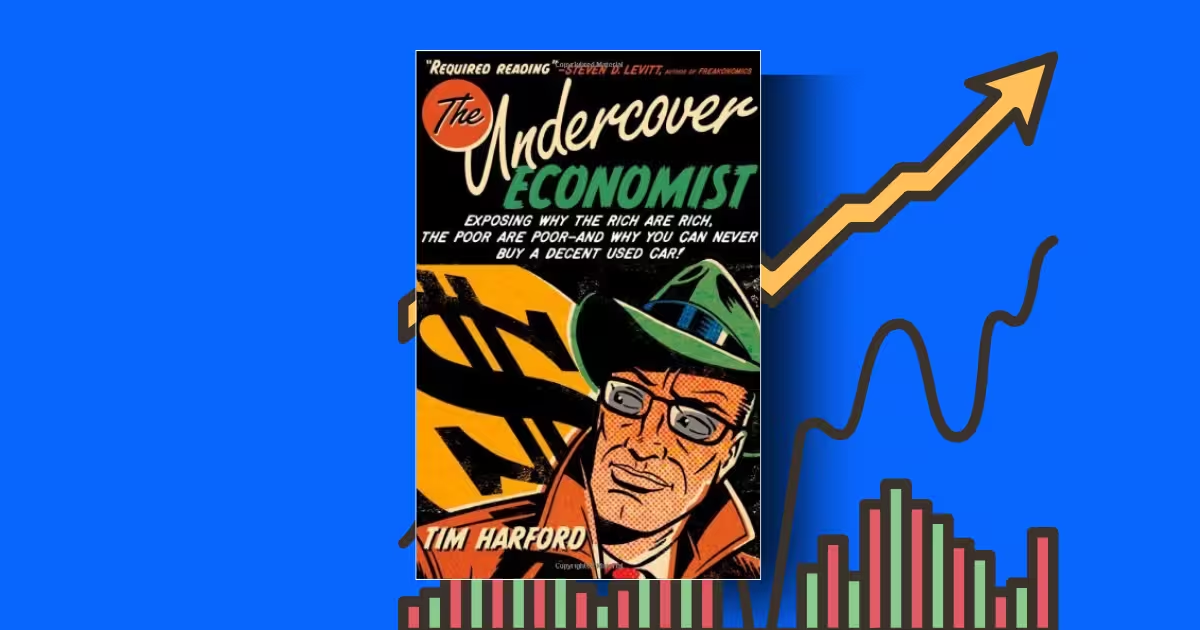
Why does the same sandwich cost more at a train station kiosk than it does four blocks away at the exact same chain? I picked up Tim Harford’s The Undercover Economist years ago chasing an answer to that one dumb, nagging question, and it quietly rewired how I read a grocery receipt, a traffic sign, and a newspaper story about a corrupt president in a country I had never visited. Twenty years after Oxford University Press first put it in American bookstores, I went back through it slowly, page by page, to see how much of it still holds.
Table of Contents
Overview
Tim Harford’s The Undercover Economist: Exposing Why the Rich Are Rich, the Poor Are Poor and Why You Can Never Buy a Decent Used Car came out in the UK from Little, Brown on November 3, 2005, and in the US from Oxford University Press on January 1, 2006.
It uses ten chapters built around ordinary situations, a cup of coffee, a supermarket aisle, a used car lot, a rush-hour traffic jam, to teach real microeconomics without a single equation: scarcity power, price discrimination, market efficiency, externalities, asymmetric information, auction theory, and development economics.
It has sold more than 1.5 million copies in over 30 languages. What surprised me on a full reread is how unevenly it has aged. The dot-com era examples (Amazon’s $40 share price, “internet portals,” the freshly minted 3G phone networks) now read as a period piece.
But the arguments about scarcity, corruption, and incentives have aged into something close to prophecy, and one storyline from Chapter 8 is, as I write this in August 2026, an active news story.
Who Will Love This Book, Who Should Skip The Undercover Economist
Read this if: you have never taken an economics class and want one that doesn’t feel like homework; you loved Freakonomics and want the version with more actual economic theory underneath the anecdotes; you keep wondering why some countries stay poor no matter how much aid money arrives; you want to understand price tags, health insurance, and stock market crashes as one connected system instead of three separate mysteries.
Skip it, or read it as history, if: you want current macroeconomic commentary (this is a pre-2008-financial-crisis book about microeconomics, not macro, Harford wrote a separate book for that, more on it below); you’re looking for a critique of markets from the left, since Harford writes from a broadly market-friendly, Ricardian point of view throughout; or you already hold an economics degree and want new theory rather than a clear restatement of old theory.
The Undercover Economist, the Author, and What It’s Actually Trying to Do
The Undercover Economist is Tim Harford’s first book, and at the time he wrote it he was a member of the Financial Times editorial board, running a column of the same name that explained the economic logic behind everyday experiences. He had also worked as an economist at Shell and at the World Bank, which is where the Cameroon material in Chapter 8 comes from directly, he traveled there himself in late 2001.
Harford went on to host the BBC Radio 4 series More or Less, write the syndicated Dear Economist advice column, and later create the Pushkin Industries podcast Cautionary Tales, which as of this writing is still releasing new episodes on a regular schedule. He was awarded an OBE and the 2007 Bastiat Prize for economic journalism.
None of that biography is padding, it matters here because the book’s authority doesn’t come from academic credentials so much as from someone who spent years translating World Bank development reports and FT market coverage into sentences a commuter could read over a cappuccino.
The Undercover Economist‘s stated purpose, laid out in its short introduction, is disarmingly simple: Harford wants you to see the “intricate game of signals and negotiations” hiding inside your morning coffee order, and then use that same way of seeing to understand why libraries in Cameroon have readers but no books while bookstores in rich countries somehow never run out of anything.
He is upfront that he will teach you nothing about exchange rates or interest rate policy. What he promises instead is detective work: taking a puzzle everybody has noticed (why is popcorn so expensive at the movies, why can’t you find a good used car) and showing you the hidden mechanism.
Background
It helps to know when The Undercover Economist landed. Steven Levitt and Stephen Dubner’s Freakonomics came out in April 2005, just months before Harford’s UK edition, and the two books are constantly compared because they arrived at almost the same moment and both promised to make economics fun.
But they’re doing different jobs. Freakonomics is built from applied statistics and clever natural experiments (sumo wrestlers, crack dealers, baby names). The Undercover Economist is built from actual price theory, the kind you’d meet in a first-year microeconomics course, just explained through Starbucks instead of graphs.
Harford is teaching you David Ricardo, George Akerlof, and Kenneth Arrow. Levitt and Dubner are teaching you how to read a dataset.
I read them back to back and The Undercover Economist is the one that left me able to explain a concept to somebody else afterward.
It’s also worth noting the book predates the 2008 financial crisis by three years. Harford later wrote The Undercover Economist Strikes Back (2013) specifically to cover macroeconomics and the crisis, so if you finish this book wanting to know what happened to banks and central banks, that’s a different book on the shelf, not a gap in this one.
The Undercover Economist Summary
I’m going to walk through all ten chapters in enough depth that you genuinely will not need to go back to the source to follow the arguments. Take your time here; this is the part that saves you the read.
Introduction. Harford opens in a bookstore café, imagining an economist sitting near you, invisible, watching you decide whether to buy his book over a cappuccino. He borrows a line from economist Paul Seabright, who quotes a bewildered Soviet official asking, essentially, “who is in charge of the supply of bread to London,” the punchline being that nobody is, and the system still works.
That’s the whole book in one sentence: massive, functioning complexity with no one in charge of it.
Chapter 1, Who Pays for Your Coffee? This is the Ricardo chapter, and it’s the load-bearing wall for everything that follows. Harford stands in a Washington DC Metro station explaining why a Starbucks charges $2.55 for a cappuccino that costs less than a dollar to make. According to economics professor Brian McManus’s research, which Harford cites directly, markups on coffee run around 150 percent.
The answer to who pockets the difference isn’t Howard Schultz, it’s the landlord. Harford rebuilds David Ricardo’s 1817 theory of agricultural rent using a fictional frontier where farmers named Axel, Bob, and Cornelius compete for meadowland, and shows that rent is set by the productivity gap between the best land and the “marginal” land, the worst land still worth farming. Swap “meadow” for “coffee kiosk next to a subway exit” and you get the same math.
He then widens the lens: the same scarcity logic explains OPEC’s 1973 oil shock (prices jumped from under $10 a barrel to $40, then $80 in today’s money), why doctors and lawyers protect their income through licensing requirements (Harford quotes George Bernard Shaw’s line that professions are “all conspiracies against the laity”), and why skilled workers benefit from unskilled immigration while unskilled workers resent it.
It’s a genuinely uncomfortable, honest section, Harford admits his own self-interest in the immigration debate before making the argument.
Chapter 2, What Supermarkets Don’t Want You to Know. This chapter is about price discrimination, though Harford calls it “price-targeting,” and it will change how you shop.
He walks through three strategies companies use to charge different customers different prices for the same product: the “unique target” approach (haggling, loyalty cards, Amazon’s brief and controversial experiment with cookie-based pricing), the “group target” approach (senior discounts, student discounts, Disney World charging Florida locals roughly half of what it charges tourists), and the cleverest one, “self-incrimination,” where companies design products that let price-insensitive customers volunteer themselves, a large cappuccino instead of a small one, whipped cream, “fair trade” markups.
On that last point, Harford did his own math on Cafédirect coffee: the actual farmer premium was less than a penny per cup, while Costa Coffee was charging customers an extra ten pence, meaning more than 90 percent of the “fair trade surcharge” never reached a farmer at all.
He also compares two Marks & Spencer stores fifteen hundred feet apart in London with prices roughly 15 percent different, and two Sainsbury’s branches that stock cheaper own-brand alternatives right next to premium products, but only in the poorer neighborhood.
His practical advice, which I’ve genuinely used since: don’t hunt for a cheap store, hunt for cheap products inside any store, since price-targeting explains far more of the difference than store quality does.
Chapter 3, Perfect Markets and the World of Truth. Harford invents a thought experiment: a “world of truth” where a barista must answer honestly if you ask what the coffee actually cost her, and where nobody can be forced to buy or sell above or below their real valuation. In that world, he argues, prices carry perfect information and the resulting market is completely efficient, meaning nobody can be made better off without making somebody else worse off.
This chapter’s real payoff is the section on Kenneth Arrow, who proved (Harford calls it the “head start theorem”) that you can combine a perfectly competitive market with lump-sum, one-time taxes or subsidies and get an outcome that is both efficient and fair, the market equivalent of moving a sprinter’s starting blocks instead of asking the fastest runner to run backward.
He uses this to explain why domestic heating fuel gets tax breaks in Britain, where The Undercover Economist notes roughly 25,000 seniors used to die each winter from inadequate heating, and why philosopher Robert Nozick’s Wilt Chamberlain argument about fairness runs into the same wall: taxing Chamberlain’s income changes his behavior, but a one-time lump-sum tax wouldn’t.
Chapter 4, Crosstown Traffic. This is the externalities chapter, and it’s the one that has aged the best of all ten, largely because London actually ran the experiment Harford describes. He distinguishes between the average price you pay to own a car (insurance, an annual tax) and the marginal price of one more trip (close to zero once you own the car), which is exactly why traffic jams happen: nothing gets more expensive at the margin no matter how many extra trips you take.
His fix is a congestion charge tied to that marginal trip. When London introduced its congestion zone in February 2003 at £5 a day, Harford reports that car trips fell by nearly a third within a year, bus trips rose 15 percent, motorcycle trips rose 20 percent, and bicycle trips rose 30 percent.
He also covers the US EPA’s 1990s sulfur dioxide permit auction: regulators had estimated cutting a ton of sulfur emissions would cost $250 to $700, maybe as much as $1,500, but the actual 1993 auction cleared at a fraction of that, and by 1996 permits were trading around $70 a ton. The lesson he draws, that a well-designed price forces the truth out of people who would otherwise lie about their costs, runs through the rest of the book.
Chapter 5, The Inside Story. Here Harford introduces George Akerlof’s 1970 “market for lemons” model, the single most famous idea a general reader is likely to take from The Undercover Economist.
If sellers know whether their used car is a “peach” or a “lemon” and buyers don’t, the market for good used cars can collapse entirely, since no honest seller can prove their car isn’t a lemon, and no buyer will pay peach prices without proof.
Harford applies this directly to US health insurance, walking through why premiums for private insurance are patchy and expensive: healthy people (peaches) drop out, sick people (lemons) stay in, premiums rise, more healthy people leave.
He backs this with real numbers: US administrative health-care costs exceeded $1,000 per person according to Harvard Medical School researchers he cites, more than three times Canada’s roughly $307 per person, and 15 percent of Americans had no coverage at all when he wrote this, compared with 0.2 percent in Germany.
His proposed fix, borrowing from Singapore’s model of mandatory medical savings accounts plus catastrophic insurance, cites Singapore’s system running at roughly $1,000 per person total (public and private combined) with life expectancy around 80 years. He closes with George Akerlof, Michael Spence, and Joseph Stiglitz’s shared 2001 Nobel Prize for exactly this family of ideas, asymmetric information, signaling, and screening.
Chapter 6, Rational Insanity. This is the stock market chapter, and it’s the one most obviously stuck in 2005. Harford explains the “random walk” theory of share prices (if a price move were predictable, rational investors would already have acted on it, erasing the predictability), then spends pages debating whether Amazon.com’s roughly $40 share price in late 2004 was justified given its eight cents of earnings per share that year.
He recounts fund manager Tony Dye, nicknamed “Dr. Doom,” who pulled £7 billion out of UK shares in 1996 believing the market was overvalued, was mocked and forced into early retirement in March 2000, right before the dot-com crash proved him correct, his fund then earned an annualized 28 percent return in the crash’s opening months.
Harford also cites Yale economist Robert Shiller’s finding that the historical price-to-earnings ratio for US stocks has always drifted back toward roughly 16, and that a ratio above 30 had only happened once before 2000, in 1928, right before economist Irving Fisher infamously declared shares had reached “a new and permanently high plateau.”
Chapter 7, The Men Who Knew the Value of Nothing. My favorite chapter, and one that hasn’t dated at all despite being entirely about auctions for a wireless technology nobody uses anymore. Harford tells the story of how governments around the world auctioned off radio spectrum for third-generation (3G) mobile networks using game theory pioneered by John von Neumann and John Nash.
New Zealand’s early-1990s auction, run with a “second-price” Vickrey design that theorists loved but the public found bizarre, one bidder who offered NZ$100,000 for a license ended up paying only NZ$6, was a public relations disaster.
The US spectrum auctions in the late 1990s were quietly gamed by companies bidding in area codes to signal territorial carve-ups to rivals, and one 1997 auction raised less than 1 percent of the expected revenue.
Then, in 2000, a UK team including economists Paul Klemperer and Ken Binmore designed an auction with five licenses (deliberately one more than the number of existing carriers, to draw in real challengers) that ran for over a month and eventually raised £22.5 billion, the biggest auction in modern history at that point. Vodafone alone paid nearly £6 billion for one license.
Chapter 8, Why Poor Countries Are Poor. This is where The Undercover Economist stops being clever and starts being genuinely moving, and it’s also the chapter I want to spend the most time on, because one of its central threads is unfolding in real news right now.
Harford traveled to Cameroon, which he describes bluntly as, at the time, one of the most corrupt countries Transparency International had ever ranked. He builds his explanation around economist Mancur Olson’s theory of the “stationary bandit”: a dictator confident he’ll hold power for decades has an incentive to let the economy grow so there’s more to steal each year, while an unstable dictator strips the country bare and runs.
Harford’s driver in Douala tells him the roads hadn’t been repaired in nineteen years, exactly matching how long Paul Biya had then been president. Harford wonders, almost in passing, whether Biya’s habitual landslide “reelections” were genuinely democratic.
Here’s where the “20 years later” angle stopped being an exercise for me and became something closer to a jolt. As of this writing in late August 2026, Paul Biya is still president of Cameroon, having just been sworn in for an eighth term after an October 2025 election his own government says he won with 53.66 percent of the vote, an outcome his chief rival called a “masquerade.”
He is 93 years old and, according to the Associated Press, spent over ten weeks abroad in Switzerland this summer with no vice president in place, prompting opposition figures to describe the country as running “on autopilot” during his absence.
That is Mancur Olson’s stationary-bandit theory, and Harford’s own unanswered question about whether the elections are democratic, playing out in real time, forty-four years into a presidency Harford was already puzzling over in 2001.
The chapter’s other unforgettable moment is what I’d call the world’s worst library: Harford visits a private school near Bamenda where a locally powerful “Bafut Mafia” education official had a two-story library built with a dramatic sloped roof shaped like an open book, purely for prestige. Nobody accounted for Cameroon’s five-month rainy season.
The roof functioned as a giant funnel, and by the time Harford saw it, four years after construction, the interior was ruined, plaster peeling, unusable, while the old library sat perfectly dry and three times bigger than the school’s book collection needed.
He also covers economist Elinor Ostrom’s study of Nepalese irrigation, where donor-funded modern dams, ironically, made systems less reliable than the traditional ones, because they broke the informal bargain between upstream and downstream farmers who used to trade dam maintenance for canal maintenance. Once the dam needed no maintenance, upstream farmers stopped helping with the canals.
Chapter 9, Beer, Fries, and Globalization. Harford opens in Bruges, once one of Europe’s great trading ports until its river silted up in the fifteenth century and trade simply moved to Antwerp, a five-century case study in what happens when a place cuts itself off from the world.
He then rebuilds Ricardo’s second big idea, comparative advantage, using a joke about himself and biologist E.O. Wilson (Wilson would write a better economics book than Harford, but should still stick to biology, since that’s where his advantage over Harford is largest). He applies this to US-China trade with a simple example: even if Chinese workers are faster at making both machine drills and televisions, both countries gain from specializing and trading.
He backs the free-trade case with real figures: the 1994 Uruguay Round trade agreement is estimated to have added roughly $100 billion to world income, and full removal of remaining trade barriers could add over 6 percent of global income.
On the sweatshop question, which The Undercover Economist handles more carefully than a summary can fully convey, Harford argues sweatshops are a step up from the alternatives (subsistence farming, scavenging landfills like Manila’s now-closed Smokey Mountain, where over 130 people died in a 2000 landslide) and a step toward something better, pointing to South Korea, where he notes the typical worker’s inflation-adjusted wage was four times what their father earned a generation earlier.
Chapter 10, How China Grew Rich. The closing chapter is Harford’s strongest piece of reporting. He describes standing in Shanghai’s People’s Park with his wife, stunned that the tallest building there a decade earlier was now dwarfed by dozens of skyscrapers.
Then he pulls back to Mao’s Great Leap Forward, where villagers were ordered to build backyard steel furnaces and melt down usable tools and doorknobs to meet quotas, producing steel too poor to use, while agricultural mismanagement (closer planting, killing grain-eating birds, which let insect populations explode) triggered a famine Harford says killed somewhere between 10 and 60 million people, even China’s own government later acknowledged roughly 30 million deaths, while it kept exporting grain to preserve the appearance of success.
He contrasts this with Deng Xiaoping’s reforms starting in 1978: the “household responsibility system,” under which farming collectives that rented land to individual families instead of managing it centrally, went from 1 percent of collectives in 1979 to 98 percent by 1983, and agricultural output grew roughly 10 percent a year through the early 1980s.
He tracks the return on capital investment climbing from 18 yuan of output per 100 yuan invested at the end of the Mao era to 72 yuan per 100 by the mid-1990s, and describes Shenzhen’s transformation from a fishing village in 1980 into a city where, locals told him, “you’ll think you’re rich until you set foot in Shenzhen.”
The chapter ends on a woman named Yang Li, who left a Pearl River Delta sweatshop after one month to open her own hair salon, closing the book’s argument with the line, “Economics is about Yang Li’s choice.”
My Takes from The Undercover Economist
The Sense of an Ending this is not, and it isn’t trying to be. But as an introduction to how economists actually think, I’d call it close to essential. Harford’s real skill isn’t simplifying economics, plenty of writers do that, it’s showing his work.
Every time he makes a claim, he backs it with a specific number, a specific auction result, a specific study, and he’s honest about where the theory breaks down (Ricardo’s own attempt to extend his rent model to the whole economy, Harford points out, failed because Ricardo treated all farmland as one unified estate instead of many competing landlords).
That kind of intellectual honesty is rarer in popular nonfiction than it should be.
Does The Undercover Economist fulfill its stated purpose? Almost entirely.
Harford promised to teach you nothing about exchange rates and everything about scarcity, and he delivers on exactly that promise across ten different domains, coffee, supermarkets, taxation, traffic, health insurance, stock markets, auctions, corruption, trade, and one country’s entire economic transformation, without the argument ever feeling repetitive, mostly because each chapter introduces a genuinely new tool (Ricardian rent, then price discrimination, then Arrow’s efficiency theorem, then externality pricing, then asymmetric information, then game theory) rather than reusing the last one.
What I Loved, and Where It Shows Its Age
On the plus side, the writing itself has held up better than most economics books from 2005, because Harford writes in scenes, not abstractions, you remember the Douala taxi horns and the leaking library roof long after you’ve forgotten the exact wording of the theory they’re illustrating.
The Cameroon and China chapters in particular read like serious journalism, not just a columnist reaching for an anecdote.
And the policy tool at the center of Chapter 4, the congestion charge, has only grown more relevant: London’s daily charge has climbed from that original £5 to £18 as of January 2026, per Transport for London’s own published rate change, and versions of the idea are now live or under discussion in cities across the world.
The weaknesses are mostly a function of timing rather than craft. The stock market chapter’s central case study, whether Amazon’s roughly $40 share price could be justified, now reads almost quaint: after a 20-for-1 stock split in June 2022, that historical price would translate to roughly $2 on today’s share count, and Amazon closed around $261 a share in late August 2026 with a market capitalization above $2.8 trillion.
Harford’s skepticism about the company’s 2005 valuation was, in hindsight, correct for the following few years and wrong about the following twenty, Amazon eventually did grow into the scarcity power (AWS, the Prime ecosystem) that would have justified far more than $40 a share, it just took closer to a decade than the bulls of 2005 hoped.
Similarly, the entire spectrum-auction chapter revolves around 3G, a technology now three generations obsolete, and a passing line about a coming world with “only two or three big Internet portals” reads as almost quaint given how that market actually developed.
None of this weakens the underlying economics, Ricardo’s rent theory doesn’t care what year it is, but it does mean a reader picking this up in 2026 is getting a economics textbook wrapped in a 2005 time capsule, and it’s worth knowing that going in.
I’d also flag, as other reviewers have, that this is a market-friendly book throughout; if your politics lean toward skepticism of free trade or deregulation, Harford will make you work to disagree with him, but he won’t spend much time steelmanning your side first.
How The Undercover Economist Stacks Up Against Similar Books
If you’ve read Steven Levitt and Stephen Dubner’s Freakonomics, published just months before this book, you already know the tone this genre wants, curious, playful, built on unexpected data.
The difference is that Levitt and Dubner are statisticians hunting for surprising correlations, while Harford is a price theorist teaching you the actual mechanics economists use, so you finish this book able to explain a concept, not just recall a fact. Charles Wheelan’s Naked Economics covers similar beginner-friendly ground but leans more textbook and less narrative.
If you want the development-economics chapters of this book (8 through 10) expanded into a full argument, Abhijit Banerjee and Esther Duflo’s Poor Economics is the natural next stop, it’s more rigorous and less anecdotal, built on randomized trials rather than travel writing.
And if you finish this and want Harford’s take on the 2008 financial crisis and macroeconomics generally, his own sequel, The Undercover Economist Strikes Back (2013), picks up exactly where this book stops.
Who Should Actually Read This
If you’ve never taken an economics class and want the version that doesn’t feel like homework, start here, it remains one of the best entry points into the subject I’ve found, and I’ve read a lot of them for this site.
If you’re a policy-curious reader who wants to understand why certain countries stay poor no matter how much foreign aid arrives, Chapters 8 through 10 alone are worth the price of the book, especially now that you can watch the Cameroon chapter’s central prediction play out in this week’s news.
If you’re already deep into economics, you’ll recognize most of the theory, but you may still enjoy watching a genuinely gifted writer stage it. The one group I’d steer elsewhere: anyone specifically hunting for post-2008 macroeconomics, inflation, central banking, the crisis itself, since this book was written and published before any of that happened.