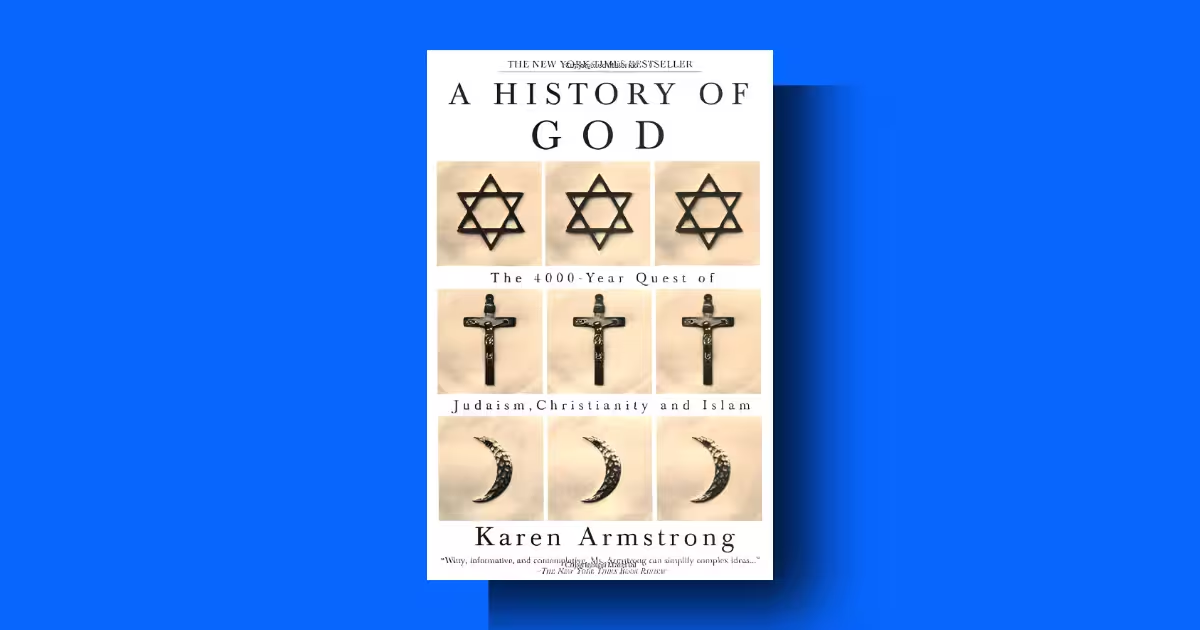

A History of God by Karen Armstrong is not a book that comforts you. It does not hand you a tidy answer about who God is or which religion got it right. Instead, it does something far more unsettling. It shows you how the idea of God has shifted, cracked, and reformed over 4,000 years, often in ways that would make modern believers uncomfortable.
I read A History of God expecting a straightforward history. What I got was a mirror held up to my own assumptions. Armstrong, a former Roman Catholic nun who left religious life in the 1960s, spent years studying the three monotheistic faiths.
Her central argument, stated early in the introduction, is that “the human idea of God has a history, since it has always meant something slightly different to each group of people who have used it at various points of time”.
That single sentence is the engine of the entire book. It means that when you say “God,” you are not pointing to a fixed, unchanging fact. You are invoking a concept that has been shaped, debated, and reinvented by countless human hands.
Table of Contents
Snapshot
A History of God is a dense but rewarding survey of how Judaism, Christianity, and Islam developed their ideas about God from Abraham to the twentieth century. Armstrong argues that God is not an objective fact that can be proven or disproven but a subjective experience shaped by culture, imagination, and historical circumstance.
A History of God is not for casual readers looking for devotional inspiration. It is for anyone willing to sit with discomfort and ask hard questions about what they actually mean when they talk about God.
Reader Recommendation
You will love A History of God if:
You are curious about why Judaism, Christianity, and Islam, despite sharing the same God, have fought each other for centuries. You want to understand how the Trinity went from a confusing paradox to official doctrine.
You are an atheist or agnostic who wants to understand what believers actually mean by “God” beyond the strawman version. You enjoy intellectual history that treats all three faiths with equal seriousness.
You should probably skip A History of God if:
You are looking for spiritual encouragement or a defense of your existing faith. You want a quick, light read. You are uncomfortable with the idea that your religion’s core doctrines might have been shaped by politics, philosophy, and historical accident. Armstrong does not set out to destroy faith, but she does not protect it either.
According to a 1993 review in the Los Angeles Times, Armstrong “fills it with history” and acts as a “chatty and engaging docent,” showing readers “the companionable God of Genesis who broke bread with Abraham, the fire-and-brimstone ‘God of Armies’ who thundered atop Mt. Sinai”. That description captures both the book’s appeal and its challenge. It is engaging, but it is also demanding.
Introduction
A History of God: The 4,000-Year Quest of Judaism, Christianity and Islam was written by Karen Armstrong and published in 1993 by Alfred A. Knopf.
Armstrong is a British author and commentator on religion who spent seven years as a Roman Catholic nun before leaving religious life. She later studied at Oxford University and became one of the most widely read writers on comparative religion.
Her background matters because she writes about God from the inside. She knows the rituals, the prayers, the fears, and the doubts. That insider knowledge gives her a credibility that a purely academic historian might lack.
Context: What A History of God Is About
A History of God is a work of religious history. It sits somewhere between academic scholarship and accessible narrative nonfiction. Armstrong is not writing for specialists alone.
She is writing for anyone who has ever wondered why the God of the Bible seems to change from a tribal warrior in the book of Joshua to a universal compassion in the prophets, or why Muslims and Christians have such different views of Jesus.
A History of God covers approximately 4,000 years of history, beginning with the ancient Babylonian creation myth, the Enuma Elish, and ending with twentieth-century debates about the death of God. It traces how the three monotheistic traditions developed, not in isolation but in dialogue and conflict with one another.
Purpose: The Central Argument
Armstrong states her purpose clearly in the introduction. She is not writing “a history of the ineffable reality of God itself, which is beyond time and change,” but “a history of the way men and women have perceived him from Abraham to the present day”. That distinction is crucial.
Armstrong is not trying to prove or disprove God’s existence. She is studying the human side of the equation. How did people experience God? How did they talk about that experience? How did those ideas change over time?
Her thesis is that religious ideas survive only when they work. “It is far more important for a particular idea of God to work than for it to be logically or scientifically sound,” she writes. “As soon as it ceases to be effective it will be changed”. This pragmatic view of religion is both the book’s greatest strength and its most controversial claim.
Background
To understand Armstrong’s argument, you need to understand the world she describes. Before there was monotheism, there was a different kind of religious consciousness. People in the ancient Middle East did not believe in a single, all-powerful God. They believed in many gods, and they understood those gods as part of the natural world rather than separate from it.
Armstrong begins with the Babylonian creation story, the Enuma Elish, which was recited annually during the New Year Festival in Babylon. In that story, the god Marduk defeats the chaos monster Tiamat and creates the world from her body. Humanity is made from the blood of a defeated god.
The world is understood as a battlefield where order is constantly threatened by chaos, and the gods are not distant rulers but active participants in the struggle.
This pagan worldview was not primitive or stupid. Armstrong takes it seriously. She notes that in the pagan vision, “the gods were not shut off from the human race in a separate, ontological sphere: divinity was not essentially different from humanity.” There was no gulf between the human and the divine.
People believed that by imitating the gods, they could share in divine power and ensure the fertility of the land and the survival of their communities.
The God of Abraham, Isaac, and Jacob emerged from this world, not in opposition to it. Armstrong argues that the early Israelites were probably not monotheists at all.
They worshiped El, the High God of Canaan, alongside other deities. The God of Abraham, she suggests, “was El, the High God of Canaan”. The idea that there was only one God, and that all other gods were false, came much later.
A History of God Summary
I want to give you the full picture here. If you read this section carefully, you will not need to go back to the book unless you want the pleasure of Armstrong’s prose and her detailed footnotes.
Part One: The Birth of Monotheism
Armstrong begins with the ancient world and the slow emergence of a distinctively Israelite conception of God. She traces the development of Yahweh from a tribal war god into a universal creator. The early Israelites, she argues, were not monotheists in the modern sense.
They believed that Yahweh existed alongside other gods, but they had made a covenant to worship him alone. The Ten Commandments themselves acknowledge the existence of other gods: “There shall be no strange gods for you before my face.”
The prophets, especially Amos, Hosea, Isaiah, and Jeremiah, transformed this tribal deity into something else. They insisted that Yahweh demanded justice and compassion, not just ritual sacrifice.
Amos, a shepherd from Tekoa, burst into the shrine of Beth-El and announced that Yahweh was sickened by the animal sacrifices and the empty festivals. “I hate, I despise your festivals,” Yahweh says through Amos. “But let justice roll down like waters, and righteousness like an ever-flowing stream.”
This prophetic tradition made compassion the central test of authentic religion. Armstrong argues that this was a revolutionary development. The prophets claimed that God was on the side of the poor and the oppressed, and that the nation of Israel itself would be judged by how it treated its most vulnerable members.
Part Two: The Christian God
Armstrong then turns to Christianity.
She shows how the early Christians, who were Jews, gradually developed a distinctive understanding of God as Trinity. This was not a simple process. The doctrine of the Trinity, she argues, “was not finalised until the fourth century” and was the product of intense political and theological conflict.
The central figure in this story is Arius, a presbyter from Alexandria who argued that Jesus was not divine by nature but had been promoted to divine status as a reward for his obedience. Arius’s opponents, led by Athanasius, insisted that only a fully divine Christ could save humanity from death and nothingness.
The Council of Nicaea in 325 CE sided with Athanasius, but the controversy continued for another sixty years.
Armstrong shows that the doctrine of the Trinity was not a simple statement of fact. It was an attempt to articulate a religious experience that defied logical description. The Cappadocian Fathers, Basil of Caesarea, Gregory of Nyssa, and Gregory of Nazianzus, developed a theology that insisted God’s essence was ultimately unknowable.
The three persons of the Trinity, they argued, were not three separate gods but three manifestations of a single divine reality that transcended all human categories.
“God cannot be described in words,” Gregory of Nazianzus wrote. “He can only be approached in silence.” Armstrong argues that this apophatic tradition, the tradition of negative theology, is essential to understanding what monotheists actually mean when they talk about God.
Part Three: The God of Islam
Armstrong’s treatment of Islam is notable for its evenhandedness. She acknowledges that many Western readers approach Islam with suspicion, but she argues that Muhammad’s message was fundamentally similar to the message of the Hebrew prophets.
Muhammad, she writes, was a man who “believed that a prophet of this God could solve the problems of his people.”
The Quraysh tribe of Mecca had become wealthy through trade, but their new wealth had eroded the old tribal values of generosity and mutual care. Muhammad preached that the worship of the one God, al-Lah, demanded a just and equitable society. “The early moral message of the Koran is simple,” Armstrong writes. “It is wrong to stockpile wealth and to build a private fortune and good to share the wealth of society fairly by giving a regular proportion of one’s wealth to the poor.”
Armstrong also shows that Islam developed its own mystical tradition, Sufism, which sought a direct, personal experience of God beyond doctrine and ritual.
The Sufis, like the Christian and Jewish mystics, insisted that God was not a being among other beings but the ground of all being. Al-Hallaj, a Sufi mystic who was executed in 922 for claiming “I am the Truth,” became a symbol of the tension between mystical experience and institutional religion.
Part Four: The Philosophers and the Mystics
A significant portion of A History of God deals with the relationship between philosophy and religion. Armstrong shows that Muslim, Jewish, and Christian thinkers all struggled to reconcile the God of revelation with the God of the philosophers. The God of Aristotle, for example, was an Unmoved Mover, entirely remote from the world and indifferent to human affairs.
This was very different from the God of the Bible, who was passionately involved in history and who cared about justice and mercy.
The Muslim philosopher Ibn Sina, known in the West as Avicenna, argued that God could be known by reason. He developed a proof for God’s existence based on the idea that everything in the world is contingent, dependent on something else for its existence.
There must, therefore, be a Necessary Being that exists in its own right. This argument was influential for centuries.
But other thinkers, such as al-Ghazzali, argued that reason was inadequate to the task of knowing God. Al-Ghazzali underwent a personal crisis in which he doubted the validity of all his intellectual certainties.
He eventually found peace in Sufism, the mystical tradition of Islam. He argued that the only way to know God was through direct experience, not through logic or philosophy.
Armstrong shows that this tension between reason and experience is central to the history of all three faiths. The Jewish philosopher Maimonides, the Christian theologian Thomas Aquinas, and the Muslim philosopher Ibn Rushd all tried to synthesize faith and reason.
But the mystics, in all three traditions, insisted that the ultimate reality that we call God transcends all concepts and all words.
Part Five: The Death of God?
The final sections of A History of God deal with the modern period. Armstrong traces the rise of atheism, the scientific revolution, and the Enlightenment.
She shows that the God who died in the nineteenth and twentieth centuries was not the God of the mystics but the God of the philosophers, the Supreme Being who had been reduced to a mere fact in the universe.
“God had become just another being,” Armstrong writes, “like the host of other objects that scientists and philosophers were beginning to explore in the West.”
Nietzsche’s proclamation that God is dead was, in Armstrong’s view, a rejection of this inadequate conception of God. The mystics had always insisted that God was not a being among other beings. When atheists declared that there was no God, they were often rejecting a caricature.
Armstrong does not predict the future.
She ends A History of God with a question: Has God a future? She suggests that the God of the mystics, the God who is not a person but a presence, might have a better chance of surviving the modern world than the God of the philosophers. But she does not pretend to know.
A History of God Analysis
Armstrong’s greatest achievement is her refusal to privilege any one tradition. As Donald Wayne Viney noted in a 1995 review for The Midwest Quarterly, “Perhaps the book’s best feature is that Christianity has no privileged status. Armstrong admirably demonstrates that Judaism is no mere prelude to Christianity and Islam is not its coda”.
This is rare. Many histories of religion, even scholarly ones, subtly treat Christianity as the culmination of a story that begins with Judaism. Armstrong does not.
Her prose is another strength. She is not a dry academic. She tells stories. She describes the visions of Ezekiel, the wrestling match between Jacob and the angel, the terror of Isaiah in the Temple. She makes abstract theological debates feel urgent and human. The book is dense, but it is not boring.
However, there are real weaknesses. Viney points out several factual errors, including misunderstandings of Aristotle’s cosmology and Anselm’s ontological argument. More seriously, some readers have found Armstrong biased against Christianity.
A reviewer on The StoryGraph complained that “the author, Ms. Armstrong, clearly dislikes Christianity and to a lesser extent Judaism and tends to be overly critical of these religions”. Another noted that “for every page spend on Christianity, there seem to be ten on Islam”.
I do not share the view that Armstrong is hostile to Christianity.
She is critical of the institutional church and of the way Christian doctrine was sometimes shaped by political power rather than spiritual insight. But she is equally critical of the institutional aspects of Islam and Judaism. She is, if anything, critical of institutional religion in all its forms.
What she respects is the mystical tradition, the tradition of direct experience, and she finds that tradition in all three faiths.
Strengths and Weaknesses
What I found compelling:
Armstrong’s treatment of the Trinity was the highlight of the book for me. She shows how a doctrine that seems abstract and irrelevant today was originally a desperate attempt to hold together two incompatible ideas: that God was utterly transcendent and that God had been present in Jesus.
The Trinity, she argues, was not a logical solution but a way of preserving mystery. It was a reminder that God cannot be captured in a formula.
Her discussion of the mystics was also powerful. She shows that in all three traditions, there were people who insisted that God could not be known through doctrine or ritual but only through a direct, transformative experience.
The Sufis, the Kabbalists, and the Christian hesychasts all developed similar techniques for achieving this experience, techniques that often involved breathing exercises, repeated prayers, and prolonged contemplation.
What I found frustrating:
A History of God can be overwhelming. Armstrong covers so much ground that some topics get only a few pages. The chapter on the Reformation, for example, feels rushed. She mentions Luther and Calvin but does not have space to explore their ideas in depth. The same is true of the section on modern atheism.
Nietzsche, Freud, and Marx each get only a few pages.
A more serious issue is that Armstrong’s own theological views sometimes color her interpretation of the past. She clearly believes that the mystical tradition is superior to the doctrinal tradition.
This leads her to treat the mystics with more sympathy than the theologians. Someone who believes that doctrine matters, that the creeds of the church are not just human constructions but faithful responses to divine revelation, will find Armstrong’s approach frustrating.
Comparison With Similar Works
If you are interested in the history of religion, you have several options. Karen Armstrong’s other books, including The Case for God and The Great Transformation, cover similar ground. The Great Transformation focuses on the Axial Age, the period from 800 to 200 BCE when the major world religions emerged.
Another option is Huston Smith’s The World’s Religions, which is more introductory and more sympathetic to traditional faith. Smith writes as a believer, and his book is often used in introductory religion courses.
For a more academic treatment, you could try Jaroslav Pelikan’s five-volume The Christian Tradition, which is far more detailed and far more demanding. Pelikan was a scholar’s scholar, and his work is not for casual readers.
Armstrong’s book occupies a middle ground. It is more accessible than Pelikan but more challenging than Smith. It is written for intelligent general readers who are willing to work.
Conclusion:
A History of God is not a book that will make you feel good about religion. It will not confirm your existing beliefs or give you ammunition for arguments with atheists. What it will do is show you that the idea of God is not a static thing. It is a living, changing, human thing.
It has been shaped by politics, philosophy, and culture. It has been used for good and for evil. It has been a source of comfort and a source of terror.
I think this book is essential for anyone who wants to understand the world we live in. Religion is not going away. It shapes politics, culture, and personal identity for billions of people. Understanding how the idea of God has developed, and why it has taken so many different forms, is not just an academic exercise. It is a way of understanding ourselves.
If you are a believer, this book will challenge you. It will ask you to examine what you mean when you say “God.” It will show you that some of the ideas you take for granted were invented by human beings in particular historical circumstances.
That can be unsettling. But it can also be liberating. It can free you from the assumption that your particular conception of God is the only possible one.
If you are an atheist or agnostic, this book will also challenge you. It will show you that the “God” you reject may not be the God that serious believers actually worship.
It will introduce you to the mystical tradition, which has always insisted that God is not a being among beings but the ground of all being. It will ask you to consider whether the God you do not believe in is the only God on offer.
Either way, you will not finish this book unchanged. Armstrong’s central claim is that “God” is a product of the creative imagination. That is not a dismissal of religion.
It is a recognition that human beings are meaning-making creatures. We create symbols to express our deepest experiences of wonder, awe, and moral obligation. The history of God is the history of those symbols. It is a history worth knowing.