
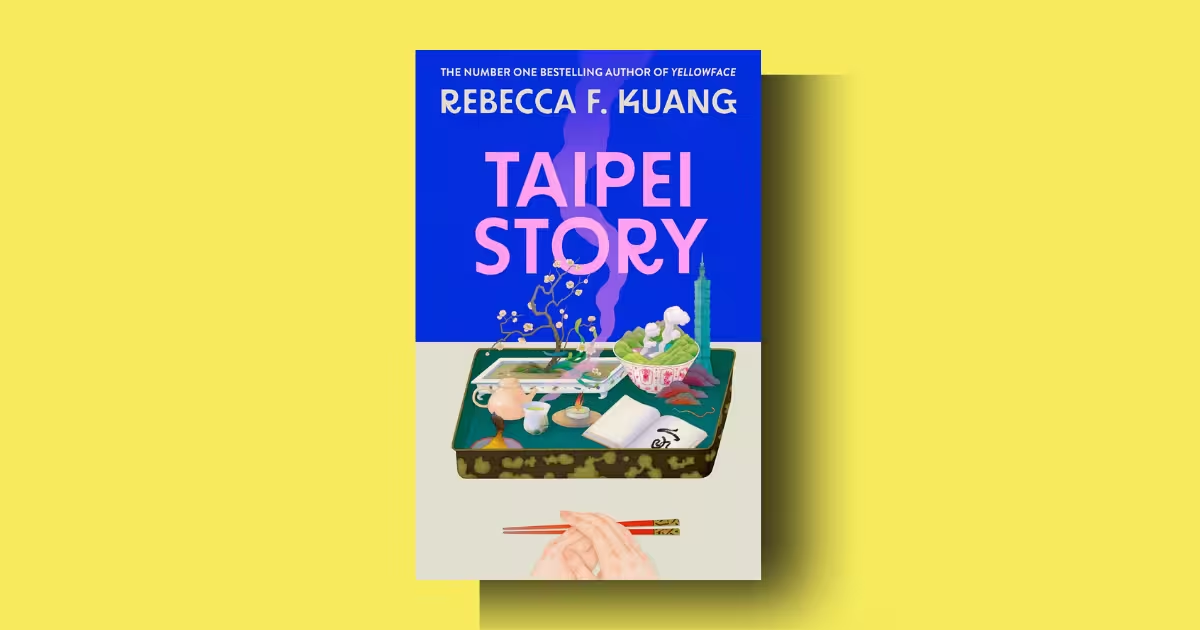

Taipei Story by R.F. Kuang is the novel Chinese-American readers have been waiting for, a razor-sharp, often uncomfortable portrait of what it really feels like to “reconnect” with a culture you’ve never fully owned.
If you’ve ever felt the awkward gap between heritage and fluency, Taipei Story will hit hard. Here’s a clear breakdown of its main characters, major themes, books that pair well with it, and a final take.
Table of Contents
Taipei Story plot summary
A Hopeful Arrival
The story follows Lily Chen, a Yale freshman who travels to National Taiwan University for an intensive summer Mandarin program. She arrives with a profound goal: to master the language and finally bridge the gap with her Chinese heritage. But reality hits hard and fast. Hoping to save money, Lily and her friend Anna rent what turns out to be a dismal, cramped apartment plagued by terrible plumbing.
The sweltering Taipei heat, relentless mosquitoes, and the program’s grueling “language pledge” quickly wear Lily down. Her anxiety peaks when she fumbles her Mandarin and locals simply reply to her in English, leaving her feeling like an imposter who is failing at her own culture.
Tangled Friendships
Seeking a distraction, Lily finds a bright spot in her grueling routine by sharing daily lunches with a TikTok-famous classmate named JC. However, this growing closeness sparks deep jealousy in Anna, who eventually snoops through Lily’s phone and fractures their friendship. The drama reaches a boiling point when JC invites both girls to a hot springs resort, booking a single shared room to cut costs.
While at the baths, JC initiates an uncomfortable sexual encounter. Feeling awkward and pressured, Lily gives him a handjob rather than going all the way. In a cruel betrayal, JC returns to class and spreads a rumor that Lily gave him a blowjob.
Anna and JC both ice her out. When Lily finally confronts him, JC casually dismisses the harm he caused, driving a devastated Lily to isolate herself and focus solely on her studies.
The Cost of Waiting
Behind the academic stress, a deeper tragedy is brewing. Throughout the summer, Lily intentionally puts off calling her grandparents in Guangzhou, stubbornly wanting to wait until her Chinese is “perfect” enough to have a meaningful conversation.
Suddenly, her grandfather passes away. Lily is crushed by the heavy realization that she waited too long to ask him about their family’s migration history. She is forced to navigate this grief alone, facing unsympathetic teachers who penalize her for skipping class and a mother who refuses to discuss their unhappy past.
An Unresolved Departure
As the summer draws to a close, Lily manages to survive her final exams and tentatively gets back on speaking terms with Anna. She boards her flight home, but she leaves Taipei with a bittersweet, realistic epiphany: language fluency is not a magic wand. It cannot instantly harmonize her dual identities, nor can it heal the deep silences in her family’s history.
Characters in Taipei Story
Lily Chen is the first-person narrator, a rising Yale sophomore majoring in East Asian Studies. She arrives in Taipei for an intensive summer language program already carrying quiet insecurity about her Mandarin.
She notices other Chinese-American students immediately, judges their “Americanized” looks and textbook Chinese, then realizes her own skill level is no better. Her internal monologue is full of self-comparison, mild envy, and the constant fear of being exposed as not Chinese enough.
Anna is Lily’s program friend and temporary roommate. They bond in language class over shared awkwardness and laughter at mistakes. Once they try speaking only Chinese outside class, Lily finds Anna’s higher-pitched, softer speaking style grating and “babyish,” while Anna describes Lily as becoming “docile and uncertain.” Their friendship is practical but strained by the language pledge and the tiny apartment.
Skipper Leys is the ROTC classmate who treats Taiwan primarily as a strategic interest. He talks about the Thucydides Trap, semiconductor “silicon shields,” and potential conflict timelines with no contractions and intense eye contact. He is the clearest example of an outsider approaching the place through geopolitics rather than personal connection.
John Cahan-Song (JC) is the TikTok-famous multilingual student whose mother raised him and his siblings in multiple languages. Even he is still working on his Chinese, which quietly comforts Lily. He functions as a symbol of polished, public diaspora performance.
Minor figures (the program director Teacher Xu, the landlord Lee, Lily’s family back home) reinforce the same pressures: accent policing, parental expectations, and the gap between idealized “home” and the actual city.
Taipei Story Themes
The novel is explicitly about getting things wrong. Almost every interaction involves mistranslation, half-understood conversations, or cultural assumptions that don’t hold up. Lily keeps measuring herself against other Chinese Americans, against ideal accents (Beijing vs. Taiwanese), and against the idea of authentic belonging.
Language is never neutral. Choosing Traditional characters, resisting Simplified, worrying about losing a Beijing accent, or failing to recall Classical Chinese all carry status and identity weight. The strict language pledge turns everyday life into constant performance and exhaustion.
Diaspora claims to authority are gently mocked. Lily and Anna become the “experts” for their white and adopted classmates simply because they look the part and have visited the mainland before, even though neither has been to Taipei. The book keeps undercutting the idea that blood or family origin automatically grants understanding.
Taipei itself is presented as humid, green, and ordinary rather than exotic. Night markets, Din Tai Fung lines, the National Palace Museum’s jade cabbage, and the tiny apartment with its shower-over-toilet reality sit side-by-side with Lily’s romantic expectations. The city refuses to be pure symbol.
Shattering the Illusion of “Perfect”
The Language Myth: Throughout the summer, Lily treats Mandarin fluency as a finish line. She believes that once she speaks “perfectly,” her imposter syndrome will vanish and she will finally feel like she belongs to her culture.
The Reality Check: Leaving Taipei, she realizes language is just a tool, not a magic cure. Even with a better vocabulary, she remains a diaspora kid caught between two worlds, and she has to accept that in-between state.
The Reality of Grief and Heritage
The Cost of Perfectionism: Her grandfather’s death serves as the story’s harshest lesson. By stubbornly waiting until she was “ready” to speak with him, she lost her chance entirely.
Living with Silence: Her mother’s continued refusal to discuss the past shows that family history cannot be neatly unlocked just because Lily learned a few new words. The ending highlights that some familial disconnects might never be fully healed, and she must learn to live with that ambiguity.
Messy, Realistic Resolutions
Tentative Forgiveness: Lily and Anna getting back on speaking terms isn’t a magical restoration of their friendship. It reflects the messy reality of young adulthood—sometimes you just agree to a fragile peace after a betrayal because holding onto the anger is too exhausting.
A New Beginning: She flies home to Yale without having “found herself” in the cliché sense. However, she is far more grounded. She finally understands that her identity is something she must build on her own terms, rather than something she can simply absorb by living in Taiwan.
Similar Books
Taiwan Travelogue by Yang Shuang-zi – playful, layered look at how outsiders write Taiwan
Taipei People by Bai Xianyong – classic short stories of mainlanders who never fully settle in Taipei
The Stolen Bicycle by Wu Ming-yi – more experimental and historically dense Taiwanese fiction
Portraits in White by Kaori Lai – contemporary Taiwanese perspectives
R.F. Kuang’s own earlier work (Yellowface, Babel) shares the same interest in authenticity, performance, and the costs of cultural fluency
Conclusion
Taipei Story is less interested in delivering a neat coming-of-age arc than in sitting inside the discomfort of partial knowledge. Lily’s experience is specific to Chinese-American students in intensive programs, yet the feeling of never quite measuring up travels easily.
The book works best when it stays close to the daily frictions of language, roommate irritation, and quiet self-judgment rather than larger geopolitical statements. For readers who have felt the gap between “should understand” and “actually understand,” it is precise and often uncomfortably accurate.





