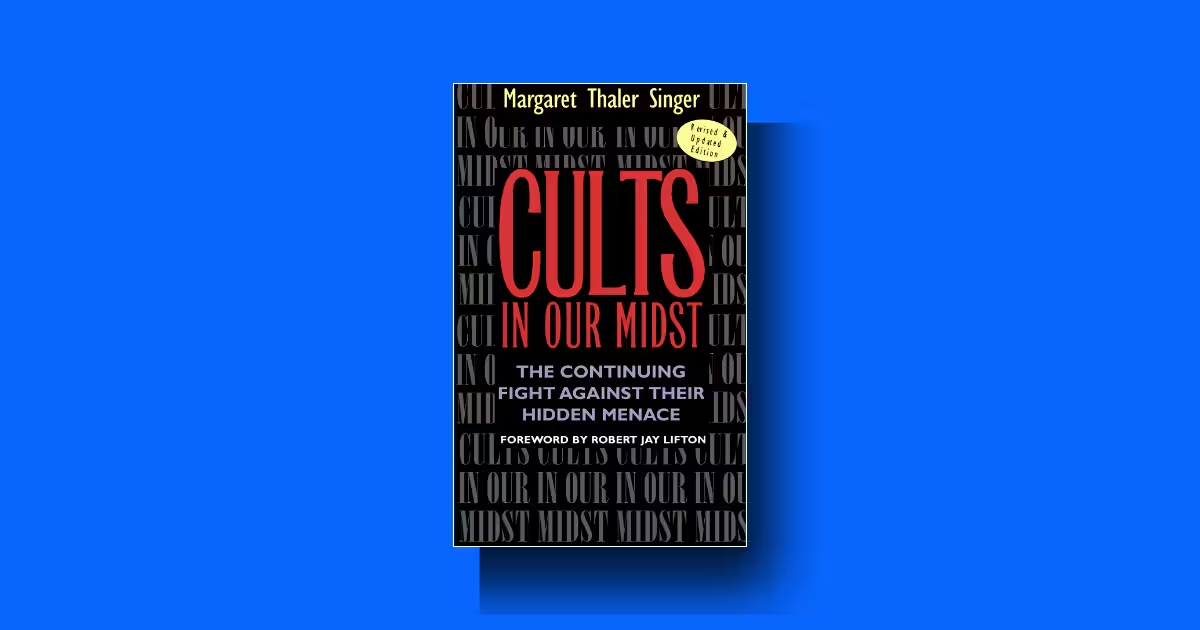

Cults in Our Midst: The Hidden Menace in Our Everyday Lives by Margaret Thaler Singer and Janja Lalich is a landmark study of how cults operate, recruit, and control. Published in 1995 by Jossey-Bass, it draws on Singer’s interviews with more than 3,000 current and former cult members.
The book defines cults through three factors: a self-appointed leader, an authoritarian power structure, and a coordinated program of thought reform. It covers recruitment tactics, physiological and psychological persuasion techniques, workplace intrusions, harassment of critics, and detailed guidance on exit counseling and recovery.
The central argument is simple and disturbing: everyone is vulnerable to cult recruitment under the right conditions. The book is essential reading for families, therapists, clergy, and anyone who wants to understand how ordinary people get pulled into groups that destroy lives.
Reader Recommendation: Cults in Our Midst will resonate most with people who have a family member or friend in a high-control group, therapists and counselors working with cult survivors, and anyone interested in the psychology of influence and coercion.
If you are looking for a light, detached academic overview, this book will feel too intense and advocacy-driven. But if you want practical, detailed knowledge about how cults actually work and what to do about them, nothing else comes close.
Table of Contents
Introduction
Cults in Our Midst: The Hidden Menace in Our Everyday Lives is a book by Margaret Thaler Singer, a clinical psychologist and emeritus adjunct professor at the University of California, Berkeley, written with Janja Lalich, a former cult member and writer.
The book was published in 1995 by Jossey-Bass, with a foreword by Robert Jay Lifton, a psychiatrist known for his work on thought reform and the psychology of totalism.
Singer spent nearly fifty years studying influence, persuasion, and coercive control, and this book represents the culmination of her work with more than three thousand cult members and their families. The central thesis is that cults are not a fringe phenomenon populated by the weak-minded or the mentally ill.
They are a pervasive social problem that exploits normal human vulnerabilities and uses sophisticated psychological techniques to control people from all walks of life.
Background
Margaret Thaler Singer was born in 1921 and died in 2003. She earned her Ph.D. in clinical psychology from the University of Denver and worked at the University of Colorado School of Medicine before moving to Washington, D.C., where she worked at the Walter Reed Army Institute of Research.
There, she studied prisoners of war from the Korean War and became familiar with coercive persuasion and thought reform techniques. She later interviewed Jesuit priests who had been imprisoned in mainland China and exposed to similar processes.
In the 1960s, she began hearing from families whose young adult members had joined cultic groups. She interviewed as many cult members and former members as she could find, and in 1976, she was appointed as a court examiner for Patricia Hearst, who had been kidnapped by the Symbionese Liberation Army.
She also counseled survivors of Jonestown and the families of those who died there in 1978, and families of the Branch Davidians who died in Waco in 1993. She served as an expert witness in numerous legal cases involving cults.
Summary of Cults in Our Midst
Defining Cults
Singer defines a cult through three factors: the origin of the group and the role of the leader, the power structure between leader and followers, and the use of a coordinated program of persuasion, commonly called thought reform or brainwashing.
A cultic relationship, according to Singer, is one in which a person intentionally induces others to become totally or nearly totally dependent on them for almost all major life decisions. The leader claims special knowledge or a special mission and keeps the focus of love and devotion on themselves.
The structure is authoritarian, with the leader as the supreme authority and no appeal outside the leader’s system. Cults also tend to have a double set of ethics: honesty within the group, deception toward outsiders.
Singer writes: “Cults are authoritarian in structure. The leader is regarded as the supreme authority although he may delegate certain power to a few subordinates for the purpose of seeing that members adhere to his wishes and rules.”
Who Joins Cults?
Singer directly challenges the myth that only crazy, stupid, or needy people join cults. She writes: “Most people tend to believe that their own minds and thought processes are invulnerable. ‘Other people can be manipulated, but not me,’ they declare.”
Research indicates that approximately two-thirds of those who join cults come from normal, functioning families and were demonstrating age-appropriate behavior around the time they entered a cult.
Only about 5 to 6 percent had major psychological difficulties prior to joining. The key vulnerability factors are being in a state of transition, feeling lonely or depressed, and being between important affiliations. Singer calls this the “Not Me” myth and argues that everyone is susceptible under the right conditions.
How Thought Reform Works
Singer outlines six conditions that create the atmosphere for thought reform:
- Keeping the person unaware that there is an agenda to control or change them.
- Controlling the person’s time and physical environment.
- Creating a sense of powerlessness, fear, and dependency.
- Suppressing old behavior and attitudes.
- Instilling new behavior and attitudes.
- Putting forth a closed system of logic.
She also draws on Robert Lifton’s eight themes of thought reform, including milieu control, loading the language, demand for purity, confession, mystical manipulation, doctrine over person, sacred science, and dispensing of existence. And she uses Edgar Schein’s three stages: unfreezing, changing, and refreezing.
The key insight is that thought reform attacks the self, not just political beliefs. It destabilizes a person’s sense of identity and reality.
Physiological Persuasion Techniques
Singer describes how cults use physiological techniques to produce predictable effects that can be reinterpreted as spiritual or psychological progress.
These include hyperventilation through overbreathing and chanting, repetitive motion such as spin dancing, changes in diet and sleep, body manipulations such as pressing on eyeballs, and relaxation-induced anxiety from meditation. For example, she explains how hyperventilation produces dizziness, tingling, and fainting, which leaders then reframe as “becoming blissed out” or “receiving the spirit.”
She writes: “Cults, quacks, and manipulators have become aware of the predictable outcomes of hyperventilation—the giddiness, the out-of-control feeling, the possible loss of consciousness, the tingling, and the clenching of fingers and toes.”
Psychological Persuasion Techniques
The book covers trance induction, guided imagery, indirect directives, trickery, personal history revision, emotional manipulation, and peer pressure. Singer explains Milton Erickson’s naturalistic trance induction and how cult leaders use storytelling, repetitive speech, and guided imagery to put people into altered states.
She describes how Jim Jones used fake visions by having members gather information about visitors and relay it to him before he spoke. She also covers the practice of rewriting personal histories, where members are taught to portray their pasts as miserable and their families as abusive.
She quotes a former member: “I was always being told, ‘You are being too horizontal.’ Translated, this meant she was being reprimanded for listening to and being sympathetic to peers.”
Psychotherapy Cults
Singer and her colleagues studied twenty-two psychotherapy cults. The leaders ranged from college faculty to a paroled felon. The groups varied in size from 15 to more than 300 members.
She describes the Center for Feeling Therapy, where therapists had sexual relations with patients, forced them to stand naked, beat them, and had patients beaten by other patients. The therapists collected fines and donations running into thousands of dollars and used the money to buy a ranch in Arizona. All twelve therapists lost or surrendered their licenses.
The administrative law judge wrote that the therapists “preyed on young and credulous persons who were in a unique position to be misled.”
Intruding into the Workplace
The book covers how cults and thought-reform groups infiltrate businesses through large group awareness training programs. Singer describes how these programs are sold as management and communication courses but use intense psychological techniques and sometimes serve as recruitment venues for cults.
She covers the Equal Employment Opportunity Commission’s 1988 policy statement warning employers about New Age training programs. She describes the Pacific Bell Krone program, where the company spent $50.6 million in two years and would have spent an additional $135.6 million to send all 67,000 employees through the program.
The California Public Utilities Commission disallowed recovery from ratepayers of half the expenditures actually made.
The Threat of Intimidation
Singer describes how cults use lawsuits and harassment to silence critics. She shares her own experiences: being detained at the London airport because someone told customs officials she was an IRA terrorist, receiving dead rats on her steps, having live rats released into her house, and being followed and having her reservations canceled.
She writes: “I have learned to travel and book hotel reservations under assumed names because one cult used to have a man monitor my work and the lectures and meetings that I would be attending. He would then cancel my plane and hotel reservations.”
Rescuing the Children
The book has a detailed chapter on children in cults. Of the 912 members of the Peoples Temple who died in Jonestown, 276 were children. Children were separated from parents, subjected to hard labor, beaten, and given powerful drugs. Singer describes the children of Waco, where twenty-five of the more than eighty who died were children.
Dr. Bruce Perry studied the children released before the final fire and found that their hearts raced at about 120 beats a minute even at rest, that they drew pictures of Koresh as God, and that they found it nearly impossible to think or act independently.
Leaving the Cult
Singer explains the five D’s that keep people in cults: deception, debilitation, dependency, dread, and desensitization.
She describes the factors that make leaving difficult: belief, decency and loyalty, respect for authority, peer pressure and lack of information, exhaustion and confusion, separation from the past, fear, and guilt over participation.
She writes: “When a person is taken in by the coercive psychological and social influence of a cult, she or he experiences what I call the five D’s.”
Exit Counseling and Recovery
The book covers the history of deprogramming, including Joe Alexander and Ted Patrick, and explains the shift to voluntary exit counseling. Singer explains that exit counseling is a process of providing and exchanging information, not therapy. The team presents details about the cult and leader and explains thought reform.
She writes: “The advantage of having former cult members present is that they will be able to talk about their experiences, describe how they made the decision to leave, and share what they now know about the group.”
She also covers recovery, including practical issues like money and education, psychological and emotional difficulties like panic attacks and fear of retribution, cognitive inefficiencies like memory loss and uncritical passivity, social and personal relations like loneliness and dating, and philosophical and attitudinal issues like aversions and hypercritical attitudes.
Analysis and Critique
Cults in Our Midst is a powerful and necessary book. Singer’s authority is unmatched. She interviewed more than 3,000 cult members, testified in numerous legal cases, and was called to examine Patricia Hearst.
The book is dense with information but readable. It is not academic in a detached way. It is advocacy-driven and alarmist, which is both its strength and its weakness. The Library Journal review noted: “While Midst does present numerous examples of deceptive recruitment and other unethical practices, no new ground is broken.
Further, as the title implies, Singer’s approach is alarmist and often tabloidesque.” That criticism has some merit. Singer does not pretend to be neutral. She believes cults are harmful and she wants to stop them.
For readers who share that concern, the book is exactly what they need. For readers who want a more neutral academic survey, other books may be better. But Singer’s evidence is extensive and her reasoning is logical. She supports her arguments with case studies, legal documents, and research. The book fulfills its stated purpose: to explain how cults work and how to help people escape and recover. Its weakness is that it can feel overwhelming and one-sided.
It does not give much attention to former members who look back on their cult experience with mixed feelings. It also does not fully engage with the debate among sociologists about whether “brainwashing” is a valid scientific concept.
But for families and professionals dealing with the reality of cult involvement, those debates matter less than practical guidance.
Comparison with Similar Works
Other books on cults include Combatting Cult Mind Control by Steve Hassan, which offers a former member’s perspective and practical strategies for intervention.
Recovery from Cults edited by Michael Langone is a collection of essays on helping survivors. The Making of a Moonie by Eileen Barker offers a sociological study of the Unification Church.
Strange Gods by David Bromley and Anson Shupe is a critique of the anti-cult movement. Singer’s book differs from these in its clinical depth and its focus on thought reform as a psychological process. It is more comprehensive than most and more practical than many.
Conclusion
Cults in Our Midst is a book that stays with you.
It is not an easy read, because the stories are painful and the implications are disturbing. But it is an important read. It will change how you think about influence, persuasion, and the fragility of the self. It will make you more alert to the warning signs in groups and relationships.
It will give you concrete tools to help someone who is in a cult. I recommend it to anyone who wants to understand how ordinary people can be led to do extraordinary things.
Who should read this book?
- Family members and friends of people in cults.
- Mental health professionals, clergy, and exit counselors.
- Anyone interested in the psychology of influence and coercion.
- Researchers studying new religious movements and thought reform.
Who should skip it?
- Readers looking for a neutral, detached academic survey.
- Readers who are not prepared for detailed accounts of abuse and manipulation.
Related Information and Books
- Combatting Cult Mind Control by Steve Hassan
- Recovery from Cults edited by Michael D. Langone
- Thought Reform and the Psychology of Totalism by Robert Jay Lifton
- The Making of a Moonie by Eileen Barker
- Captive Hearts, Captive Minds by Madeleine Landau Tobias and Janja Lalich
- Crazy Therapies by Margaret Thaler Singer and Janja Lalich
- Snapping: America’s Epidemic of Sudden Personality Change by Flo Conway and Jim Siegelman
Films and Documentaries:
- Jonestown: The Life and Death of Peoples Temple (2006)
- Waco: The Rules of Engagement (1997)
- Going Clear: Scientology and the Prison of Belief (2015)
- Holy Hell (2016)
- The Vow (2020)