
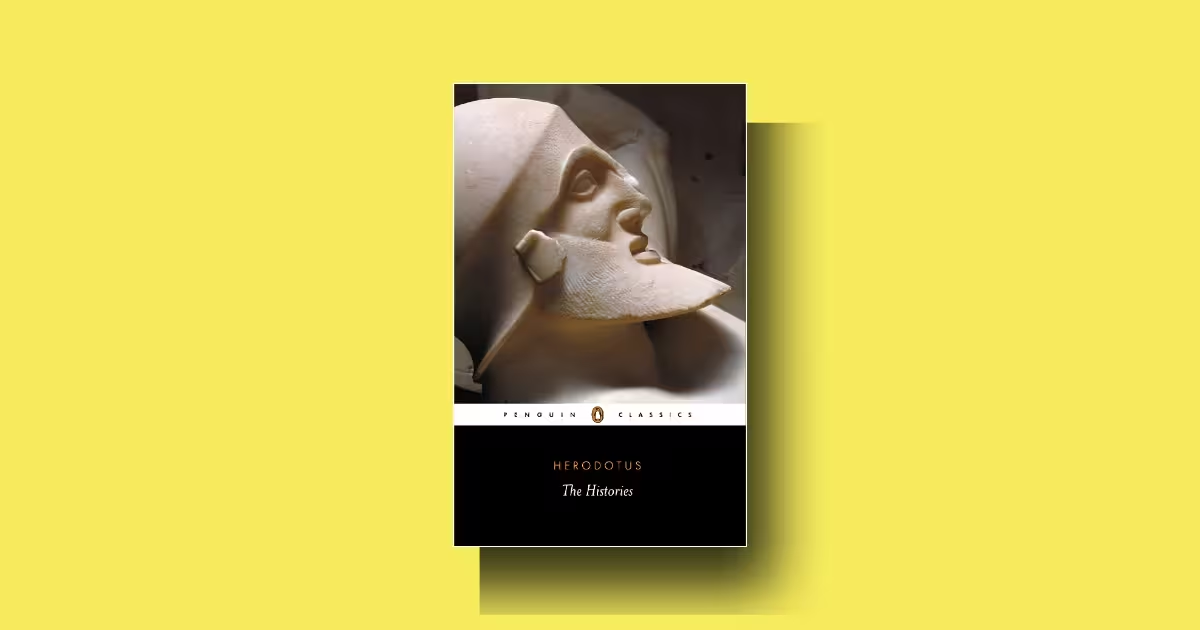

The Histories by Herodotus is the oldest surviving work of history in the Western world, and it is also the one most often accused of lying. Written in the fifth century B.C., it tells how a small, quarrelsome collection of Greek cities beat the largest empire on earth between 490 and 479 B.C.
Herodotus says Xerxes marched on Greece with 5,283,220 men. Modern historians think the real figure was closer to 200,000. That gap is the reason people still argue over whether he was the “father of history” or the “father of lies.”
After reading all nine books, my answer is both, and that the lies matter far less than you might think. This review gives you the full summary, the famous stories, the hard numbers, and a straight verdict on whether this 700-page book deserves your time.
Table of Contents
The Histories brief
The Histories is a nine-book inquiry into why the Greeks and Persians went to war, and how the Greeks won. Herodotus of Halicarnassos (c. 484 to c. 425 or 414 B.C.) spends the first half of the book tracing the rise of Persia under Cyrus, Cambyses, and Darius, with long, entertaining detours through Lydia, Egypt, Scythia, and Libya.
The second half narrows into a war story: the Ionian Revolt (499 B.C.), Marathon (490 B.C.), Thermopylae, Artemision, and Salamis (480 B.C.), and finally Plataea and Mycale (479 B.C.).
His central argument is simple and still unsettling. Power grows, overreaches, and falls. “Human prosperity never continues steadfast in the same place,” he writes in his opening (1.5). Free people who rule themselves by law fight harder than subjects who fear a king. And nobody, not even the richest man alive, should be called happy until you see how his life ends.
Quick facts
Author: Herodotus of Halicarnassos (modern Bodrum, Turkey)
Written: mid-fifth century B.C.; the Barnes & Noble edition notes it is believed to have been first published or recited between 449 and 447 B.C.
Length: nine books; Stewart Flory estimated the original would have filled about 300 feet of papyrus in 30 rolls, and Lateiner notes a full reading aloud would take more than 50 hours
Edition reviewed: Barnes & Noble Classics (2004), translated by G. C. Macaulay (first published 1890), introduction and notes by Donald Lateiner,
Covers: roughly 560 to 479 B.C., with the war years of 499 to 479 B.C. at its center
Best known for: Thermopylae, Marathon, Salamis, Solon and Croesus, the gold-digging ants, and the phrase “neither snow nor rain nor heat”
Who Should Read The Histories by Herodotus, and Who Will Bounce?
You will love it if:
- You enjoy history that reads like a story collection. Herodotus is funny, gossipy, and dramatic.
- You watched 300 or read about Thermopylae and want the original source, not the comic book.
- You like anthropology. Book II on Egypt and Book IV on the Scythians are among the first ethnographies ever written.
- You care about political philosophy. The debate over democracy, oligarchy, and monarchy in Book III (3.80-82) is one of the oldest in Western literature.
- You are a writer. Few authors handle suspense, irony, and reversal this well.
You will probably bounce if:
- You want a tight, linear military history. The war with Xerxes does not really start until Book VII, around page 450 in my edition.
- You get impatient with long lists of tribes, genealogies, and tribute payments.
- You need every number to be accurate. Many are not.
- You want a modern, fast translation. Macaulay’s 1890 English is faithful but old-fashioned (“thou,” “wont,” “Hellenes”). If that bothers you, try Tom Holland’s 2013 Penguin translation instead.
Introduction
The Histories (in Greek, Historiai, which the Barnes & Noble biography explains means “inquiries”) was written by Herodotus, a Greek born around 484 B.C. in Halicarnassos, then a Greek city under Persian rule.
The edition I read is the Barnes & Noble Classics paperback from 2004, using George Campbell Macaulay’s English translation, which first appeared in 1890. Donald Lateiner, a classicist, wrote the introduction, the notes, and the appendix of English translations.
One fun detail from Lateiner’s introduction: Michael Ondaatje’s novel The English Patient (1992) features a badly burned desert traveler who carries a battered copy of Herodotus everywhere, and according to Lateiner, Ondaatje’s acknowledgments make clear it was this very Macaulay translation.
Context: what The Histories is about
The Histories is a work of narrative history, geography, and ethnography all at once. Its subject is the conflict between the Greek world and the Persian Empire, but Herodotus decided that to explain the war he had to explain everyone involved.
So he tells you how the Lydians lost their kingdom, how Cyrus built Persia, how Egyptians mummify their dead, how Scythians scalp their enemies, and how Babylonians choose wives.
His credentials are those of a traveler. According to the edition’s biography, he visited Babylon and Susa, went up the Nile as far as modern Aswan, and traveled to North Africa, the Black Sea, and Scythia.
He later moved to Athens around 447 B.C., then joined the new colony of Thurii in southern Italy in 443 B.C. He did not speak Persian, Egyptian, or any other foreign language, as Lateiner points out, which made him dependent on interpreters.
Purpose: what is the main thesis of The Histories?
Herodotus states his purpose in the famous first sentence, and I will quote Macaulay’s version in full because everything else grows from it:
“This is the showing forth of the Inquiry of Herodotus of Halicarnassos so that neither the deeds of men may be forgotten by lapse of time, nor the works great and marvellous, which have been produced some by Hellenes and some by Barbarians, may lose their renown; and especially that the causes may be remembered for which these waged war with one another.” (Prologue)
Three goals sit in that sentence. Preserve memory. Give credit to Greeks and non-Greeks. Find causes. That last word is what separates Herodotus from Homer. He wanted to know why, not just what.
Underneath, his larger message is about the instability of fortune. Great cities become small, small ones become great, and arrogance (the Greeks called it hubris) tends to invite its own correction.
Background
Why Was Herodotus Called the Father of History and the Father of Lies?
The Roman orator Cicero called Herodotus the “father of history” in his dialogue On the Laws (De Legibus 1.5), and in the same breath noted that his work was full of fables. That double reputation has stuck ever since.
The critics started early. Thucydides, a generation later, never names him but clearly takes swipes at his methods. Around the second century A.D., Plutarch wrote an entire essay, On the Malice of Herodotus, partly because Herodotus reported that Plutarch’s fellow Boeotians sided with Persia.
In modern times, the German scholar Detlev Fehling argued that Herodotus invented his sources and perhaps never traveled at all. W. Kendrick Pritchett answered him in a book with the wonderful title The Liar School of Herodotus.
Here is the part that surprised me. Lateiner argues in his introduction that the accuracy of Herodotus’ disputed accounts “turns out to be greater with nearly every new discovery.” He cites the excavation of Xerxes’ canal through the Athos peninsula (7.22), reported by the New York Times in 2001.
The gold-digging ants of India (3.102-105) may be a garbled account of Himalayan marmots that throw up gold-bearing soil, a theory from the French traveler and writer Michel Peissel’s 1984 book The Ants’ Gold. The World History Encyclopedia makes the same point about Peissel’s research.
So, the “father of lies” label is real, but it is only half the picture.
The Histories by Herodotus Summary
The nine books of The Histories were named after the nine Muses by later scholars in Alexandria, probably more than 300 years after Herodotus, according to Lateiner. The division is not original, but it is how every edition is organized, so I will follow it.
Book I (Clio): How did the war between Greeks and Persians begin?
Herodotus opens with the Persian version of events. The trouble started, they say, with Phoenician traders kidnapping Io from Argos. Then Greeks took Europa, then Medea, then Paris took Helen, and the Greeks overreacted by attacking Troy.
The Persians find it foolish to go to war over abducted women. Herodotus shrugs off these legends and says he will start instead with the man “who first within my own knowledge began to commit wrong against the Hellenes” (1.5). That man is Croesus of Lydia.
Before Croesus, though, comes one of the best short stories in ancient literature. King Candaules of Lydia is so obsessed with his wife’s beauty that he forces his bodyguard Gyges to hide in the bedroom and see her naked. “Men trust their ears less than their eyes,” Candaules tells him (1.8). Gyges protests that “when a woman puts off her tunic she puts off her modesty also.” The queen spots him anyway. She gives Gyges a choice: kill the king or die. He kills the king, marries her, and founds the dynasty that ends with Croesus five generations later.
Then comes the scene most people remember. The Athenian lawmaker Solon visits Croesus, the richest man of his time, who shows off his treasury and asks who is the happiest man Solon has ever seen. Solon names Tellos, an ordinary Athenian who saw his grandchildren grow up and died bravely in battle.
Second place goes to Cleobis and Biton, two young men who pulled their mother’s cart over five miles to a festival and died peacefully in their sleep that night.
Croesus is furious. Solon then does the math. Seventy years of life, with the extra calendar months, add up to 26,250 days, and “one day produces nothing at all which resembles what the next brings with it. Thus then, O Croesus, man is altogether a creature of accident” (1.32). His conclusion: do not call a man happy until he dies well. Until then, call him only fortunate.
Croesus learns this the hard way. His son Atys is killed by accident by Adrastos, a man Croesus had purified and protected. Then Croesus asks the Delphic oracle whether to attack Persia and hears that if he does, he will destroy a great empire. He attacks. The empire he destroys is his own.
Sardis falls after a siege of 14 days, ending his 14-year reign (1.86). Placed on a pyre by Cyrus, Croesus groans the name of Solon three times. Cyrus asks why, hears the story, and orders the fire put out. When Croesus later complains to Delphi, the oracle replies that he should have asked which empire it meant (1.91).
Croesus also gives us one of the most quoted lines in the book when he tells Cyrus that no one is foolish enough to prefer war to peace, because “in peace the sons bury their fathers, but in war the fathers bury their sons” (1.87).
The rest of Book I of The Histories tells the rise of Cyrus the Great. His grandfather Astyages, king of the Medes, dreams that his grandson will overthrow him and orders the baby killed. The official Harpagos hands the child to a herdsman, whose wife has just lost a stillborn baby, and they raise Cyrus as their own. When the truth comes out, Astyages punishes Harpagos by serving him his own son at dinner. Harpagos waits years and then helps Cyrus overthrow Astyages.
Cyrus goes on to conquer Lydia, the Ionian Greek cities of Asia Minor, and Babylon (which he takes by diverting the Euphrates). Herodotus fills the gaps with Persian customs, including one that made me laugh out loud: the Persians debate important matters while drunk, then reconsider the decision sober the next day, and if they first decided sober, they check it again drunk (1.133).
Book I ends with Cyrus’ death fighting Queen Tomyris of the Massagetai. After Cyrus kills her son through a trick, she dips his severed head in a skin of blood, saying she will give him his fill (1.214).
Book II (Euterpe): What does Herodotus say about Egypt?
Book II of The Histories is almost entirely about Egypt, and it is the section that made me understand why people call Herodotus the father of anthropology. Cyrus’ son Cambyses is about to invade, so Herodotus pauses to explain the country.
He begins with an experiment. Pharaoh Psammetichos, wanting to know which people is oldest, gives two newborns to a shepherd with orders that no one speak to them. After two years, the children say bekos, which turns out to be the Phrygian word for bread. The Egyptians concede the Phrygians are older (2.2).
Herodotus then turns geographer. He calls Egypt “a gift of the river” (2.5), noting how the Nile’s silt built the land. He tries to explain the Nile flood, rejects three Greek theories, and offers his own (wrong) one. He measures, estimates, and argues with his sources.
His famous observation on Egyptian customs is that they are “opposite to other men in almost all matters” (2.35): women trade at market while men weave at home, men carry loads on their heads and women on their shoulders. He describes mummification in close detail, the sacred cats that leap into fires, crocodiles, the hippopotamus, and the phoenix (which he admits he has only seen in pictures).
The history section covers the pharaohs, as the priests of Memphis told them to him. The most famous passage concerns the Great Pyramid. Cheops, Herodotus says, closed the temples and forced all Egyptians to work for him, “a hundred thousand men at a time, each group three months continually” (2.124). The causeway alone took ten years and the pyramid twenty.
Modern Egyptology has complicated the “slave labor” picture, but his figure of 20 years for construction is still often repeated.
There are also folktales. The clever thief who robs King Rhampsinitos’ treasury and outwits him so completely that the king gives him his daughter in marriage. And a surprising claim that Helen never went to Troy at all but spent the war in Egypt, which Herodotus uses to argue that the gods punish great wrongs with great penalties (2.120).
Book III (Thalia): What happened under Cambyses and Darius?
Cambyses conquers Egypt in 525 B.C. and then, according to Herodotus, goes mad. He stabs the sacred Apis bull, mocks Egyptian temples, and kills his own brother Smerdis after a dream.
Herodotus uses this to make his most famous point about culture. Darius once asked some Greeks what price would make them eat their dead fathers. No price, they said. He then asked the Callatian Indians, who did eat their dead, what would make them burn their fathers instead. They cried out in horror. Herodotus concludes that Pindar was right: “of all things law is king” (3.38).
Every people thinks its own customs are best, so only a madman mocks another’s.
On Samos, the tyrant Polycrates is so lucky that the Egyptian king Amasis warns him to throw away his most prized possession to break the streak. Polycrates throws a precious emerald ring into the sea.
Days later a fisherman brings him a large fish, and the ring is inside it (3.41-42). Amasis breaks off the friendship, sensing doom. Polycrates is later lured to his death and crucified.
Next, a Magian priest pretending to be the dead Smerdis seizes the Persian throne. Seven Persian nobles uncover the fraud and kill him. Then comes what I consider the intellectual center of the whole book: the Constitutional Debate (3.80-82). Otanes argues for democracy, warning that even the best man given absolute power will change, since “insolence is engendered in him by the good things which he possesses.” Megabyzos argues for oligarchy, saying a mob is like “a torrent stream.”
Darius argues for monarchy and wins.
Herodotus insists this debate really happened, though Greeks doubted it. Whether or not it did, it is one of the earliest surviving comparisons of the three forms of government.
Darius then wins the throne when his groom rigs a contest so that his horse neighs first at dawn. Herodotus follows with Darius’ tribute list, province by province, and the strange tales of the world’s edges, including those gold-digging ants.
Book IV (Melpomene): Why did Darius fail in Scythia?
Darius crosses the Bosporus around 512 B.C. to invade the Scythians, the nomads north of the Black Sea. Herodotus first gives a long account of their origins, their scalping and skull-cup customs, their royal burials, and their neighbors, including the Amazons who intermarry with young Scythian men to create the Sauromatai.
The Scythians refuse to fight. They retreat, fill wells, and burn pastures. Finally they send Darius a bird, a mouse, a frog, and five arrows. Darius reads it as surrender. His adviser Gobryas reads it correctly: unless you become birds and fly, or mice and hide underground, or frogs and leap into lakes, “you shall not return back home, but shall be smitten by these arrows” (4.132). Darius retreats.
The second half of Book IV moves to Libya (all of North Africa to Herodotus), the founding of Cyrene, and the peoples of the desert. It also contains one of my favorite moments.
Herodotus reports that Phoenician sailors sent by Pharaoh Necos circled Africa in about three years, and says they claimed the sun was on their right as they sailed west around the south. “I cannot believe” it, he writes (4.42). Many historians today point out that this is exactly what sailors south of the equator would see. His honesty in reporting a detail he doubted is why we can take the voyage seriously now.
Book V (Terpsichore): What was the Ionian Revolt?
The Greek cities of Ionia, under Persian rule, rebel in 499 B.C. The trigger is personal ambition. Aristagoras of Miletus, having failed in a Persian-backed attack on Naxos, stirs up revolt. He is urged on by his father-in-law Histiaios, who is being held at the Persian court and sends a message tattooed on the shaved head of a slave, waiting for the hair to grow back before sending him.
Aristagoras goes to Sparta with a bronze map of the world and tries to persuade King Cleomenes. When he admits Susa is a three-month journey from the sea, Cleomenes’ young daughter Gorgo warns her father that the stranger will corrupt him, and Cleomenes sends him away. Aristagoras then goes to Athens and succeeds. Herodotus’ dry verdict: “it is easier to deceive many than one,” since he could not fool one Spartan but fooled “thirty thousand Athenians” (5.97). Athens sends 20 ships, which Herodotus calls “the beginning of evils.”
The Ionians and Athenians burn Sardis. When Darius hears, he shoots an arrow into the sky and orders a servant to say three times at every dinner: “Master, remember the Athenians” (5.105).
Book V of The Histories also contains Herodotus’ strongest statement in favor of free government. After Athens expelled its tyrants, he says, it became “far the first” in war, which proves “that Equality is an excellent thing,” because men working for a master are slack, but free men each strive for themselves (5.78).
Book VI (Erato): What happened at the Battle of Marathon?
The Ionian fleet is crushed at Lade in 494 B.C., and Miletus is destroyed. When the Athenian playwright Phrynichos stages The Capture of Miletus, the audience weeps and the city fines him a thousand drachmas for reminding them of their own sorrows (6.21).
Darius then sends heralds demanding earth and water from the Greek cities, and in 490 B.C. launches an expedition under Datis and Artaphrenes. They land at Marathon, 26 miles from Athens. The runner Pheidippides races to Sparta for help, meeting the god Pan on the way. The Spartans agree but say religious law forbids them to march until the full moon.
The Athenian generals are split on whether to fight. Miltiades persuades the war-archon Callimachos to cast the deciding vote. The Athenians, with their Plataean allies, charge the Persian line at a run.
Herodotus says they were the first Greeks to attack at a run and the first who “endured to face the Median garments” (6.112), when the very name of the Medes had been a terror. The Greek center breaks, but the wings win and close in. Herodotus gives the toll: “about six thousand four hundred men” on the Persian side, and 192 Athenians (6.117).
He also records that the Athenian soldier Epizelos went blind in the fighting with no wound at all, and “Thus, as I was informed, Epizelos told the tale.” To me, that small phrase is Herodotus at his best, reporting fairly while flagging his source.
The Persians sail around to attack Athens, supposedly after a traitor flashed a shield signal, but the Athenian army marches back in time. The Spartans arrive after it is all over.
Book VI ends in comedy. Hippocleides, the favored suitor for the daughter of the tyrant Cleisthenes of Sicyon, gets drunk at the final banquet and dances on a table, finally standing on his head and kicking his legs in the air. “You have danced away your marriage,” says Cleisthenes. “Hippocleides cares not,” he answers (6.129), a saying that became a Greek proverb.
Book VII (Polymnia): What really happened at Thermopylae?
Darius dies in 486 B.C., and his son Xerxes takes up the invasion. His uncle Artabanos warns him against it, but a recurring dream pushes Xerxes forward. The preparations are immense.
Workers dig a canal through the Athos peninsula and build two bridges of boats across the Hellespont, about eight-tenths of a mile wide. When a storm wrecks the first bridges, Xerxes orders the sea whipped with 300 lashes and a pair of fetters thrown in, while his men shout “Bitter water, your master lays upon you this penalty” (7.35).
At Abydos, watching his fleet and army fill the sea and plains, Xerxes calls himself happy and then bursts into tears. He explains that “of these multitudes not one will be alive when a hundred years have gone by” (7.46).
It is the most human moment in the book, and Artabanos’ reply is even darker: life is so full of trouble that every person at some point wishes to be dead.
Herodotus then counts the army. He reaches 2,641,610 fighting men and doubles it for support staff, arriving at a total of “5,283,220” (7.186). This is where the “father of lies” charge bites hardest. According to Wikipedia’s article on the second Persian invasion, which summarizes modern scholarship, the modern consensus centers on around 200,000 soldiers.
Xerxes asks the exiled Spartan king Demaratos whether the Greeks will fight. Demaratos says the Spartans are free, but not entirely, “for over them is set Law as a master, whom they fear much more even than your people fear you” (7.104), and that law tells them never to flee from battle.
At the same time, Athens consults Delphi and receives a terrifying oracle, followed by a second one promising that a “bulwark of wood” will survive and naming “Salamis, the divine.” Themistocles argues that the wooden wall means the navy.
The Greeks hold the narrow pass of Thermopylae under the Spartan king Leonidas. For two days, the Persians fail to break through. Then a local man, Epialtes (usually spelled Ephialtes), shows Xerxes a mountain path around the pass. Leonidas sends most of the allies away and stays with his 300 Spartans, the Thespians, and the Thebans. The Spartan Dienekes, told the Persian arrows would block out the sun, replies that it is good news, because they will fight “in the shade and not in the sun” (7.226).
The Greeks fight with their spears, then swords, then “with hands and with teeth” until overwhelmed.
Herodotus preserves the epitaphs. The one for the Spartans, in Macaulay’s translation, reads: “Stranger, report this word, we pray, to the Spartans, that lying / Here in this spot we remain, faithfully still keeping their laws” (7.228).
Another claims four thousand Peloponnesians faced “three hundred myriads,” that is, three million men. Lateiner admits in his introduction that he cannot read these chapters without tears. I did not cry, but I did read them twice.
Book VIII (Urania): How did the Greeks win at Salamis?
At the same time as Thermopylae, the Greek fleet fights an inconclusive battle at Artemision. After Thermopylae falls, the Persians march into Attica. The Athenians evacuate, and Xerxes burns the Acropolis.
The allied Greek commanders, especially the Peloponnesians, want to retreat to the Isthmus of Corinth. Themistocles knows that the narrow straits of Salamis favor the smaller Greek fleet, so he secretly sends his slave Sikinnos to tell Xerxes that the Greeks are about to flee. Xerxes blocks the exits, forcing the Greeks to fight exactly where Themistocles wanted.
The battle is a Persian disaster. Queen Artemisia of Halicarnassos, Herodotus’ own hometown, is, in his account, the lone voice at Xerxes’ war council advising against a sea battle (8.68).
Chased by an Athenian ship, she rams and sinks an allied vessel to escape. Xerxes, watching from shore, thinks she has sunk an enemy and says, “My men have become women, and my women men” (8.88). Herodotus adds a telling detail: many Persians drowned because they could not swim, while Greeks from wrecked ships swam to Salamis.
Xerxes sends word home by the royal relay post, and Herodotus describes the riders in a line now carved on New York’s former main post office: “These neither snow nor rain nor heat nor darkness of night prevents from accomplishing each one the task proposed to him” (8.98). Xerxes returns to Asia, leaving his general Mardonios with an elite army to finish the job.
Herodotus also makes his most controversial claim here, stated in Book VII (7.139): without the Athenian navy, all of Greece would have fallen, so “if a man should say that the Athenians proved to be the saviours of Hellas, he would not fail to hit the truth.” He knows this will be unpopular, and he says it anyway.
Book IX (Calliope): How did the Persian Wars end?
In 479 B.C., Mardonios tries to buy Athens away from the alliance. The Athenians refuse. The combined Greek army under the Spartan regent Pausanias meets the Persians at Plataea. After days of maneuvering, water shortages, and a messy night retreat, the battle turns when Mardonios is killed. The Greeks storm the Persian camp.
Herodotus says that of 300,000 Persians (minus 40,000 who fled with Artabazos), “not three thousand men survived,” while the Greeks lost 91 Spartans, 16 Tegeans, and 52 Athenians (9.70). The numbers are again suspicious, but the outcome was decisive.
On the same day, according to Herodotus, the Greek fleet destroys the Persian force at Mycale in Asia Minor. The Ionians switch sides. A Persian at a banquet before Plataea tells a Greek guest what Lateiner lists among the book’s great lines: “The most hateful grief of all human griefs is this, to have knowledge of the truth but no power over the event” (9.16).
The book of The Histories closes strangely and brilliantly. After the Athenians capture Sestos and crucify the Persian governor Artayctes, Herodotus jumps back decades to Cyrus. Persian nobles once asked Cyrus to move the nation from its poor, rugged land to a richer one.
Cyrus replied that “from lands which are not rugged men who are not rugged are apt to come forth” (9.122). The Persians chose to stay on poor land and rule rather than farm rich plains and be slaves.
That is the last line of the work. It reads, after everything, as a warning about what empire does to the people who build it.
The Histories by Herodotus Review: Is It Worth Reading Today?
Yes. The Histories by Herodotus is a sprawling, unreliable, often hilarious, and deeply wise book, and I think it is still the best introduction to how human beings behave when they have too much power.
I came to it expecting a dusty war chronicle. What I found was closer to a novel, a travel diary, and a book of philosophy stitched together. The Solon story in Book I and Xerxes’ tears in Book VII are the two bookends of the same idea: wealth and armies are no protection against time.
Does Herodotus support his arguments with evidence?
Mostly, yes, by the standards of his world. According to Lateiner, he identifies more than 200 sources with some specifics and sets conflicting versions side by side so the reader can judge. He tells you when he is reporting what he saw and when he is repeating hearsay. When he doubts something, he says so, as with the Phoenician voyage.
Lateiner also counts more than 1,000 first-person statements in the text (citing Carolyn Dewald’s research), and I felt that presence constantly. You are never unsure who is speaking.
Where his evidence fails is in numbers and in long-ago events. The 5.28 million-man army is impossible. Some Egyptian chronology is wrong. Speeches are reconstructions, as Lateiner reminds readers: ancient historians wrote what “must” have been said, not transcripts.
Does it fulfill its purpose?
Completely. He set out to keep great deeds from being forgotten, and 2,500 years later, we know about Marathon, Thermopylae, and Salamis largely because of him. Lateiner puts it bluntly: without Herodotus, “we know almost nothing of Greek history before the generation of Thucydides.”
The British philosopher R. G. Collingwood, quoted in the introduction, went further and said Herodotus was the man who invented the science of history.
Strengths: what I found compelling
Fairness toward “barbarians.” Herodotus uses the word to mean non-Greeks, not savages. He gives Persians wit, courage, and moral depth. Plutarch attacked him for being too kind to foreigners, which to me is a compliment.
The cultural relativism of 3.38. “Of all things law is king” is an idea many readers assume is modern. It is 2,500 years old.
Storytelling. Gyges, Polycrates’ ring, the Scythian gifts, and Hippocleides’ dance are as good as anything in fiction.
Political thinking. The Constitutional Debate (3.80-82), the praise of equality (5.78), and Demaratos on Law as master (7.104) give you a working introduction to Greek political thought before Plato.
Honesty about uncertainty. Phrases like “as I was informed” and “I cannot believe it, but another man may” taught me something about how to read any source.
Weaknesses: where The Histories frustrated me
Impossible numbers. Five million soldiers, three million at Thermopylae, fewer than 3,000 Persian survivors at Plataea. These are propaganda-sized figures, and Herodotus did not question them enough.
Divine explanations. Dreams, oracles, and divine jealousy drive a lot of the plot. Lateiner defends him by noting that Herodotus often reports these beliefs rather than endorsing them, and that he never shows gods physically intervening as Homer does. Still, it can feel strange to a modern reader.
The structure. The main war takes up only the last third of the book. Several times in Books II and IV I lost track of why we were in Egypt or Libya at all.
Pro-Athenian tilt. Herodotus defends Athens strongly, especially in 7.139. Plutarch accused him of bias against Thebes and Corinth, and I cannot confirm with certainty how fair he was to them, but the tilt is visible.
The translation. Macaulay’s 1890 English is accurate and poetic, but sentences like “They are wont to deliberate when drinking hard” will slow some readers down.
The Histories by Herodotus Quotes
- “In peace the sons bury their fathers, but in war the fathers bury their sons.” — 1.87
- “When a woman puts off her tunic she puts off her modesty also.” — 1.8
- “For great wrongs great also are the penalties which come from the gods.” — 2.120
- “To be envied is better than to be pitied.” — 3.52
- “The most valuable of all possessions is a friend who is a man of understanding and also sincerely well-disposed.” — 5.24
- “God strikes with thunderbolts the creatures which stand above the rest and suffers them not to make a proud show; while those which are small do not provoke him to jealousy.” — 7.10
- “The hastening of any matter breeds disasters.” — 7.10
- “Misfortunes falling upon us and diseases disturbing our happiness make the time of life, though short indeed, seem long: thus, since life is full of trouble, death has become the most acceptable refuge for man.” — 7.46
- “Accidents will rule the men and not men the accidents.” — 7.49
- “The most hateful grief of all human griefs is this, to have knowledge of the truth but no power over the event.” — 9.16
- “The fated destiny it is impossible even for a god to escape.” — 1.91
- “Human prosperity never continues steadfast in the same place.” — 1.5
- “Of all things law is king.” — 3.38
- “Insolence is engendered in him by the good things which he possesses, and envy is implanted in man from the beginning; and having these two things, he has all vice.” — 3.80
- “It is not possible for man to avert that which is destined to come to pass.” — 3.65
- “Great power is in general gained by running great risks.” — 7.50
- “It is better to have good courage about everything and to suffer half the evils which threaten, than to have fear beforehand about everything and not to suffer any evil at all.” — 7.50
- “Over them is set Law as a master, whom they fear much more even than your people fear you.” — 7.104
- “Stranger, report this word, we pray, to the Spartans, that lying / Here in this spot we remain, faithfully still keeping their laws.” — 7.228
- “My men have become women, and my women men.” — 8.88
Books Like The Histories by Herodotus
Thucydides, History of the Peloponnesian War. The natural rival. Thucydides is colder, more analytical, and focused almost entirely on politics and war.
Herodotus is wider and warmer. Lateiner quotes Momigliano’s line that “there was no Herodotus before Herodotus,” and Collingwood’s that “Herodotus had no successors.” If you want to understand why the two are always paired, read Book I of each.
Homer, The Iliad. Herodotus clearly models his scale and speeches on Homer, but he replaces divine action with human cause. If you have read our Iliad review on Sopranu or my piece on The Song of Achilles, you will see how Herodotus’ opening (Io, Medea, Helen) deliberately pulls the Trojan War into rational history.
Aeschylus, The Persians (472 B.C.). A tragedy about Salamis by a man who may have fought there. It is usually described as the only surviving Greek tragedy on a recent historical event rather than a myth, and it makes a strong companion to Book VIII.
Tom Holland, Persian Fire (2005). A modern narrative history of the same wars, very readable, and a good guide if you want the story first before tackling Herodotus. Holland later translated The Histories for Penguin (2013).
Ryszard Kapuściński, Travels with Herodotus. The Polish journalist’s memoir of carrying Herodotus with him on assignments across Asia and Africa. It shows why so many travelers, as the Barnes & Noble edition notes about Flaubert, used Herodotus as a guidebook.
Michael Ondaatje, The English Patient (1992). A novel that uses this very translation as a character’s companion, and borrows the Candaules and Gyges story.
For more reading in this area, see our list of the 100 Best History Books and our piece on the 10 Greatest Thinkers of All Time. If you prefer the Hollywood version of Greek war, my review of Troy (2004) is a fun contrast.
Conclusion
The Histories by Herodotus is not a flawless history, and it was never meant to be one in our sense. It is an inquiry by a curious, funny, fair-minded man who talked to hundreds of people across three continents and tried to explain why a war happened. He got some numbers badly wrong. He got people, power, and pride almost exactly right.
Who will benefit most? Students of history, classics, and political science should treat it as essential. General readers who like narrative nonfiction, travel writing, or big-picture books about civilizations will enjoy it too, as long as they are patient.
Specialists will want a more annotated edition such as The Landmark Herodotus, but the Barnes & Noble Macaulay edition, with Lateiner’s excellent introduction, is a solid and affordable place to start.
My practical advice: read Book I of The Histories first, then jump to Books VI through IX for the war. Come back to Books II through V afterwards, when you know why those detours matter. You will finish with a clearer sense of why Solon refused to call Croesus happy, and why Xerxes wept at Abydos. Both of them, in their different ways, were right.
References
- Herodotus, The Histories, trans. G. C. Macaulay, introduction and notes by Donald Lateiner (New York: Barnes & Noble Classics, 2004), ISBN 978-1-59308-102-7.
- Cicero, De Legibus 1.5, Perseus Digital Library
- “Second Persian invasion of Greece,” Wikipedia (modern estimates of Xerxes’ army)
- “Herodotus,” Wikipedia (Plutarch’s On the Malice of Herodotus; Macaulay’s 1890 translation)
- Joshua J. Mark, “Herodotus,” World History Encyclopedia (2022)
- “Guide to the classics: The Histories, by Herodotus,” The Conversation
- Penguin Random House, The Histories, trans. Tom Holland




