
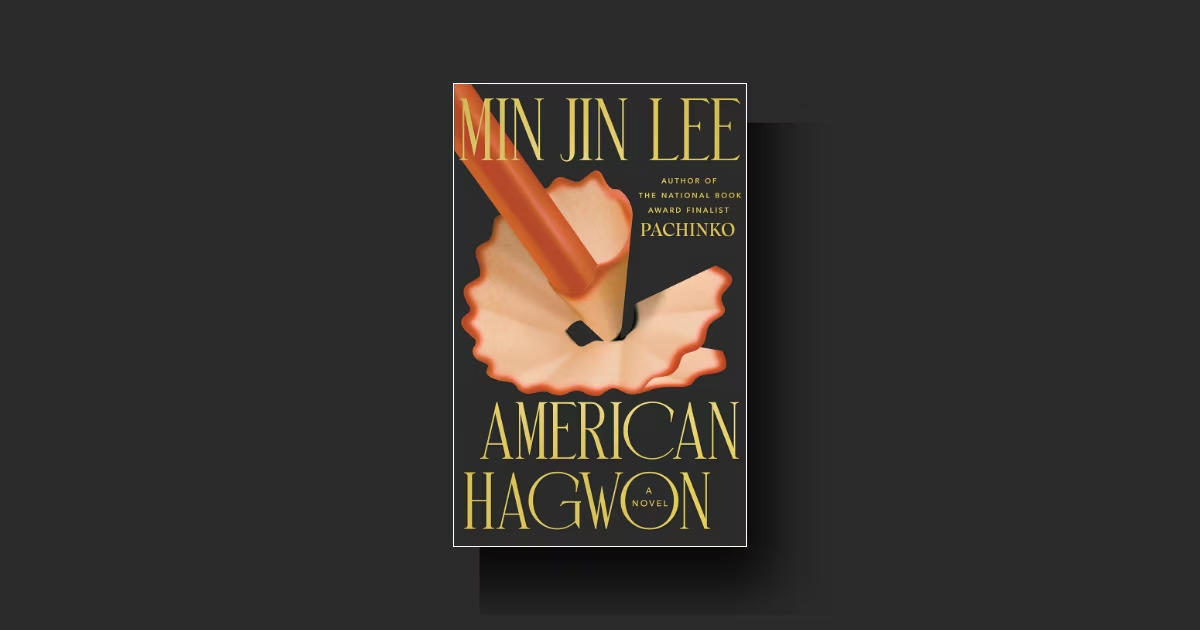

American Hagwon by Min Jin Lee is a sweeping family saga that examines education, immigration, ambition, and the painful cost of pursuing a better future. It follows the Koh family from Seoul to Sydney and California as success, sacrifice, and survival collide.
It is a breathing, demanding fifth character that eats paychecks, swallows childhoods, and promises salvation through standardized test scores. Lee’s third novel in her Diaspora Quartet, released on September 29, 2026, spans 656 pages and fifteen years, from 1992 to 2007, tracing the Koh family across Seoul, Sydney, and Orange County.
In contrast to the sprawling four-generation arc of Pachinko, this novel zooms in on a single middle-class family crushed by the 1997 Asian financial crisis and forced to rebuild their lives in Southern California, where their children become the tutors they once needed.
Surprisingly, the most devastating question the novel asks is not whether the Kohs will survive, but whether the education they sacrificed everything for was ever meant to save them at all. This is a review from someone who has sat with these characters, and I am here to tell you what I found.
Table of Contents
1. Brief Summary
What is American Hagwon about? It is a 656-page family saga about the Koh family, Korean immigrants who move from Seoul to Sydney to Orange County after a betrayal and the 1997 IMF Crisis.
The novel follows John, Helen, and their three children—Bo, DH, and Mido—as they navigate downward mobility, menial jobs, and the hagwon system that becomes both their livelihood and their burden.
Who will love it? Readers who appreciate meticulous character studies, immigrant narratives that refuse easy uplift, and fiction that treats education as a moral problem rather than a plot device. Fans of Pachinko will recognize Lee’s precision and empathy, though this novel is more claustrophobic and domestic in scope.
Who might bounce? Readers who need a fast-moving plot or who want a triumphant assimilation story. The exposition is heavy, the pacing is deliberate, and the ending refuses to resolve the central tension between sacrifice and selfhood.
Key statistic: The novel spans 15 years (1992–2007), covers three continents, and was nearly 10 years in the making. The 1997 Asian financial crisis serves as the narrative’s catastrophic hinge, forcing the Kohs from relative comfort into survival mode.
2. Introduction
American Hagwon is Min Jin Lee’s third novel, published by Cardinal (an imprint of Grand Central Publishing) on September 29, 2026. It is the third installment in Lee’s “Diaspora Quartet,” following Free Food for Millionaires (2007) and Pachinko (2017), the latter of which was a National Book Award finalist and adapted into an acclaimed Apple TV+ series.
Lee, born in Seoul in 1968, immigrated to the United States at age seven and grew up in Queens, New York. She is a graduate of Yale College and Georgetown University Law Center, and she has held fellowships from the Guggenheim Foundation and the Radcliffe Institute for Advanced Study at Harvard University.
The novel is dedicated “To my teachers and students, in whose debt I remain”.
3. Background
The hagwon (pronounced “hog-one”) is a private, for-profit tutoring center that has become endemic to Korean communities worldwide. Traditionally, these institutions supplement the public school curriculum, preparing students for the Suneung (the Korean college entrance exam) or for American standardized tests like the SAT.
However, as Lee demonstrates throughout the novel, the hagwon is not merely an educational institution. It is a social mechanism designed to preserve class status and manufacture competitive advantage in a system that offers few second chances.
The 1997 Asian financial crisis serves as the novel’s central historical event. Beginning in Thailand in July 1997, the crisis cascaded across Indonesia, South Korea, Malaysia, Laos, and the Philippines, as governments and corporations that had borrowed in US dollars could not repay their debts when local currencies depreciated.
South Korea accepted a $58 billion IMF bailout package in December 1997, which imposed strict austerity measures, including massive layoffs and corporate restructuring. As a result, the won lost roughly half its value against the dollar, and unemployment soared.
The Koh family’s downward mobility is a direct consequence of this economic catastrophe, and Lee uses their story to illustrate how middle-class security can evaporate within months.
In parallel, the novel examines the Korean American immigrant experience in Southern California, particularly in Orange County, where Korean churches, shopping malls, and hagwons form a dense social ecosystem.
According to Lee, her research involved interviews with students, parents, educators, economists, and policymakers in the U.S. and abroad. “What kept on coming up over and over was education—what they would do for their children, what were their regrets,” she told Kirkus Reviews.
The novel’s sociological foundation is further strengthened by its epigraph from Chang Kyung-Sup’s concept of “compressed modernity,” which describes how economic, political, and social changes occur in an extremely condensed manner, forcing individuals to manage their lives intensely, intricately, and flexibly to remain integrated with society.
4. American Hagwon Summary
American Hagwon opens in March 1992 in Gaepo-dong, Seoul, where the Koh family has just returned from six years in Sydney, Australia. John Koh, a senior manager at a Korean conglomerate, has been stationed overseas multiple times, and his wife, Helen, a former math major at Seoul National University, manages the household finances with ruthless efficiency.
Their three children—Bo, DH, and Mido—were all born in Paramus, New Jersey, and have lived in Seoul, Sydney, and now Seoul again.
Mido, the youngest at thirteen, is the child Helen worries about most. She is exceptionally quiet, has no friends, and was seen by learning specialists in Sydney who found nothing medically wrong but noted her shyness and difficulty with social relationships.
On the third day of middle school, Mido is called to solve a math problem on the chalkboard. She makes a computation error and, when she tries to erase it, her teacher, Mr. Na, strikes her open palms three times with a brass ruler. This is Mido’s first encounter with corporal punishment, and it is Yun Kim, the class president, who rescues her afterward in the washroom, offering her a white handkerchief and telling her, “I hate him. A real son of a bitch”.
Yun becomes Mido’s first real friend. Her mother, Nari, introduces the Kohs to Eagle Academy, an elite hagwon run by Tom Song, an American with a doctorate from Cornell and Teachers College. Despite a long waitlist, Tom and his wife, Clara, accept all three Koh children after their assessments reveal that they are academically capable but behind in math. The hagwon becomes the family’s lifeline and its largest expense.
Helen takes a job at a Lotte duty-free store to cover the fees.
Meanwhile, John’s oldest friend and superior at Han River Industrials & Trading (HRI), Taehun Shin, asks him to do something unconscionable. Shin is having an affair with a young employee named Danbi Jung, a brilliant math major from Korea University.
Danbi is pressuring Shin to leave his wife, Mary, who is a devout Catholic and the mother of his three sons. Shin orders John to set Danbi up to fail by giving her an impossible assignment, then fire her. John, a man of integrity, objects but ultimately obeys.
However, Danbi turns the tables. In a glass-walled conference room, she falsely accuses John of attempted rape, tearing open her blouse and screaming for help. John is put on leave without pay, and his career is destroyed.
The scandal forces the Kohs to leave Seoul. Mary, Shin’s wife, intervenes through her Ewha classmate, who is married to a vice-chairman at HRI’s parent company. John is offered a demoted position in Sydney, and the family moves again.
This time, however, the economics are different. Helen works at Crawford’s Emporium, a luxury department store, and the children attend public schools. Mido, now a teenager, spends her holidays in Sydney with Yun, who has also moved there after her father’s business partner embezzled their savings and fled, leaving the family bankrupt. Yun eventually moves to California with her parents, and Mido is devastated.
In Sydney, Mido meets Tek, a Korean Australian law student whose parents are both professors at the University of New South Wales. They begin dating, and Mido enrolls at the University of Sydney, studying education. She joins the Sydney University Dramatic Society (SUDS) at the suggestion of Tek’s mother, and although she never acts, she writes a one-act play called Desde/Mona/Rockstar that is selected for production. The experience reveals something crucial: writing her own words makes it easier for her to speak.
Then the 1997 Asian financial crisis hits. John loses his job when HRI shuts down its Sydney office, and Helen is laid off from Crawford’s.
The family’s savings evaporate. Bo, who has been living in Orange County, California, working as a van driver and tutor at a hagwon called Exodus Academy, tells his parents to come to California. John and Helen, now in their early fifties, pack up their lives and move to a small, shabby apartment in Cypress.
John finds work at Shrimp Castle, a fish restaurant in a Korean shopping mall, frying shrimp and cleaning the kitchen for $1,250 a week in cash. Helen goes to work for Mrs. Chung, the owner of an upscale Korean department store called the Emporium, selling luxury handbags and jewelry.
Mido, who has dropped out of university to help her family, joins Bo at Exodus Academy.
She quickly becomes one of the best tutors, earning a reputation for raising students’ SAT scores by hundreds of points. She also becomes a college admissions counselor, helping high school students craft personal essays and navigate the byzantine American application process.
The hagwon, founded by Lion Han, a Princeton graduate and former aspiring musician, and his wife, Yun Kim, has two locations: Exodus in Cypress, which serves poorer immigrant families, and Fortress in Irvine, which serves wealthy families and subsidizes the former.
The novel introduces a sprawling cast of characters whose lives intersect with the Kohs. There is Peter Son, DH’s best friend from Andover and Yale, who transfers to Pomona after a painful breakup with an older actress and comes to work at Fortress. There is Ginny Noh, a young Korean student whose parents send her to California alone to study, and whom Yun and Lion take in when her homestay guardian threatens to evict her.
There is Danbi Jung, who follows Shin to Orange County, marries him (though he is still legally married to Mary), and has a daughter named Anna. There is George Hong, a church elder and real estate developer who becomes Danbi’s lover and embezzles money from the church building fund to finance her real estate flipping schemes.
Helen is diagnosed with pancreatic cancer. The family has no health insurance. Mido, Bo, and DH, who is now a law student at Columbia, take turns caring for her, while John continues working six days a week at Shrimp Castle.
Helen dies on December 29, 2000, at the age of fifty-one. Her death devastates the family, particularly John, who retreats into silence and work. Mido steps into the role of caretaker, cooking her father’s meals and managing the household. Bo pursues a PhD in psychology at UCLA. DH becomes a corporate lawyer in Los Angeles and later moves to Seoul to work for a Korean firm.
The novel’s later sections follow Mido’s complicated relationship with Peter, who declares that he loves her but does not believe in marriage. Meanwhile, Shin Taehun’s life unravels. Danbi’s embezzlement is discovered, and she is arrested at LAX with $10,000 in cash. George Hong is arrested, and Danbi is charged with grand theft, conspiracy, and assaulting a deputy.
Facing prison and humiliation, Shin commits suicide in his garage. His death leaves Anna orphaned, and John—despite everything Shin did to him—takes the child in. He even visits Danbi in jail, where she refuses to see her daughter and insists that Anna be sent to Mary in New Jersey.
The novel ends in 2007. Mido and Peter return to California from Seoul, where they have spent a year running Fortress Seoul, a hagwon for Korean students who want to attend American universities.
Mido has decided to finish her college degree. John is still caring for Anna, who has become a quiet, studious child much like Mido was at her age. The family has survived, but the cost is immeasurable.
5. American Hagwon Analysis and Critique
5.1. Characters
Mido Koh is the novel’s emotional center. She is quiet, observant, and deeply empathetic, a child who learns to navigate the world by watching rather than speaking. Her transformation from a silent, friendless girl into a confident tutor and business manager is the novel’s most satisfying arc.
However, Lee refuses to make her a simple success story. Mido sacrifices her own education to support her brothers, and her relationship with Peter is complicated by his refusal to marry. Her decision to return to school at the end is not a triumph but a reclaiming of something she deferred for too long.
John Koh is a man of principle crushed by a system that rewards ruthlessness. His integrity is his greatest strength and his greatest liability. He obeys Shin’s order to fire Danbi because he believes in loyalty, and he pays for it with his career.
His devotion to Helen is unwavering, and his grief after her death is one of the novel’s most poignant threads. His decision to care for Anna, the daughter of the man who betrayed him, is a testament to his character.
Helen Koh is the family’s backbone. She manages the finances, works retail jobs, and never complains. Her death is the novel’s turning point, and Lee renders her final months with devastating restraint. The scene where she distributes her jewelry to her children—a pearl necklace for Mido, an engagement ring for Bo, a watch for DH’s future wife—is heartbreaking precisely because it is so practical.
Danbi Jung is the novel’s antagonist, but Lee refuses to make her a caricature. She is brilliant, ambitious, and willing to do whatever it takes to survive. Her seduction of Shin, her manipulation of George, and her embezzlement schemes are all in service of a desperate desire for security.
Her refusal to see her daughter in jail is not cruelty but a kind of twisted protection. She is a femme fatale, but she is also a product of a system that offers women few paths to power.
Taehun Shin is a tragic figure. He is weak, selfish, and ultimately destroyed by his own desires. His suicide is not a redemption but a final act of cowardice. Yet Lee allows us to see his guilt and his love for his sons, complicating our judgment of him.
5.2. American Hagwon Themes and Symbolism
Education as Salvation and Trap. The hagwon is the novel’s central symbol. It is a place where children learn to solve problems, but it is also a machine that reproduces inequality and consumes childhood. The novel’s title is deliberately ironic: the “American Hagwon” is both a refuge and a prison.
The Cost of Assimilation. The Kohs’ journey from Seoul to Sydney to California is a story of downward mobility. They lose their class status, their professional identities, and their sense of belonging. The novel asks whether assimilation is worth the price.
Faith and Sacrifice. Helen’s faith is a quiet but constant presence. She believes that “everything will get done” and commits her plans to the Lord. Her death forces the family to confront the limits of that faith.
Love and Duty. Mido’s relationship with Peter, John’s devotion to Helen, and Shin’s destructive affair with Danbi all explore the tension between personal desire and familial obligation.
6. Evaluation
American Hagwon is a magnificent, heartbreaking novel that confirms Min Jin Lee as one of the most important chroniclers of the Korean diaspora. It is not a comfortable read, and it does not offer easy answers.
Instead, it asks its readers to sit with the uncomfortable truth that sacrifice does not always guarantee reward, and that the systems we build to save our children can sometimes consume them.
6.1. Strengths
Lee’s prose is precise and restrained, and her character work is extraordinary. The novel’s greatest achievement is its refusal to sentimentalize the immigrant experience. The Kohs are not heroes; they are survivors. The hagwon is not a savior; it is a symptom.
6.2. Weaknesses
The exposition can be heavy, particularly in the novel’s early sections. Some readers may find the pacing slow, and the large cast of characters can be difficult to track.
6.3. Impact
I finished this novel feeling hollowed out. It is a book that stays with you, not because of its plot but because of its honesty. It made me think about my own education, the sacrifices my parents made, and the systems I participate in without questioning.
6.4. Comparison with Similar Works
American Hagwon shares thematic DNA with Jhumpa Lahiri’s The Namesake and Chang-rae Lee’s Native Speaker, but it is more ambitious in scope and more unflinching in its critique of the education system. It is also a worthy successor to Pachinko, though it is a more intimate and domestic novel.
6.5. Adaptation
There is no TV or film adaptation of American Hagwon as of September 2026. However, given the success of the Pachinko Apple TV+ series, an adaptation seems likely. Lee has expressed interest in seeing the novel adapted.
7. Personal Insight: What the Hagwon Taught Me About My Own Education
The most important theme in American Hagwon is the difference between education as a transaction and education as a transformation. Mido spends years helping students get into elite colleges, but she never finishes her own degree. When she finally decides to return to school, it is not because she needs a credential. It is because she wants to learn.
This resonates with me personally. I grew up in a household where education was treated as a ladder, not a gift. My parents worked multiple jobs to pay for tutoring, test prep, and extracurricular activities that would “look good” on applications. I never questioned it. But reading American Hagwon made me realize that I had internalized the same logic: I was always optimizing, always strategizing, never just learning.
Lee’s novel suggests that this is not a personal failing but a systemic one.
The hagwon exists because the system is broken. Parents invest in hagwons because they believe, correctly, that the public education system will not give their children a fair shot. The novel does not offer a solution, but it does offer a warning: if we continue to treat education as a commodity, we will produce a generation of students who are excellent at taking tests and terrible at living.
Five lessons from the novel:
- Sacrifice without reflection is a trap. The Kohs sacrifice everything for their children’s education, but they never ask what that education is for.
- Downward mobility is not a failure. John and Helen lose their class status, but they do not lose their dignity.
- Quiet people have the most to say. Mido’s silence is not a weakness; it is a form of observation.
- The hagwon is a symptom, not a solution. It exists because the system is unfair, and it perpetuates that unfairness.
- Education should be about becoming, not achieving. The novel’s most radical suggestion is that learning is valuable for its own sake, not for the credentials it produces.
8. American Hagwon Quotes
“The paradox of education is this—that as one begins to become conscious one begins to examine the society in which one is being educated.” —James Baldwin, epigraph to Book I
“His hair was matted down with sweat and oil beneath the net.” —On John Koh’s work at Shrimp Castle
“Everything will get done. Commit your plans to the Lord.” —Helen Koh’s refrain
“The rules of engagement have changed already.” —Opening line
“I don’t think I need my brother’s permission on who I date.” —Mido
“It’s not like a stray cat. She’s an eleven-year-old human.” —Lion Han on taking in Ginny
9. Conclusion
American Hagwon is a novel about the things we do for our children and the things we lose in the process. It is not a cheerful book, but it is an honest one. I recommend it to readers who appreciate slow-burn character studies, immigrant narratives that refuse sentimentality, and fiction that asks difficult questions without pretending to have the answers.
If you loved Pachinko, you will find much to admire here, though you should be prepared for a more claustrophobic and emotionally demanding experience.
This is a book that will stay with me for a long time. It is a testament to Min Jin Lee’s extraordinary talent that she can make a 656-page novel about education feel like a thriller, a tragedy, and a prayer all at once.





