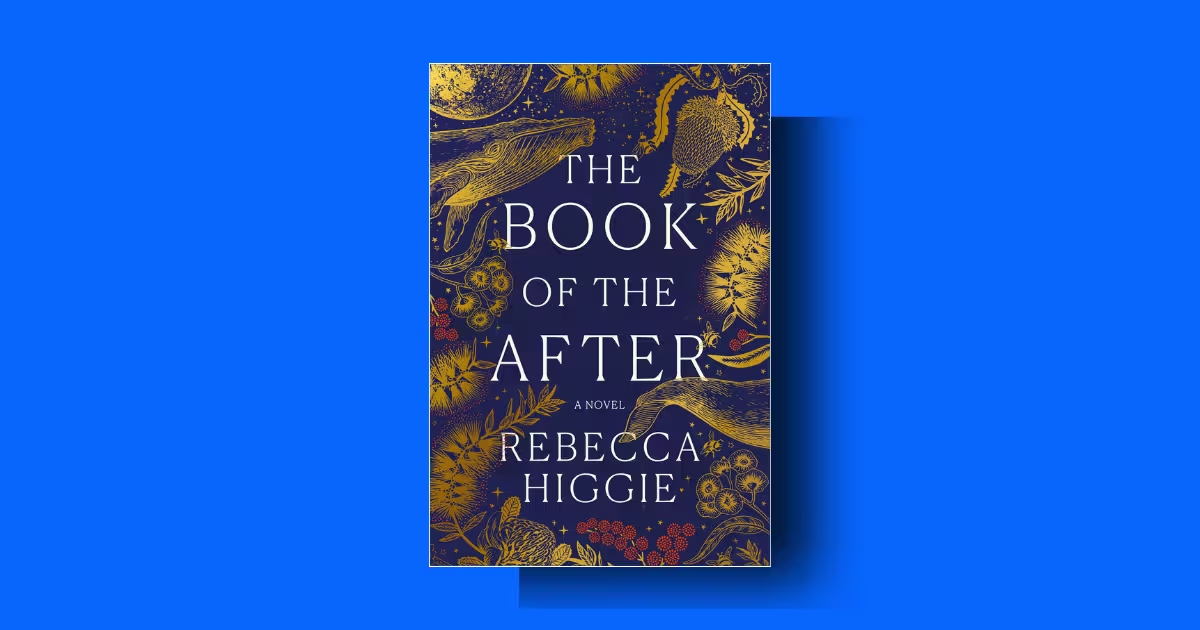

The Book of the After by Rebecca Higgie is a 560-page Australian novel about a world where the dead stay exactly as long as the living remember them, and it made me rethink something I had always assumed was good: being remembered. In this book, fame is not a reward. It is a sentence. A murdered Prime Minister, her grieving Deputy, a boy stranded on the moon and Guy Fawkes himself all learn that history can keep you trapped for centuries.
If you want the full story, the ending explained and an honest verdict before you buy it, this is the review I wish I had found first.
Table of Contents
What is The Book of the After about, in short?
The Book of the After is a speculative love story set mostly in a fire-scarred Australia of 2049, where Prime Minister Eleanor Rigby is assassinated and her Deputy, Negus Kebede, who secretly loved her for more than twenty-five years, inherits the job. Here is the quick version:
Author and publisher: Rebecca Higgie, Fremantle Press, 2026. Paperback, 560 pages, AUD 34.99.
The big idea: A cult book, also called The Book of the After, claims the dead linger only while the living remember them. In the novel, it turns out to be true.
The three timelines: Australia in 2049 to 2050, a jump to 2149, and a final section called “The End” set a thousand or more years later.
The narrators: Negus, Eleanor (as a ghost), Guy Fawkes (dead since 1606), Little Bee (a child cancer patient), plus short chapters “written” by the Author of the in-world book.
The twist on the Author: The cult book was dictated by Enheduanna, the Sumerian priestess often called the world’s first named author, through three generations of women in Lewes, England.
The ending, in one line: The lovers reunite on Patmos, are slowly forgotten, and in “The End” they get to live the quiet life they were robbed of.
Critical reception so far: Magdalena Ball called it “a tremendous book which achieves its big vision“.
My verdict: Big, brave, overlong in places, and one of the most moving novels about grief and public memory I have read this year.
Recommended Readers for The Book of the After
You will probably love The Book of the After if you like slow, emotional literary fiction that mixes history, politics and the supernatural. You will probably bounce if you want a tight thriller or a clean romance.
Read it if you:
Loved Lincoln in the Bardo or The Lovely Bones and want another afterlife told with real grief in it.
Follow Australian politics and enjoy spotting echoes of Gillard, Rudd and the Black Summer fires.
Like second-chance love stories between older, flawed adults rather than young, perfect ones.
Care about climate fiction that is angry but not preachy.
Enjoy historical villains with inner lives, because Higgie’s Guy Fawkes is unforgettable.
Skip it, or wait, if you:
Need fast pacing. The book is 560 pages and takes its time, especially in the middle.
Find suicide, assassination, torture or child death too heavy right now. All four are on the page, some in graphic detail.
Dislike explicit sex scenes. There are several, and they matter to the story.
Prefer one clear narrator. This novel jumps between at least six voices and three centuries.
Who is Rebecca Higgie?
Rebecca Higgie is a writer from Boorloo (Perth), Western Australia, and The Book of the After is her second novel, published by Fremantle Press in 2026. Her debut, The History of Mischief, won the inaugural Fogarty Literary Award for an unpublished manuscript and came out in 2020.
According to the author bio printed in the book, she holds a PhD in cultural studies and was formerly an academic at Curtin University and Brunel University London, with research on satire and politics. Compulsive Reader lists the release as October 2026, and an early review appeared in Books+Publishing in August 2026.
In a Fremantle Press interview, Higgie said the novel took about six years: roughly four of writing (including one and a half to two years of research), a year of editing and a year with the publisher. She also said it began with one surreal image, a dead whale swimming between Perth’s skyscrapers.
The acknowledgements add a sweet detail: the “You are my little bee” song was something she sang to her baby son through a sleepless year, and her husband, Yirga Gelaw Woldeyes, gave her the Amharic proverb at the heart of the book.
What real history and events sit behind The Book of the After?
The novel braids together three real histories: the Gunpowder Plot of 1605, the life of Enheduanna in ancient Ur, and Australia’s experience of catastrophic bushfire.
The Gunpowder Plot. Guy Fawkes was born in York in 1570, was arrested on 5 November 1605 guarding gunpowder beneath the House of Lords, and was executed on 31 January 1606, breaking his neck on the gallows and avoiding the worst of the sentence. Testimony puts the powder at twenty barrels, followed by sixteen more, which matches the “thirty-six barrels” in the novel.
Higgie’s author’s note says the only record of Fawkes’s wife, Maria Pulleyn, and their son Thomas comes from a genealogical index, and Wikipedia flags those entries as uncertain. That thin paper trail is exactly the point. A woman barely recorded is a woman easily forgotten.
Enheduanna. She flourished around 2300 BCE as the high priestess of the moon god Nanna at Ur and was the daughter of Sargon of Akkad. A disc naming her was found by Leonard Woolley in 1927, and the first complete English translation of her Exaltation of Inanna appeared in 1968.
Higgie uses that 1968 date as the moment her ghost regains the strength to touch the living world. In the author’s note she admits she invented Enheduanna’s lover and child.
Fire. Higgie told Fremantle Press that the story changed during the 2019-20 Black Summer fires. In New South Wales alone, those fires burned about 5.5 million hectares, killed 26 people and destroyed 2,448 homes. The novel’s fictional “Year of Fire” in 2046 is built on that memory. Her note at the back says Black Summer conditions are projected to be average by 2040 under growing emissions.
There are smaller real anchors too. Otto, the blue whale skeleton that haunts the book, is real. It was found by a girl named Daisy Locke near the mouth of the Vasse River in August 1897, is 24 metres long, and was named after museum taxidermist Otto Lipfert.
The children’s hunger strike on Parliament’s lawns was inspired by former diplomat Gregory Andrews, who began a climate hunger strike outside Parliament House in November 2023 and was taken to hospital on day 16.
The Book of the After summary
Part one: 2049, a Prime Minister is shot
The novel opens with the dead. Guy Fawkes, four centuries into the After, nudges a scented candle onto a pile of notebooks and burns down the home office of an Australian scientist who is building a machine to eat ocean plastic. Fawkes has already killed the man’s London colleague. He is not interested in what scientists do, only that they might succeed.
On the same morning in Perth, Prime Minister Eleanor Rigby visits Perth Children’s Hospital. A strange, serious eight-year-old named Bunny holds up a glitter painting of a whale she made “for the Prime Minister.”
Then a sniper’s bullet hits Eleanor in the head. In Canberra, her Deputy, Negus Kebede, watches it happen live on a staffer’s phone stream, seven seconds ahead of the television. Fires lit by an extremist group break out across Kings Park at the same time, and videos of masked people setting themselves alight flood the internet.
Eleanor wakes as a ghost beside her own body. Bunny’s dead grandmother, Betty, explains the rules: the dead have form but no body, they can walk through walls, and they stay only as long as they are remembered. Eleanor realises this is the world described in The Book of the After, a cult classic released around the turn of the century and translated into eighty languages. She also sees a folded page in the bag of her belongings at the morgue.
It is a note torn from that book, given to her the day before. She promised to read it when the time was right. Now she cannot even touch it.
Overhead, a dead blue whale swims through the smoke, calling. Betty says it is Otto, the skeleton from the WA Museum, still looking for a lost companion.
Part two: a reluctant king
Negus is six foot eight, scarred over about forty percent of his body from a fire-truck burnover during the 2046 “Year of Fire,” and missing three fingers on his left hand. He is also, it soon becomes clear, the man who loved Eleanor. He refuses the bunker, refuses the leadership talk and finally agrees to be sworn in as Prime Minister on an old Ge’ez Bible. The press calls him the first black man to hold the job.
Eleanor’s husband, Julian Hargraves, son of the party’s National Secretary Edward, packs up the Lodge in a drunken rage. He shoves a small red copy of The Book of the After at Negus, the copy Negus once gave Eleanor, now missing its title page. At the funeral, Julian twirls the torn page between his fingers while giving his eulogy, as if about to read it aloud. He does not. At the graveside, he holds it up to Negus’s face.
A photographer catches the moment, and the “note” becomes a national mystery.
Eleanor, meanwhile, ignores her grandfather Pop and Negus’s long-dead mother, Maaza, and follows Negus. She learns she can touch his cheek, and he can feel it. Night after night he whispers “Eleanor, touch me,” and she does. Pop warns her she is pulling him too close to death. Negus, for his part, begins to believe he is going mad. In Amharic he tells himself exactly that.
Part three: the Before, how they met
Woven through the 2049 story are chapters headed “The Before,” and they slowly reveal the love story. Negus and Eleanor met in their twenties at the Bonfire Night parade in Lewes, England, where she wore a banner reading “we burn to remember.” He was a PhD student researching The Book of the After; she was an exchange student in political science. They slept together that night in a tiny B&B room with a single bed.
They became a couple in London and then Perth, where Eleanor rented a dusty West Perth apartment from her family friend Monty, later WA Premier. Negus ran Kings Park at dawn, flipped off the Queen Victoria statue “for Maqdala,” lay under Otto in the museum with her, and filled the flat with books. After a pregnancy scare and a night where he broke down over friends killed fighting fires, they promised each other a future. His card to her read “You and me. We’re eternal.”
Then everything broke on one day. Eleanor drove to her brother Fox’s honey farm near Esperance and found he had died by suicide. That same day, Negus’s mother had a major stroke in Melbourne. Before flying home, Negus scrawled a love note on the back of the title page of his favourite book, tore it out, kept it in his wallet and left her only a sticky note.
Months later, worn out from caring for his paralysed mother and working night fill, he saw a photo of a minister’s son, Julian, with his arm around Eleanor. He ended things at Melbourne airport, shouting at her in front of strangers, and blocked her everywhere.
Years later, Eleanor married Julian and entered Parliament in 2038. Negus became a disability advocate, then an MP and minister. At their first meeting in Parliament, he pretended not to know her.
It took the 2046 Year of Fire, his near-death in a burning truck and a hospital visit from Eleanor, who needed him as Deputy to win the leadership, to bring them side by side.
A visit to the Lodge study, where he found she had kept his red book, finally ended the pretence. They forgave each other, became close friends, and together passed the “Climate Parliament,” a raft of laws that effectively ended fossil fuels in Australia.
Part four: Guy Fawkes and the Author
Fawkes’s chapters run alongside all this. In life, he married Maria in secret; she died after childbirth and their son Thomas died soon after. His grief pushed him toward war and gunpowder. After his execution, he found Maria and Thomas waiting in the After, and they were happy for sixty years, until Maria vanished in front of him on a Bonfire Night. She had been forgotten because he had kept her a secret.
Furious that history keeps him alive by burning his effigy every year, Fawkes meets a mysterious ancient woman with lapis beads in her hair. In 1999 he follows her to a house in Lewes, where she is dictating a book about death through a typewriter to a teenage beekeeper named Isabel.
The ancient is Enheduanna. The book is The Book of the After. Fawkes joins her. At her command he types the instruction for Isabel to fill the house with lit candles and leave, then knocks the candles over himself. The fire kills Isabel’s father, Isabel is arrested, her newborn daughter Queenie is taken from her, and the book is leaked to the world.
Enheduanna’s goal is dark. Both she and Fawkes want the End, and since the long-remembered can only be forgotten if the living stop remembering, they decide the living must end. On Patmos, the Greek island where John wrote Revelation, a voice in John’s cave tells the plotters to throw down the Earth. Fawkes sends his old co-conspirators to tamper with nuclear plants, seawalls and labs.
Part five: the moon, the shooting and the suicide
Little Bee, an eight-year-old with blood cancer famous from a viral video of his mother Queenie singing “You are my little bee,” gets his wish: space billionaire Nick Tavangarian takes him on Odyssey’s first flight to HotelLunar. Fawkes and Catesby spend weeks bending joins and fraying wires inside the rocket. The ship lands, then explodes into the hotel. Everyone aboard dies and their spirits are stranded on the moon.
Leaked reports later show engineers asked Tavangarian to delay the launch and he refused. Back on Earth, Negus, who had held Queenie’s hand during the launch, orders police to remove the cameras filming the grieving families. That same night, Bunny dies by jumping from the hospital balcony, using stacked plastic boxes she had cut “smiles” into.
The pressure keeps building. Negus becomes hugely popular for his blunt speeches, his morning runs and a song choice, Yothu Yindi’s “Treaty,” that pushes his party into promising a treaty with First Nations people. But he is also having panic attacks at sharp sounds.
Fawkes and Catesby, haunting Julian’s mother’s house, manage to send an email Julian had drafted to an ABC journalist. It contains a link to Eleanor’s encrypted cloud folder of old photos and one recent video.
During a morning run in Canberra, an Extinction Reckoning member shoots Negus in the shoulder. Pinned to the pavement and filmed by bystanders, he begs his bodyguard Jack, in Amharic, to let him die. Recovering at home, he confronts Julian, who burns the red book and the note with a cigarette lighter. Left alone, in pain, sleep-deprived and certain of nothing, Negus takes his own life. He feels a touch on his cheek just before and believes it is Eleanor. In the After, Fawkes is sitting on his couch. The touch, Fawkes implies, was his.
Part six: the hacks and the long search
After his death, hackers release the whole folder. The country sees the photo by Tower Bridge, the moat at UWA, the anniversary photo with the gold banksia pendant, and finally the video from “that night in the Lodge.” In it, a tipsy Eleanor asks Negus, “What am I to you?” He answers “Queen.” She asks what he is to her, and he says “King.”
The public decides it was an affair. Riots follow. Protesters breach Parliament House and police open fire. The election produces a hung parliament, and the treaty is abandoned.
Here the book reveals what really happened the night before the shooting. A month after the drunken Lodge dinner, Negus kissed Eleanor in the Breakfast Room just as Julian walked in. He resigned the same day. Eleanor came to his apartment, told him she had left Julian, kissed him and refused his resignation. Before her flight to Perth, he gave her the note and asked her to read it only if she was serious. She chose to wait so they could read it together. The next morning she was shot.
Both ghosts then miss each other for years. Eleanor is stuck on Fox’s farm, where her brother guilts her into staying, and later misses Negus’s funeral by twenty hours. Negus searches every place they loved in Perth. One dawn, a second dead whale arrives over the river and the two whales reunite. That gives each lover the same idea: go where the note said to meet. Eleanor does not know what it said. Negus goes to Patmos and waits.
Part seven: 2149 and Patmos
A century later, Australia is a republic, Perth’s CBD is flooding behind seawalls, and the world sits at roughly 5.1 degrees of warming.
Eleanor still searches. Little Bee is rescued from the moon by Chinese astronauts’ return flight, but he has forgotten his mother’s face and nearly forgotten his real name. Eleanor helps him look for Queenie, but Fawkes finds the boy first in a flooded space museum Queenie built, tells him she has been forgotten and wins his trust. Fawkes realises the boy’s real name is Thomas, the same as his own dead son.
On Patmos, Negus has become “the King of the After.” He sends grieving ghosts out to look for Eleanor, promising them peace, while Enheduanna sends others out to cause destruction. Julian visits, now an old ghost with a second wife, and the two men make peace.
In Lewes on Bonfire Night, Julian finds Eleanor and recites the note from memory: Negus will wait “until the End, at the very peak, on the shores of the apocalypse.” She goes to Patmos. When she climbs to the top of the monastery, they both feel breath, tears and touch again. They kiss as a giant wave rises over the island.
The Book of the After ending explained
The ending happens in three movements, and it helps to take them one at a time.
First, the wave. The storm and tsunami that hit Patmos are linked to a geoengineering plane Little Bee and Fawkes tamper with, changing its “aerosol dispersal rate.” In the water, Enheduanna touches a drowning woman with long black hair who calls her “mother.” She has finally found a true descendant of her lost daughter, and both of them vanish.
Then Queenie appears on the mainland, very much remembered, and embraces her son before she too vanishes. Fawkes had lied. Little Bee calls him a devil and leaves him.
Second, being forgotten. In “The End,” a thousand years or more later, Eleanor and Negus have wandered together through drowned cities. They reach what is left of Perth and walk under the sea to lie beneath Otto’s fallen bones. In the village above, the only person who still knows who Negus was is an old woman historian. As she lies dying, he vanishes mid-sentence, halfway through saying “I love”.
Eleanor survives a while longer as “the Queen of the Sunken Lands” in another old storyteller’s bedtime tales. When that storyteller dies in her sleep, Eleanor vanishes too. Only then is the little girl at the bedside revealed to be Bunny, who knocks over the candle and burns the last papers.
Third, what the End actually is. This is the part readers will argue about. The End is not nothing. Eleanor and Negus wake up young at the Lewes bonfires, return to their old B&B and then dream the life they lost: the bullet misses, she resigns, he resigns, they move into a Kings Park flat, get engaged in Lewes, he finishes his PhD, he writes a bestselling memoir, and they grow old together before waking one last time in that tiny bed and fading. Little Bee is not given the End yet.
Bunny shows him a vision of the life he wished for, one where he never boards the rocket and Queenie is happy, then tells him a nursery rhyme will keep him remembered for well over a thousand more years. The two of them walk into the sea after the whale. Even Fawkes, repentant at last, sees a masked rider take off her mask and say “Dear husband.”
So what does the ending mean? My reading is that the End is a final act of memory rather than an erasure. Each soul gets the life love would have built if history had not intervened. Whether that life is “real” or a last kindness of the dying mind, Higgie leaves open, and I think she is right to.
The Book of the After analysis
Who are the main characters in The Book of the After?
Negus Haddis Kebede is the heart of the novel, a giant of a man who is terrified of his own size. He is a literature PhD turned firefighter, carer, advocate and finally Prime Minister, and his name means “king” in Amharic. What makes him complex is the private reason he keeps trying to be good. In one of the hardest scenes, drunk and grieving after two friends die in a fire, he tells Eleanor he has to make up for “what he did.
To Mum,” and she realises he is speaking about the white father who hurt Maaza. He fights fires partly so his body can be useful without being frightening.
His jealousy, his temper and the cruel way he ends their relationship at Melbourne airport keep him from being a saint. His later suicide is written as the end of a long slide, through PTSD, a bullet wound, sleeplessness and the theft of the one note that held his younger self. I found him the most fully drawn character in the book.
Eleanor Joelle Rigby is harder to love on first meeting, and I think Higgie wants it that way. At thirteen she held a placard reading “history will remember what you did.” As an adult she admits, in a rare moment of honesty, “Because I want power.”
She is careful, ambitious and sometimes careless with the people closest to her. Her arc is the slow discovery that she was lonely inside her own success. As a ghost she grows: she lets go of Fox, helps Little Bee, and finally flips off Queen Victoria “For Negus.” Her name, of course, comes from the Beatles song about loneliness, which Negus wonders about in his very first chapter.
Guy Fawkes is the novel’s most surprising creation. Higgie gives him a dead wife, a dead baby and a lifelong horror of women’s screams, beginning with the execution of Margaret Clitherow he watched at sixteen.
His grief makes him dangerous. Over four hundred years he turns from a man who once felt Maria’s touch saying “Husband, no” into a ghost who burns houses and sabotages a rocket with a sick child on board. He never stops thinking of himself as God’s servant. His final chapter, where he repents in the hollow of a burnt tree, is one of the best things in the book.
Little Bee (Thomas) is the moral centre of the book’s climate argument.
He believes a billionaire’s rocket is his “one chance” to be more than the sick kid on the news. What he loses on the moon is not just his life but his memory of his mother’s face and the tune of her song. Higgie said in her Fremantle Press interview that he stands for humanity needing to refocus on family and Earth rather than technological rescue.
Enheduanna, the Author is a priestess who invented authorship and is punished for it with four thousand years of being remembered. In the novel’s version, she lost a shepherd lover and a daughter she could never publicly name, her “little bee.” Her book is both a gift and a trap. It comforts grieving mothers, and it also lures exhausted souls to Patmos to help end the world.
The supporting cast is strong. Julian is weak, unfaithful and petty, yet by 2149 he is the one who gives Eleanor the words of the note. Lily, Negus’s chief of staff, quietly leaves him one painkiller because she fears what he might do. Jack, his bodyguard, keeps saying “Sir, you’re here” to bring him out of flashbacks. Bunny begins as an odd hospital child and ends as something close to a goddess of memory. Fox, Eleanor’s brother, is a portrait of how suicide damages the people left behind, and Higgie refuses to soften it.
What are the main themes and symbols in The Book of the After?
The central theme of The Book of the After is that memory is a kind of afterlife, and that being remembered for too long is a punishment rather than a prize. The in-world book says it directly: “This is the curse of the long-remembered.” Everything else grows out of that idea.
Memory and legacy. Negus asks Eleanor in their youth, “Do we cease to exist if people forget us?” The novel answers yes, literally. Ghosts of extinct animals roam museums because their bones are on display. Kings and assassins linger for centuries.
Ordinary mothers vanish in decades. Fawkes loses Maria precisely because he kept her secret, and the Author’s chapter calls being forgotten “a punishment for men who dared not honour the deeds of their women.” This is the novel’s sharpest political idea. History is not neutral, and the people it leaves out disappear twice.
Public image versus private grief. Negus is mythologised as “Kingman,” the hero with burn scars, while he is falling apart at night. The press, the party and his own social media manager, who tells him he gets more engagement running in sleeveless shirts, all turn him into a symbol.
A Perth artist paints the lovers as “The King and Queen of the After.” In 2149, students watch plays about them. The book keeps asking who owns a dead person’s story.
Fire. Fire is everywhere: the Gunpowder Plot, the Year of Fire, Kings Park burning, Bonfire Night, the candle that kills Isabel’s father, the lighter that burns the note. Negus taught Eleanor that in firefighting, black ground is safe because there is nothing left to burn, so she comforts his nightmares with “You’re with me in the black. Nothing can burn us here.” Fire destroys, but in this book it also preserves memory, as the Lewes banner says: “we burn to remember.”
Whales and bees. Otto, the dead blue whale calling for a lost companion, is the book’s image of faithful love. When a second whale finally arrives, both lovers understand that one of them must stop searching and wait. Bees stand for fragile life and for the line of mothers and daughters, from Enheduanna’s “little bee” to Queenie’s song to the beekeeping women of Lewes. In the very last section, a new kind of bee with blue stripes lands on a firewood banksia in drowned Perth. Life adapts, even after us.
Climate politics and hope. Higgie’s argument is not that we are doomed. In a key early scene, Eleanor tells Negus, “Some people want utopia or apocalypse. Anything in-between is a betrayal.” Later he tells her, “Belief, hope: it’s a strategy!” The tragedy of the novel is timing. As Negus says near the end, “We did everything we could, Yene mar. We just did it too late.”
Faith and the End. The End functions like a secular heaven, and Higgie handles religion with care. Negus is Ethiopian Orthodox, Fawkes is Catholic, Eleanor is an atheist. Each finds something like grace at the End, though none of their religions predicted it.
My evaluation of The Book of the After
The Book of the After is an ambitious, aching, sometimes exhausting novel that turns a political assassination into a four-thousand-year meditation on who history keeps and who it lets go. It is the most emotionally intelligent Australian novel about climate grief I have read, and I closed it feeling oddly grateful for the people in my life who will one day forget me.
What works well in The Book of the After?
The love story is earned. Because Higgie shows us the full twenty-five years, including the ugly break-up, the reunion on Patmos lands with real force.
Guy Fawkes is a brilliant idea. Using the man burned in effigy every 5 November to show how memory punishes is smart and original.
The political detail is sharp. Question Time, polling numbers, hot-mic scandals and media pile-ons all feel authentic. The novel’s in-world polls, such as a preferred Prime Minister rating of 63.7 to 27.1 for Kebede, read like real newsroom copy.
The Amharic thread. Phrases like “yene konjo” (my beauty), “yene mar” (my honey) and the hyena proverb give Negus a culture, a language and a faith, not just a backstory.
The ending is brave. Letting both lovers be forgotten, and then giving them a dream of the life they wanted, is a risky emotional move that paid off for me.
What are the weaknesses of The Book of the After?
It is too long. At 560 pages, the middle section, especially Eleanor’s months on Fox’s farm, drags.
The Fawkes and Enheduanna plot is the weakest strand. Magdalena Ball felt the Fawkes thread was “a little clunky” in places, and I agree. The Patmos cave voice and the sabotage of nuclear plants feel more like a fantasy thriller than the rest of the book.
Some scenes are very graphic. The torture and execution chapters, the suicide and the sex scenes are explicit. They have purpose, but some readers will find them too much.
The time jumps can confuse. Good Reading’s reviewer noted the “fragmented structure” can lose its threads, and I also had to flip back to check who was dead and who was alive more than once.
What books are similar to The Book of the After?
Lincoln in the Bardo by George Saunders (2017 Booker Prize winner): another afterlife where ghosts cling to the world of the living. Saunders is funnier; Higgie is more romantic and more political.
Sum: Forty Tales from the Afterlives by David Eagleman: the idea that you die a final time when your name is spoken for the last time is very close to Higgie’s rule.
Coco (Pixar, 2017): the same “final death” by forgetting, but for children.
The Ministry for the Future by Kim Stanley Robinson: climate politics at government level, though far less personal.
Cloud Atlas by David Mitchell: for its time jumps across centuries and its linked souls.
If climate fiction is your entry point, I have rounded up more of it in my list of 15 climate fiction novels that explain the future better than the news. For another 2026 novel about doubles, regret and the life not lived, see my Exit Party review. And if Patmos and Revelation caught your interest, Karen Armstrong’s A History of God is a good companion.
What does The Book of the After teach us about memory, leaders and grief today?
The most important lesson of The Book of the After is that how a society remembers people decides how it treats the living. Here are five lessons I took from it.
We remember the dramatic death, not the quiet ones. Black Summer’s direct deaths made headlines, yet a Royal Commission hearing was told bushfire smoke was linked to about 445 death. Higgie’s Year of Fire works the same way.
Records erase women first. Fawkes’s wife survives in history only through one uncertain genealogical entry. The novel’s afterlife makes that erasure literal.
Performance hides pain, especially in men. The ABS recorded 3,214 suicide deaths in Australia in 2023, about three quarters of them mal, and Suicide Prevention Australia reports suicide as the leading cause of death for Australians aged 15 to 44. Negus, joking and running for the cameras, is a portrait of that hidden crisis.
Protest becomes memory. The fictional hunger strikers echo Gregory Andrews’s 2023 strike, and their chalkboard line outlives everyone in the book.
Myths can be weaponised. Fawkes’s face moved from devil to freedom fighter to anarchist mask. In the novel, the same happens to Eleanor and Negus. If you are interested in how crowds turn people into symbols, my review of The Crowd by Gustave Le Bon covers the psychology.
Best quotes from The Book of the After
These lines are quoted directly from the novel, with the section they appear in.
- “We, the dead, linger / only as long as you, / the living, / remember us.” (The Author, opening chapter)
- “This is fame. / This is fortune. / This is the curse of the long-remembered.” (The Author)
- “Some people want utopia or apocalypse. Anything in-between is a betrayal.” (Eleanor, The Before, Lewes)
- “But meaningful action is always in the in-between.” (Eleanor, same scene)
- “Siet yelakew jib ayiferam.” Translated in the book as “A man sent by a woman fears no hyena.” (Negus)
- “You and me. We’re eternal.” (Negus’s anniversary card, and the last line of his note)
- “Belief, hope: it’s a strategy!” (Negus, The Before)
- “You’re with me in the black. Nothing can burn us here.” (Eleanor, The Before)
- “Don’t trust the fire, Little Bee. The fire is a liar.” (Bunny)
- “No one ever remembered the mothers.” (Guy)
- “I’ll wait for you until the End, at the very peak, on the shores of the apocalypse.” (The Note)
- “We did everything we could, Yene mar. We just did it too late.” (Negus, The End)
- “Please, won’t you, please, take us out of your memory.” (The Author)
- “Memory. / What a shifting history.” (Enheduanna’s chapter)
Final verdict on The Book of the After
The Book of the After is a flawed but unforgettable novel, and for me its strengths win. It is a love story, a climate novel, a political drama and a ghost story at once, and while that makes it baggy, it also makes it rare. Higgie takes a simple rule, that the dead last as long as we remember them, and follows it to a place few writers would dare: a world where being famous is a cage and being forgotten is mercy.
I would recommend it to readers of literary and speculative fiction, fans of Lincoln in the Bardo, people who follow Australian politics, and anyone who has loved someone they could not be with in public. If you want something fast or light, wait for a calmer week. And if you have lost someone, read the ending slowly.
It may hurt, but it is also kind.
References
- Fremantle Press, The Book of the After
- Fremantle Press, Imagining the After: Rebecca Higgie on love, death and memory
- Compulsive Reader, review by Magdalena Ball
- Queensland Reviewers Collective, review by Ian Lipke
- Good Reading Magazine review
- Books+Publishing review
- Wikipedia, Guy Fawkes
- Wikipedia, Enheduanna
- WA Museum Boola Bardip, Otto’s Symphony
- AIDR Knowledge Hub, Black Summer bushfires NSW 2019-20
- ABC News, smoke killed nearly 445 people
- ABS, Causes of Death, Australia, 2023
- Suicide Prevention Australia, Stats and Facts
- Canberra Times, Gregory Andrews hunger strike