
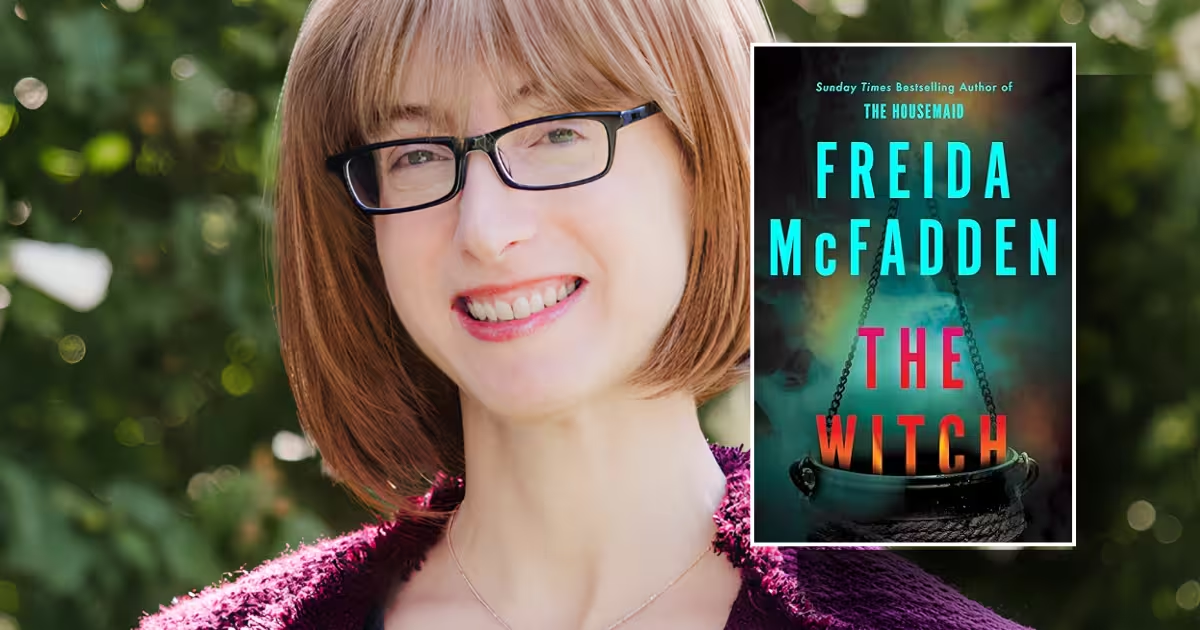

The Witch by Freida McFadden is not the book I expected from the author of The Housemaid. To be published on October 6, 2026, by Poisoned Pen Press, this 352-page thriller splits itself between two timelines: a present-day haunted estate in rural Massachusetts and the brutal reality of a 1692 witchcraft accusation.
The result is a novel that, for me, worked brilliantly in one half and stumbled in the other.
I’ve read over twenty McFadden books. I know her formula: fast chapters, unreliable narrators, and twists that reframe everything. The Witch follows that blueprint, yet it also does something new. It asks a question that haunted me long after I closed the book: what happens when the real monster isn’t a ghost, but the people who were supposed to love you?
Table of Contents
Brief Summary
The Witch is a dual-timeline psychological thriller about Caroline Eldridge, a young wife executed for witchcraft in 1692, and Julia Barlow, her descendant who moves into the family estate Pemberton in the present day.
Caroline’s chapters are gripping, historically grounded, and emotionally devastating. Julia’s chapters are thinner, relying on manufactured hauntings and a rushed romance. The ending reveals that the “ghost” was a hoax orchestrated by a woman who murdered the real Ethel Eldridge decades ago and stole her identity.
The Witch is best for McFadden completists, readers who love witch trial fiction, and anyone who wants a spooky fall read with real emotional stakes. Skip The Witch if you need both timelines to be equally strong, or you’re tired of the “it was all a trick” resolution.
Reader Recommendation
Who will love it: Readers who adored The Crucible and want a thriller that takes the machinery of witchcraft accusations seriously. Fans of dual-timeline historical fiction like The Weight of Ink or The Familiars. Anyone who wants a Halloween read with genuine historical texture.
Who might bounce: Readers who prefer McFadden’s pure domestic suspense (like The Housemaid). Those who need the present-day mystery to match the historical one in quality. Readers who feel cheated when supernatural elements are “explained away” as human trickery.
Introduction to the Book
Title: The Witch
Author: Freida McFadden
Publisher: Poisoned Pen Press (an imprint of Sourcebooks)
Publication Date: October 6, 2026
Length: 352 pages
Audiobook Narrators: Saskia Maarleveld and Marin Ireland
McFadden is a physician specializing in brain injury and a #1 New York Times bestselling author. The Witch is her third novel of 2026, following Dear Debbie and The Divorce.
Background
The Witch is set against the historical backdrop of the 1692 witch trials in colonial Massachusetts. While the town of Woodhaven and the Eldridge family are fictional, the novel draws on real history: more than 200 people were accused of witchcraft during the Salem trials, and 20 were executed. Notably, the condemned in Salem were hanged, not burned, burning at the stake was more common in Europe.
McFadden uses this historical tension to explore how communities turn on their own, how evidence becomes irrelevant once an accusation is made, and how women’s lives were controlled by men who claimed to protect them.
The Witch Plot Summary
The 1692 Timeline: Caroline Eldridge
Caroline Eldridge is twenty years old, married to Archibald Eldridge, a wealthy merchant fifteen years her senior. She has been unable to conceive, a fact she hides from Archie by pretending to be pregnant. Her servant, Molly Howe, discovers the deception and threatens to expose her.
Caroline’s only friend is Hitty Atkins, an elderly herbalist and widow whom the town considers peculiar. When their neighbor Judith Hatch falls gravely ill, Caroline refuses to call Dr. Shaylor (whose bloodletting killed her father) and instead nurses Judith with cool rags, saving her life. But Dr. Shaylor and Molly twist the story: they claim Caroline caused Judith’s feverish convulsions through witchcraft.
Hitty is arrested for witchcraft and hanged. Caroline publicly protests at the gallows, which seals her own fate. She is arrested, strip-searched for a “witch’s teat,” and put on trial. Molly testifies that Caroline fed the devil in the form of a cat (Gideon, a stray she fed) and tried to make her sign the devil’s book. Dr. Shaylor claims Caroline caused Judith’s fits. Deputy Strickland produces a dull needle and declares that Caroline doesn’t bleed, “proving” she’s a witch.
Archie refuses to speak in Caroline’s defense. She is convicted and sentenced to hang.
Meanwhile, Caroline shares a jail cell block with Jonas Reeve, a man accused of being the “Night Reaper,” a serial killer who strangled four young women. Caroline initially believes him guilty. But Jonas, using a stone dug from the floor, attacks Deputy Strickland and escapes, taking Caroline with him. They set fire to the jailhouse, killing Strickland.
They flee to Pemberton. Caroline sneaks in to steal money, but hears screams from upstairs. She finds Archie strangling Molly Howe—who is naked and visibly pregnant. Caroline realizes Archie is the real Night Reaper. He has murdered multiple women, including his first wife. Archie tries to strangle Caroline too, but Jonas arrives and shoots him.
Caroline and Jonas bury Archie and Molly in the backyard. They assume the identities of Archie and Molly Eldridge and flee Woodhaven. Caroline eventually falls in love with Jonas and bears him children.
The Present-Day Timeline: Julia Barlow
Julia Barlow, 27, loses her job and apartment in Manhattan and moves to Pemberton, her family’s 1660 estate in Woodhaven, Massachusetts. Her grandmother Letitia (“Gram”) has declining memory, and her great-aunt Ethel lives there too. The Woodhaven Museum, represented by curator Henry Ziegler, wants to buy the property and turn it into a historic site.
Strange things happen immediately. The grandfather clock stops at 3:41 AM every night. A woman cries outside Julia’s door. A noose appears in the backyard oak tree. Lights flicker. Julia finds a human pelvic bone that Gram dug up in the backyard. Ethel warns her to lock her bedroom door at night.
Julia hires Alistair Dixon, a “certified ghost hunter,” to investigate. His equipment malfunctions dramatically. He leaves an EVP recorder, which captures a woman’s voice whispering “Celia.”
Julia discovers two unmailed letters from Ethel to her mother, revealing that Ethel was pregnant by a soldier named Howard who was killed in Vietnam. The second letter is dated two months before Julia’s father’s birth. Julia suspects Ethel gave her baby to Letty to raise—meaning Ethel is actually her grandmother.
She obtains a DNA sample from Ethel’s hairbrush and sends it to Henry’s lab contact. The results come back: no match. Ethel is not Julia’s great-aunt. She is not related to Julia at all.
Julia confronts the truth: the woman she knows as “Ethel” is actually Celia Caine, the housekeeper mentioned in Ethel’s letters. Celia murdered the real Ethel after she gave birth, buried her in the backyard, and stole her identity. She and Mick Wheeler—her former fiancé, still in love with her—have been staging the hauntings to drive Julia away and prevent the sale of Pemberton.
Celia shoots Mick when he hesitates to continue the deception. She forces Julia to dig her own grave. But Gram—Letitia—saves Julia by hitting Celia with a shovel. Celia is arrested. Mick dies.
The real Ethel’s remains are found and buried properly. Caroline Eldridge finally gets a gravestone. Pemberton is sold to the museum. Julia and Henry begin a relationship. In a final twist, the police find three skeletons in the backyard: Ethel, and two others estimated to be 300 years old—one male, one female. The mystery of the extra male skeleton is never solved.
The 1717 Epilogue
Caroline and Jonas, now elderly and using the identities of Archie and Molly, return to Pemberton with their four grown children. They bring a painting of themselves that looks like the historic portrait of Archie and Molly.
They plan to live out their days at Pemberton, “making sure nobody ever discovers what we buried behind the house.”
Analysis and Critique
Characters
Caroline Eldridge is the emotional core of the novel. She is not a modern woman in a bonnet; her instincts are period-correct and often wrong. She keeps feeding a stray cat because she cannot bear to let a creature starve, unaware that this will be used against her. She nurses a feverish neighbor and then genuinely wonders if she caused the woman’s fit. The novel is at its best in that uncertainty—when the whole town insists a thing is true, the accused starts checking her own memory for corroboration.
Julia Barlow is thinner. Kirkus Reviews called her storyline “anemic” with “insipid characters” and “Scooby-Doo villains”. I found Julia’s chapters readable but forgettable. Her romance with Henry lacks chemistry. Her ghost-hunting exploits feel like a distraction from the real story.
Archibald Eldridge is the novel’s true villain—a charming merchant who strangles women and lets his wife take the blame. His refusal to defend Caroline in court, his affair with Molly, and his ultimate attempt to kill Caroline make him far more terrifying than any ghost.
Celia Caine / “Ethel” is a compelling antagonist. She murdered her friend to steal her life, then spent decades maintaining the deception. Her willingness to kill Mick—the man who loved her—shows how far she’ll go to protect her secret.
Jonas Reeve is the most complex character. Accused of being a serial killer, he is actually innocent. He saves Caroline multiple times, kills to protect her, and ultimately marries her. His arc from feared monster to devoted husband is the novel’s most satisfying transformation.
Themes and Symbolism
The Machinery of Blame: The novel’s central argument is that once accused, no procedure exists by which you can be found innocent. Caroline’s trial is a masterclass in how communities weaponize fear. Spectral evidence, a dull needle, a servant’s grudge—these are enough to kill a woman.
Inherited Secrets: The title refers not just to Caroline’s ghost, but to the secrets families pass down. The Eldridge/Barlow family has buried bodies, stolen identities, and lied for generations. Julia’s discovery that her “great-aunt” is a murderer is the ultimate inheritance.
The Performance of Womanhood: Caroline’s failure to conceive, her friendship with the “wrong” people, her refusal to be silent—these are all violations of expected behavior. Her execution is not about witchcraft; it’s about punishing a woman who stepped out of line.
The Cat as Symbol: Gideon the stray cat appears throughout the 1692 timeline. Caroline feeds him out of kindness; Molly uses him as evidence of devil-worship. The cat represents how innocence can be twisted into guilt.
Evaluation
The Witch is Freida McFadden’s most ambitious novel. It attempts to bridge historical fiction and psychological thriller, and for about half its length, it succeeds brilliantly. The 1692 chapters are riveting—procedurally exact, emotionally devastating, and genuinely scary in ways that have nothing to do with ghosts. The trial chapters made me furious. I was angry at Molly, at Dr. Shaylor, at Archie, at the entire town. That’s the mark of effective writing.
The modern chapters, however, feel like scaffolding. The hauntings are manufactured, the romance is forced, and the resolution—”it was all a trick”—undermines the supernatural tension McFadden spent 300 pages building. Henry Ziegler is charming but one-dimensional. Alistair Dixon is a caricature. Julia is likable but not particularly interesting.
Strengths: Caroline’s storyline, historical accuracy, the trial sequence, Jonas’s character arc, the final twist regarding Celia’s identity.
Weaknesses: Weak present-day plotting, underdeveloped romance, the “Scooby-Doo” resolution, an unnecessary ghost hunter subplot.
Impact: The novel made me think about how easily communities turn on their own, how women’s lives were controlled by men who claimed to protect them, and how secrets can poison a family for generations. The 1692 chapters will stay with me. The modern chapters, less so.
Comparison: The Witch shares DNA with The Crucible (the machinery of accusation), The Haunting of Hill House (the haunted estate), and McFadden’s own The Housemaid (the twisty domestic thriller). But it’s less cohesive than any of those.
Personal Insight: The Real Terror of The Witch
The most important lesson I took from The Witch is not about ghosts. It’s about the machinery of accusation. Caroline’s trial is fiction, but the pattern is real. In 1692, spectral evidence was accepted in courtrooms. Today, we have different forms of “spectral evidence”—social media pile-ons, leaked accusations, trial by public opinion. The novel argues that once a community decides you are guilty, no procedure exists to prove your innocence.
According to the Salem Witch Museum, more than 200 people were accused during the 1692 trials, and 20 were executed. The youngest was Dorothy Good, age 4. These were not abstract numbers. They were people whose neighbors decided they were dangerous.
Five lessons from the novel:
- Accusation is often enough. Caroline’s guilt was established before her trial began. The trial was performance.
- Women who speak up are punished. Caroline defended Hitty and was executed for it.
- Those closest to us can be the most dangerous. Archie was the real monster, not the accused “Night Reaper.”
- Secrets corrupt families. The Eldridge/Barlow family buried more than bodies.
- Kindness can be weaponized. Caroline’s cat, her nursing, her friendship—all were used as evidence against her.
The Witch Quotes
“I always knew I would die young.” — Caroline, opening line
“If you are found guilty by the court, the sentence will be death.” — Magistrate Putman
“Once you are accused, no procedure exists by which you can be found innocent.” — The novel’s central argument
“I used to believe I would die young. But after settling in Pemberton with Archie, I dared to dream that there might be more to my life. But that won’t happen now.” — Caroline
“You’re not going to kill anyone I care about ever again.” — Letitia, to Celia
“Why should I spare you? You were willing to sign the death warrant of Mistress Eldridge here based on lies.” — Jonas, to Deputy Strickland
Conclusion
The Witch is a flawed but fascinating novel. The 1692 chapters are some of the best writing McFadden has produced—tense, historically grounded, and emotionally devastating. The modern chapters are serviceable but forgettable.
I recommend it to readers who love historical fiction about witch trials, who want a spooky fall read with real substance, and who can forgive a weaker present-day timeline for the sake of a powerful past one.
Overall rating: 3.5/5 stars. A worthwhile read, but not McFadden’s best.





