
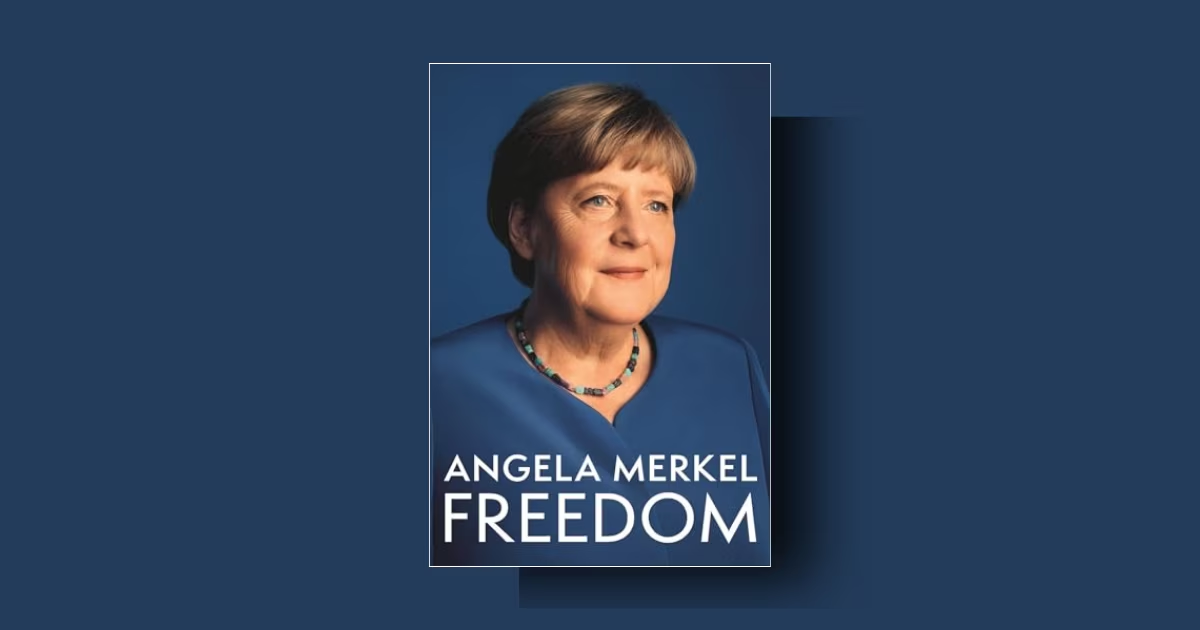

Freedom: Memoirs 1954-2021 by Angela Merkel is the most revealing book a German chancellor has ever written about growing up under a dictatorship, and the least revealing about the decisions that critics still hold against her. I finished all 720 pages of the St. Martin’s Press edition with two clear feelings.
The first 35 years, lived in East Germany, read like a quiet thriller about a pastor’s daughter learning to outwit the Stasi with a smile.
The last 16 years, lived in the Chancellery, read like a carefully argued closing statement in which the defendant concedes small errors and none of the big ones. If you want to know whether this Angela Merkel memoir explains why Germany grew dependent on Russian gas, why she blocked Ukraine’s path to NATO in 2008, and why she let refugees in on the night of September 4, 2015, the answer is yes.
If you want her to say she was wrong about any of it, the answer is no. That tension is the reason this Freedom by Angela Merkel review exists, and it is also the reason the book is worth your time.
Table of Contents
What Is Freedom by Angela Merkel About?
Freedom: Memoirs 1954-2021 is Angela Merkel’s autobiography, co-written with her long-time advisor Beate Baumann, covering her childhood in the GDR, her career as a quantum chemist, her entry into politics in 1989, and her 16 years as German chancellor (2005 to 2021).
Published: November 26, 2024 in the US by St. Martin’s Press; first published in Germany by Kiepenheuer & Witsch and in the UK by Macmillan.
Length: 720 pages in the US hardcover; 736 pages in the German original, Freiheit.
Translated by: eight translators, led by Shaun Whiteside.
Audiobook: narrated by Juliet Stevenson.
Structure: five parts plus a prologue and epilogue, from “I Wasn’t Born Chancellor” (1954 to 1989) to “Serving Germany (II)” (2015 to 2021).
Core argument: freedom is not just escape from dictatorship but responsibility for others, and politics “isn’t witchcraft” but the work of ordinary people.
What she defends: the 2008 refusal of NATO membership plans for Ukraine and Georgia, the 2015 refugee decision, Nord Stream, the euro rescue.
What she admits: the 2021 Easter lockdown plan, her muddled 1990s stance on abortion law, a few tactical misreads.
Sales: about 600,000 copies in Germany by Christmas 2024, plus roughly 40,000 in the UK and 25,000 in the US in the first weeks, according to the Swiss news agency Keystone-SDA citing publisher Kerstin Gleba.
My verdict: 4 out of 5 for the GDR chapters, 3 out of 5 for the chancellorship chapters. Essential for anyone who wants to understand modern Germany. Frustrating for anyone hoping for a confession.
Recommendation for Freedom by Angela Merkel
You will probably love this book if you:
- want a first-hand account of life inside East Germany, told by someone who never romanticizes it;
- follow European politics and want the inside story of the euro crisis, the Minsk talks, and the 2015 refugee summer;
- are curious how a woman with a physics doctorate rose through a male-dominated conservative party;
- like leadership books that show process rather than slogans;
- enjoy small, dry, human details (Merkel buying cigarettes for her grandmother in West Berlin days before the Wall went up, or walking to the open border with her sauna bag still in her hand).
You will probably bounce if you:
- want gossip, settled scores, or a tell-all about other leaders;
- expect Merkel to apologize for her Russia policy;
- dislike long lists of meetings, dates, and acronyms (there is a full alphabetical inventory of her routine duties, from “Alexander von Humboldt Foundation” to “World Economic Forum”);
- want lyrical prose. The book is clear, but it is the prose of a scientist writing a report.
Introduction: Freedom by Angela Merkel at a Glance
Freedom: Memoirs 1954-2021 is the political autobiography of Angela Merkel, Chancellor of the Federal Republic of Germany from November 22, 2005 to December 8, 2021, and the first woman to hold that office. She wrote it “with Beate Baumann,” her advisor since 1992 and her office manager through most of her career, and signed the prologue in Berlin in August 2024.
The English edition I read was published by St. Martin’s Press in the United States, with a translation credited to Alice Tetley-Paul, Jamie Lee Searle, Jo Heinrich, Lucy Jones, Ruth Martin, Sharon Howe, Shaun Whiteside (lead translator), and Simon Pare.
Context: what is Freedom by Angela Merkel about?
Freedom by Angela Merkel is a political memoir split into two lives that she insists are one: the first “in a dictatorship,” the second, from 1990, “in a democracy.” The genre is memoir, but large stretches read like contemporary history, with dates, vote counts, and summit agendas. Her credentials for writing it are obvious.
She was born in Hamburg in 1954, raised in East Germany, earned a doctorate in physical chemistry, served as minister for women and youth (1991 to 1994), minister for the environment (1994 to 1998), CDU general secretary, CDU chair (2000 to 2018), and chancellor for four terms.
Purpose: the central thesis of the book
Merkel states her purpose in the prologue. She wants to tell “a story that will not happen again,” explain how a woman from the GDR ended up running a reunified Germany, and show “how politics works.”
Her thesis is simple and repeated: politics is made by people with weaknesses and strengths, and “Politics isn’t witchcraft.” In the epilogue she defines freedom as “finding out where my own boundaries lie, and going to those boundaries,” and insists that “true freedom is not only freedom from something” but responsibility for neighbors and community.
She also admits upfront that her account is “deeply subjective,” while aiming for “honest self-reflection.” Keep that promise in mind. The book keeps it better in Part One than in Parts Four and Five.
Background
Merkel says the idea first came to her during the night of September 4 to 5, 2015, when she decided not to turn back refugees arriving from Hungary. She did not want to “leave the further description and interpretation just to other people.”
She left office on December 8, 2021, planning a few quiet months. Then came February 24, 2022. Russia invaded Ukraine, and suddenly every photograph of her smiling beside Vladimir Putin or opening a Nord Stream valve became evidence in a public trial.
That trial was loud. On April 3, 2022, after the Bucha massacre, Volodymyr Zelenskyy invited Merkel and Nicolas Sarkozy to Bucha to see what “the policy of concessions to Russia” had led to, as Agence France-Presse reported via Inquirer. Merkel’s office replied that she stood by her 2008 decisions.
In June 2022 she told an interviewer, as quoted by Constanze Stelzenmüller of Brookings: “I will therefore not apologize.” So the book arrived in November 2024 with a burden. Readers wanted either a defense or a mea culpa. They got a long, patient defense.
Freedom by Angela Merkel Summary
I am going to walk through the whole book in order, because the order matters. Merkel’s argument depends on you reading the GDR chapters first.
Part One: How did Angela Merkel grow up in East Germany? (“I Wasn’t Born Chancellor,” 1954 to 1989)
She grew up as a pastor’s daughter in a state that saw itself as atheist, and that single fact shaped almost everything. Angela Kasner was born in Hamburg on July 17, 1954. Her father, Horst Kasner, a theologian, had decided to take a church post in the GDR, so the family moved east when she was six weeks old, first to Quitzow, then in 1957 to Templin in the Uckermark, where her father ran a pastoral college on the Waldhof estate. The estate also housed a foundation for people with learning disabilities, and the young Angela spent her days with gardeners, smiths, and residents.
A few details from this section stuck with me:
- Her Polish roots. Her paternal grandfather, Ludwig Kaźmierczak, was born in Poznań. The family changed its name to Kasner in 1930.
- Parcels from the West. The family got about seventy deutsche marks a month in church aid, and parcels from Hamburg relatives. Opening them, the children thought, “This smells of the West.” The East, she writes, smelled of scouring powder and turpentine. She even links her later love of colorful blazers to a childhood without bright colors.
- The Wall. On August 13, 1961, her father held a normal Sunday service. “Everyone was in a state of pure shock, and people were crying.” Days earlier, her Berlin grandmother had dragged seven-year-old Angela to West Berlin to buy cigarettes. It was the last time she would see West Berlin for decades.
- Learning when to stay quiet. Teachers tried trick questions to find out which children watched West German TV. Her brother got the family in trouble in first grade for calling leader Walter Ulbricht “Old Goatee.” Her dry summary: “The state had no sense of humor.”
- The “Pfarrer” problem. When substitute teachers asked children to state their father’s job, she was tempted to mumble “Fahrer” (driver) instead of “Pfarrer” (pastor). She mumbled, but told the truth.
Her parents let her choose whether to join the Pioneers, the state youth group. She joined in second grade, then the FDJ (Free German Youth). This compromise let her stay on the academic track. In 1968, on holiday in Czechoslovakia, she watched Prague Spring hope up close. Then, on August 21, 1968, she heard on her grandmother’s radio that Warsaw Pact tanks had crushed it. “At fourteen I learned that there are few things worse in life than shattered hope.”
Her father, nicknamed “Red Kasner” for his leftist views, turned against the state after that, and her parents began copying banned texts by Solzhenitsyn on the college copier.
She won a bronze and then a gold medal in national Russian Olympiads and traveled to Moscow in 1969, where she bought a Beatles record and heard young Soviet communists say Germany would one day be reunited.
The school-leaving year produced the funniest and most frightening episode in Part One. In 1973 her class refused, then hastily agreed, to perform in a cultural program. They read Christian Morgenstern’s poem about a pug sitting on a wall watching life pass by, collected money for Mozambique’s FRELIMO instead of Vietnam, and sang “The Internationale” in English. The next morning other classes had pinned up statements condemning them. The Stasi questioned students. Her father went over the school’s head to the church lawyer Manfred Stolpe, and the class escaped with a reprimand.
Why physics? She wanted psychology but was not rated “especially suitable,” partly because she was a pastor’s daughter. She chose physics because “even the GDR couldn’t twist all the scientific facts. Two plus two was still four.” She studied at Karl Marx University in Leipzig from 1973 to 1978, married fellow student Ulrich Merkel in 1977, and graduated with a “very good” Master’s on July 18, 1978.
How did Merkel avoid working for the Stasi? This is the scene I recommend to anyone short on time. Applying for a doctoral post in Ilmenau in 1978, she was pulled into a room by two Stasi officers who wanted reports on students. She remembered her parents’ childhood advice: tell them you could never keep a secret.
So she told them she would have to tell her husband right away because “I always have to tell other people what’s on my mind.” The conversation ended. So did the job offer. She concludes she had “no chance” of the post without becoming an informant.
She landed instead at the Central Institute for Physical Chemistry at the Academy of Sciences in Berlin-Adlershof on September 15, 1978. In a department of about ten quantum chemists, she was the only woman apart from the secretary.
Her doctoral work calculated reaction rates for turning methane into longer hydrocarbons, using Soviet BESM-6 computers and boxes of punch cards. She left her marriage in 1981 (they divorced in 1982, and she kept the name), squatted in a run-down flat on Templiner Strasse, and later fell in love with chemist Joachim Sauer. She received her doctorate in January 1986.
Running through all of this is the idea she calls her “greatest personal victory over the system”: a degree of light-heartedness the GDR never took from her. When she was thrown out of a Marxism-Leninism lecture for doing physics homework, she felt humiliated, and later, superior.
On November 9, 1989, she heard Günter Schabowski announce the travel rules, called her mother, went to the sauna as she did every Thursday, and then walked with the crowd over the Bornholmer Strasse bridge, sauna bag in hand. A West Berliner gave her a beer. She went home by 11 p.m. because she had to work in the morning. That one detail tells you more about Merkel than any profile I have read.
Part Two: How did Merkel get into politics? (“A Democratic Awakening,” 1989 to 1990)
She entered politics almost by accident, by unpacking computers. In December 1989 she walked into the office of Demokratischer Aufbruch (Democratic Awakening, DA), a new opposition party, and was asked to set up donated Western PCs. Weeks later, chairman Wolfgang Schnur double-booked himself, and when she suggested he not snub a room of Western journalists, he replied, “I hereby appoint you DA spokesperson.”
Then came a hard lesson in trust. Four days before the first free Volkskammer election, Schnur confessed to decades as a Stasi informant. Merkel was giving a press briefing when a dpa reporter got the news by phone.
On March 18, 1990, the CDU-led Alliance for Germany won 40.8 percent, but DA took just 0.9 percent. She still became deputy spokesperson for the new government of Lothar de Maizière, went to Moscow for the signing of the Two-plus-Four Treaty on September 12, 1990, and watched East Germany vanish at midnight on October 3.
On reunification day she spotted a former East German policeman now in a West German uniform and wondered aloud whether unification could ever be “complete.” That question, she writes, haunted her for over thirty years.
She then won the CDU nomination for constituency 267 (Stralsund, Rügen, Grimmen) in a near-midnight runoff, “184 votes to 178,” and took the seat on December 2, 1990, with 48.2 percent of the vote.
Part Three: How did Merkel rise in the CDU? (“Freedom and Responsibility,” 1990 to 2005)
She rose because she was useful, then because she was ruthless at exactly one moment. Helmut Kohl made her minister for women and youth in January 1991. She learned of it secondhand from Günther Krause, who added that she should “find yourself something decent to wear.”
Key events from this part:
Rohwedder’s murder. On Maundy Thursday 1991 she met Detlev Karsten Rohwedder, head of the Treuhand privatization agency. Days later, on April 1, the Red Army Faction shot him through his study window.
The broken leg that changed her career. On January 6, 1992, she broke her left leg. Christian Wulff recommended a young assistant. Beate Baumann arrived at her flat, made instant coffee, and put drawers back in a cupboard. She has been at Merkel’s side ever since.
Equal rights. She pushed through the 1993 Equality Act with Wolfgang Schäuble’s help. On abortion law (Section 218), she admits her “zigzagging behavior” had “little to do with courage.” She also describes getting a stiff neck mid-speech at a party retreat. Asked in 2017 whether she was a feminist, she dodged. Today, she writes, she would answer: “Yes, I am a feminist, in my way.”
Environment minister and climate diplomacy. From November 1994 she oversaw CASTOR nuclear-waste transports and presided over the first UN climate conference in Berlin in spring 1995, which produced the Berlin Mandate that led to the Kyoto Protocol. Her account of all-night shuttle diplomacy between rich and developing nations is one of the book’s livelier chapters.
Killing her mentor’s legacy. After the 1998 defeat she became CDU general secretary. When the party donations scandal broke, she wrote an op-ed for the Frankfurter Allgemeine Zeitung, published December 22, 1999, declaring that “The actions admitted to by Helmut Kohl have damaged the party.” She was elected party chair on April 10, 2000, with 897 of 935 votes.
Stepping back to step forward. On January 11, 2002, she turned up at Edmund Stoiber’s house in Wolfratshausen at eight in the morning, barely touched breakfast, and handed him the chancellor candidacy rather than lose a party fight. He narrowly lost. She took over the parliamentary group instead.
Iraq. She supported the US position in 2003 and was branded a “warmonger.” She now writes that the Iraq War “really was a mistake” and that Schröder’s analysis “had been correct,” while still calling his confrontational tactics wrong.
2005. Polls promised 45 percent. The Union got far less. On election night Gerhard Schröder claimed on live TV that only he could govern. Weeks of talks produced a grand coalition, and on November 22, 2005, at 51, she became chancellor.
Part Four: What does Merkel say about her first decade as chancellor? (“Serving Germany (I),” 2005 to 2015)
Domestic reforms. Her first government raised VAT by three points to 19 percent, set the retirement age to rise to 67 by 2029, introduced parental allowance, and promised 230,000 extra childcare places. She cites official figures showing women’s workforce participation rising from 59.5 percent in 2005 to 72.0 percent in 2021. She also includes the 2006 “summer’s tale” World Cup, where she lit up over football and fetched an ashtray for Franz Beckenbauer.
Putin and the dog. Merkel had been bitten by a dog in 1995. In Sochi in 2007, Putin brought his black Labrador, Koni, into the room for the photo call anyway. She stayed still and followed what she calls the British royal maxim, “Never explain, never complain.” At the G8 in Heiligendamm the same year, Putin turned up at least 45 minutes late. These moments are small, but she uses them on purpose: they show a man who demands respect while denying it to others.
The financial crisis. On October 5, 2008, she and SPD finance minister Peer Steinbrück stood before cameras and promised that German savings were safe. She pushed short-time work (Kurzarbeit) to keep people employed, and helped turn the G20 into the main forum for crisis management.
The euro crisis. This is the most technical section. She opposed rushing money to Greece in February 2010 without reforms, agreed to the first package in May, and then to a €750 billion rescue fund overnight on May 9 to 10, 2010, with Germany contributing €123 billion of the €440 billion in eurozone guarantees. She explains why she called the rescues “no alternative,” admits “there are always alternatives,” and notes that the AfD party, founded in 2013, took its name from her phrase.
Mexican president Felipe Calderón once compared Germany to a bullied girl who should ask her big brother (the European Central Bank) for help.
She told him she wasn’t allowed to. Her line on the stakes: “If the euro fails, Europe fails.” She also recounts the 2015 Greek crisis, including Alexis Tsipras’s surprise referendum (61.3 percent voted no) and the last-minute deal that kept Greece in the euro.
Why did Merkel block Ukraine’s NATO path in 2008? This is the chapter most readers will look for, and her answer is clear. At the Bucharest NATO summit in April 2008, she and France refused Ukraine and Georgia a Membership Action Plan (MAP). Her reasons: Russia’s Black Sea Fleet was based in Crimea under a lease running to 2017, only a minority of Ukrainians backed NATO at the time, and Georgia had unresolved territorial conflicts.
Most of all, she thought MAP status would invite Russian aggression without offering Article 5 protection, and that believing otherwise was “politics reduced to hope.”
The compromise, a general promise that both countries would one day join, satisfied nobody. Putin later told her: “You won’t be chancellor forever, and then they’ll become NATO members.” She thought: you won’t be president forever either. She directly rejects Zelenskyy’s 2022 claim that this was an “absurd fear” of Russia.
Crimea, MH17, and Minsk. She covers the 2013 Vilnius summit where Viktor Yanukovych backed out of the EU deal, the Maidan, the annexation of Crimea in March 2014, the downing of MH17 on July 17, 2014, and the seventeen-hour Minsk negotiation of February 11 to 12, 2015, with Hollande, Putin, and Poroshenko. She describes Minsk as “the only more or less reliable way” to stop Russian advances. She also records that German defense spending in 2014 was just 1.15 percent of GDP.
“We can do this.” The final chapter of Part Four is the core of the book. She traces the 2015 refugee story from the April shipwreck off Libya, through a citizens’ dialogue in Rostock on July 15, 2015, when 14-year-old Reem Sahwil, whose family had come from Lebanon without permanent residence, burst into tears in front of her (Merkel admits she handled it badly and the hashtag #merkelstreichelt followed), to the August 31 summer press conference where she said “Wir schaffen das,” “We can do this.”
On September 4, Austrian chancellor Werner Faymann called about thousands of refugees walking from Budapest along the highway. Unable to reach CSU chief Horst Seehofer, she decided around 10:45 p.m. not to wait.
After midnight, Germany and Austria posted identical Facebook messages letting the refugees in, because they assumed refugees were using Facebook to get information. Then she “fell into bed.”
Part Five: What happened after the refugee decision? (“Serving Germany (II),” 2015 to 2021)
“Then this is not my country.” On September 15, 2015, asked by a journalist whether she should apologize, she replied that if Germany had to apologize “for showing a friendly face in emergency situations, then this is not my country.” She points out it was often misquoted as “no longer my country.”
From open border to EU-Turkey deal. She defends the March 18, 2016 EU-Turkey statement and gives the numbers: close to 7,000 arrivals a day in November 2015, around 3,000 by January 2016. According to then interior minister Thomas de Maizière, about 890,000 asylum seekers arrived in Germany in 2015 and about 280,000 in 2016, as per Al Jazeera, January 2017.
Her four-point conclusion surprised me: Europe must protect its external borders, people with no right to stay “must leave,” and yet “Germany is a country of immigration.”
Terror and trust. She covers the 2016 Christmas market attack at Breitscheidplatz in Berlin by Anis Amri, a rejected asylum seeker, and the public humiliation she endured on stage at the CSU conference in November 2015, when Horst Seehofer launched into a long demand for a refugee cap while she stood beside him.
Brexit, Trump, Xi, Modi. On Donald Trump, the book is sharp. She writes that he was “captivated by politicians with autocratic and dictatorial traits,” and that he saw the world like a property developer: “Each piece of property can only be allocated once.”
On June 1, 2017, he called to tell her the US was leaving the Paris climate agreement. Before the Hamburg G20, she asked Pope Francis, without naming names, how to handle deep disagreement among powerful leaders. His answer: “Bend, bend, and bend some more, but take care that it doesn’t break.”
Energy. After Fukushima in March 2011 she reversed her own extension of nuclear plant lifetimes and set Germany on the path to a full exit. She still writes, “I cannot recommend that Germany resumes the use of nuclear energy.” On Nord Stream, she reminds readers that the first pipeline’s contracts were signed under Schröder in 2005, gives its capacity (27.5 billion cubic meters a year per pipeline), and says she only accepted Nord Stream 2 on condition that Ukraine kept a gas transit deal, which came in 2019.
Afghanistan, Libya, conscription, the Balkans, Israel. She covers the chaotic 2021 Kabul evacuation, Germany’s 2011 abstention on the Libya intervention (which she still thinks was right), the 2011 suspension of military conscription, and her 2008 Knesset speech calling Israel’s security part of Germany’s “reason of state.”
Kairos and the tremors. In October 2018 she announced she would give up the CDU chair and not seek another term. She bought a small sculpture of Kairos, the Greek god of the right moment. In summer 2019, she shook visibly at three public ceremonies. Doctors found nothing; an osteopath told her she was releasing years of tension, including grief for her mother, who had died that spring. She chose to sit for anthems from then on.
The pandemic. Her televised address of March 18, 2020, was her only one outside the usual New Year speech. As someone “for whom freedom of movement and travel were a hard-won right,” she said, restrictions could only be justified by absolute necessity.
In September 2020 she explained exponential growth to the press, warning that daily infections could reach 19,200 by Christmas; some called it doom-mongering, and state premiers resisted tougher measures until the second wave proved her right.
On March 24, 2021, a day after agreeing an Easter lockdown with the states, she canceled it and publicly apologized: “That mistake is mine and mine alone.” With Emmanuel Macron she proposed the EU recovery fund that became Next Generation EU. She also concludes that COVID was “the last nail in the coffin” of the Minsk agreement, because face-to-face diplomacy stopped.
On her farewell visit to Putin on August 20, 2021, she sensed he was already thinking ahead to her successor. She left office on December 8, 2021, after a military tattoo where, at her request, the band played Nina Hagen’s East German hit “Du hast den Farbfilm vergessen” (“You forgot the color film”).
Epilogue: what does freedom mean to Merkel?
She ends with a definition and a warning. Freedom means continuing to learn and starting new chapters. But true freedom “has inhibitions and scruples.” She urges younger politicians to give concrete answers, admitting she too often spoke “a lot but say little.” Near the very end she sums it up: “Everyone for themselves, and all of us in it together.”
Freedom Themes and Arguments
What is the main theme of Freedom by Angela Merkel?
The main theme is that her East German life is the key to her democratic career, and I think this is the book’s strongest and most original argument. Here is the angle that most reviews missed. Nearly every big chancellorship decision in this memoir uses a tool she first learned in the GDR:
| GDR lesson | Where it reappears as chancellor |
|---|---|
| Stay calm under surveillance, never show fear | Sitting still beside Putin’s Labrador in Sochi |
| Tell the Stasi you can’t keep secrets | Refusing private side deals, insisting on transparent EU rules |
| Find the exact boundary before you cross it | Bucharest 2008: refusing a NATO promise she thought NATO could not defend |
| Wait for the right moment | The Kairos sculpture, stepping down in 2018 |
| Physics, because “two plus two was still four” | Modeling COVID infection curves for state premiers |
| People, not masses | Rejecting the word “influx” for refugees in 2015 |
This is also where the book gets uncomfortable. The same caution that saved the euro may have left Germany too slow to see Putin clearly. Merkel never accepts that reading, but the evidence she provides lets you draw it yourself.
Does Merkel admit mistakes in Freedom?
Yes, but only on matters of process, not strategy. She apologizes for the Easter lockdown, calls her 1992 abortion stance timid, regrets comparing a possible radiation leak from nuclear-waste containers to spilled baking powder in a cake, and says she “could have spared myself” her 2003 Washington Post op-ed, “Schroeder doesn’t speak for all Germans.” She does not apologize for Bucharest, Minsk, Nord Stream, or 2015.
How does Merkel describe Putin in her memoir?
She describes him as a man who resents perceived slights yet enjoys humiliating others, whose “real ambition was to push back against the American victory in the Cold War.” After Crimea, she writes: “The rulebreaker was setting the terms. He had to be stopped.” Still, she defends keeping lines open to him because Russia is a nuclear power and a permanent UN Security Council member.
Freedom by Angela Merkel Review
Freedom is an important, often moving, and deeply frustrating memoir, a book whose first third is a small masterpiece of quiet resistance and whose last two thirds are a lawyer’s brief written by a physicist.
Does she support her arguments with evidence?
Mostly, yes. Merkel argues like a scientist. She gives dates, percentages, seat counts, and the exact time she made calls. Her Bucharest case is the best-argued section of the book: Crimea lease, polling, Article 5 timing, and the five-year gap between MAP and membership in earlier enlargements.
Whether you agree or not, you can test her reasoning. Where the evidence runs thin is in what she leaves out. She gives Nord Stream’s capacity and shareholders but never quantifies Germany’s overall dependence on Russian gas before 2022, which is the number her critics care about.
Does the book fulfil its purpose?
Partly. It succeeds in explaining “how politics works,” maybe too well, since a whole section catalogues her routine meetings alphabetically. It succeeds brilliantly at showing what dictatorship does to daily life. It only half succeeds at the “honest self-reflection” promised in the prologue, because reflection without revision feels more like explanation than confession.
Strengths: what I found compelling
The GDR chapters are superb. The Stasi interview, the pug poem scandal, the sauna on November 9: these scenes have the tension of good fiction and the authority of fact. They are the reason I would hand this book to a student.
The euro crisis, explained. For the first time I understood why Germany kept saying no to the ECB “bazooka.” Calderón’s bullied-girl analogy and her reply are worth the chapter.
Real candor about women in politics. The “something decent to wear” line, the trouser suit advice from a CSU colleague, and her late acceptance of the feminist label are honest and quietly funny.
The Trump portrait. Short, precise, and damning without a single insult.
She writes about her body. Few political leaders would admit to public tremors and explain them. This passage humanized her more than any campaign ever did.
Weaknesses: what disappointed me
No real reckoning on Russia. Calling Minsk “the only more or less reliable way” may be true, but she never asks whether eight years of Nord Stream and dialogue sent Putin the wrong signal. The silence is loud.
Too much agenda, too little interior life. In The Observer, Richard J. Evans wrote that “the dullness of her political utterances is faithfully reproduced in this volume” (via inkl). Harsh, but in the summit chapters I understood him.
Missing people. Her husband appears often but briefly. Her relationship with Kohl, the central mentorship of her career, is mostly reduced to the scandal and one 2005 photo.
Small editing slips. In the Minsk chapter, the text says the February 2015 deal built on Poroshenko’s peace plan “from September 2015,” which cannot be right, since the agreement came first and the book itself dates his plan to June 20, 2014. It is minor, but in a book this proud of precision, it stands out.
AfD and the East. She explains AfD’s rise as a reaction to the euro rescue and refugee policy, and advises other parties not to copy its rhetoric. That is sensible, but she says little about whether her own long tenure left a vacuum on the right.
What did the critics say about Freedom by Angela Merkel?
Reception was mixed to positive. Book Marks, which aggregates reviews, lists two raves, four positive, four mixed, and one pan. Liana Fix in The Washington Post wrote that it “reminds us that another politics, humanist and humble, can exist.” Jacob Heilbrunn in the Los Angeles Times called it “absorbing.”
Philip Oltermann in The Guardian found in it “all the human qualities that made Merkel a likable and liked leader.” At the other end, Tunku Varadarajan of The Wall Street Journal suggested it “might well be retitled Boredom.” Timothy Garton Ash in the TLS saw both “the triumph but also the tragedy” of her career. My own view sits close to Garton Ash’s.
Books Like Freedom by Angela Merkel
A Promised Land by Barack Obama (2020). Obama’s first presidential memoir covers many of the same summits from the other side of the table. Obama writes with far more literary flair and self-doubt; Merkel writes with more data and less drama. Read them side by side for the 2008 to 2009 financial crisis.
Adults in the Room by Yanis Varoufakis (2017). The former Greek finance minister’s account of 2015 is the perfect counterweight to Merkel’s euro chapters. Where she sees rules, he sees a creditors’ cartel.
The Chancellor: The Remarkable Odyssey of Angela Merkel by Kati Marton (2021). An outsider’s biography, warmer and more admiring than Merkel is about herself, useful for the personal texture she leaves out.
Educated by Tara Westover. A very different memoir, but it shares Merkel’s theme of a sheltered, controlled childhood followed by escape through education. I covered it in our Educated review.
Finding My Way by Malala Yousafzai. Another woman who became a global symbol and then had to write about the gap between image and self. See our Finding My Way review.
Waste Land by Robert D. Kaplan. If Merkel’s book makes you want the bigger geopolitical picture of a world in crisis after 2022, read our Waste Land review.
Eichmann in Jerusalem by Hannah Arendt. Merkel quotes Arendt’s The Human Condition when explaining why stopping is itself a political act. For Arendt on how ordinary bureaucracies enable dictatorship, see our Eichmann in Jerusalem analysis.
The Communist Manifesto by Marx and Engels. Merkel spent years forced to “prove” Marx and Engels correct in school essays. Our Communist Manifesto explainer shows what she was made to study.
Further reading on Sopranu: for the theory of why some states build lasting institutions and others don’t, see The Origins of Political Order analysis; for a classic novel about how power corrupts a politician, see All the King’s Men.
Conclusion
Should You Read Freedom by Angela Merkel?
Yes, if you care about Europe, and especially if you were born after 1989 and think of the Cold War as ancient history. This Angela Merkel memoir gives you the most vivid account I know of what it felt like to grow up behind the Wall and then to govern a country that half-forgot it. Read Part One slowly.
Skim the routine lists in Part Four. Read the Bucharest and 2015 chapters twice, once trusting her and once arguing with her.
Who benefits most? Students of politics, history, and international relations; anyone working in policy or diplomacy; women navigating male-dominated institutions; and general readers curious about East Germany. It is written for general audiences, with explanations of German terms, though specialists will get more from the euro and Minsk chapters.
Who should skip it? Readers who want a fast, gossipy memoir or a confession on Russia will close it disappointed.
My final verdict on Freedom by Angela Merkel: a brave and clear memoir about escaping a dictatorship, and a stubborn one about the dictator next door. Both halves are worth reading, if only because you will rarely see a world leader’s strengths and blind spots laid out so plainly in the same 720 pages.
FAQ: Freedom by Angela Merkel
When was Freedom by Angela Merkel published?
It was published on November 26, 2024, in the US by St. Martin’s Press, with the German original, Freiheit, from Kiepenheuer & Witsch and the UK edition from Macmillan.
How long is Angela Merkel’s memoir?
The US hardcover runs 720 pages; the German edition runs 736 pages.
Who co-wrote Freedom?
Beate Baumann, Merkel’s advisor since 1992 and her longtime office manager.
Does Merkel regret blocking Ukraine’s NATO membership?
No. She argues that a Membership Action Plan in 2008 would have provoked Russia without giving Ukraine NATO protection.
What does Merkel say about Trump in Freedom?
She says he was captivated by autocrats and viewed every deal as zero-sum, like a property developer.
Does Merkel apologize for the 2015 refugee policy?
No. She defends the decision of September 4 to 5, 2015, while supporting border protection and the EU-Turkey agreement.
What does “Wir schaffen das” mean?
“We can do this.” Merkel said it at her summer press conference on August 31, 2015, and calls it an “ordinary phrase” that became the most polarizing of her career.
Is Freedom by Angela Merkel worth reading?
Yes, especially for its East German chapters, but expect a defense of her record rather than a confession.
References
- Merkel, Angela, with Beate Baumann. Freedom: Memoirs 1954-2021. Translated by Alice Tetley-Paul, Jamie Lee Searle, Jo Heinrich, Lucy Jones, Ruth Martin, Sharon Howe, Shaun Whiteside, and Simon Pare. New York: St. Martin’s Press, 2024. All book quotations verified against this edition.
- Freedom (Merkel book), Wikipedia
- Book Marks, all reviews of Freedom: Memoirs 1954-2021
- Richard J. Evans review, via inkl (December 1, 2024)
- Keystone-SDA via bluewin, “Publisher: Sensational sales of Merkel’s Freedom” (January 18, 2025)
- Inquirer/AFP, “Merkel defends 2008 decision to block Ukraine from Nato” (April 5, 2022)
- Constanze Stelzenmüller, Brookings (June 21, 2022)
- Al Jazeera, “Refugee arrivals drop by a third in Germany” (January 11, 2017)
- Kyiv Independent, “Merkel describes Trump as ‘fascinated by Putin'” (November 21, 2024)




