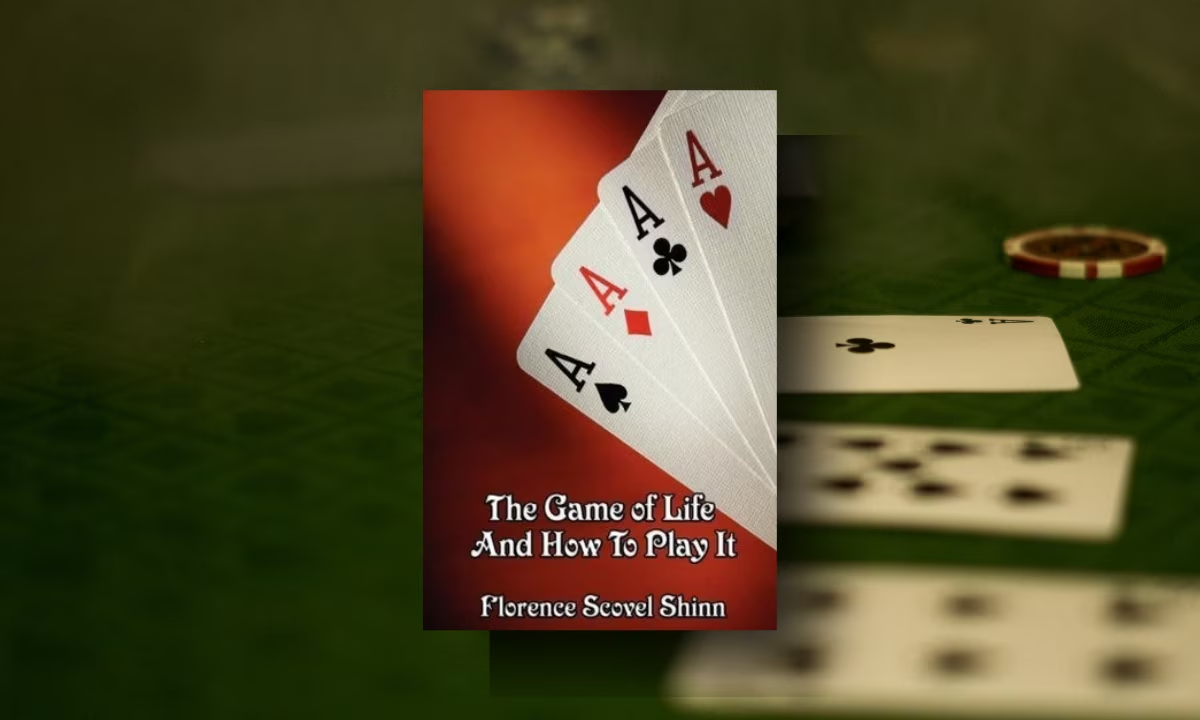

The Game of Life and How to Play It is Florence Scovel Shinn’s 1925 self-help classic that turned the Bible into a rulebook for manifesting money, love, and health, and a century later it still reads like the blueprint for every “manifestation” video on your feed.
I finished it in one sitting.
It is short, about 21,000 words by my count, and full of sharp, usable advice about fear, words, and follow-through. It also tells you that criticism causes rheumatism, that a woman “attracted the wrong oyster” by quarrelling with nineteen people, and that a mother’s worry gives her child measles.
So the honest answer to “should I read it?” is yes, but with a pencil in your hand. Below I give you the whole book, chapter by chapter, every major story and affirmation, plus what the research on positive thinking actually says, so you can keep the gold and throw out the brass.
Table of Contents
What Are the Key Lessons of The Game of Life and How to Play It?
The key lesson of The Game of Life and How to Play It is that your inner pictures and spoken words shape your outer life, so you should guard your imagination, speak carefully, act as if your good is already on its way, and refuse to live in fear. Here are the takeaways at a glance:
Life is a game, not a battle. Shinn opens with this line, and the whole book follows from it: you play by “spiritual law,” and the rules come from the Bible, both Old and New.
The mind has three departments. The subconscious is raw power without direction, the conscious mind sees limitation, and the superconscious holds your “Divine Design.”
Words are laws you write for yourself. The man who says “I always miss a car” keeps missing it. His daughter, who says she always catches one, keeps catching it.
Fear is “inverted faith.” It is faith in bad outcomes instead of good ones, and it is the only real enemy in The Game of Life and How to Play It.
“Dig your ditches.” Prepare for what you asked for before there is any sign of it. This is active faith, and it is the most practical idea in the book.
Don’t resist. Bless the person or situation that troubles you, and it loses its power or leaves your life.
Forgiveness beats karma. What you send out comes back, but forgiveness and “grace” can cancel the debt.
Cast the burden. Hand the worry to the “Christ within” with a repeated statement, then stop gripping.
Follow your hunches. Ask for a “definite lead,” then wait for it before you act.
Ask for the “divine selection,” not a specific person or thing, and always add “under grace, in a perfect way.”
The goal is the “square of life”: health, wealth, love, and perfect self-expression.
The weak spot: Shinn’s claims about disease, germs, death, and spending your last dollars have no scientific support and can cause real harm if taken literally.
Reader recommendation for The Game of Life and How to Play It
The Game of Life and How to Play It is best for readers who already believe in prayer or the law of attraction and want a short, story-driven manual; it is a poor fit for skeptics, people with serious illness, and anyone in financial trouble looking for practical money advice.
You will probably love it if you enjoyed The Secret, Louise Hay, or Norman Vincent Peale and want to read the source those authors drew from; like short books (you can finish it in two to three hours); respond to anecdotes more than arguments, because the book is nearly all stories (I counted 47 uses of the phrase “For example”); are Christian or open to Christian language, since Jesus Christ is named 22 times and nearly every rule is tied to a verse; struggle with worry, grudges, or negative self-talk and want simple scripts to interrupt them.
You will probably bounce if you want evidence, studies, or anything you can check (there are none); are dealing with a chronic or serious illness, because The Game of Life and How to Play It repeatedly blames sickness on the sick person’s thoughts; are in debt and hoping for budgeting help, because Shinn calls saving and hoarding a cause of loss; dislike religious framing or 1920s gender assumptions; and have low self-esteem and plan to rely only on affirmations (I explain the research on this below).
What Is The Game of Life and How to Play It About?
The Game of Life and How to Play It is a New Thought self-help book written by Florence Scovel Shinn and first published in 1925. According to Wikipedia, Shinn could not find a publisher and released it herself that year. The edition I read is the St. Martin’s Essentials paperback from February 2020, with a foreword by Joel Fotinos.
The Game of Life and How to Play It has ten chapters, ending with a short list of “Denials and Affirmations” you can say aloud. Because it was published in the United States in 1925, the original text entered the US public domain on January 1, 2021, along with The Great Gatsby, as NPR reported on Public Domain Day that year. That is why you will find free copies online.
Context: Genre, Subject, and Why Shinn Wrote It
The Game of Life and How to Play It belongs to the New Thought movement, the late nineteenth and early twentieth century current of American spirituality that taught that thought shapes reality. It is part sermon, part case file.
Shinn writes as a metaphysical teacher who “treats” students by “speaking the word,” and most chapters are built from short stories about her students, her friends, and herself in New York.
Wikipedia notes that her ideas share ground with Mary Baker Eddy and Christian Science, and that her focus on the spoken word may have come from the teacher Emma Curtis Hopkins.
Her credentials are not academic. She was a trained artist and a successful illustrator before she became a spiritual teacher, and her authority in The Game of Life and How to Play It comes entirely from her experience and her reading of scripture.
Purpose: The Central Thesis
The central thesis of The Game of Life and How to Play It is that life is a game of “Giving and Receiving” governed by spiritual law, and that anyone who trains the imagination, controls their words, drops fear, refuses to resist, and practices love can bring health, wealth, love, and perfect self-expression into their life.
She states the closing version plainly: “All power is given man (through right thinking) to bring his heaven upon his earth, and this is the goal of the ‘Game of Life.'” Her three-word summary of the rules is “fearless faith, nonresistance and love.”
Who Was Florence Scovel Shinn?
Florence Scovel Shinn was an American illustrator turned spiritual teacher, born on September 24, 1871, in Camden, New Jersey, who died in New York on October 17, 1940. She studied at the Pennsylvania Academy of the Fine Arts in Philadelphia, where she met the painter Everett Shinn. They married and lived in Greenwich Village, and they divorced in 1912.
Before she wrote a word about metaphysics, she drew for Harper’s and illustrated popular novels, including Mrs. Wiggs of the Cabbage Patch (1901). The Society of Illustrators elected her an associate member in 1903. Joel Fotinos’s foreword adds that she also acted in New York and that, divorced and living alone in Manhattan, she turned to New Thought and became a popular teacher.
After The Game of Life (1925) came Your Word Is Your Wand (1928) and The Secret Door to Success (1940). The Power of the Spoken Word appeared in 1945, five years after her death. Wikipedia records that Louise Hay acknowledged Shinn as an early influence, and Hay’s company later published Shinn material as The Magic Path of Intuition (2013).
The foreword also claims the book has “sold millions of copies” and never gone out of print. I could not find an independent sales figure to confirm that number, so treat it as the publisher’s claim.
Knowing the biography changes how I read the book. Many of her stories involve women alone in New York with no money, failed marriages, rent, and jobs. That was her world. When she writes about a divorced woman learning to stop resenting, it does not feel abstract.
The Game of Life and How to Play It Summary
Each chapter of The Game of Life and How to Play It teaches one “spiritual law” through a handful of short stories. Here is the full book, in order, with the stories that carry each idea.
Chapter 1. The Game: Why Does Shinn Call Life a Game?
Shinn calls life a game because she believes it runs on fixed rules, and once you know them you can win. Her first sentence is the thesis of the whole book: “Most people consider life a battle, but it is not a battle, it is a game.”
The first rule is sowing and reaping. Whatever you give, in word or deed, comes back. “If he gives hate, he will receive hate; if he gives love, he will receive love,” she writes, and the list continues with criticism, lies, and cheating.
The second rule is imagination. Quoting Proverbs 4:23, she argues that whatever a person pictures eventually shows up in their life. She calls the imagination “The Scissors of The Mind,” always cutting out the pictures you hold until you meet them in the world. Her examples are dark. A man who obsessively feared a rare disease “pictured it continually” until he got it and died. A girl who played at being a widow, dressed in a black veil, grew up, married a man she loved, and lost him soon after.
Then she gives her model of the mind:
| Part of the mind | What Shinn says it does |
|---|---|
| Subconscious | “Simply power, without direction,” like steam or electricity. It carries out whatever you feel deeply or picture clearly. |
| Conscious | The “mortal or carnal mind.” It sees sickness, poverty, and limits, and it feeds those pictures to the subconscious. |
| Superconscious | “The God Mind within each man,” home of the “Divine Design,” the perfect plan for your life. |
The chapter introduces nearly every tool she will use later. There is the “divine selection”: when a woman asked Shinn to make a certain man (she calls him A. B.) marry her, Shinn refused and instead asked for “the right man.” The woman soon lost interest in A. B. and met someone who said everything she had wanted A. B. to say. Shinn calls this the law of substitution.
There is also the danger of idle words. One woman who often said she wished she “lived in a trunk” ended up poor, saying, “Today I am living in that trunk.” Shinn’s line here is one of her best: “The subconscious mind has no sense of humor and people often joke themselves into unhappy experiences.”
And there is intuition. A worn-out woman with eight dollars to her name followed a “hunch” to go home, met an old family friend there, and received “thousands of dollars.” Shinn’s advice: “never violate a hunch.”
The chapter ends with her most important definition. Fear, she says, is “only inverted faith; it is faith in evil instead of good.” The cure is to replace the old records in the subconscious, like scratched phonograph discs, with new ones. She gives a statement to “smash and demolish” every untrue record, and names the four goals she calls the “square of life”: health, wealth, love, and perfect self-expression.
Chapter 2. The Law of Prosperity: What Does “Dig Your Ditches” Mean?
“Dig your ditches” means preparing for the thing you have asked for before there is any sign of it, as proof that you believe it is coming. The phrase comes from 2 Kings, where the prophet Elisha tells three thirsty kings in the desert: “Ye shall not see wind, neither shall ye see rain, yet make this valley full of ditches.” They dig, and the ditches fill.
Shinn’s core claim is that “God is man’s supply” and that the spoken word releases it. Her stories are specific about money, which is part of why The Game of Life and How to Play It still sells:
- A woman facing a lawsuit over $3,000 was told to “act rich.” Shinn took her to lunch and told her to order an expensive meal. A cousin with a long white beard turned up, asked about her finances, and gave her the $3,000 just in time.
- A man asked Shinn to clear a debt but spent his time rehearsing excuses for not paying. Shinn’s verdict: “If one asks for success and prepares for failure, he will get the situation he has prepared for.”
- During a New York apartment shortage, a woman bought new blankets as “ditches” and got an apartment despite “over two hundred other applicants.”
- A businessman needed $50,000 and had been turned down by his bank. Shinn told him he had lost his power by losing his temper. His train was late, he arrived fifteen minutes before the bank closed, and they gave him the loan “without a question.”
Two ideas in this chapter stayed with me. First, “Man can only receive what he sees himself receiving.” She compares it to the children of Israel, who were promised all the land they could see, yet saw themselves “as grass-hoppers” next to the giants. Second, she says the darkest moment often comes right before success, because the old doubts in the subconscious rise up to be cleared out.
She also makes a case for asking for help. “It is much easier to ‘demonstrate’ for someone else than for one’s self,” she writes, because a friend is not close enough to the problem to panic. She ends with a line I have heard quoted without credit for years: “no man can fail, if some one person sees him successful.”
Chapter 3. The Power of the Word: How Do Words Create Your Reality, According to Shinn?
According to Shinn, words create your reality because “through his spoken word, man is continually making laws for himself.” Repeated statements become expectations, and expectations become events.
Her example is the father who always missed the car (most likely a streetcar, given the era) and the daughter who always caught it. She explains superstitions the same way. A rabbit’s foot has no power, she says, but the belief behind it creates expectancy.
Two of her students who did well in business bought “lucky monkeys,” trusted the monkeys instead of God, and saw “everything ‘went to smash.'” They threw the monkeys down a coal hole, and business recovered.
The ladder story is the most memorable in the chapter. A friend terrified of walking under ladders was told to walk under the next one she saw. At her bank’s safe-deposit vault, a ladder blocked her way. She turned back, then forced herself to return, and the ladder was gone. Shinn’s lesson: “If one is willing to do a thing he is afraid to do, he does not have to.”
She also warns about conversation. When a friend invites her for “a fine old-fashioned chat,” which Shinn says means “five hundred to a thousand destructive words” about loss and sickness, she declines: “I’ve had enough old-fashioned chats in my life, they are too expensive, but I will be glad to have a new-fashioned chat, and talk about what we want, not what we don’t want.” She adds an old saying that you should only use your words to “heal, bless or prosper.”
This chapter is also where the book first goes badly wrong. Shinn claims “all sickness and unhappiness come from the violation of the law of love.” She writes that “continual criticism produces rheumatism,” that jealousy and hatred cause “false growths,” and that “unforgiveness is the most prolific cause of disease.” She tells a woman sick from a bad oyster that she “poisoned the oyster” herself; the woman admits she had quarrelled with “about nineteen people,” so she “attracted the wrong oyster.” There is also a stage actress who says her skin disease vanished after three nights of praying not to hate a jealous colleague.
The chapter ends on a better note with a machinery salesman who was told to bless his rival instead of fearing him. The rival’s machine “refused to work,” and he made the sale.
Chapter 4. The Law of Nonresistance: What Does Shinn Mean by Nonresistance?
By nonresistance, Shinn means refusing to fight a bad situation emotionally, blessing it instead, so that it either turns to good or falls out of your life. She opens with a strong claim: “Nothing on earth can resist an absolutely non-resistant person.” Her image is water, which wears away rock because it never pushes back.
Her reasoning is theological. There is only one power, God, so evil is not real; it comes from believing in “two powers.” Resisting evil only makes it more real to you. “Resistance is Hell,” she writes, “for it places man in a ‘state of torment.'”
Her favorite technique comes from an unnamed metaphysician who used to baptize children and now baptizes events instead: “If I have a failure I baptize it success.” A woman who felt poor around a business contact who “talked lack” stopped resenting him, blessed him, and said, “this man is here for my good and my prosperity.” Through him, she met a woman who paid her several thousand dollars, and the man moved away.
What I liked most here is that Shinn sees the obvious objection. Her students say they don’t want to be doormats. She answers, “when you use nonresistance with wisdom, no one will ever be able to walk over you.”
Three more ideas from the chapter are worth carrying around:
You can’t outrun a pattern. “So long as man resists a situation, he will have it with him. If he runs away from it, it will run after him.” One woman ran from a critical mother into marriage and found she had “married my mother.”
You change others by changing yourself. When people ask Shinn to “treat” a husband or brother, she refuses: “when you change, your husband and your brother will change.”
Life is a mirror. A student who lied habitually was “cured of lying” by living with a woman “who lied worse than I did.” Shinn’s summary: “Life is a mirror, and we find only ourselves reflected in our associates.”
She also attacks living in the past. “The robbers of time are the past and the future,” she writes. A woman who mourned last year’s money bought Christmas seals, paper, and twine as “ditches” and received “several hundred dollars” days before Christmas. The chapter closes with morning affirmations and the rhyme that, in its first version, a student sang her way into a job.
A businessman tried his own version and closed a $41,000 deal that afternoon, according to Shinn. Her caution: word your affirmations carefully. One woman demanded work, got plenty of it, and was never paid, because she forgot to ask for pay.
Chapter 5. The Law of Karma and the Law of Forgiveness: Can Forgiveness Cancel Karma?
Yes, Shinn says forgiveness can cancel karma, because “the law of grace, or forgiveness” is a higher law that “frees man from the law of cause and effect.” First, though, she lays out karma itself: “The Game of Life is a game of boomerangs.”
She defines karma as “Sanskrit for ‘Comeback.'” That is not accurate. Britannica gives the Sanskrit root karman as “act,” which is close to the idea but not her translation.
Her karma stories have the feel of a moral fable. A friend snapped “No more talk, I wish to eat in peace” at her aunt, and the next day a woman she wanted to impress said the exact same sentence to her. A woman sent a friend stage money as a joke and then received a counterfeit $20 bill from her bank. Shinn’s advice was to call on “the law of forgiveness,” return to the bank “fearlessly,” and the bank replaced it with an apology.
The darkest story in The Game of Life and How to Play It is here. A strong-willed woman kept picturing herself living in an acquaintance’s house. He died, she moved in, and later her husband died too, leaving the house “a white elephant on your hands for years.”
Shinn tells her she paid her “Karmic debt” and should have asked for “the right house” instead. The moral, “Desire is a tremendous force, and must be directed in the right channels,” is reasonable; the suggestion that a woman’s wishing killed two men is not.
Then comes money. Shinn tells a messy woman, “You will never become rich with a burnt match in the pincushion,” and the woman tidies her home and soon receives a gift from a relative. That part is harmless and even charming. The next part is not.
Shinn states that “hoarding and saving invariably lead to loss.” Her model investor is a man with about $700 who paid $500 for a fur-lined overcoat because it made him feel rich; a month later he earned a $10,000 commission. A woman who cancelled Thanksgiving dinner to save money had the same amount stolen.
Another bought her nephew a toy and found the exact price in the street on her way home.
The chapter ends with Shinn’s boldest theology: that grace can overcome “the race (or world) thought” of sin, sickness, and death, and that “death could be overcome by stamping the subconscious mind with the conviction of eternal youth and eternal life.” She calls this a scientific view. It isn’t one.
Chapter 6. Casting the Burden: How Do You Impress the Subconscious Mind?
You impress the subconscious mind, Shinn says, mainly by “casting the burden”: repeating a statement that hands your worry to the superconscious, the “Christ within,” until the feeling of weight lifts.
Her explanation comes from a metaphysician who compared a burden to a boulder: lift it far enough from the earth and it weighs nothing. That, he said, is what Jesus meant by “my burden is light.”
The core statement is short: “I cast this burden on the Christ within, and I go free.” She says to repeat it “over and over and over, sometimes for hours at a time,” and compares it to winding up a gramophone. Her stories:
- A woman in urgent need of money cast her “burden of lack” and received “an avalanche of supply.”
- A student with a new piano arriving and no room for it repeated the statement; minutes later a friend called asking to rent the old piano.
- A woman whose burden was resentment cast it off, and “her whole life was changed.”
When a student asks how long one must stay in the dark before things improve, Shinn answers, “until one can see in the dark.” I think that is a lovely line.
This chapter also adds three more techniques. Active faith: a woman separated from her husband set a place for him at the table every day for more than a year, until “one day he walked in.” Music and movement: one friend plays her gramophone daily; another dances while saying affirmations.
Signs of land: before the real result comes, small hints appear, like the birds and twigs Columbus saw before reaching land. A woman who asked for a set of dishes received one cracked plate, then the full set.
On fear, she is at her most practical: walk up to it. “The lion takes its fierceness from your fear,” she writes. And on people you fear, her advice is to meet them cheerfully, because they will either become “golden links in the chain of one’s good” or “disappear harmoniously.”
Then she undercuts herself again. A fearless person in “a germ-laden situation” would be “immune,” she says, because “one can only contract germs while vibrating at the same rate as the germ.”
Chapter 7. Love: What Does Shinn Say About Love and Jealousy?
Shinn says real love is “selfless and free from fear,” gives without demanding anything back, and that jealousy is “the worst enemy of love” because it makes you picture losing the person until it happens. She credits P. D. Ouspensky’s Tertium Organum with the idea that love is “a cosmic phenomenon.”
Her central love story is the longest in The Game of Life and How to Play It. A woman whose lover, a captain she called “The Cap,” left her for other women came to Shinn full of jealousy and hoping he would suffer. Shinn told her: “You can never receive what you have never given.”
The woman refused at first to bless him unless she knew where he was. Shinn told her about a brotherhood in India who greeted each other with “I salute the Divinity in you.” Months later the woman said, out of nowhere, “God bless the Cap wherever he is.” A few weeks after that, Shinn received a letter: “We are married.”
The chapter has its share of sharp lessons:
Indifference loses love. A woman who said she didn’t care about married life lost her husband to another woman. Her own conclusion: “People get what they want, and then feel very much hurt.”
Love your work. A man told by his wife’s numerologist that he would never amount to anything “because I am a two” went on to find a fine job and later success as a writer.
Don’t despise money. “No man can attract money if he despises it.” Shinn says this is why so many artists are poor, and quotes one artist sneering at another: “He’s no good as an artist, he has money in the bank.”
Use what you have. A rich woman owned “sixty-seven” necklaces, wrapped in tissue paper and never worn, which Shinn calls a violation of “the law of use.”
She also uses a film as a warning. In Greed, she writes, a woman wins $5,000 in a lottery, hoards it, lets her husband starve, and is murdered for it. That is accurate: Erich von Stroheim’s 1924 silent film shows Trina winning $5,000 and refusing to spend it, and its plot summary confirms McTeague beats her to death and takes the money.
It was a new release when Shinn was writing, which makes the book feel very much of its year.
The chapter ends on remorse and grief. If a past wrong can’t be repaired, she says, cancel it by doing someone a kindness now. One grieving mother stopped Shinn’s treatments because she was “so happy, it wasn’t respectable.” And then the troubling claim: “mother-fear is responsible for many of the diseases and accidents which come into the lives of children.”
Chapter 8. Intuition or Guidance: How Do You Get a “Lead” in The Game of Life?
You get a lead, Shinn says, by speaking your request and then waiting: “Speak the word and then do not do anything until you get a definite lead.” The lead may come as a hunch, a chance remark, or a line in a book. “Intuition is a spiritual faculty and does not explain, but simply points the way.”
Her best story here is also her funniest. A woman offered three jobs, two in New York and one in Palm Beach, couldn’t decide. Then she called Shinn: “When I woke up this morning, I could smell Palm Beach.” She took that job, and it worked out. Shinn herself once felt an urge to go into a bakery, found nothing she wanted, and met a woman on the way out who needed her help.
This chapter also brings in tithing. Shinn calls giving a tenth of your income “an old Jewish custom,” says “many of the richest men in this country have been tithers,” and adds, “I have never known it to fail as an investment.” Bills, she says, should be paid “cheerfully” and with a blessing.
Other rules in the chapter:
Ask for the right job, not just a job. Ask for “the place already planned in Divine Mind.”
Stop condemning. “What man condemns in others, he attracts to himself.” A woman who condemned her husband’s mistress later fell for a married man herself.
Beat indecision with a statement: “I am always under direct inspiration; I make right decisions, quickly.”
Avoid psychics, numerology, and horoscopes. She says they “keep man down on the mental (or mortal) plane.”
The chapter’s closing story is classic Shinn. A woman had lost $2,000 she lent to a relative who died without mentioning it in her will. She forgave the relative and “denied the loss.” Years later, her landlord broke her lease, raised the rent, and forgot to include a ninety-day move-out clause in the new lease.
When the building sold, the agent offered tenants $200 to leave, then offered her $1,500, and finally she got exactly $2,000 to give up the apartment. “I will restore to you the years the locusts have eaten,” Shinn quotes, and defines the locusts as “the doubts, fears, resentments and regrets of mortal thinking.”
Chapter 9. Perfect Self-Expression or the Divine Design: What Is the Divine Design?
The Divine Design is Shinn’s name for the perfect plan for your life, held in “Divine Mind,” which includes the work only you can do. “There is a place which he is to fill and no one else can fill, something which he is to do, which no one else can do; it is his destiny.”
Her suggested request is: “Infinite Spirit, open the way for the Divine Design of my life to manifest; let the genius within me now be released; let me see clearly the perfect plan.” She warns that asking can shake things up; for one woman it was “as though a cyclone had struck her affairs” before things settled into something better.
Her best claim in the book about work is this one: “Perfect self-expression will never be labor; but of such absorbing interest that it will seem almost like play.” She adds that “the thing man seeks is seeking him,” with the example that the telephone was seeking Bell.
Stories here include a man with seven cents who gave Shinn one of them and came back a year later with “a roll of yellow bills,” and a schoolboy who affirmed “I am one with Infinite Intelligence” for arithmetic and passed “with the highest honors,” then trusted himself in history and got a poor mark.
A traveler had perfect luck abroad while she prayed constantly, then lost her trunks back home in New York once she stopped. Shinn’s lesson is to practice “the Presence of God” every minute and not get “too sure” of yourself.
She also covers:
Poise. “Poise is Power,” she writes, because it lets clear thinking through. Anger, she says, “blurs the visions.”
Finishing things. A student whose money never arrived admitted she left projects unfinished. She went home, finished a sewing project, and her husband was paid twice that month by mistake and told to keep it.
Receiving well. “The Lord loveth a cheerful receiver, as well as a cheerful giver.” A woman who refused a gift of several thousand dollars soon found herself in debt for the same amount.
Two passages date The Game of Life and How to Play It badly. One says “a woman’s perfect self-expression may be in becoming a perfect wife, a perfect mother, a perfect home-maker.” The other explains why some people are born rich and healthy and others poor and sick: reincarnation, and the pictures each held in “his past life.”
Chapter 10. Denials and Affirmations: How Should You Word an Affirmation?
You should word an affirmation as a thank-you for something already received, ask for the “divine selection,” and end with “under grace, in a perfect way,” Shinn says. Her standard form is: “Infinite Spirit, open the way for my right home, my right friend, my right position. I give thanks it now manifests under grace in a perfect way.”
Her reason for that ending is chilling. A woman asked for a thousand dollars. Her daughter was injured and they received a thousand dollars in compensation. It came, but not “in a perfect way.”
Other lessons from the final chapter:
Don’t cap your request. A student asked for $600, got it, and later learned he had nearly received $1,000.
Wealth is a feeling first. Shinn retells a French legend about a poor man given a “gold nugget” that made him so confident he got rich without ever selling it. When he passed it on, the next man had it valued; it was brass.
Don’t plead; give thanks. She points out that the Lord’s Prayer is phrased as a command and a demand and ends in praise.
Impatience backfires. “Man’s dreary desires are answered drearily, and his impatient desires, long delayed or violently fulfilled.” A woman who kept saying she wished she could get rid of her glasses kept breaking and losing them.
Let go and help appears. A woman whose borrowed umbrella blew inside out said, “Oh, God, you take charge of this umbrella,” and an umbrella mender appeared behind her.
Always follow a denial with an affirmation.
She makes a distinction I found useful: “Visualizing is a mental process governed by the reasoning or conscious mind; visioning is a spiritual process, governed by intuition.” In plain terms, don’t force a detailed fantasy; ask to be shown, then hold the picture that comes. “Many a man is building for himself in imagination a bungalow when he should be building a palace.”
The Game of Life and How to Play It ends with a short list of ready-made affirmations. Here are the main ones as she wrote them:
For prosperity: “God is my unfailing supply, and large sums of money come to me quickly, under grace, in perfect ways.”
For right conditions: “Every plan my Father in heaven has not planned, shall be dissolved and dissipated, and the Divine Idea now comes to pass.”
For faith: “As I am one with God, I am one with my good, for God is both the Giver and the Gift.”
For health: “Divine Love floods my consciousness with health, and every cell in my body is filled with light.”
For guidance: “I am divinely sensitive to my intuitive leads, and give instant obedience to Thy will.”
For right work: “I have a perfect work / In a perfect way; / I give a perfect service / For perfect pay.”
For freedom from all bondage: “I cast this burden on the Christ within, and I go free.”
The Five Rules Behind Every Chapter
If you remember nothing else from the summary, remember these five patterns. Nearly every story in the book follows one of them.
| Rule | Shinn’s phrase | What you actually do |
|---|---|---|
| Ask for the right thing | “divine selection” | Ask for the right job, partner, or home, not a specific one |
| Prepare before proof | “dig your ditches” | Take one concrete step as if it is coming |
| Stop fighting | “nonresistance” | Bless the person or problem instead of resenting it |
| Release the worry | “cast the burden” | Repeat a release statement until the panic eases |
| Wait for direction | “definite lead” | Act on a clear hunch, not on anxiety |
Does The Game of Life and How to Play It Actually Work?
The Game of Life and How to Play It works as a psychology of attention and a cure for worry, and fails as a theory of how money, illness, and death actually behave. That is my verdict in one sentence. It is a warm, quotable, frequently wise little book wrapped around a set of claims that range from unproven to harmful.
Does Shinn Support Her Arguments With Evidence?
No, not in any way you could check. Every proof in the book is an anecdote, almost always about an unnamed “woman” or “student,” told by Shinn herself, with Shinn’s “treatment” as the turning point. There are no failures. Nobody digs ditches and stays dry.
That is survivorship bias in its purest form: you only hear from the woman with eight dollars and a hunch, never from the woman with eight dollars, a hunch, and an empty train ride home.
Her logic is also circular. When something good happens, the law worked. When something bad happens, the person must have feared it, resented someone, joked about it, or “made Karma.”
Because no outcome can disprove the law, the law explains everything and predicts nothing. And her scripture is used as a rulebook rather than read in context, a habit she admits openly when she suggests reading “Lord” as “law.”
Does The Game of Life and How to Play It Fulfill Its Purpose?
Partly. Shinn promised a set of rules for living with less fear and more love, and on that level the book delivers. A century later, I can still use “dig your ditches,” “baptize it success,” and “cast the burden” on an ordinary bad Tuesday.
As a contribution to its field, its influence is real: Louise Hay named Shinn as an early influence, Unity churches still discuss her books according to Wikipedia, and you can trace a straight line from her “speak the word” to The Secret (2006) and today’s manifesting culture. But the promise of health and wealth through right thinking is not one any reader can rely on.
What Does Modern Psychology Say About Shinn’s Methods?
Modern psychology supports some of Shinn’s habits and directly contradicts others. Two studies are worth knowing before you start reciting affirmations.
Affirmations can backfire. In 2009, psychologists Joanne Wood and John Lee (University of Waterloo) and Elaine Perunovic (University of New Brunswick) published a study in Psychological Science in which people repeated the statement “I am a lovable person.” According to the ScienceDaily summary, people with high self-esteem felt slightly better afterward, but people with low self-esteem felt worse than a control group who did not repeat it. The authors concluded that such statements “may benefit certain people” but “backfire for the very people who need them the most.”
Interestingly, Shinn half-anticipated this. She writes that “one should never use an affirmation unless it is absolutely satisfying and convincing to his own consciousness.”
That caution is buried in Chapter 4, and it deserves a much bigger font.
Vivid fantasies can slow you down. Gabriele Oettingen and Thomas Wadden followed 25 women in a year-long weight-loss program, published in Cognitive Therapy and Research in 1991. Optimistic expectations helped, but women with the most positive fantasies lost less weight.
Oettingen later built a technique called mental contrasting (picture the goal, then picture the obstacle, then plan), and in an April 2026 Boston Globe opinion piece Nir Eyal summarized her research as showing that “fantasy plus friction” beats positive thinking alone.
Here is the part I find fascinating. Shinn’s best advice is actually closer to Oettingen than to The Secret. “Dig your ditches” is a plan, not a fantasy. “Walk up to the lion” is facing the obstacle.
Her warning that a man who “asks for success and prepares for failure” will get failure is a crude version of the gap between wishing and doing. Where she slips is when she tells you the ditch-digging itself causes the rain.
Strengths: What I Found Compelling
Her diagnosis of fear. Calling fear “inverted faith” is the single most useful reframe in the book. Worry really is a kind of belief in the worst outcome, and naming it that way makes it easier to notice.
Attention to everyday speech. “Old-fashioned chats” about loss and sickness, joking about the poorhouse, saying “I always miss the car”: she is right that what we repeat becomes what we expect.
Nonresistance with a spine. Her answer to the doormat objection shows she was thinking about real people, not just ideals.
Forgiveness as self-interest. Her resentment stories, especially the student who arrived “radiant” after finally letting go of one woman, describe something many readers will recognize.
“Ask for the right one.” Asking for the right job or partner instead of a specific one is a healthy way to stop fixating.
It is fun to read. The smell of Palm Beach, the umbrella mender, the lucky monkeys in the coal hole, the cousin with the long white beard. She tells a story with real timing.
Weaknesses: Where the Book Fails
It blames the sick. Rheumatism from criticism, disease from unforgiveness, germs that only reach the fearful, children who catch illness from their mothers’ fear. Rheumatoid arthritis, for example, is an autoimmune condition according to the NHS, which also notes that its trigger is not yet known.
I am not a doctor, but nothing I could find in mainstream medicine supports Shinn’s version, and a reader with a serious illness could come away feeling guilty for being sick.
It blames the grieving. The child who played at being a widow, the woman whose wishing “killed” two men, the mother whose daughter’s injury came from a badly worded affirmation. These stories turn tragedy into the victim’s fault.
Its money advice is risky. Spending $500 of your $700 on a coat, calling saving a path to loss, treating tithing as an investment that never fails. I am not a financial advisor, but advice that works out in a story told by the person who gave it is not a plan. If you are struggling, I would read the “act rich” chapters as being about mindset only.
Factual slips. Karma does not mean “Comeback,” and her claim that death could be overcome “from a scientific standpoint” has no basis.
It is of its time. There is the line about a woman’s self-expression being a “perfect wife,” the reincarnation explanation for poverty, and one student’s speech rendered in dialect. Modern editions print them unchanged.
No failures, ever. A book this sure of itself should have at least one case that didn’t work.
What Books Are Like The Game of Life and How to Play It?
Books like The Game of Life and How to Play It include James Allen’s As a Man Thinketh, Napoleon Hill’s Think and Grow Rich, Norman Vincent Peale’s The Power of Positive Thinking, and Rhonda Byrne’s The Secret, all of which teach that thought shapes circumstance. Here is how they compare, plus two books that push back.
| Book | Year | How it compares to Shinn |
|---|---|---|
| As a Man Thinketh, James Allen | 1903 | Shorter, calmer, less religious and less money-focused. Allen is the philosopher; Shinn is the storyteller. |
| Your Word Is Your Wand, Florence Scovel Shinn | 1928 | Her follow-up, mostly affirmations arranged by topic. Read it as a companion, not a substitute. |
| Think and Grow Rich, Napoleon Hill | 1937 | Same belief in “desire” and faith, but aimed at businessmen and padded with success stories of famous men. |
| The Power of Positive Thinking, Norman Vincent Peale | 1952 | The closest match. Also Christian, also anecdotal, but gentler on illness. The foreword names Peale as someone Shinn influenced. |
| The Secret, Rhonda Byrne | 2006 | Shinn’s ideas with the scripture removed and “the law of attraction” in its place. Shinn’s version has more moral weight because love and forgiveness are central. |
| Rethinking Positive Thinking, Gabriele Oettingen | 2014 | The research-based answer. Keeps the goal-picturing, adds obstacles and planning. |
| Bright-Sided, Barbara Ehrenreich | 2009 | A sharp critique of American positive-thinking culture, including its New Thought roots. Read it right after Shinn for balance. |
If you want the psychology side, Sopranu’s list of the 100 best psychology books of all time and its review of Carol Dweck’s Mindset are good next steps, since Dweck’s research tests a much narrower, evidence-based version of “your beliefs shape your results.”
FAQs About The Game of Life and How to Play It
What is the main idea of The Game of Life and How to Play It?
The main idea is that life is a game of giving and receiving run by spiritual law, and that your imagination and spoken words, backed by faith instead of fear, bring your inner pictures into your outer life.
Is The Game of Life and How to Play It a religious book?
Yes. It is Christian New Thought. Nearly every rule is tied to a Bible verse, and Jesus Christ is named 22 times in the main text.
Is The Game of Life and How to Play It the same as the law of attraction?
It is an early version of it. Shinn doesn’t use the phrase “law of attraction,” but her claims that “man attracts what he fears” and that words and images draw events to you are the same core idea later popularized by The Secret.
How long does it take to read The Game of Life and How to Play It?
About two to three hours. The main text is roughly 21,000 words in ten short chapters.
Is The Game of Life and How to Play It free?
In the United States, the original 1925 text has been in the public domain since January 1, 2021, so free copies are legal there. Modern editions with forewords, like the 2020 St. Martin’s Essentials version, are still under copyright for the new material.
What is the most famous affirmation in The Game of Life?
Probably “I cast this burden on the Christ within, and I go free,” along with the work rhyme “I have a perfect work / In a perfect way; / I give a perfect service / For perfect pay.”
What does “square of life” mean in Shinn’s book?
It is her name for the four parts of a complete life: health, wealth, love, and perfect self-expression.
Is The Game of Life and How to Play It Worth Reading? My Conclusion
The Game of Life and How to Play It is worth reading if you treat it as a book about fear, words, and follow-through rather than a manual for medicine or money. It is a charming, sometimes moving, sometimes alarming little classic, and I understand why it has survived a hundred years. Shinn writes with the confidence of someone who rebuilt her life after a divorce and decided to stop being afraid. That energy comes through on every page.
Read it if you are a general reader who likes spiritual self-help, a Christian looking for a practical prayer life, or a fan of The Secret who wants the original. It is written for a general audience, not specialists, and you need no background to follow it. Skip it, or read it only alongside Oettingen or Ehrenreich, if you are ill, in debt, or prone to self-blame.
My practical advice: keep three habits from Shinn. Catch yourself when you speak your fears out loud. Dig one small ditch toward whatever you are waiting for. Bless the person you resent, even if you don’t feel like it yet. Leave the rest, especially anything about germs, oysters, and coats, in 1925.