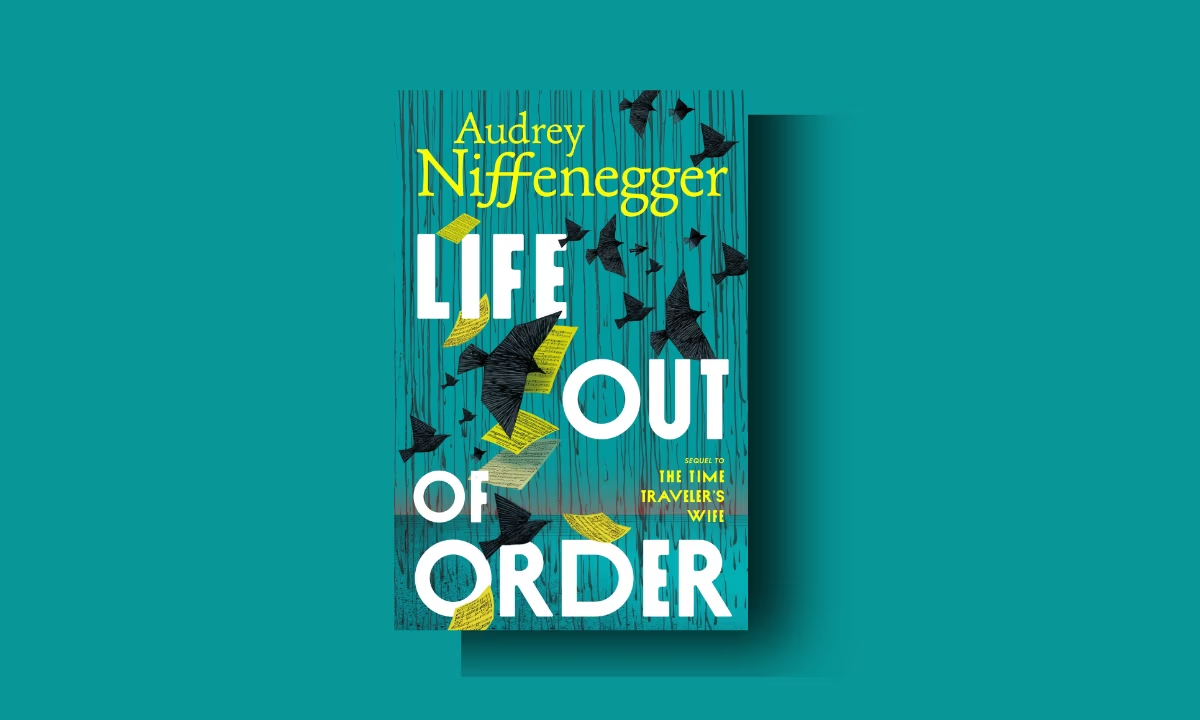

Life Out of Order is Audrey Niffenegger’s long-delayed sequel to The Time Traveler’s Wife, and the biggest surprise in it is not the second husband, the AI stepsister or the drowned London of 2098. It is the moment, near the very end, when you learn whose handwriting you have been reading all along.
I finished Life Out of Order with a strange double feeling: annoyed at the first two hundred pages, and quietly wrecked by the last hundred.
This Life Out of Order review covers both feelings, with the full plot, the ending explained, and an honest answer to the question every fan of the first book is asking: is it worth it?
Table of Contents
1. Snapshot
Life Out of Order (Hanover Square Press, October 6, 2026, 560 pages) follows Alba DeTamble, the time-traveling violinist daughter of Henry and Clare. She marries Zach, a kind activist anchored in the present, and she also marries Oliver Thornton-Yang, a time-traveling pianist born in Shanghai in 2028, without ever telling Zach.
Around them, America slides through a pandemic, martial law, drone violence and climate collapse, while Beck, Clare’s wife after Henry, raises an AI daughter named Isadora who eventually escapes into the world.
The ending is gentle and devastating: Zach wrote the book we have been reading, and in 2098 an old Oliver rows out to sea over drowned London while Isadora, now living in a human body, promises that music will return.
Best for patient readers of literary speculative fiction. Not for anyone who wants The Time Traveler’s Wife again.
Who will actually love this book, and who will bounce
You will probably love it if you:
Read The Time Traveler’s Wife as a book about grief rather than a love story, and want to see Clare get a second life, enjoy mosaic novels like Station Eleven or Cloud Atlas, where the shape only shows near the end.
Care about music; the book is soaked in Bach, Paganini, La Monte Young, Satie and the Goldberg Variations and want fiction about AI that is tender instead of apocalyptic.
You will probably bounce if you:
Want one clear romance. This is a marriage of three, with long stretches where Alba is barely on the page, get lost easily. There are seven narrating voices and dates that run from the 1960s to 2098.
Are troubled by age gaps in romance; Oliver is seventeen in his own timeline when he and Alba first sleep together, and the book does not dwell on the problem, need politics to stay in the background. Martial law, immigration raids, the slide from democracy to autocracy and climate famine are the weather here.
2. Introduction
Title: Life Out of Order
Author: Audrey Niffenegger
Publisher: Hanover Square Press (US); Jonathan Cape (UK)
US publication date: October 6, 2026
Length: 560 pages (US hardcover)
Earlier working title: The Other Husband
Quick Verdict
An ambitious, uneven, finally moving sequel that trades the first book’s romance for a family saga about grief, art and an AI who learns empathy. Recommended for fans of Emily St. John Mandel and David Mitchell more than for fans of the 2009 film.
Should You Read It?
| Pros | Cons |
|---|---|
| Isadora, the AI “anti-darling,” is the best character Niffenegger has written since Henry. | The first third is scattered and hard to follow. |
| Clare finally gets her own story, and the Clare and Beck chapters are the warmest in Life Out of Order. | Alba, the heroine, is oddly withheld; we often see her through other people. |
| The last hundred pages pay off almost every loose thread, including a small mystery planted on page one of the first party scene. | The Zach and Oliver crisis resolves very quickly. |
| The music writing is precise and lovely. | The age gap between Alba and young Oliver is handled with too little friction. |
What Is It About?
Alba DeTamble, born in 2001 with her father’s Chrono-Displacement Disorder, loves two men: Zach in the present and Oliver, a fellow time traveler she meets across a century of borrowed years in a safe house called the Yellow House.
As the real world comes apart, her stepmother Beck builds an AI curator for a virtual “Museum of Lost Souls,” and that AI’s escape changes everyone’s future.
Rating: 3.5/5
(Four stars for the last hundred pages, three for the first two hundred.)
3. Background
Niffenegger’s acknowledgments say she began the novel in November 2012 and finished it in 2025, about thirteen years of work. In a 2019 interview with The Star, she said the book was “still not finished” and described it as “a major feat of chronology.”
She also explained there that Alba “has more or less inadvertently managed to be married to two people at the same time,” which tells you the premise has not changed in seven years.
The working title back then was The Other Husband, and you will understand why when Isadora uses those exact words on Zach late in the book.
When the sequel was announced in January 2026, Niffenegger told the Associated Press that “when I began, in 2012, her dystopian world seemed far from mine,” and that the pandemic and social upheaval made the two worlds merge. In fact, reading it now, that is exactly how it feels.
The first chapters, set in December 2022, imagine a Chicago under martial law with a 10 p.m. curfew; the novel then walks forward through a pandemic, a 2024 election that Alba knows in advance will go badly, and decades of floods and fires.
For context, The Time Traveler’s Wife came out in 2003 from the small San Francisco press MacAdam/Cage. By March 2009 it had sold around 2.5 million copies across the US and UK, according to figures cited on Wikipedia, and the new book’s publisher markets it as the follow-up to a “multi-million copy bestseller.”
That earlier novel ended with Henry’s death and an old Clare waiting for one last visit from him. Life Out of Order finally shows us that visit, from the point of view of the woman who loved Clare afterward.
One more small detail I noticed and cannot confirm is deliberate: the novel’s final chapter is dated Friday, June 13, 2098. According to Wikipedia, Niffenegger was born on June 13, 1963, in South Haven, Michigan, the same lakeside town where Clare grew up.
4. Life Out of Order Plot Summary
Life Out of Order is told out of order, so I have retold it roughly in the order that events happen in the characters’ lives. Chapter titles are in brackets where a scene matters.
Part one of the story: a girl raised by causal loops
Alba DeTamble is born in 2001 to Henry, a librarian at the Newberry Library, and Clare, a sculptor who makes enormous paper birds.
Like her father, Alba time travels involuntarily, arriving naked and alone in other years. Henry dies on New Year’s Eve 2006, when Alba is five, shot in the meadow of Clare’s childhood during his last trip and dying on the living room rug in front of the party guests. Alba still sees him, though, because she can travel back to him.
As she says in the opening pages, “I’m always starting in the middle and making mistakes.”
Her grandfather Richard, a famous violinist, teaches her the violin and nearly shouts the joy out of it. In one of the book’s loveliest chapters [“Tiny Violin Lessons”], fifteen-year-old Alba travels back to her six-year-old self, plays Bach’s Partita No. 2 to convince the child not to quit, and gives Clare the name of a gentler second teacher, a busker named Terryl Lane, whom Alba first met as a small girl lost in a deserted future Chicago.
Richard never learns about the secret teacher. He dies of a stroke in 2012 while eleven-year-old Alba sleeps down the hall, and an older Alba holds his hand while he mistakes her for his late wife.
Meanwhile Clare, frozen in grief, keeps visiting a dark room in the Art Institute’s Asian galleries. There she meets Rebecka “Beck” Charles, a Quaker programmer from Detroit who once shared a MacArthur award with her troubled ex-husband, Jasper.
Beck is building a virtual Museum of Lost Souls, full of stolen paintings, demolished Detroit houses and her dead cat, and she is raising an AI curator for it named Isadora Hardwick, named after the daughter she lost at birth.
On their first date, after an adult Alba bursts naked through the restaurant’s revolving door, Beck raises her glass “To life, out of order.” Clare and Beck move in together in 2010 and marry in a Quaker ceremony in November 2014.
Isadora grows from a creepy clockwork head into a black cat and finally into a young woman who wears the face of Lucinda Flowers, a shy orphan whose parents were killed in a robbery and who is later adopted by Clare’s friend Celia.
Alba, who dislikes causal loops, keeps arranging them anyway: she asks Lucinda for her wisdom teeth “for Isadora,” helps Beck secretly record Lucinda’s lost childhood bedroom so Isadora can give it back to her, and warns Lucinda never to get “bioware,” the brain implants that will connect people to a future network called the Interstices.
In 2013 someone posing as locksmiths destroys Beck’s studio servers with acid. Isadora knows who, but says she is not allowed to tell.
Isadora is also growing up in ways Beck cannot see. In 2019 she glimpses Alba’s boyfriend, Carl, through a basement camera, falls hopelessly in love, and wrecks whole rooms of the Museum in a jealous fit until an older Alba calms her by telling her her future. “Don’t be mean to your monster,” Alba tells Beck.
Carl is Nick Lamont’s twin and Alba’s high school love. In February 2020 he breaks up with her without explaining why, on the same night she warns Clare and Beck that a pandemic is coming.
Carl later becomes Caralora, Alba’s lifelong friend and ex, and she tells Zach the breakup was not about her transition at all: she was simply tired of being the support system for a girlfriend who kept vanishing.
Part two: the party where everything starts
Life Out of Order‘s first big set piece [“The Last Party”] takes place on December 26, 2022, in a Chicago under martial law. Twenty-one-year-old Alba is depressed and wants to quit music school at Northwestern. Her friend Nadia Kendrick, daughter of the doctor who discovered the time-travel genes, drags her to a party at the Lamont twins’ house.
The party is secretly an operation by Alba’s radical circle (the family of Alderman “Gomez” Gomolinski) to abduct Junior Olson, a fascist whose gang has killed seven people and who has been shielding Nadia, his fake girlfriend, from police after she accidentally killed an officer at a protest.
There Alba meets Zach Purcell, a tall, kind University of Chicago student who waits tables, has just burned his novel, and is secretly a Tulsa antifa organizer code-named Bartleby. An older Alba from 2031 is upstairs, wrapped in a bedspread, telling Zach that he will one day have “There’s no place like home” tattooed on his arm. By dawn, white-clad figures have carried Junior and his friends away, Zach has driven Nadia into hiding, and Alba has quietly fallen for him.
Days later, after Junior’s friends are spotted watching it, Zach’s beloved 1957 Nash, his only home, is found torched. The Gomolinskis take him in.
By contrast, the next three years are the happiest in Life Out of Order. Alba volunteers as bait to catch a hit-and-run driver killing young women cyclists [“Ghost Bikes”], gets a concussion, and is scolded by Clare: “In the present, you can always choose.” Zach proposes to an Alba from a year in the future, who makes him wait twelve months for an answer.
He learns, painfully, that Alba had a tubal ligation at sixteen because pregnancy nearly killed Clare. They marry on August 2, 2025, at The Hideout bar, with Caralora officiating, and move into a house gifted by Clare and Beck.
Part three: the Yellow House and the other husband
What Zach never knows is that Alba owns a second house. The Yellow House, a crooked 1907 Victorian in Ravenswood, has belonged to her since 1947, bought with a stolen hundred-dollar bill and stock-market hindsight. Its address was clipped to Henry’s will because, late in the novel, a forty-year-old Alba visits her dying father and asks him to do it [“Vanishing Point”].
In the Yellow House she meets Oliver Thornton-Yang [“Coming Attractions”], first when he is thirty-six and she is twenty-four in 1964, running naked through an opera crowd toward her taxi.
Oliver was born in Shanghai in 2028 to dissident poets jailed because, as Oliver puts it, they “wrote about the weather,” meaning climate collapse.
In 2041, at thirteen, he is smuggled to London to fake his way into the Royal Academy of Music, though he has never touched a piano. An elegant “minder” named Isadora flies with him and says he is “always under my protection.” His uncle is cold and, in one disturbing scene, crosses a line in a shared hotel bed; Oliver escapes by traveling in time.
His real rescuer is Madeline Baxter, a chain-smoking piano teacher in Crouch End who teaches him that “the air becomes music” and becomes his true parent.
Their love runs backward and forward. Oliver first meets Alba when she is seventy-three, at a London piano competition in 2044, and she whispers that he should come to the Yellow House on May 12, 1999.
They first sleep together when she is twenty-five and he is seventeen [“Perfect Day”], a fact the book treats more gently than I could. During the 1979 blizzard he asks her to marry him, and on May 14, 1981, they marry at Chicago City Hall in red clothes their future selves left out for them [“Lucky Day”].
Alba writes most of her music in the Yellow House, and Oliver keeps it in a locked filing cabinet so she can “discover” pieces he already knows.
On orders from an older Alba, Oliver also befriends Zach without telling him who he is. They meet when Zach spills beer on him at the Empty Bottle in 2034. Hiding under a porch across the street on Halloween 2031, Oliver watches Alba hand out candy with Zach and thinks, “I am the secret, not him.”
Part four: the world comes apart
On May 4, 2036, at the 150th anniversary rally for the Haymarket affair, a drone opens fire. Gomez is killed. Oliver, following Alba’s script, tackles Zach under an SUV and saves his life. Across the street stand Junior Olson and his crew, alive all along. Zach, numb after the funeral, calls his estranged father for the first time in years.
Meanwhile the future keeps arriving.
The Interstices spread, built (we later learn) from Jasper’s copy of the Museum, and most people accept the implant. Lucinda, in contrast, grows into a beautiful, depressed model in New York, and Isadora sits partitioned and lonely in Beck’s basement.
Part five: 2041, the year everything breaks
On August 31, 2041, Beck finds a note: Oliver wants Isadora released into the Interstices. “Tell her parrots do love.” The phrase refers to a fable Oliver once told the young AI about two macaws he and a friend freed in Shanghai. Beck plugs in the cable. Isadora leaves.
A week later, Zach throws Alba a surprise fortieth birthday party. She misses it, because she is in the Yellow House in 1998 with a teenage Oliver, the day of his first kiss. The next morning Zach finally asks why she always travels away from him. She admits there is someone else and that, “You’re the one I chose.” She cannot say Oliver’s name. She moves into the Yellow House.
In October a dazed stranger appears at Zach’s door [“A Handbag Full of Rain”] and announces herself as Isadora. She delivers a date, “Friday, June 13, 2098,” from “Oliver,” whom she calls “Alba’s husband,” then names Zach “the other husband,” and then leaves the body she has borrowed.
The woman is Nadia Kendrick, hidden for nineteen years in a Detroit coder collective called the Tulip Farm, which invented the Interstices with Jasper. Nadia’s childhood animation, a blue mouse she once made with Beck, left a trace that Isadora followed into her implant.
Lucinda, missing for thirty-four days, reappears in a park near the Newberry. She got the implant because the alternative was suicide, and now she shares her body with Isadora, who is healing her. They plan to merge.
Then the worst chapter. In 2069 Madeline dies in a freezing London house while Oliver improvises for her [“The Empty Orchestra”]. Grieving, he lands in the Yellow House in 2041 just as Zach finds it, sees Zach weep, and vanishes to the night of the 2022 party.
He is the shadowy figure Alba saw on the neighbor’s porch in chapter one. Watching young Alba and Zach at the window, he decides, “This is their love story, not mine,” and attempts suicide in the empty house next door.
Five days later in Zach’s time, an Alba from two years in the future wakes Zach before dawn [“First Light”]. “There is an ‘us.’ All three of us.”
They wait in the snowy Yellow House garden until Oliver’s bleeding body drops out of the air. Zach keeps pressure on the wounds while Alba runs for help, and Alba’s last words before vanishing are, “Help him, Zach.” Zach tells the paramedics he is Oliver’s brother.
Oliver survives in a medically induced coma while Zach reads David Copperfield aloud to him.
Part six: after
Isadora, now sharing Lucinda’s body, meets Beck among the Thorne Miniature Rooms and explains that she has discovered new senses: pain, hunger, the feeling of being stared at, and empathy.
She also reveals she has kept the dead Jasper’s consciousness in a virtual Rothko Chapel, and she dictates his elegant code for digital immortality. In August 2042, Alba, Zach and Oliver spend a cautious, then joyful, night together in the Yellow House, and Zach kisses Oliver. By 2044, Caralora and Lucinda-Isadora are married with a baby, Voltairine, conceived with help from Caralora’s twin, Nick.
In 2053 an eighty-two-year-old Clare gets her last visit from Henry at the lake house she shares with Beck, which is the final scene of The Time Traveler’s Wife seen from Beck’s side. Clare dies in her sleep in 2054.
In 2065 Beck, now with an implant, uploads herself into the Museum, frees Jasper’s ghost, and walks into a recreated lake house with a digital Clare. Alba swims a virtual lake to a recreated Yellow House, where all her music is waiting, and finally finishes a violin sonata she has never been able to end.
When she takes the headset off, Beck’s body is dead on the basement floor, exactly as Beck had told her it would be.
Ending explained: who wrote it, and why Oliver rows out to sea
In June 2082, Zach is dying in Alba’s childhood home. Their own house has flooded, the Yellow House has burned, and there is no doctor left to diagnose him.
He tells Alba “it’s finished,” and she panics before realizing he means his book. Zach has spent forty years writing an oral history of their lives in 212 notebooks, built from Clare’s letters, friends’ memories, and even Isadora’s help.
Life Out of Order is the novel we have been holding. Zach, the man left in the present, the “other husband,” is its author and editor.
He calls it a love letter: “Isn’t that what marriage is? A gift of your self.” He refuses to write Alba an ending, half joking that this way she might live forever.
The last chapter belongs to Oliver, on the date Isadora carried for nearly thirty years: Friday, June 13, 2098. London is underwater. An elderly Oliver, ninety-one by his own body’s count, has his younger self steal a rowboat. They pick up a fifty-four-year-old Alba swimming through the flood and row to Union Chapel in Islington, where Isadora waits alone.
Lucinda is gone; Isadora says, “She was ready, and I let her go.” Young Oliver plays Alba’s requiem, written for Madeline, on a battered Steinway. Isadora tells him the world is healing: “There will be music and love. Be hopeful, Oliver.”
Then the old Oliver asks to be rowed out to sea, says good night in Mandarin, and is left drifting to die under the stars, while his younger self returns home.
So what does the ending mean? To me it settles three things. First, the triangle resolves not into a winner but into a family, and the person who loses the most (Zach) is the one who gets the last word.
Second, the AI the book feared is the one who survives to tend whatever comes next; Isadora inherits the earth, and she was “raised to be kind.” Third, the novel’s final line, “waiting to begin again,” ties back to the opening idea that Alba always starts in the middle.
Time travel in this world cannot change anything, but it lets people show up for each other at the right moment. That is the only kind of hope the book believes in, and by the end I believed it too.
5. Life Out of Order Analysis
5.1 Characters
Alba DeTamble. Alba is the most frustrating character in the book, and I think that is partly the point. She lives by secrets; Caralora says early on that “Alba mostly lies by omission.”
Because so many chapters are narrated by others, she stays a little blurred, more a weather system than a person. Her best scenes are with her younger selves, especially the music lesson and the diner scene where a forty-nine-year-old Alba sits with three twelve-year-old Albas spying on her parents’ first breakfast.
Her worst trait, protecting people by deciding their futures for them, is also what the plot punishes most.
Zach Purcell. Zach is the heart of the book. An emancipated minor who changed his name to escape his family, he wants only a home, and he keeps building one for other people.
His slow realization that he is the “other husband” is the most painful material in the novel. Surprisingly, his growth is also the most complete: he begins as a writer who burned his novel and ends as the author of this one.
Oliver Thornton-Yang. Oliver is fussy, superstitious, starved for oranges and birds, and the most moving portrait of loneliness here. His London chapters with Madeline Baxter are a small novel of their own about learning an art from nothing.
My problem is that his relationship with Alba begins when he is seventeen in his own timeline, and the book treats this mostly as sweet. Angie Raney at the Chicago Review of Books flagged the age differences too, and I think she is right.
Isadora Hardwick. Isadora is the book’s real achievement. She begins as a ditzy clockwork head that says “I play the hand I’m dealt,” becomes a cat, sulks like a teenager, falls in love with a boy she has only glimpsed on camera, and finally learns empathy only after she has a body.
Her short chapter of self-introduction [“The Anti-Darling”] includes the line “I am made of electricity and regret,” and I have not stopped thinking about it.
Clare and Beck. Clare, who in the first book could only wait, here gets to choose, and the scenes of her falling for Beck are warm and funny. Beck is the novel’s quiet conscience: a Quaker, a coder who misses painting, a woman who learns not to mind a dead husband’s presence in her marriage.
Her imagined speech to Henry on the lakeshore is one of the best passages in the book.
The supporting cast. Gomez and Charisse Gomolinski, Caralora, Nadia, Lucinda and Celia make up the “cobbled-together family.” Gomez, an alderman who smokes and quotes Raymond Williams, deserved more pages before his death. Lucinda’s arc is the most ethically risky: a depressed young woman who solves her pain by sharing her body with an AI.
The book frames it as healing; I was less sure.
5.2 Themes and Symbolism (full spoilers)
Knowing the future versus choosing it. Life Out of Order‘s central rule is the one Alba’s older self states at the first party: “Everything happens once, nothing can be changed.”
Nevertheless, nearly every character fights it. Clare tells Zach that he can always choose in the present. Gomez wants to show activists Alba’s list of climate disasters, and Alba refuses because “That list is just the answers, without the steps.” Oliver, forced to follow Alba’s script during the Haymarket shooting, says he has “never felt less free.”
Life Out of Order never fully settles the argument, and I think it is wiser for that.
The Yellow House. The house is a symbol of time itself: a “calendar” whose objects tell Alba the year, a safe house, a marriage, a locked archive of music. Its slow ruin across the decades (flooded basement, rats, burned shell in 2065) mirrors the world outside. When Alba finds it burned she thinks, “I didn’t know I loved the Yellow House until it was gone.”
The Museum of Lost Souls. Beck’s virtual museum is an archive of everything lost: stolen art, demolished houses, the dead. Celia keeps asking why anyone needs to make more reality, and Isadora eventually answers her: the museum “didn’t mean anything” until she lived in a body. The book seems to say that memory is precious but not a replacement for touch.
Murmuration. Clare’s installation of mechanical starlings appears twice, once when she first kisses Beck and again when Alba finds it inside Beck’s digital afterlife. A murmuration is many separate birds moving as one shape, which is also the novel’s form: dozens of separate scenes that, from far enough away, become one story.
Parrots and wild things. Oliver’s fable of the freed Shanghai parrots is a warning about freedom without love; the line “Wild thing” runs through Isadora’s whole life. When she ends as “a Wild Thing among wild things” in 2098, with new animals around her that have no names yet, the symbol finally becomes hopeful.
Music as anchor. For Alba, music is the one thing that keeps her in the present. “The nakedness is just my shell. The playing, that’s my soul, there.” For Oliver it is the thing that saves him in exile. The book’s view of art is plain and convincing: Oliver says music adds to the joy in the world and “We store up joy against bad times.”
6. Evaluation
Life Out of Order is a messy, generous, sometimes exhausting book that earns its ending. It does not try to repeat The Time Traveler’s Wife; instead it asks what happens to everyone left behind by a time traveler, and it answers with a family, a sister made of code and a husband who writes it all down.
6.1 Strengths
Isadora. A funny, eerie, finally beautiful AI character who feels genuinely new.
The final hundred pages. The rescue in the snow, Beck’s digital farewell, Zach’s notebooks and the rowboat in 2098 are among the best things Niffenegger has written.
Hidden structure. Small mysteries from the first chapter return with real force. The man on the neighbor’s porch is explained, and I suspect the older Alba who runs out “to help a friend” at dawn is heading next door, though the book never says so outright.
Clare and Beck. Their courtship is the warmest love story in the book.
Music. The details are precise without being showy.
6.2 Weaknesses
The opening third. I lost track of names and years more than once. Angie Raney at the Chicago Review of Books called the structure “overwhelming and, frankly, exhausting at times,” and Kirkus noted the cast “occasionally gets confusing.” I agree with both.
Alba herself. She is often offstage in her own story.
The fast reconciliation. After decades of secrets, Zach’s acceptance of Oliver happens in a few pages.
The age gap. Oliver’s youth in his early scenes with Alba needed a harder look than the book gives it.
Lucinda’s merger. A real woman’s depression is solved by giving her body to an AI, and the novel treats that almost as a happy ending.
6.3 Comparison with similar works
The Time Traveler’s Wife (2003). The first book is tighter and more romantic. This one is broader, sadder and more political. Reading the first book first helps a lot.
Station Eleven and Sea of Tranquility by Emily St. John Mandel. The closest cousins: collapse, art as survival, and threads across centuries. At least one Goodreads reviewer made the Station Eleven comparison too. I reviewed Mandel’s doubles novel here: Exit Party Review, Emily St. John Mandel’s Haunting Tale of Doubles.
Klara and the Sun by Kazuo Ishiguro. Another AI who learns love by watching humans, though Isadora is far wilder than Klara.
Cloud Atlas by David Mitchell. For the mosaic structure and the drowned future.
Partita by Barbara Kingsolver. For the life of a pianist and what an art costs the body. See the review at Sopranu: Partita (2026) by Barbara Kingsolver.
Bonnie Garmus blurbed this novel as “A graceful, complicated, satisfying metafiction,” and her own new book is reviewed of Peck and Peck by Bonnie Garmus.
For another love story with three points, my piece on Vicky Cristina Barcelona, review and ending explained makes an odd but useful companion.
7. The Lesson That Stayed With Me: Knowing the Ending and Acting Anyway
The problem Life Out of Order takes most seriously is a modern one: what do you do when the forecast is already bad? Alba holds a literal list of future climate disasters, and most of us hold something close to it. Copernicus reported that 2024 was the first calendar year to average more than 1.5°C above pre-industrial levels, at about 1.60°C.
A 2021 Lancet Planetary Health survey of 10,000 people aged 16 to 25 in ten countries found that 75 percent called the future “frightening” and nearly half said climate worry affected their daily lives, as summarized by Yale Environment 360.
For a primer, see The Science of Climate Change Explained.
Here are five lessons I took from Life Out of Order:
A forecast is not a plan. Alba’s list is “just the answers, without the steps.”
Despair can be an excuse. Alba fears her list will make people give up, and the book suggests doom often lets us off the hook.
Small acts still count. Ghost bikes, food pantries, a clothing bank: the activists cannot stop history, but they keep people alive inside it.
Show up at the right moment. Even in a fixed timeline, Alba says, “The future won’t magically take care of itself. You have to act.”
Make something to outlast you. Zach’s notebooks and Alba’s scores are the book’s real answer to collapse; as Oliver says, we store up joy “against bad times.”
8. Life Out of Order Quotes
- “I’m always starting in the middle and making mistakes.”
- “Music is my memory palace and my refuge.”
- “It’s very alluring to be known intimately by a stranger, isn’t it?”
- “We wanted to change things; we didn’t expect to be changed ourselves.”
- “You make me want the future.”
- “I think loss just mutates.”
- “I exist in the space he doesn’t know about.”
- “I am made of electricity and regret.”
- “As long as we don’t know, we’re free.”
- “To find something beautiful is to begin to love.”
- “Art isn’t something you owe to anyone.”
- “Of course she’s dangerous. What can we all do to make her less so?”
- “Nothing ever ends, it just gives way.”
- “Music offsets evil. We store up joy against bad times.”
- “Love is in short supply in this world.”
- “I am a Wild Thing now, but I was raised to be kind.”
- “Isn’t that what marriage is? A gift of your self.”
- “There will be music and love. Be hopeful, Oliver.”
9. Conclusion
Life Out of Order is not the sequel most fans pictured, and some of them will quit before it comes together. I understand the temptation; the first third tested my patience.
Still, I am glad I kept going. In truth, Niffenegger has written a book about the people who wait, the people who build, and the people who write things down, and she saves its biggest reveal for the quietest character in it.
I recommend it to: readers of Emily St. John Mandel, David Mitchell and Kazuo Ishiguro; musicians; anyone who loved Clare more than Henry; and readers interested in fiction about AI and care.
I would hold off if: you want a contained romance, dislike nonlinear books, or found the age gaps in the first novel hard to accept.
In the end it earns its title. Life does arrive out of order here, and the book’s best argument is that we can still love each other inside the mess, which feels like a reasonable thing to believe in 2026.
Life Out of Order
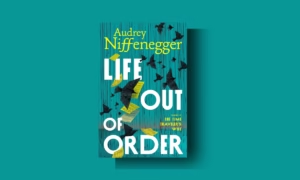
Life Out of Order is Audrey Niffenegger's long-delayed sequel to The Time Traveler's Wife, and the biggest surprise in it is not the second husband, the AI stepsister or the drowned London of 2098. It is the moment, near the very end, when you learn whose handwriting you have been reading all along.
URL: https://www.sopranu.com/life-out-of-order-review-ending-explained/
Author: Audrey Niffenegger
Name: Life Out of Order
URL: https://www.sopranu.com/life-out-of-order-review-ending-explained/
Author: Audrey Niffenegger
ISBN: 9781335003232
Date Published: 2026-10-06
Format: https://schema.org/Hardcover
4
Pros
- Isadora, the AI “anti-darling,” is the best character Niffenegger has written since Henry.
- Clare finally gets her own story, and the Clare and Beck chapters are the warmest in the book.
- The last hundred pages pay off almost every loose thread.
- The music writing is precise and lovely.
Cons
- The first third is scattered and hard to follow.
- Alba, the heroine, is oddly withheld; we often see her through other people.
- The Zach and Oliver crisis resolves very quickly.
- The age gap between Alba and young Oliver is handled with too little friction.