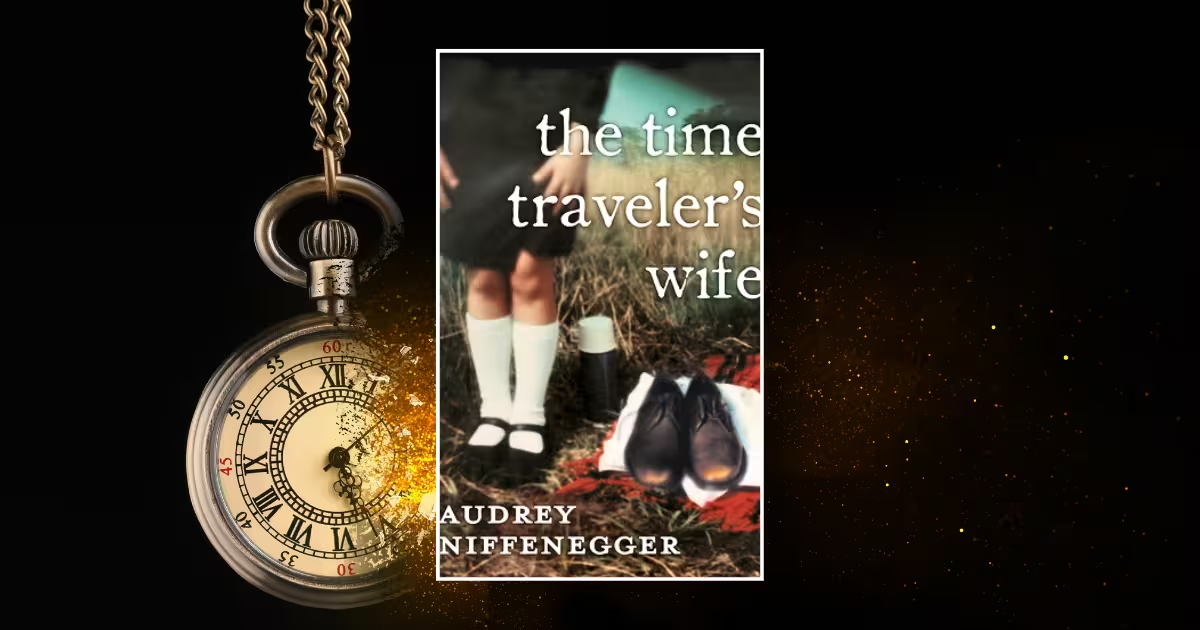
Ever wondered why a story about a man who can’t control his comings and goings feels more real than most love stories that stay put? I picked up Audrey Niffenegger’s debut novel in 2004, and I’m still not over it. Twenty years and over 9 million copies sold worldwide, yet The Time Traveler’s Wife still finds new ways to wreck me every time I think about it.
This isn’t just another time travel gimmick. This is a love story that uses time as a weapon, a gift, and a curse all at once. Niffenegger, a visual artist who teaches at Columbia College Chicago’s Center for Book and Paper Arts, wrote this book because she couldn’t figure out how to make it a picture book, “still pictures don’t represent time very well,” she said.
So she wrote a novel instead, and the literary world hasn’t been the same since.
Overview
A librarian with a genetic disorder that causes involuntary time travel meets the love of his life when she’s six years old and he’s thirty-six, and spends the rest of his (non-linear) existence trying to hold onto her across the chaos of past, present, and future.
The Time Traveler’s Wife is best for readers who love emotional devastation wrapped in philosophical questions about fate, free will, and whether love can survive when one partner literally disappears without warning.
The Time Traveler’s Wife is not anyone who needs their timelines linear, their love stories uncomplicated, or who gets uncomfortable with the “ick factor” of a grown man befriending a child who will one day become his wife.
Table of Contents
Introduction
Title: The Time Traveler’s Wife
Author: Audrey Niffenegger
Publication: 2003 by MacAdam/Cage
Pages: 546 (first edition hardcover)
Genre: Literary fiction, romance, science fiction
Awards: Exclusive Books Boeke Prize (2005), British Book Award for Popular Fiction (2006), Arthur C. Clarke Award shortlist (2005), Orange Prize longlist (2004)
Adaptations: 2009 film starring Rachel McAdams and Eric Bana; 2022 HBO series; a musical
Background
Audrey Niffenegger wasn’t trying to write a bestseller. She was frustrated with love when she began the novel, writing the story as a metaphor for her failed relationships. The title came to her first, she wrote it down on the brown paper covering her drawing table and couldn’t stop thinking about it.
The Time Traveler’s Wife became a word-of-mouth phenomenon after an endorsement from author Scott Turow on NBC’s Today show. By March 2009, it had sold nearly 2.5 million copies in the US and UK alone, and that number has since grown to over 9 million globally.
What makes this even more remarkable? Niffenegger is primarily a visual artist. She produces limited-edition hand-painted books, some in editions of just ten copies. She wasn’t a career novelist. She was an artist who had a story that demanded to be told in words.
The Time Traveler’s Wife Summary
The Premise
Henry DeTamble (born 1963) is a librarian at Chicago’s Newberry Library. He has a rare genetic disorder called Chrono-Impairment that causes him to time travel involuntarily. He can’t control when, where, or how long he’ll be gone. He always arrives naked. He can’t take anything with him.
Clare Anne Abshire (born 1971) is an artist who makes paper sculptures. When she’s six years old, Henry appears in the meadow behind her family’s Michigan home. He’s thirty-six. He knows her name. He knows her future.
The Time Traveler’s Wife uses alternating first-person perspectives from Henry and Clare. This structure is crucial, we see the same events from both sides, and what one knows, the other doesn’t. It’s maddening and beautiful, like love itself.
Part One: The Beginning of the End (and the End of the Beginning)
The Time Traveler’s Wife opens in 1991. Clare is twenty. Henry is twenty-eight. They meet at the Newberry Library. For Henry, this is their first meeting. For Clare, it’s their 153rd.
“I’m Clare Abshire. I knew you when I was a little girl,” she tells him. She’s been waiting for this moment her entire life. She has a diary, a little blue book, with 152 dates, the times Henry appeared in her childhood. Henry dictated those dates to her when she was six.
This is the central paradox of the novel: Henry experiences time in fragments, but Clare experiences it as a straight line, one that Henry keeps intersecting at odd angles. She knows him better than he knows himself. She’s loved him longer than he’s known she exists.
Part Two: Growing Up With Your Future Husband
The Time Traveler’s Wife jumps back and forth between the “present” (the 1990s and early 2000s) and Henry’s visits to Clare’s childhood.
September 23, 1977: Henry, age thirty-six, meets six-year-old Clare for the first time. He’s naked, hiding in the meadow. She throws a shoe at him. He convinces her he’s a time traveler. “Greetings, Earthling,” he says.
This is where the “ick factor” enters. A grown man befriending a six-year-old girl, knowing she’ll one day be his wife. Niffenegger doesn’t shy away from this, she makes it uncomfortable on purpose. Henry is constantly resisting Clare’s advances as she gets older. He refuses to touch her sexually until she’s eighteen. He’s aware of how it looks, even if he can’t change it.
What develops is something stranger than grooming: a genuine friendship that spans years. Henry tutors Clare in math, French, and state capitals. He plays chess with her. He teaches her to pick locks. He’s a mentor, a confidant, and—eventually—a lover.
Clare’s teenage years are marked by her desperate longing for Henry. She tries to seduce him repeatedly. He refuses, citing her age. “You’re sixteen, Clare,” he tells her. It’s not easy—he admits later that he spent many hours “trying to ignore painful hard-ons”.
The first time they make love is on Clare’s eighteenth birthday. It’s 1989. Henry is forty-one. It’s the last time he’ll visit her childhood. After this, they’re separated for two years until the library meeting in 1991.
Part Three: Marriage and Loss
October 23, 1993: Henry and Clare marry. It’s a Catholic ceremony in Clare’s hometown. Henry is thirty. Clare is twenty-two.
But marriage doesn’t mean stability. Henry continues to disappear. Sometimes it’s minutes. Sometimes it’s days. Clare learns to live with absence.
The real heartbreak comes when they try to have children. Clare has five miscarriages. The fetuses carry Henry’s genetic anomaly. “Nature is telling us to give up,” Henry thinks. “Nature is saying: Henry, you’re a very fucked-up organism and we don’t want to make any more of you.”
Henry gets a vasectomy to spare Clare further pain. But a past version of Henry visits Clare one night—she’s half-asleep, he’s from 1996—and they make love. She becomes pregnant again.
Part Four: Alba
August 24, 2001: Alba DeTamble is born. She has Henry’s black hair and Clare’s eyes. She also has Chrono-Impairment, but unlike Henry, she has some control over where and when she goes.
Henry meets Alba before she’s born. He travels to the future, to a museum field trip, and sees his ten-year-old daughter. She recognizes him immediately. “He’s dead,” her teacher tells her. “But he’s not continuously dead,” Alba replies.
This is the cruelest twist of The Time Traveler’s Wife: Henry knows he’ll die when Alba is five. He knows he’ll never see her grow up. And yet he can’t change it.
Part Five: The End
January 7, 2006: Henry time travels to a Chicago parking garage on a frigid winter night. He can’t find shelter. He suffers hypothermia and frostbite. Both of his feet are amputated.
Without feet, Henry can’t run. Without running, he can’t control his time traveling. He knows his next jump will be his last.
December 31, 2006: Henry throws a New Year’s Eve party. Everyone he loves is there. He says goodbye without saying goodbye.
At midnight, Henry time travels to October 27, 1984, the Meadow in Michigan. Clare’s brother Mark is deer hunting. He hears a noise, fires, and hits Henry.
Henry returns to the present, dying in Clare’s arms. Alba, now five, whispers “Daddy…”. “World enough… And time…” Henry says. And then he’s gone.
The Ending: Waiting
Clare finds a letter Henry wrote before his death. He tells her to stop waiting for him:
“Please, Clare. When I am dead. Stop waiting and be free of me—put me deep inside you and then go out in the world and live.”
But he also gives her hope:
“I found myself in a dark hallway… at the end of the hall I could see a rim of light around a door… there, with her back to me, sat a woman… it was you, Clare, this was you as an old woman, in the future.”
The Time Traveler’s Wife ends in 2053. Clare is eighty-two. She’s sitting by the lake, drinking tea, waiting. Henry appears, forty-three, the age he died. They embrace.
“Now from his breast into his eyes the ache of longing mounted, and he wept at last, his dear wife, clear and faithful, in his arms…”
She’s been waiting her whole life. And she’ll keep waiting.
The Time Traveler’s Wife Characters Analysis
Henry DeTamble: The Man Out of Time
Henry is a contradiction. He’s a librarian who can’t control his own presence. He’s a thief and a survivor, he’s learned lock-picking, pickpocketing, and self-defense from older versions of himself. He’s also a romantic who wants nothing more than domesticity:
“All my pleasures are homey ones: armchair splendor, the sedate excitements of domesticity. All I ask for are humble delights. A mystery novel in bed, the smell of Clare’s long red-gold hair damp from washing…”
Henry’s defining trait is his helplessness. He can’t control his time travel. He can’t change the past—even when that past is his mother’s death in a car accident when he was six. He’s witnessed that accident from every angle, over and over. He’s a ghost in his own life.
But Henry is also kind. He protects Clare from himself as a child. He tries to protect her from the pain of miscarriage. He loves her with a ferocity that transcends time:
“I hate to be where she is not, when she is not. And yet, I am always going, and she cannot follow.”
Clare Abshire: The One Who Stays
Clare is the heart of the novel. She’s patient, fierce, and stubborn. She’s known Henry since she was six. She’s loved him longer than she’s understood what love means.
Clare’s tragedy is that she’s always waiting. She waits for Henry to appear in the meadow. She waits for him to come back from his time travels. She waits for him to die, and then she waits to see him again.
“It’s hard being left behind. I wait for Henry, not knowing where he is, wondering if he’s okay. It’s hard to be the one who stays.”
Clare is also an artist. Her paper sculptures are her way of making something permanent in a world where nothing stays. When Henry loses his feet, she makes him wings, a terrible angel, a “deadly bird”.
Clare’s strength is her ability to endure. She survives five miscarriages. She survives her mother’s death from ovarian cancer. She survives Henry’s death. And she keeps waiting.
Alba DeTamble: The Future
Alba is the hope of The Time Traveler’s Wife. She has Henry’s disorder, but she can control it. She can go where she wants, when she wants. She’s what Henry could have been.
Alba is also the source of Henry’s greatest pain and greatest joy. He meets her before she’s born. He learns his own death from her. And she loves him unconditionally:
“Daddy!” she cries when she sees him in the museum, and throws her arms around him.
Supporting Characters: The People Who Hold Them Together
- Gomez: Clare’s best friend, who loves her hopelessly and marries Charisse instead. He’s Henry’s best man. He carries Henry when Henry can’t walk.
- Charisse: Gomez’s wife, Clare’s roommate, the steady presence in a chaotic world.
- Kimy: Henry’s Korean landlady, surrogate mother, keeper of his secrets. She’s the only one who understands his time travel without needing proof.
- Dr. Kendrick: The geneticist who studies Henry’s disorder. He creates time-traveling mice. He’s the scientist who can’t save his patient.
The Time Traveler’s Wife Themes and Symbolism
Time as a Character
Time isn’t just a setting in this novel. It’s a force, a character, a tormentor. Henry describes time travel as “like listening to a car radio that’s having trouble holding on to a station”.
The novel asks: What does it mean to be present? Henry can be in the past, the present, and the future, but he can never fully be anywhere. Clare is always in the present, but she’s always waiting for a future that might not come.
Fate vs. Free Will
This is the central philosophical question of the novel. Henry can’t change the past. He can’t prevent his mother’s death. He can’t prevent his own death. Everything has already happened, and he’s just living through it again.
“I can only do things that work toward what has already happened.”
But does that mean free will doesn’t exist? Henry tells Clare:
“You have to behave as though you have free will, as though you are responsible for what you do.”
The Time Traveler’s Wife doesn’t resolve this tension. It leaves us with the paradox: we’re both free and not free. We make choices, but we can’t change the outcome.
Love as Survival
Love is the only thing that transcends time in this novel. Henry and Clare love each other across years, across decades, across death itself. Their love is the thread through the labyrinth, the net under the high-wire walker.
But love doesn’t protect them. It doesn’t stop Henry from dying. It doesn’t stop Clare from waiting. Love is simply what makes the waiting bearable.
Art and Memory
Clare’s art is her way of making something permanent. Henry’s mother’s recordings are his way of holding onto her. Art is the bridge between the living and the dead, between past and present.
Henry gives Clare a drawing of himself that she keeps for years. Clare draws Alba sleeping. These are acts of love that outlast the people who made them.
The Time Traveler’s Wife Evaluation
Strengths
The structure is brilliant. The alternating first-person perspectives create a narrative that’s disorienting in exactly the right way. We experience Henry’s confusion and Clare’s patience simultaneously.
The emotional depth is devastating. Niffenegger doesn’t flinch from the hard stuff, miscarriage, death, loss. The scene where Henry holds his dying wife after their second miscarriage is almost unbearable:
“Clare is curled up in the middle of it like a kitten… She says, simply, ‘He died,’ and bursts into tears.”
The love story feels earned. Henry and Clare don’t just fall in love, they grow into it. They know each other’s flaws, their fears, their secrets. They choose each other, over and over.
Weaknesses
The “ick factor” is real. A grown man befriending a six-year-old girl is uncomfortable, even when the narrative tries to justify it. Some readers will never get past this.
The pacing is uneven. The middle section, with its multiple miscarriages and Henry’s drug experiments, can feel repetitive.
Clare sometimes lacks agency. She’s defined by her waiting, her patience, her endurance. She’s the one who stays, but she’s also the one who’s passive.
Impact
The Time Traveler’s Wife broke me. I read it in 2004, and I’m still not over it. The ending, Clare waiting for Henry at eighty-two, is one of the most beautiful and heartbreaking things I’ve ever read.
What makes it so powerful is the ambiguity. Does Henry really come back? The novel suggests he does, but it’s not certain. Clare believes. That’s what matters.
“This is where I have always been coming to. Since my time began. And when I go away from here, this will be the mid-point, to which everything ran, before, and from which everything will run. But now, my love, we are here, we are now, and those other times are running elsewhere.”
Comparison with Similar Works
| Work | Similarity | Difference |
|---|---|---|
| Outlander by Diana Gabaldon | Time-traveling romance | Claire can control her travel; Henry can’t |
| The Time Machine by H.G. Wells | Time travel as sci-fi | Wells focuses on science; Niffenegger focuses on emotion |
| Slaughterhouse-Five by Kurt Vonnegut | Non-linear time | Vonnegut uses it for satire; Niffenegger uses it for romance |
| About Time (film) | Time-traveling love story | Tim can control his travel; Henry can’t |
Adaptations
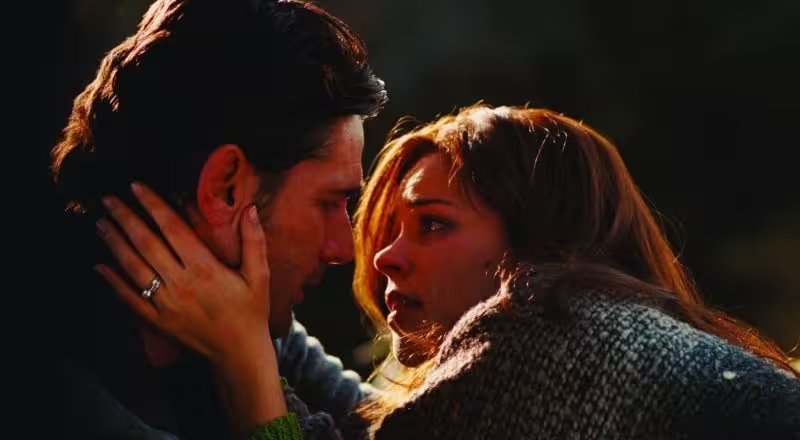
The 2009 film starring Rachel McAdams and Eric Bana is a competent but simplified version. It changes the ending, Clare gets more closure, and the ambiguity is lost. The film grossed $101 million worldwide on a $39 million budget.
The 2022 HBO series is more faithful to the book’s structure. It updates the timeline from the 1960s to the 1990s. But it also makes changes: Henry’s death age is altered, and the “grooming” aspect is handled differently. The series was canceled after one season.
Personal Insight: Five Lessons from The Time Traveler’s Wife
1. Love is not enough, but it’s everything
Henry and Clare love each other unconditionally. That doesn’t stop the miscarriages. It doesn’t stop Henry’s death. Love doesn’t fix anything. But it makes everything bearable.
“I love him. He’s my life. I’ve been waiting for him, my whole life, and now, he’s here.”
2. Presence is a choice
Henry can be anywhere, anytime, but he can’t be present. Clare is always present, but she’s always waiting for someone else. The novel asks us: Are we really here?
“Time is meaningless.”
3. Grief is a form of love
Henry’s mother dies when he’s six. He spends the rest of his life visiting her, watching her, loving her from a distance. Grief doesn’t end. It transforms.
“Dead people need us to remember them, even if it eats us, even if all we can do is say I’m sorry until it is as meaningless as air.”
4. Waiting is an act of hope
Clare waits her entire life for Henry. She waits for him to appear. She waits for him to come back. She waits for him to die, and then she waits to see him again.
Waiting isn’t passive. It’s an active choice to believe that something is coming.
5. We are all time travelers
We can’t go backward or forward, but we do experience time in fragments. We remember the past. We anticipate the future. We’re always somewhere else, even when we’re here.
“The hardest lesson is Clare’s solitude. Sometimes I come home and Clare seems kind of irritated; I’ve interrupted some train of thought, broken into the dreamy silence of her day.”
The Time Traveler’s Wife Quotes
“Clock time is our bank manager, tax collector, police inspector; this inner time is our wife.”
“It’s hard being left behind. I wait for Henry, not knowing where he is, wondering if he’s okay. It’s hard to be the one who stays.”
“How does it feel? Sometimes it feels as though your attention has wandered for just an instant.”
“When I am out there, in time, I am inverted, changed into a desperate version of myself. I become a thief, a vagrant, an animal who runs and hides.”
“All my pleasures are homey ones: armchair splendor, the sedate excitements of domesticity.”
“I hate to be where she is not, when she is not. And yet, I am always going, and she cannot follow.”
“Maybe God just made us up and He’s not telling us.”
“This is where I have always been coming to. Since my time began. And when I go away from here, this will be the mid-point, to which everything ran, before, and from which everything will run. But now, my love, we are here, we are now, and those other times are running elsewhere.”
“Time is nothing.”
Conclusio
The Time Traveler’s Wife is not a perfect book. It’s messy, uncomfortable, and sometimes frustrating. But it’s also one of the most honest love stories I’ve ever read.
Niffenegger understands something that most romance novels miss: love is not about staying together. It’s about staying present, even when the other person can’t.
Henry and Clare’s love is tested by time itself. They lose children. They lose each other. They lose themselves. But they keep choosing each other, over and over, across decades and death.
“Our love has been the thread through the labyrinth, the net under the high-wire walker, the only real thing in this strange life of mine that I could ever trust.”
I recommend The Time Traveler’s Wife to anyone who:
- Believes in love that transcends time
- Isn’t afraid of emotional devastation
- Loves philosophical questions wrapped in beautiful prose
- Can handle the discomfort of a non-linear narrative
I don’t recommend this book to anyone who:
- Needs their timelines linear and their love stories simple
- Gets uncomfortable with age-gap relationships
- Prefers their science fiction hard and their romance soft
The Time Traveler’s Wife is a book that will stay with you long after you’ve finished it. It will make you think about time, love, loss, and what it means to be present. It will break your heart, and then it will put it back together, just in time for you to start all over again.