
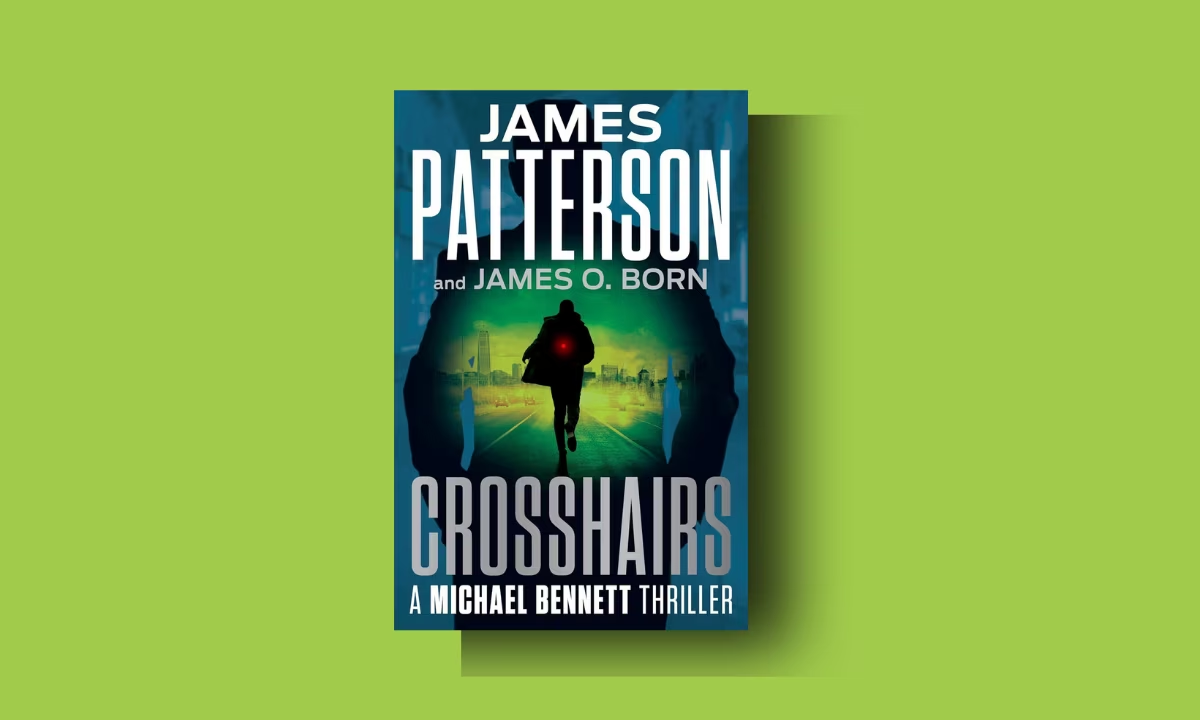

Crosshairs is a gripping, morally complex thriller that asks uncomfortable questions about justice, trauma, and how far someone will go when the system fails. Recommended for readers who enjoy police procedurals with psychological depth.
Should You Read It?
Pros:
- Fast-paced investigation with authentic NYPD details
- Compelling exploration of PTSD in veterans and first responders
- Michael Bennett remains one of Patterson’s most relatable detectives
- The sniper’s methodology feels disturbingly plausible
Cons:
- Some readers may find the vigilante angle morally ambiguous
- The ending resolution feels slightly rushed
- Familiar Patterson formula may feel repetitive to longtime fans
What Is It About? NYPD Detective Michael Bennett is assigned to catch a sniper targeting criminals who evaded prosecution. As he works with Rob Trilling, a young former Army Ranger, Bennett uncovers a conspiracy that hits closer to home than he ever imagined.
Rating: 4.2/5
Table of Contents
Introduction
Crosshairs, the sixteenth installment in James Patterson’s Michael Bennett series, arrived in February 2024 with co-author James O. Born returning to the fold.
Published by Little, Brown and Company, this 384-page thriller tackles one of the most polarizing questions in modern criminal justice: what happens when the people who are supposed to protect us decide to take justice into their own hands?
The timing of this novel’s release feels almost prophetic. With debates raging about bail reform, prosecutorial discretion, and police accountability, Crosshairs taps into a cultural moment where trust in institutions sits at historic lows. Patterson and Born do not shy away from these tensions. Instead, they weaponize them.
As someone who has followed Michael Bennett since his introduction in Step on a Crack back in 2007, I approached this installment with cautious optimism. The series has weathered uneven entries, and I wondered whether the well of compelling stories had run dry.
I was wrong.
Background
James Patterson needs little introduction. With over 300 million books sold worldwide, he has become a publishing phenomenon unto himself.
The Michael Bennett series, co-written with various collaborators over the years, follows an NYPD detective who balances high-stakes homicide investigations with the chaos of raising ten adopted children.
James O. Born brings a different energy to the series. A career law enforcement agent who has worked with the Florida Department of Law Enforcement and served as a federal task force officer, Born infuses the narrative with procedural authenticity that few thriller writers can match.
His previous collaborations with Patterson on this series, including Shattered and Obsessed, demonstrate a clear chemistry.
Crosshairs follows Bennett’s narrative arc from the earlier books. He has recently married Mary Catherine, the Irish nanny who helped raise his children. They are exploring fertility treatments, adding a personal dimension that grounds the detective amid the violence of his professional life.
The novel draws on contemporary anxieties about mass shootings, sniper attacks, and the psychological toll on military veterans.
According to the U.S. Department of Veterans Affairs, approximately 11 to 20 percent of veterans who served in Operations Iraqi Freedom and Enduring Freedom experience PTSD in a given year. This statistic becomes thematically central to the story.
Crosshairs Plot Summary
The novel opens with Adam Glossner, a hedge fund manager, tucking his young children into bed in his Upper West Side apartment. The domestic scene feels tender, almost mundane.
Glossner steps onto his balcony with a snifter of brandy, appreciating the view of the Hudson River. Then a bullet tears through his skull.
Bennett receives the call at 6:01 a.m. His boss, Harry Grissom, delivers news that has become distressingly familiar: another victim of a sniper the media has dubbed the Longshot Killer. This is the third such murder, following Marie Ballard, a grandmother in Queens, and Thomas Bannon, a firefighter on Staten Island.
What makes this case different is the victim’s profile. Glossner was wealthy, connected, and lived in a neighborhood near Bennett’s own Upper West Side apartment. The media already knows about the killing, complicating the investigation before it properly begins.
At the crime scene, Bennett encounters Victoria Glossner, the victim’s widow, who offers an alibi for her whereabouts but seems evasive about her husband’s business affairs. Her mother eventually spirits her away before Bennett can press further.
The investigation reveals a troubling pattern. All three victims shared something beneath the surface: they had committed crimes but escaped prosecution. Marie Ballard had used city funds for personal expenses through the Housing Authority. Thomas Bannon had downloaded child pornography on an FDNY computer. Adam Glossner had committed securities fraud that the SEC referred to the FBI.
Here is where Patterson and Born introduce their most compelling creation: Rob Trilling. At twenty-four years old, Trilling is a former Army Ranger with a Bronze Star, a sniper’s precision, and deep psychological wounds from his service in Afghanistan. He has been assigned to help Bennett navigate the unfamiliar terrain of long-distance shooting investigations.
Trilling is guarded, almost painfully reserved. He avoids questions about his personal life and disappears for unexplained “appointments” that eventually prove to be therapy sessions at a VA clinic. His vulnerability becomes the emotional anchor of the novel.
As Bennett and Trilling pursue leads, they encounter Wendy Robinson, a female former Army sniper with anger issues and a penchant for bare-knuckle fighting. She lies about her alibi, sending the investigation down a frustrating detour before she is cleared.
The political dimensions of the case intensify when Gus Querva, a community activist with a criminal background, is shot outside his Bronx apartment building. Bennett recognizes the name from Trilling’s earlier comments. Trilling had expressed disgust at how Querva was being celebrated in the media despite running an extortion racket.
When Querva is murdered, suspicion falls on Trilling. He had the expertise, the opportunity, and expressed clear animosity toward the victim. The FBI discovers a .308 bullet casing in the car Trilling had been using, matching the caliber used in the sniper attacks.
Internal Affairs Sergeant Dennis Wu interrogates Trilling, who demands an attorney and walks out. He is suspended and becomes the primary suspect. Bennett, torn between his professional obligations and his belief in his young partner, begins investigating other possibilities.
His breakthrough comes through surveillance footage from Trilling’s apartment building. On the night Querva was killed, Trilling is seen entering his apartment at 6:05 p.m. and not leaving until 7:05 the next morning. He could not have committed the murder.
Bennett also discovers that Trilling was at a VA retreat in Albany when Thomas Bannon was shot. The young officer had been at the retreat for five days, confirmed by credit card receipts and registration records at Holliday’s Tavern and Inn.
The real killer emerges from an unexpected direction: Darnell Nash, a former Marine and FBI analyst who worked alongside Joe Tavarez, an NYPD sniper who had been sidelined after a controversial shooting. Nash had access to all the FBI files on the victims. He planted the .308 casing in Trilling’s car to deflect suspicion.
The novel climaxes with a tense stakeout operation designed to trap the sniper. The plan involves planting a fake memo about a corrupt cop being transported, hoping the killer will take the bait. Instead, Joe Tavarez shows up at the scene, having deduced the operation from other memos.
Tavarez is shot and killed by Nash during the confrontation, the bullet striking him in the back. Nash then leads Bennett, Trilling, and FBI ASAC Robert Lincoln on a high-speed chase through Brooklyn. The pursuit ends at a construction site where Bennett tackles Nash and arrests him after a brutal physical struggle.
In custody, Nash confesses without remorse. He explains that after his military service and the loss of his leg to an IED, he felt purposeless. Targeting criminals who escaped justice gave him a sense of mission. He apologizes to Trilling for framing him but shows no regret for the murders.
The novel concludes on a hopeful note. Bennett learns that Mary Catherine is pregnant. Trilling reveals that he has been housing the five Pakistani women rescued from the heroin operation.
Jane, Bennett’s daughter, delivers a speech at Columbia University about the importance of family and diversity.
Crosshairs Analysis and Critique
Characters
Michael Bennett remains the emotional center of the series.
His ten children provide both comic relief and genuine stakes, grounding the detective in a world where violence has consequences beyond the crime scene. His marriage to Mary Catherine has matured the character without diminishing his edge.
Patterson and Born show Bennett’s investigative instincts in fine form, particularly when he uses old-school techniques like the calendar trick during interviews.
Rob Trilling is the novel’s breakout figure. His reserve masks deep trauma, and his gradual opening up to Bennett feels earned rather than contrived. The revelation that he has been housing the trafficked women demonstrates a compassion that contradicts his stoic exterior.
His PTSD and sleep disturbances, including episodes of unconscious activity, add genuine uncertainty to his guilt or innocence.
Victoria Glossner, the widow of the first Manhattan victim, remains somewhat underdeveloped. Her mother’s intervention cuts short what could have been a more revealing interview.
Still, her comment about “rough spots in his business” plants seeds of doubt about her husband’s character.
Darnell Nash serves as a tragic figure. His military service cost him his leg and left him searching for purpose. His decision to become a vigilante killer stems from legitimate frustration with a justice system that lets criminals walk free. Patterson and Born do not excuse his actions, but they make him understandable.
Joe Tavarez appears briefly but leaves a significant impact. His backstory, a sniper who made a perfect shot to save a hostage and was rewarded with a desk job, illustrates the institutional failures that drive people toward extremism. His death feels genuinely tragic.
Crosshairs Themes and Symbolism
Vigilante Justice and Institutional Failure form the novel’s thematic core. The victims were not innocent. They had committed real crimes but escaped consequences through legal technicalities, plea deals, or prosecutorial discretion.
Nash’s killing spree represents an extreme response to legitimate grievances. Patterson and Born do not advocate for vigilante justice, but they force readers to confront uncomfortable questions about a system that often fails.
The Invisible Wounds of Service runs throughout the narrative. Trilling’s PTSD, Nash’s depression after losing his leg, and the struggles of veterans at VA clinics all illustrate the gap between public gratitude and actual support. The novel suggests that society’s failure to care for those who served creates the conditions for violence.
Trust and Deception operate on multiple levels. Bennett must decide whether to trust Trilling despite mounting evidence. Nash hides in plain sight within the FBI. The victims conceal their crimes behind respectable facades. The novel suggests that nothing is exactly as it appears.
Crosshairs Evaluation
Strengths
The procedural authenticity stands out. Born’s law enforcement background shows in every detail, from the way canvasses are organized to the politics of Internal Affairs investigations. The novel does not glorify police work or simplify its complexities.
The pacing is relentless. Short chapters, a Patterson trademark, keep the narrative moving. The twist regarding Nash’s identity feels earned rather than arbitrary. The moral ambiguity of the victims creates genuine tension about who deserves sympathy.
Trilling’s character arc is the novel’s greatest achievement. Watching him emerge from his shell, first through his handling of the grieving Duane Ballard, then through his intervention with Lou Pershing’s abused girlfriend, provides satisfying emotional beats.
Weaknesses
The novel’s resolution feels slightly rushed. Nash’s capture happens quickly after the lengthy build-up. His confession provides closure but lacks the psychological depth that might have made him a more compelling villain.
Some readers may find the political dimensions heavy-handed. The victims’ crimes are chosen to appeal to particular political sensibilities, which could alienate readers who disagree with the novel’s implicit politics.
The Wendy Robinson subplot feels underdeveloped. She appears, lies, fights, and disappears without contributing meaningfully to the resolution. The novel could have either developed her character further or trimmed her scenes.
Impact and Controversy
Crosshairs arrived at a moment of intense debate about criminal justice reform. The novel does not take an explicit political stance, but its exploration of criminals escaping consequences taps into real anxieties.
The victims represent different types of wrongdoing, from financial fraud to child pornography, ensuring that readers will find some crimes more forgivable than others.
The novel’s treatment of veterans and PTSD feels particularly timely. Trilling’s struggles, Nash’s radicalization, and Tavarez’s institutional abandonment all reflect real challenges facing the veteran community.
Comparison with Similar Works
Readers who enjoyed Crosshairs might appreciate Stephen Hunter’s Bob Lee Swagger series, particularly Point of Impact, which also features a skilled sniper navigating questions of honor and justice. Lee Child’s Jack Reacher novels share the theme of vigilante justice but with a more straightforward moral calculus.
Within the Patterson oeuvre, Crosshairs compares favorably to the earlier Michael Bennett installments. It lacks the emotional heft of Step on a Crack, which dealt with Bennett’s wife’s cancer, but surpasses the more formulaic entries like Alert.
Personal Insight: What Crosshairs Teaches About Justice and Trauma
The most important theme in Crosshairs concerns the relationship between trauma and violence. Darnell Nash did not become a killer overnight. His journey from decorated Marine to vigilante sniper passed through losing his leg, struggling with depression, and watching criminals escape accountability.
According to the National Institute of Mental Health, veterans are 1.5 times more likely to die by suicide than non-veterans. This statistic underscores the stakes of the novel’s exploration of untreated trauma.
Nash’s descent illustrates how institutions fail the people they claim to serve. The VA clinic Trilling visits operates on a shoestring budget with no receptionist. The FBI assigns Nash to an intake role that wastes his skills. The NYPD sidelines Tavarez after a heroic shooting.
Five Lessons from Crosshairs
Justice delayed is not always justice denied. The victims’ crimes eventually caught up with them, but through means that undermine the rule of law.
Trauma requires community. Trilling’s recovery depends on the support of his family, his therapist, and eventually his partner. Isolation breeds violence.
Institutions cannot be trusted to police themselves. The sniper operated within law enforcement. Internal Affairs almost arrested the wrong man.
Appearances deceive. The victims looked respectable. The killer looked like a hero. Bennett’s ability to see past surfaces solves the case.
Redemption is possible but not guaranteed. Trilling emerges intact. Nash faces life in prison. Their trajectories diverge based on choices and support systems.
Quotable Lines
“Justice isn’t about what people deserve. It’s about what we can prove.” — This line captures the central tension of the novel.
“I don’t need a babysitter.” — Trilling’s defiant response to Bennett’s initial attempts to mentor him.
“They’re not just rumors. They’re patterns.” — Bennett’s insight into the victims’ criminal histories.
“Some people need killing.” — Nash’s justification for his murders, chilling in its simplicity.
“This isn’t a movie and Rob Trilling isn’t Charles Bronson.” — Bennett’s rejection of vigilante fantasy.
Conclusion
Crosshairs delivers a satisfying entry in the Michael Bennett series that balances procedural detail with genuine emotional stakes. Patterson and Born have crafted a thriller that entertains while raising uncomfortable questions about justice, trauma, and institutional failure.
The novel works best for readers who appreciate moral complexity in their thrillers.
Those seeking simple good-versus-evil narratives may find the gray areas frustrating. But for readers willing to sit with ambiguity, Crosshairs rewards the investment.
Fans of James Patterson’s earlier work will find familiar pleasures here: short chapters, propulsive pacing, and a hero worth rooting for. The addition of Rob Trilling suggests potential for future collaborations that could deepen the series.
I finished Crosshairs in two sittings, unable to put it down during the final hundred pages. The construction site confrontation ranks among Patterson’s best action sequences. The resolution, while slightly neat, satisfies.
This novel is significant because it refuses easy answers. The Longshot Killer’s victims were criminals. His motives were understandable. His actions were inexcusable. That tension is what makes Crosshairs worth reading.
Crosshairs: A Michael Bennett Thriller
Crosshairs is a gripping, morally complex thriller that asks uncomfortable questions about justice, trauma, and how far someone will go when the system fails. Recommended for readers who enjoy police procedurals with psychological depth.
URL: https://www.sopranu.com/crosshairs-james-patterson-review/
Author: James Patterson and James O. Born
4.2
Pros
- Fast-paced investigation with authentic NYPD details
- Compelling exploration of PTSD in veterans and first responders
- Michael Bennett remains one of Patterson's most relatable detectives
- The sniper's methodology feels disturbingly plausible
Cons
- Some readers may find the vigilante angle morally ambiguous
- The ending resolution feels slightly rushed
- Familiar Patterson formula may feel repetitive to longtime fans





