

Last updated on October 17th, 2026 at 10:27 am
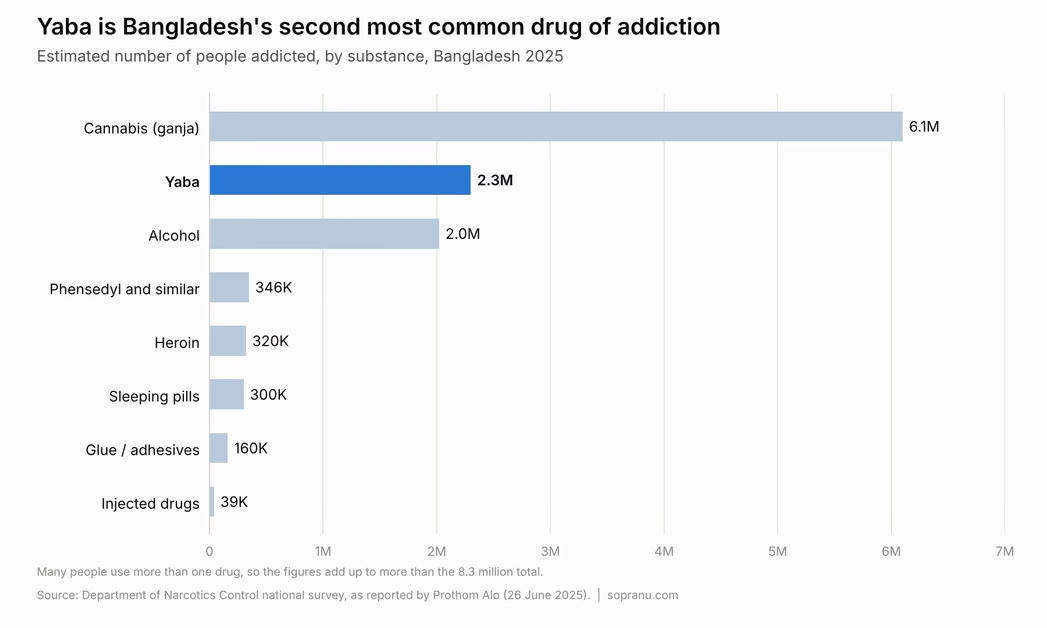
Yaba is a cheap pill of methamphetamine mixed with caffeine, and in Bangladesh it sits at the centre of a drug crisis that keeps getting worse. Almost all of it is made in Myanmar and smuggled in across the Naf river, it sells for about Tk 300 a pill, and a 2025 government survey estimates that 2.3 million Bangladeshis are dependent on it, out of 8.3 million people addicted to drugs. The 2018 “war on drugs” left hundreds of suspects dead in a single year, yet the supply did not slow: yaba seizures nearly doubled in 2025.
That 8.3 million estimate, about 4.89 per cent of the population, comes from the Department of Narcotics Control’s first national survey of drug dependence. When the National Institute of Mental Health ran a similar survey in 2018, the year the crackdown began, the estimate was 3.6 million.
This piece looks at what yaba is, where it comes from, who uses it, what the 2018 crackdown actually achieved, and what the evidence suggests might work better.
Table of Contents
What yaba is
Yaba is a tablet made from methamphetamine mixed with caffeine, popular across South-East Asia because it is cheap and easy to find. The tablets are usually swallowed, though methamphetamine can also be smoked, snorted or injected.
The name is Thai. The drug was first known in Thailand as ya khayan, the “hard-working pill”, then as ya maa, “horse medicine”, before it was renamed ya ba, “crazy pill”, in 1996. In Bangladesh it travels under a long list of street names, among them baba, guti, laal, khawon and jinish.
Pharmacologically, yaba belongs to the amphetamine-type stimulants. Methamphetamine raises alertness and energy and suppresses appetite and sleep, and the US National Institute on Drug Abuse describes it as highly addictive, with long-term use linked to anxiety, paranoia, memory problems and severe dental damage.
Where it comes from
Almost all of it comes from Myanmar. The DNC says yaba is produced mainly in Myanmar’s Shan and Kachin states, and the United Nations Office on Drugs and Crime (UNODC) calls Myanmar the predominant source of methamphetamine for the regional market, a position it has held since the late 2000s.
Myanmar’s civil war has made the problem much worse. Since the military coup of February 2021, UNODC reports that drug flows from Myanmar have surged into South Asia as well as across East and South-East Asia. Seizures across East and South-East Asia hit a record 236 tons of methamphetamine in 2024, and then jumped again to 349 tons in 2025, a 48 per cent rise in a single year. UNODC’s World Drug Report 2026 notes that the conflict has opened new westward trafficking routes into South Asia.
Bangladesh sits on the receiving end of those routes. It shares a 271-km border with Myanmar, and the DNC’s Annual Drug Report 2025 identifies the south-eastern corridor along that border as the main entry route for both yaba and crystal meth. Large quantities cross the Naf river from Myanmar’s Rakhine State every day, landing around Teknaf in Cox’s Bazar. In one operation in July 2026, Border Guard Bangladesh seized 110,000 tablets from a boat crossing the Naf and arrested two men, both residents of Rohingya camps in Ukhiya.
The Rohingya camps sit uncomfortably close to these routes. Law enforcers say traffickers use the camps to store consignments and use refugees as couriers. That deserves to be said carefully. People with no legal right to work, living in extreme poverty beside a smuggling corridor, are the easiest couriers for a trade run by others, and they carry the risk while the profit goes elsewhere.
I have written separately about the causes and effects of the Rohingya crisis and about security, aid cuts and the question of return to Myanmar.
How much is getting through
Seizure figures give only a partial picture, because they measure what police catch rather than what arrives. Still, the trend is telling. Bangladeshi agencies seized 5.31 crore yaba tablets in 2021, the highest in ten years, and 4.59 crore in 2022. According to the DNC’s latest annual report, seizures of yaba and other amphetamine-type tablets nearly doubled to 4.35 crore in 2025, up from 2.28 crore in 2024. DNC officials estimate that about 80 per cent of the yaba and crystal meth entering the country is consumed locally, and that traffickers now use at least 105 border points across 18 districts.
The money involved is large. Citing a 2023 UNCTAD report, Prothom Alo reported that Bangladesh loses around USD 481 million a year to drug trafficking.
Who uses it
The 2025 DNC survey breaks the 8.3 million estimate down as follows: about 7.76 million men, 285,000 women and 255,000 children and adolescents. By substance, cannabis accounts for 52 per cent of those addicted and yaba for 20 per cent, followed by alcohol, phensedyl and heroin. Many people use more than one drug, which is why the substance totals add up to more than the headline figure.
So cannabis, not yaba, is the most widespread drug in Bangladesh. What sets yaba apart is its hold on young people, which the Daily Observer has described as the country’s biggest drug problem. The economics are punishing too. At around Tk 300 a pill, a habit of two pills a day costs roughly Tk 18,000 a month.
Help remains scarce. Government facilities have only 279 beds for drug treatment nationwide. The DNC counts 387 private rehabilitation centres, and plans have been announced for a 250-bed public centre in Dhaka and seven 200-bed centres in the other divisions.
The wider strain on care is the subject of a separate piece on healthcare costs and medical negligence in Bangladesh.
What methamphetamine does to the brain
The best-known image of meth damage comes from a 2004 UCLA brain-imaging study led by Paul Thompson. Comparing 22 long-term methamphetamine users with 21 non-users, the team found tissue loss of about 11 per cent in the limbic region and about 8 per cent in the hippocampus, the brain’s memory centre. The New York Times reported the findings under the headline “This Is Your Brain on Meth: A ‘Forest Fire’ of Damage”.
Not every researcher accepts the most alarming version of that story. In a 2014 report for the Open Society Foundations, Columbia University psychologist Carl Hart and his co-authors argued that many of meth’s harms have been exaggerated, much as crack cocaine’s were in the 1980s, and that hysteria has fed punitive policies. Both positions can be partly true. Heavy, long-term use clearly harms health, and panic still makes for poor policy.
One harm is easy to see from Bangladesh’s highways. A 2016 World Health Organization policy brief on drug use and road safety estimated that illicit drug use caused just over 39,600 road deaths worldwide in 2013, with amphetamines responsible for about half of them, and that amphetamine use raises crash risk roughly fivefold. Globally, road traffic injuries are already the leading killer of people aged 5 to 29, according to the WHO.
Bangladesh’s own road toll is covered in Bangladesh’s Safe Road Movement and the Toll of Road Deaths.
The 2018 war on drugs
In mid-May 2018, the government of Sheikh Hasina launched a nationwide anti-narcotics drive aimed chiefly at yaba. The killings started almost at once: 52 alleged dealers were confirmed dead in the first ten days, and by early June the official count had reached about 130 suspects killed in what authorities described as shootouts.
The case that changed public opinion was that of Ekramul Haque, a municipal councillor in Teknaf, who was shot dead on 26 May 2018. The Rapid Action Battalion said he was a drug dealer killed in a gunfight. His family released recordings of phone calls made as he died, and in bdnews24’s account the audio became a window onto how night-time raids ended in deaths that security forces then described as gunfights.
Years later, an investigation report placed before Bangladesh’s International Crimes Tribunal-2 named 11 suspects in his killing, including Sheikh Hasina.
Amnesty International later estimated that 466 people were killed in 2018 alone in apparent extrajudicial executions under the cover of the anti-drug campaign, and documented witnesses who said they were brought to the scene only after the shooting was over.
Teknaf became the centre of the killing. The Business Standard reported that 205 people were killed in “gunfights” with police while Pradeep Kumar Das was officer-in-charge of Teknaf police station, and that RAB’s investigation placed 150 of those deaths on the Cox’s Bazar-Teknaf Marine Drive between 2018 and 2020. The pattern caught up with Teknaf police on 31 July 2020, when retired army Major Sinha Mohammad Rashed Khan was shot dead at a checkpoint on that road.
According to RAB’s investigating officer, Sinha had found evidence of the officer-in-charge’s involvement in the yaba trade while making a documentary. A Cox’s Bazar court sentenced Pradeep Kumar Das and Inspector Liaqat Ali to death on 31 January 2022, and the High Court later upheld those sentences.
Read that again. The officer running the war on yaba in its busiest district was himself accused of profiting from yaba, and was convicted of murdering a man who tried to expose it.
The law that followed
In October 2018 parliament passed the Narcotics Control Act 2018, replacing the 1990 law. It made dealing in 200 grams or more of yaba punishable by death or life imprisonment, with one to five years in prison for smaller amounts, and extended the death penalty to anyone who finances or patronises the trade. The law took effect on 27 December 2018.
On paper, the financiers are covered. In practice, enforcement has fallen on couriers, users and small dealers. Courts acquit often: in 2014, 55 per cent of drug cases disposed of ended in full acquittal. The DNC’s own 2025 report blames overburdened courts, poor investigation, weak evidence handling and witness intimidation, along with shortages of staff and equipment. In June 2025 the home affairs adviser put it bluntly: “We have failed to control two things – drugs and corruption.” He told the DNC that catching low-level couriers was no longer enough and that it had to go after the godfathers.
The Philippines comparison
Bangladesh’s crackdown was widely compared with Rodrigo Duterte’s campaign in the Philippines, and in 2018 it had defenders in Bangladesh, including the earlier version of this article. It is worth correcting a figure that circulated at the time: Duterte did not kill three million people.
In 2016 he vowed to kill three million drug addicts. The actual toll is disputed. Philippine police acknowledged around 6,600 deaths by mid-2019, while the country’s Commission on Human Rights put the figure at more than 27,000.
The model has not aged well. Duterte was surrendered to the International Criminal Court on 12 March 2025. On 23 April 2026, ICC judges unanimously confirmed charges of crimes against humanity of murder and attempted murder and committed him to trial, which the court has scheduled to begin on 30 November 2026. In Bangladesh, Sheikh Hasina resigned and fled to India on 5 August 2024 after a mass uprising, and the Ekramul Haque killing is now before the International Crimes Tribunal.
Did the killing work?
The honest answer, on the government’s own numbers, is no. Seizures did not fall after 2018. They peaked in 2021, three years into the campaign, and nearly doubled again in 2025. The national addiction estimate more than doubled between the 2018 and 2025 surveys, though the two used different methods. Yaba still crosses the Naf daily, and in August 2026 the government was once again ordering a nationwide drive against yaba trafficking.
This matches what UNODC sees worldwide. Its 2026 report describes drug markets that adapt rapidly to enforcement, technology and instability, and argues that only a combination of public health, justice and security measures reduces harm. A supply that is made cheaply in a lawless war zone next door does not dry up because couriers are shot. It reroutes. Don Winslow’s novel The Power of the Dog traces the same cycle across decades of America’s war on the Mexican cartels.
The argument made for the crossfire killings in 2018 rested on the idea of necessity: when courts fail and the drug lords are protected, the state may step outside the law to protect the many. The trouble is that extrajudicial killing hands the power of execution to exactly the institutions that had already failed, and in places to officers who were part of the trade.
It killed suspects who were never tried, so no court ever heard what they might have said about who financed them. Amnesty found that it spread terror in some of the country’s poorest neighbourhoods, while the money moved on untouched. Necessity was the justification. Impunity was the result.
What might work better
None of the following is new, and most of it appears in the DNC’s own reports.
Follow the money, not the courier. The 2018 Act already covers financiers and patrons. Using it requires financial investigation, asset tracing and the political will to pursue people with connections.
Fix the cases. Better evidence handling, forensic capacity, witness protection and faster courts would mean that people who are arrested are actually convicted or cleared.
Build treatment. 279 government beds for 8.3 million people with drug dependence is not a treatment system. The announced public centres need funding and follow-through.
Prevent early. With 255,000 children and adolescents estimated to be dependent, prevention in schools and communities is not optional.
Work the border diplomatically. Bangladesh has handed Myanmar lists of clandestine yaba laboratories before. With Myanmar still at war and production rising, regional and UN-backed cooperation matters more than ever.
A generation at risk
The phrase in this article’s title is not rhetorical. Millions of Bangladeshis now live with drug dependence, yaba’s grip is tightest on the young, and families and the wider economy carry the cost.
Bangladesh tried the fastest answer available in 2018, and the bodies on the Marine Drive did not stop the boats on the Naf. The slower answers, honest police, working courts, treatment beds and pressure on the people who finance the trade, are less dramatic. They are also the only ones that the evidence supports.
Frequently asked questions
What is yaba made of?
Yaba is a tablet containing methamphetamine combined with caffeine. Most of the yaba sold in Bangladesh is manufactured in Myanmar.
How many people use drugs in Bangladesh?
A 2025 survey by the Department of Narcotics Control estimated 8.3 million people addicted to drugs, including about 2.3 million dependent on yaba.
What is the punishment for yaba in Bangladesh?
Under the Narcotics Control Act 2018, offences involving 200 grams or more of yaba carry death or life imprisonment; smaller amounts carry one to five years in prison and a fine.







