
Last updated on October 17th, 2026 at 11:02 am
Bangladesh’s safe road movement was the student uprising that began on 29 July 2018, after a racing bus killed two college students on Dhaka’s Airport Road, and it forced the government to pass the Road Transport Act 2018 within weeks. The short answer to “did it work?” is no, not yet. Road deaths recorded by the Bangladesh Road Transport Authority rose from 2,635 in 2018 to a record 5,490 in 2025 (Dhaka Tribune).
The longer answer, which is what this piece is about, is more hopeful: the fixes are known, other countries have used them, and some of the movement’s demands did turn into rules that can help you today.
When this page first went up in early 2019, the movement was still raw, and I wrote mostly out of anger. Eight years on, I have gone back through the court records, the official counts, the activist counts, and a new academic paper that questions the World Health Organization’s numbers.
What follows is my best attempt to give you the whole picture in one place, with a source next to every claim so you can check me.
Table of Contents
The Safe Road Movement and Road Deaths at a Glance
What started it: On 29 July 2018, a Jabal-e-Noor Paribahan bus racing another bus from the same company ploughed into students waiting on Airport Road in Kurmitola, killing Dia Khanam Mim and Abdul Karim Rajib (The Daily Star).
What students demanded: A nine-point charter, including removing unfit vehicles, stopping unlicensed drivers, footbridges, speed breakers, half fares for students and harsher punishment for reckless driving (Dhaka Tribune).
What they got: The Road Transport Act, passed on 19 September 2018, with a maximum of five years in jail for a death caused by reckless or negligent driving (Prothom Alo).
What happened next: Later amendments reduced several fines and penalties and made two non-bailable offences bailable (Dhaka Tribune).
The toll in 2025: BRTA counted 5,490 deaths, the Road Safety Foundation counted 7,359, and Jatri Kalyan Samity counted 9,111. Each uses a different method (sources in the table below).
The hidden toll: Death registration data point to roughly 15,000 or more road deaths a year, while the WHO’s 2021 model estimate is 31,578 (Mahmud, ICCESD 2026).
The hope: Japan cut road deaths from a peak of 16,765 in 1970 to 2,547 in 2025 (Jiji Press via Tuoi Tre). The government in Dhaka now says it will pass a comprehensive road safety law by 2027 (Dhaka Tribune).
What Was the Safe Road Movement in Bangladesh?
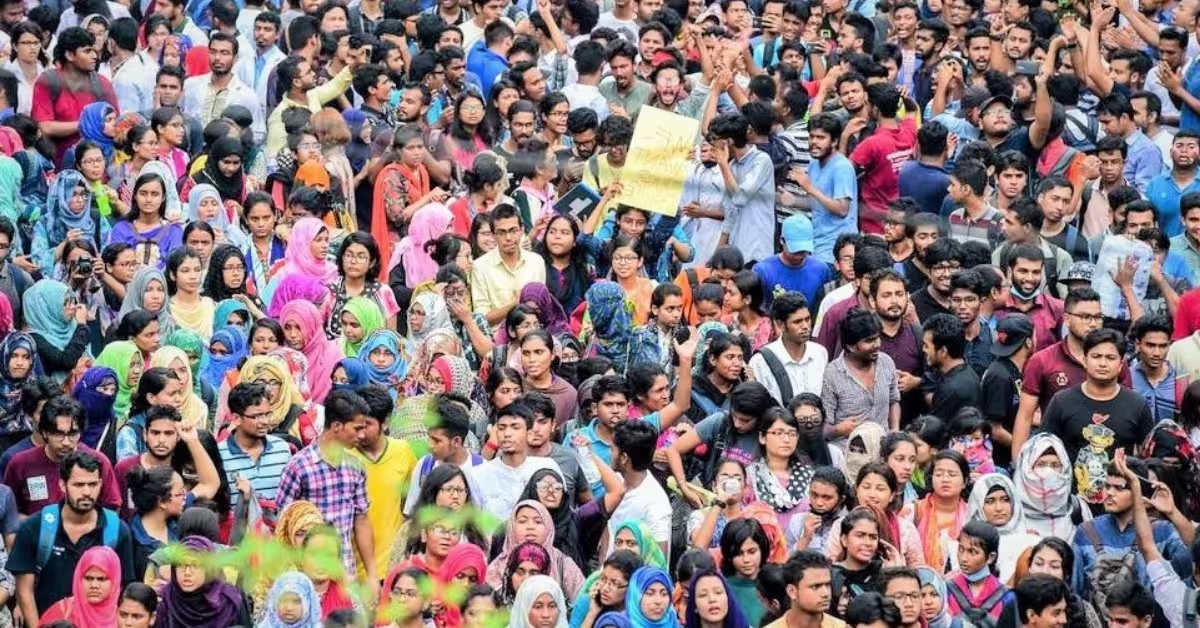
The safe road movement was a nationwide student protest for road safety that ran from 29 July to 10 August 2018 (Wikipedia summary of the 2018 protests). It began with schoolchildren and college students and quickly drew in university students, parents and ordinary commuters.
Here is how it unfolded, step by step.
On the afternoon of 29 July, students of Shaheed Ramiz Uddin Cantonment College were waiting for transport home in front of Kurmitola General Hospital. Two Jabal-e-Noor buses on the Abdullahpur to Mohammadpur route were racing each other, and one of them ran into the crowd (Dhaka Tribune). Rajib, a Class XII student, and Mim, a Class XI student, died. At least nine others were injured (The Daily Star).
The anger might have stayed local. Then the shipping minister spoke.
Shajahan Khan, who was also executive president of the Bangladesh Road Transport Workers Federation, responded to reporters that day by comparing the crash to one in India: “A road crash has claimed 33 lives in India’s Maharashtra” (The Daily Star).
He asked whether people there talked about it the way Bangladeshis did, and he was smiling as he said it. The clip spread on social media. He apologised the next day for what he called his jolly expression (Dhaka Tribune), but by then the students had a symbol of everything they were angry about: a man who led a transport union also sat in the cabinet.
Within days, students were standing at Dhaka’s intersections checking driving licences, vehicle registrations and fitness certificates themselves (Dhaka Tribune). On the seventh day, about 700 students blocked the Science Lab intersection for the whole day, and Daffodil University students checked licences on Mirpur Road (The Daily Star).
It did not stay peaceful. Some vehicles were vandalised and some were set on fire (Dhaka Tribune). On 4 August, students in Jigatola were attacked by law enforcers and Bangladesh Chhatra League activists, which brought Dhaka University, BUET and Dhaka Medical College students to Shahbagh the next day (The Daily Star).
What I keep coming back to is the image of teenagers in school uniform asking a government official’s driver for his licence, and finding he did not have one. That single scene told the country more about the transport sector than any report could.
Why Did Two Deaths on Airport Road Spark a National Uprising?
Two deaths became a national cause because the crash was not an accident in the everyday sense of the word. It came from a known, tolerated practice: buses on the same route racing each other for passengers. The court case later confirmed that the crash followed a competition between two drivers of the same company (The Financial Express).
Three things made it explode.
First, the victims were children in uniform, standing still, doing nothing wrong. Second, the minister’s response made the government look like it was protecting the transport lobby. Third, years of earlier deaths had built up silently.
According to Bangladesh Jatri Kalyan Samity, a passenger rights group that compiles crash data from news reports, 7,221 people died in road crashes in 2018 alone (Dhaka Tribune).
Initially it may seem that a protest about traffic is a narrow issue. In truth, it was about impunity. Students were asking a simple question: why does someone who kills a person with a bus so often walk away?
Did the Jabal-e-Noor drivers face justice?
Yes, and faster than most road crash cases. On 1 December 2019, a Dhaka court sentenced the two drivers, Masum Billah and Zobair Hossain Sumon, and one helper to life imprisonment, while the bus owner Jahangir Alam and another helper were acquitted (The Daily Star). The court also fined each convict Tk 50,000, and the helper Kazi Asad was tried in absentia (Prothom Alo).
That verdict mattered. Still, it was one case that had the whole country watching. Most families never get that attention.
What Were the Nine Demands, and Which Ones Were Met?
The nine demands focused on removing unfit vehicles, stopping unlicensed drivers, building pedestrian overpasses where needed, installing speed breakers at accident-prone spots, half fares for students, government accountability for student deaths, and stricter punishment for reckless driving (Dhaka Tribune).
On 2 August 2018, Home Minister Asaduzzaman Khan Kamal said the demands were being met on the prime minister’s directives (Dhaka Tribune).
Most competitor pages stop there. I wanted to check each promise against what actually happened. Here is my scorecard, based on the available data.
| Demand | What happened | My verdict |
|---|---|---|
| Harsher punishment for reckless driving | The Road Transport Act 2018 set a maximum of five years in jail for a death by reckless driving (Prothom Alo). Penalties were later reduced in several sections (Dhaka Tribune). | Partly met, then weakened |
| Remove unfit vehicles | Nearly 6 lakh (600,000) vehicles still lack valid fitness certificates, and more than 80,000 commercial vehicles have passed their economic lifespan, according to BRTA officials (Dhaka Tribune). | Not met |
| No unlicensed drivers | Many drivers still operate without proper licences, per the same report (Dhaka Tribune). BRTA has started a mandatory 60-hour driver training programme (Bonik Barta). | Not met, early steps |
| Footbridges where needed | Some were built, but reporters found broken stairs and steep steps at Mirpur-10 and Science Lab, and many people cross below instead (Dhaka Tribune). | Built, poorly used |
| Speed breakers at danger spots | I could not find reliable national data on how many were installed. I cannot confirm this either way. | Unverified |
| Half fare for students | A gazette in December 2021 fixed half bus fares for students in cities under five conditions (Dhaka Tribune). Dhaka’s bus owners later extended it to seven days a week, 6am to 12am, with a uniform or student ID (The Business Standard). | Mostly met, in cities only |
| Government accountability | The minister apologised but stayed in office (Dhaka Tribune). | Not met |
The people who led the movement agree with this grim picture. Md Enzamul Haque, one of the 2018 organisers and now general secretary of Nirapod Sorok Andolon, told the Dhaka Tribune in July 2026 that “we are still working to achieve the same nine demands” (Dhaka Tribune).
Notably, the half fare is the one demand that changed something you can feel in your pocket every day. It is also the demand that cost the transport owners the least in terms of control. I do not think that is a coincidence.
Did the Road Transport Act 2018 Make Roads Safer?
Not by the official numbers. The law looked strong on paper, but it arrived late, was enforced unevenly, and was softened under pressure.
Briefly, here is the timeline:
19 September 2018: Parliament passed the Road Transport Bill with a maximum five-year jail term for any death or serious injury caused by reckless or negligent driving (Prothom Alo). Road safety campaigners had long wanted at least 10 years (The Daily Star).
1 November 2019: The law was due to take effect, more than a year after passage, and authorities then gave a two-week grace period with no fines or jail (Prothom Alo).
Murder charges: If a court proves murder in a fatal crash, the maximum punishment under the wider legal framework is death (Banglanews24).
13 March 2024: The cabinet approved an amendment cutting penalties in several sections and making sections 84 and 98 bailable, leaving only section 105 (deaths and serious injuries) non-bailable (Dhaka Tribune). For instance, the fine for disobeying a traffic signal under section 85 dropped from Tk 10,000 to Tk 2,000 (The Business Standard).
Transparency International Bangladesh pushed back hard. Its executive director, Iftekharuzzaman, warned that “any decrease in penalties through the amendment will worsen chaos on the roads” (The Business Standard).
To be fair to the law, one of its provisions is genuinely useful: a compensation fund for victims, which I explain in the practical section below. As a matter of fact, it is the part of the 2018 Act that most families do not know exists.
How Many People Really Die on Bangladesh’s Roads?
Nobody knows the exact number, and that uncertainty is itself one of the biggest problems. Depending on whose count you trust, Bangladesh lost somewhere between about 5,500 and 31,000 people a year on its roads. This is the gap I found most competitor articles skip, so let me lay it out plainly.
| Source | Method | Deaths | Year |
|---|---|---|---|
| BRTA (government) | Official records, mainly police-based | 5,490 | 2025 (Bonik Barta) |
| Road Safety Foundation | Nine national dailies, seven online portals, electronic media and its own sources | 7,359 | 2025 (Prothom Alo) |
| Bangladesh Jatri Kalyan Samity | News reports | 9,111 | 2025 (The Daily Star) |
| Death registration (MCCoD, SVRS, Registrar General) | Hospital and vital registration estimates | 15,378 to 17,429 | 2024 (Mahmud, ICCESD 2026) |
| World Health Organization | Statistical model | 31,578 | 2021 (Dhaka Tribune) |
Why are the counts so different?
Each group is counting a different slice of reality. Police and BRTA count crashes that reach a police record. Activist groups count crashes that reach the newspapers. Neither catches the person who dies in a village hospital three days later, or the crash that gets settled quietly.
That last point is not a guess.
A study of Dhaka’s road crashes by Ishtiaque Ahmed and Bayes Ahmed found that 34 percent of accident cases were settled locally, often by paying some money, rather than being recorded (Ahmed and Ahmed, UCL Discovery).
An older Transport Research Laboratory study from 2003 suggested only about one-third of traffic deaths reached the police at all (as summarised by Mahmud, ICCESD 2026).
Is the WHO number too high?
Possibly, and this is where a fresh piece of research changes the conversation. In a paper presented at KUET in February 2026, Professor S. M. Sohel Mahmud of BUET’s Accident Research Institute argued that the WHO figure of 31,578 is inflated (Mahmud, ICCESD 2026).
His reasoning is that WHO places Bangladesh among countries without usable death registration data and estimates deaths with a regression model trained mostly on high-income countries.
Inputs like GDP, road density and speed limit laws, he says, do not behave the same way in Bangladesh as they do in Europe.
Instead, he compared three domestic death registration sources and found they broadly agree with each other. His conclusion is that Bangladesh probably had around 15,000 road deaths in 2021, at least half the WHO estimate (Mahmud, ICCESD 2026).
My honest reading: I cannot confirm with certainty which number is right, and neither can anyone else yet. Still, every serious estimate agrees on one thing. The official count misses most of the dead. Even the conservative death registration figure is roughly three times what BRTA records.
In other words, when a government plans its road safety budget around 5,490 deaths, it is planning for a much smaller problem than the one you face when you step onto the road.
Is it getting worse?
By the official count, yes. BRTA recorded 4,138 deaths in 2019, 3,918 in 2020, 5,084 in 2021, 4,636 in 2022, 5,024 in 2023, 5,480 in 2024 and 5,490 in 2025 (Dhaka Tribune). Jatri Kalyan Samity says deaths rose by 5.79 percent from 2024 to 2025 (Asia News Network). The Road Safety Foundation found deaths rose about 36 percent over five years (The Financial Express).
Part of the official rise may come from better recording, since BRTA only began publishing daily figures recently (Mahmud, ICCESD 2026). Nevertheless, no data source I found shows deaths falling since 2018.
Who Is Dying on Bangladesh’s Roads?
Mostly young, working-age people on motorcycles or on foot. The Road Safety Foundation’s 2025 report gives the clearest breakdown:
- Motorcyclists: 2,671 deaths in 3,029 motorcycle crashes, or 36.29 percent of all road deaths (The Financial Express). Motorcycles make up 71 percent of motorised vehicles in the country, according to the same report.
- Pedestrians: 1,564 deaths, or 21.25 percent of the total (The Financial Express).
- Working-age adults: 5,723 people aged 18 to 65, nearly 78 percent of all deaths (Prothom Alo).
- Children and women: 1,008 children and 962 women (bdnews24.com).
- Dhaka: The capital recorded 2,018 deaths in 2,139 crashes, and the report flags night-time crashes involving heavy vehicles as a major risk (The Financial Express).
This matches the global pattern. The WHO says road traffic crashes are the leading killer of children and young people aged 5 to 29 worldwide (WHO).
Here is what that means in plain terms. When a road death happens in Bangladesh, it most often takes a son, daughter or parent in their earning years. A family loses not only a person but often its main income. That is why I find the “accident” framing so misleading. These are predictable losses with predictable causes.
Why Did the Movement Return in 2019 and Again After That?
It returned because the conditions that killed Rajib and Mim never changed. On 19 March 2019, a Suprobhat Paribahan bus ran over Abrar Ahmed Chowdhury, a 20-year-old first-year International Relations student at Bangladesh University of Professionals, near the Bashundhara gate on Pragati Sarani (Prothom Alo).
The details were worse than the 2018 case.
The bus had already hit and injured a college student earlier that morning. Its owner later confessed to a magistrate that he had told the conductor, Yasin, who had no driving licence, to take the wheel, and the bus killed Abrar while fleeing (The Daily Star).
The same bus had faced legal action 27 times and had been running on Pragati Sarani without permission (The Daily Star).
Students from BUP, North South University, IUB, AIUB and other campuses blocked the road again, demanding stricter licensing, CCTV at crossings and a footbridge (Prothom Alo).
In late 2021, after a Notre Dame College student named Nayeem Hasan was killed, students issued an 11-point list that looked almost identical to the 2018 demands (The Business Standard). Sami Mohammed, who joined the 2018 protest, told The Business Standard that the movement “failed to bring about meaningful or lasting reforms” (The Business Standard).
Typically, each wave follows the same arc: a death, outrage, promises, a slow fade, and then another death. Breaking that cycle needs something protests alone cannot supply, which is steady enforcement long after the cameras leave.
What Changed After the 2024 Uprising?
Politically, a lot. On the roads, very little so far.
Many of the school and college students who led the 2018 movement had become university students by 2024, and they became key organisers of the July uprising that brought down the Awami League government (Dhaka Tribune).
In a strange echo of 2018, when police stopped working after the government fell in August 2024, students took over traffic duty at Dhaka’s intersections. Sabikun Nahar, an Eden Mohila College student directing traffic in Dhanmondi, told Arab News that “managing the traffic is not our job” (Arab News).
Traffic police returned to work on 12 August 2024 (Dhaka Tribune).
Her line stays with me because it captures the whole problem. Students can show what order looks like for a week. They cannot run a licensing system, inspect 600,000 unfit vehicles, or rebuild a footbridge.
More recently, the movement has also asked that 29 July be recognised as “National Safe Road Day” (The Business Standard). I could not find confirmation that this has been officially adopted. Bangladesh already observes 22 October as National Road Safety Day, which the cabinet declared in 2017 (The Daily Star).
That date honours Jahanara Kanchan, wife of actor Ilias Kanchan, who died in a road crash on 22 October 1993; he founded Nirapad Sarak Chai (We Demand Safe Roads) on 1 December that year (The Financial Express).
Yet the toll kept rising under the interim government too. Jatri Kalyan Samity said road crashes and suffering increased further despite the change in government because the underlying policies stayed the same (Asia News Network).
What Do Road Deaths Cost Bangladesh?
A lot more than most people assume, though estimates vary widely by method.
- The World Bank said in 2022 that crash-related costs in Bangladesh can be as high as 5.1 percent of GDP (World Bank).
- The Road Safety Foundation put the financial cost of 2025’s crashes at over Tk 255 billion, or Tk 25,550.85 crore (The Financial Express).
- Jatri Kalyan Samity estimates annual losses of around Tk 60,000 crore (The Daily Star).
The World Bank’s Bangladesh country director, Mercy Tembon, described the issue this way: “improving road safety is a critical economic and development priority” (World Bank).
The Bank approved $358 million that year for the first dedicated road safety project it has supported in South Asia, with pilots on two high-risk highways where it expects deaths to fall by more than 30 percent (The Business Standard).
Two years earlier, a World Bank report estimated Bangladesh would need an extra $7.8 billion over a decade to halve road deaths, and found the country’s per-capita road death rate was twice the average for high-income countries (World Bank).
Put another way, road safety is not charity spending. It protects the workforce that keeps the economy running.
Can a Country Actually Cut Road Deaths This Much?
Yes. Japan is the clearest proof, and it is the most hopeful part of this story.
Japan’s road deaths peaked at 16,765 in 1970, the years Japanese officials called the “traffic war.” By 2025 they had fallen to 2,547, the lowest since records began in 1948 (Jiji Press via Tuoi Tre).
Japan’s Ministry of Land, Infrastructure, Transport and Tourism links the turnaround to the 1970 Traffic Safety Policies Law, the first Fundamental Traffic Safety Plan in 1971, more road safety facilities such as centre strips, lighting and signals, and greater awareness of traffic rules (MLIT/NILIM).
Even Japan is not satisfied. It missed its own goal of 2,000 or fewer deaths by 2025, and Jiro Akama, chairman of the National Public Safety Commission, said: “The decline reflected active efforts to prevent accidents, but the target was not achieved” (Jiji Press via Tuoi Tre). I find that honesty instructive. A government that sets a measurable target and admits missing it is a government that takes the target seriously.
Japan is not alone. Between 2010 and 2021, ten countries including Japan, Denmark, Norway and the United Arab Emirates cut road deaths by more than half (WHO). Globally, WHO Director-General Dr Tedros Adhanom Ghebreyesus said the death toll is “heading in the right direction, downwards, but nowhere near fast enough” (WHO).
The lesson for Bangladesh is not that it should copy Japan line for line. It is that the drop came from law, infrastructure, enforcement and data working together for decades, not from one dramatic act passed after one dramatic protest.
What Is the Government Promising Now?
On 14 October 2026, Road Transport and Bridges, Railways and Shipping Minister Shaikh Rabiul Alam said the government is firmly committed to passing a comprehensive road safety law by 2027 (Dhaka Tribune).
He listed updated helmet standards, speed limit enforcement, stronger post-crash medical care, underpasses, left-side lanes on highways and better road crash data. He also admitted that progress had fallen short despite joint efforts with the World Bank and others.
The roundtable, organised by BRAC’s Road Safety Program and Road Safety Coalition Bangladesh ahead of National Road Safety Day 2026, focused on the Safe System Approach (Dhaka Tribune). That approach, which WHO also promotes, starts from the idea that people will make mistakes, so roads, speeds and vehicles should be designed so that a mistake does not kill.
Should you believe it? I would watch for three signals, because promises have been made before:
- A separate road safety law, not another amendment to the transport act. Road safety groups have demanded this for years (Prothom Alo editorial).
- A real drop in unfit vehicles. The figure of nearly 600,000 vehicles without fitness certificates is the easiest number to track year on year.
- One trusted death count. If the government starts using death registration data alongside police data, that would show it wants to see the real scale.
What Can You Do to Stay Safer on Bangladesh’s Roads?
You cannot fix the transport sector by yourself, but you can cut your own risk and know your rights if the worst happens. These are practical steps based on the patterns in the data above.
If you ride a motorcycle
Motorcyclists are the single largest group of road deaths in Bangladesh (The Financial Express). Wear a full helmet that is properly fastened, every trip, including short ones. Make sure your pillion passenger wears one too. Avoid riding at night on roads where heavy vehicles dominate, which the Road Safety Foundation flags as a major risk in Dhaka.
If you walk
Pedestrians made up over a fifth of road deaths in 2025. Use a footbridge or underpass where one is safe to use. Where there is none, cross at a junction where vehicles slow down, make eye contact with drivers, and never step out from behind a stopped bus. Wear something light-coloured if you walk on highways after dark.
If you take buses
Avoid boarding or getting off a moving bus, which helpers often encourage to save time. If two buses from the same company are racing, as on Airport Road in 2018, step back from the road edge. If you are a student, carry your ID so you can claim the half fare without an argument.
If you see a crash
Call 999, Bangladesh’s national emergency number. It is toll free and works even with zero balance (The Daily Star). Be aware that ambulances arranged through 999 are not free (Prothom Alo). Under the Road Transport Act, drivers and their staff must take crash victims to hospital and inform police or the fire service (Banglanews24).
If someone in your family is killed or injured
This is the part almost nobody knows about. Under the Road Transport Act rules announced in December 2022, the family of a person killed by reckless or negligent driving is entitled to at least Tk 5 lakh in compensation.
Someone who loses a limb or suffers life-changing injuries can get Tk 3 lakh, and someone expected to recover can get Tk 1 lakh (The Daily Star).
The deadline is tight. You must apply on the prescribed form to the chairman of the trustee board, who is the BRTA chairman, within 30 days of the crash. A probe committee is formed within 10 days, it reports within 30 days, and payment follows within 30 days of that report (Prothom Alo).
Activists have criticised the 30-day window as unrealistic for grieving families (The Daily Star), so if this ever happens to someone you know, help them start the paperwork quickly. Keep a copy of the police case or general diary entry, the hospital records and the death certificate.
My Take: What the Safe Road Movement Got Right
Looking back over eight years of numbers, it is easy to call the movement a failure. Deaths have gone up. The law was weakened. The same nine demands are still on the table.
Still, I do not think that is the full truth.
The students of 2018 did three things nobody had managed before. They made road deaths a national political issue rather than a private tragedy. They showed, with their own hands at Farmgate and Science Lab, that licence checks and lane discipline were possible.
And they forced a law into existence that, for all its flaws, gives victims’ families a legal claim to compensation and keeps section 105 non-bailable.
What they could not do was stay on the street forever. Protests create pressure, but pressure fades. Japan’s decline took more than half a century of plans, budgets and boring enforcement. That kind of patience is what Bangladesh has never sustained.
If I have one wish for 2027, it is this: that the promised road safety law comes with a single honest death count and a public, year-by-year target, like Japan’s. Then, even when the government misses, we will at least know by how much. Rajib and Mim deserve that much accounting.
Frequently Asked Questions
When did the safe road movement start in Bangladesh?
It started on 29 July 2018, the day a Jabal-e-Noor Paribahan bus killed two students of Shaheed Ramiz Uddin Cantonment College on Dhaka’s Airport Road. The main protests ran until 10 August 2018 (Wikipedia summary).
Who were the students killed in the 2018 crash?
Dia Khanam Mim, 17, and Abdul Karim Rajib, 18, both students of Shaheed Ramiz Uddin Cantonment College (The Daily Star).
What is the punishment for killing someone by reckless driving in Bangladesh?
Under the Road Transport Act 2018, the maximum is five years in jail for a death or serious injury caused by reckless or negligent driving (Prothom Alo). If murder is proved, the maximum punishment is death (Banglanews24). In the Jabal-e-Noor case, the court handed down life sentences (The Daily Star).
How many people died in road crashes in Bangladesh in 2025?
It depends on the source. BRTA recorded 5,490 (Bonik Barta), the Road Safety Foundation 7,359 (Prothom Alo), and Jatri Kalyan Samity 9,111 (The Daily Star). Death registration estimates for 2024 were higher still, at 15,000 to 17,000 (Mahmud, ICCESD 2026).
Why is the WHO estimate for Bangladesh so much higher?
WHO estimated 31,578 deaths for 2021 using a statistical model, because it classes Bangladesh as lacking usable death registration data. A 2026 paper by BUET’s Professor S. M. Sohel Mahmud argues this model overstates the toll and puts the real figure closer to 15,000 (Mahmud, ICCESD 2026). Both estimates are far above the official police-based count.
Can a road crash victim’s family get compensation in Bangladesh?
Yes. The family of a person killed can claim at least Tk 5 lakh (The Daily Star), but they must apply to the BRTA-led trustee board within 30 days of the crash (Prothom Alo).
Is there a National Road Safety Day in Bangladesh?
Yes. 22 October is National Road Safety Day, declared by the cabinet in 2017 in memory of Jahanara Kanchan (The Daily Star).







