

Last updated on October 22nd, 2026 at 10:00 am
A Man for All Seasons (1966) is Fred Zinnemann’s Oscar-winning film of Robert Bolt’s play about Sir Thomas More, the Lord Chancellor who would not swear that Henry VIII was head of the Church in England and was beheaded on Tower Hill on 6 July 1535. If you only want the short answer: yes, it is still one of the best films ever made about conscience, law and power, and Paul Scofield’s performance has not aged a day. I have watched it at least four times, and it still gets me at the scaffold.
But I also read the history behind it, and an honest A Man for All Seasons review has to say this as well: the film gives you a cleaner saint than the real Thomas More.
Below you will find the full plot with the ending explained, what the film gets right and wrong about the Tudor court, the performances, the best quotes, and why More’s silence still has something to teach you in 2026.
Table of Contents
A Man for All Seasons Review Overview
What it is: A 1966 British historical drama directed and produced by Fred Zinnemann, adapted by Robert Bolt from his own 1960 play, released by Columbia Pictures on 12 December 1966. Running time: 120 minutes.
The story in one line: Thomas More refuses to approve Henry VIII’s annulment or swear the oath that follows it, stays legally silent, and is convicted only after Richard Rich lies under oath.
Awards: Six Academy Awards, including Best Picture, Best Director and Best Actor for Paul Scofield, from eight nominations.
Box office: About $28.35 million in the US alone on a budget kept under $2 million, the fifth highest-grossing film of 1966.
Historical accuracy: True to More’s courage at the end, silent about his earlier role in hunting heretics. Six Protestants were burned during his chancellorship, and the film never mentions it.
My rating: 4.5/5.
Watch it if you love courtroom drama, great dialogue, Tudor history or films that make you argue with yourself afterwards. Skip it if you need fast pacing or action.
Who should watch A Man for All Seasons?
You will probably love this film if you are a law student, a history reader, a teacher looking for a classroom film on ethics, or anyone who enjoys cinema built on words rather than spectacle. It is also a strong pick for people of faith, though you do not need any religion to feel its pull; the fight is between one man’s sense of self and a state that wants his signature.
If you came to the Tudors through Wolf Hall or The Tudors, watch it as the other side of the argument. If you get restless when characters talk for ten minutes in a room, this one will test you, because the drama is almost all in the dialogue.
Quick Verdict
A noble, beautifully written film about a man who would rather lose his head than his integrity. Recommended for lovers of courtroom drama and historical cinema, with one warning: treat it as a portrait of conscience, not a biography.
Rating: ★★★★½ (4.5/5)
Should You Watch It?
| Pros | Cons |
|---|---|
| Paul Scofield’s Oscar-winning performance is restrained and unforgettable | The pacing is slow and the staging can feel theatrical |
| Robert Bolt’s dialogue is sharp, witty and endlessly quotable | It turns More into a near-flawless saint and hides his persecution of Protestants |
| The trial and the Tower interrogation are among the best legal scenes ever filmed | Henry VIII appears in only a few scenes |
| Strong supporting cast: Wendy Hiller, Robert Shaw, Leo McKern, a young John Hurt | Viewers who don’t know the history may struggle with who is who |
| Ted Moore’s colour photography of the Thames and Tudor interiors | Female characters, especially Margaret, have little to do beyond reacting |
What is it about?
Between 1529 and 1535, Sir Thomas More, scholar, lawyer and Lord Chancellor of England, refuses to support Henry VIII’s attempt to annul his marriage to Catherine of Aragon and break with Rome. He resigns, keeps silent, is imprisoned in the Tower of London, and is finally condemned on perjured evidence. The film follows the slow closing of the trap around a man who only wanted to keep his conscience to himself.
Quick facts
| Detail | Information |
|---|---|
| Director and producer | Fred Zinnemann |
| Screenplay | Robert Bolt, from his 1960 play |
| Main cast | Paul Scofield, Wendy Hiller, Leo McKern, Robert Shaw, Orson Welles, Susannah York, Nigel Davenport, John Hurt, Corin Redgrave |
| Cinematography | Ted Moore |
| Music | Georges Delerue |
| Release | 12 December 1966 (USA); March 1967 (UK) |
| Runtime | 120 minutes |
| Budget / US gross | Under $2 million / about $28.35 million |
| Rotten Tomatoes | 89% from 82 reviews; Metacritic 72 |
Introduction
A Man for All Seasons is a British biographical drama directed by Fred Zinnemann and based on the play of the same name by Robert Bolt. The film portrays the last years of Sir Thomas More, a 16th-century English statesman, lawyer and theologian who refused to support King Henry VIII’s attempt to end his marriage to Catherine of Aragon, his marriage to his second wife Anne Boleyn, and his break from the Roman Catholic Church.
Even at the cost of his own life, Sir Thomas More chose to follow his conscience and hold to his religious beliefs in the face of political pressure, and that choice has made him a lasting symbol of integrity and moral courage.
A Man for All Seasons is a film that made me want to dig into the history and spend real time writing about it, after I had watched it at least four times. Who knows how many times I will end up watching it in the future! It is one of the films where I have to wipe away rolling tears every time.
The work is so genuinely and beautifully done that I can hardly think of it as a historical event simply acted out by a group of actors.
Moreover, it is one of the 101 best films of 100 years on my list. The title itself is older than the play. Bolt borrowed it from Robert Whittington, a contemporary who described More in 1520 as a man of angelic wit who could be merry or grave as the moment required. Today the phrase is used for anyone who is principled and steady in every situation. The film was a critical and commercial success and won six Academy Awards, including Best Picture, and it is still admired for its intelligent screenplay, its performances and its photography.
Starring Paul Scofield (Sir Thomas More), Wendy Hiller (Alice, More’s wife), Susannah York (Margaret, his daughter), Robert Shaw (King Henry VIII), Leo McKern (Thomas Cromwell), Orson Welles (Cardinal Wolsey), Nigel Davenport (the Duke of Norfolk), John Hurt (Richard Rich), Corin Redgrave (William Roper), Colin Blakely (Matthew, the steward), Cyril Luckham (Archbishop Cranmer), Jack Gwillim (the Chief Justice) and Vanessa Redgrave in an unbilled cameo as Anne Boleyn, A Man for All Seasons portrays the dilemma of an upright man caught between his king and his God.
Background: Why Did Henry VIII Want to End His First Marriage?
Henry wanted out of his marriage because, after almost two decades, Catherine of Aragon had not given him a surviving son, and he had convinced himself that the marriage was cursed. That is the engine of the whole film, so it helps to know how it started.
The role of Sir Thomas More is played as flawlessly as that of Lady Alice. Sir Thomas’s witty, wise remarks, his statesmanship, his manners, his humanism and his loyalty to his conscience are hard to imitate.
A Man for All Seasons is a film built on the real lives of Sir Thomas More and King Henry VIII of the Tudor dynasty. Thomas More was an English lawyer, politician and social philosopher, best known abroad for Utopia, who served Henry VIII as Lord Chancellor of England from October 1529 to May 1532.
Sir Thomas More was a fierce opponent of the Protestant Reformation and wrote against the theology of Martin Luther and William Tyndale. He disapproved of King Henry’s separation of the Church of England from Rome and of the King’s claim to supremacy over the Church in England.
Because of his strong faith and private conscience, he held that both the break with Rome and the King’s marriage to Anne Boleyn, made while Catherine was still his lawful wife in the eyes of the Church, were unlawful.
Henry VIII is remembered above all for his six marriages: two annulled and ended in “divorce,” two wives beheaded, one who died, and one who survived him.
The conflict between Henry and More began when the King tried to win More’s support for ending his marriage to Catherine of Aragon, the widow of his elder brother. Catherine was born in Alcalá de Henares in Spain, the youngest daughter of Ferdinand and Isabella, and was widowed at 16.
Arthur, the elder son of Henry VII, married Catherine of Aragon in November 1501. Around Easter 1502, a few months after the wedding, the couple fell seriously ill, and on 2 April 1502 Prince Arthur died. His younger brother Henry became heir to the throne. In June 1503, a marriage treaty was arranged between Prince Henry, who was about to turn 12, and the 17-year-old Catherine.
After King Henry VII died in April 1509, his 17-year-old son took the throne. He was England’s most eligible bachelor, full of hopes and ambitions, and he needed a wife who could give the Tudors a healthy heir. He chose the woman already waiting at court, his brother’s widow. They married on 11 June 1509, when she was 23 and he was a few weeks short of 18.
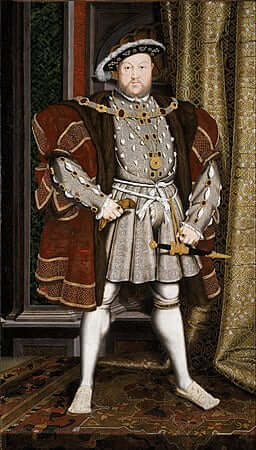
Portrait of King Henry VIII by Google Art Project
The pregnancies that followed were heartbreaking. On 31 January 1510 Catherine gave birth to a stillborn daughter. On 1 January 1511 she gave birth to a son, Henry, Duke of Cornwall, who lived just 52 days. A son born in September 1513 was stillborn or died soon after birth, and another short-lived son followed. Her only surviving child, Princess Mary, was born in February 1516. Her last pregnancy ended on 9 November 1518 with a stillborn daughter.
Accordingly, out of his desperation for a son, Henry did father one outside marriage: Henry FitzRoy, born in 1519 to Elizabeth “Bessie” Blount, one of Catherine’s ladies-in-waiting. Henry also had an affair with Mary Boleyn, the elder sister of his future second queen. By the mid-1520s he was looking for a way out of his marriage to Catherine, the woman who had loved him, supported him, fought for him and, in many ways, taught him how to be a king.
Around 1526 his eyes fell on another lady of the court, Anne Boleyn. Infatuated and desperate for a son, Henry decided that God was punishing him for marrying his brother’s wife, even though Catherine always insisted that her five-month marriage to Arthur had never been consummated.
After nearly 20 years of marriage, Henry argued that the union was against God’s law, citing Leviticus 20:21: “And if a man shall take his brother’s wife, it is an unclean thing: he hath uncovered his brother’s nakedness; they shall be childless.”
Therefore, King Henry asked the Pope to annul the marriage. The trouble was that an earlier pope, Julius II, had already issued a dispensation allowing Henry to marry Catherine in the first place. Pope Clement VII was also under heavy pressure from Emperor Charles V, Catherine’s nephew, whose troops had sacked Rome in 1527. The Pope stalled, and Henry’s frustration grew.
A Man for All Seasons opens at exactly this point: Henry has left the “King’s Great Matter” to his chief minister, Cardinal Wolsey, who cannot deliver the annulment and cannot win the support of the one councillor who keeps saying no, Sir Thomas More.
A Man for All Seasons Plot Summary
Part 1: A midnight summons to Hampton Court
The film opens with a messenger racing along the Thames with a letter for Sir Thomas More at his house in Chelsea. Cardinal Wolsey has summoned him to Hampton Court in the middle of the night. In a cramped, candle-lit room, Wolsey (Orson Welles) scolds More for being the only member of the council to oppose his efforts to get an annulment from Rome.
Wolsey wants to bring “pressure” to bear on Church property in England to push the Pope; More refuses to go along. The Cardinal mocks More’s “moral squint,” a phrase the BFI singles out, and warns him that without a male heir England could slide back into civil war. More, a firm believer in papal authority, will not budge.
Unseen by More, Wolsey’s ambitious aide Thomas Cromwell hears the conversation. More leaves the palace and is rowed home, reaching Chelsea by dawn.
Part 2: Rich, Roper and a silver cup
Waiting at More’s house is Richard Rich (John Hurt), a young man hungry for a place at court. More offers him a job as a teacher instead and tells him a man should go where he won’t be tempted. Rich wants fame, not a classroom. More gives him a silver cup that a litigant had sent him as a gift, after realising it was meant as a bribe; Rich takes it, and the cup will matter later.
Inside, More finds his daughter Margaret (Susannah York) with William Roper (Corin Redgrave), a clever young lawyer who wants to marry her. More refuses his blessing while Roper remains a Lutheran.
Part 3: Lord Chancellor More and the King’s visit
Wolsey fails to get the annulment, falls from power and dies in disgrace on his way south. More is made Lord Chancellor in his place. Soon after, King Henry (Robert Shaw) arrives at Chelsea by royal barge in an “unannounced” visit, jumping into the mud and laughing at it. He is charming, then flattering, then furious.
He praises More’s honesty because it makes him rare; he wants More’s public support precisely because people trust him. More tells him plainly that he cannot help on the marriage and that it is a matter for the Pope. Henry storms back to his barge, disappointed.
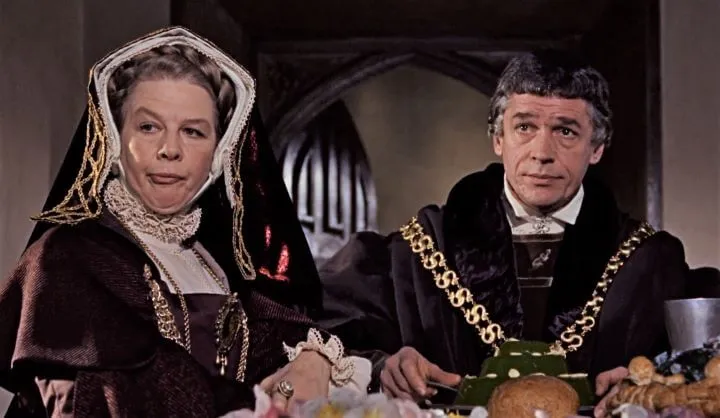
Wendy Hiller as Lady Alice and Paul Scofield as Sir Thomas More in A Man for All Seasons.
Thomas Cromwell (Leo McKern), now rising fast as the King’s chief fixer, recruits Rich with the promise of an office if he will help bring More down. Roper, who has now swung back to the Catholic side, attacks the King openly, and More warns him to guard his tongue. When Rich comes begging for a post one last time and More again refuses, Rich tells him that his steward Matthew is spying for Cromwell. More shrugs: of course he is. Humiliated, Rich walks out of the friendship. In the famous scene that follows, Margaret, Alice and Roper urge More to arrest Rich because he is a bad man. More refuses, saying there is no law against that, and then gives his speech about the Devil and the law: if you cut down every law to get at the Devil, where will you hide when he turns on you?
Part 4: The Supremacy and the resignation
The King orders the bishops and Parliament to acknowledge him as Supreme Head of the Church of England, and they give way, renouncing their allegiance to the Pope. Rather than serve under the new order, Sir Thomas quietly resigns as Lord Chancellor.
His wife Alice (Wendy Hiller) is furious; she sees a wise man throwing away his position, his income and his family’s security. The household grows poor, and More warns his family that if the authorities find him silent, they will have no lawful cause against him.
Henry marries Anne Boleyn, and Cromwell lets the Duke of Norfolk know that More’s troubles would end if he attended the wedding. More stays away.
Part 5: Cromwell’s interrogation and the end of a friendship
After the wedding, More is summoned to Hampton Court and questioned by Cromwell, with Rich taking notes. Cromwell digs for anything that might stick, including the silver cup, which he tries to present as a bribe (More shows that he gave it away as soon as he understood what it was), and contacts with the Holy Maid of Kent, a nun later executed for prophesying against the King.
More answers carefully and gives nothing away. An angry Cromwell sends him off with a clear threat: the King wants either More’s blessing on the marriage or More destroyed.
Word has spread. At the river, no boatman will dare ferry the King’s enemy, and More has to walk home. On the way he meets his old friend the Duke of Norfolk (Nigel Davenport), who begs him to give in, as everyone else has.
More understands that their friendship has become dangerous for Norfolk, so he deliberately picks a quarrel and insults him, asking whether there is any part of Norfolk that is simply Norfolk and not a servant of his appetites. Norfolk lashes out and leaves. More has protected his friend by losing him.
Part 6: The oath and the Tower
When More finally reaches Chelsea on a stormy night, Margaret has news from Parliament: a new Act requires subjects to swear an oath, and refusing it will mean a charge of treason. More’s first instinct is lawyerly; he might be able to swear, depending on the wording.
But the oath names the King as head of the Church, legitimises Anne Boleyn’s children as heirs and leaves no room for a private reservation. More refuses to take it and is locked in the Tower of London, where at first he is allowed his books.
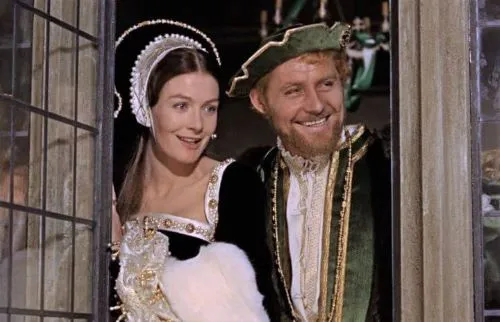
With his mistress Anne Boleyn, King Henry VIII in A Man for All Seasons.
In one quiet scene, hearing a dog barking, More climbs onto a stool and gazes through the small barred window at the riverbank, where children are playing and fishing on a beautiful morning. He keeps looking for a long time, a man staring at the life he is about to lose, and then sleeps.
Part 7: The inquiry in the Tower
More is brought before a commission made up of the Duke of Norfolk, Archbishop Cranmer and Cromwell. The Act of Succession, passed in 1534, made Princess Elizabeth, Anne Boleyn’s daughter, heir to the throne and effectively declared Mary, Catherine’s daughter, illegitimate.
More’s position is precise. He will not swear the oath, but he will not say why. He accepts that Anne is queen and that Parliament may name the heir, but he will not swear to the whole Act. The commissioners push: surely if he refuses, he must have reasons, and they must be against the King.
More answers like the lawyer he is. They may suppose he has objections, but supposing is not knowing, and the law requires a fact, not an assumption. If they could prove both that he had objections and that he had spoken them, the law would let them cut his head off. Until then, they cannot lawfully touch him.
Norfolk asks why he cannot simply come along with the rest of them “for fellowship.” More answers that when they die, Norfolk may go to heaven for following his conscience while More goes to hell for betraying his, and asks whether Norfolk would then come with him for fellowship. When Cranmer asks whether he is calling the oath-takers damned, More replies:
“I have no window to look into another man’s conscience. I condemn no one.”
Cranmer tries one last argument: More’s doubt about the oath is uncertain, but his duty to obey the King is certain, so he should weigh the doubt against the certainty and sign. More answers with his most famous image:
“Some men think the Earth is round, others think it flat; it is a matter capable of question. But if it is flat, will the King’s command make it round?”
Cromwell finally loses patience and threatens him. More tells him he threatens “like a dockside bully.” When Cromwell asks how he should threaten, More says: like a minister of state, with justice. Cromwell answers that justice is exactly what he is being threatened with, and More replies that in that case he is not threatened at all.
As punishment for his stubbornness, Cromwell takes away More’s books. Rich is the one who comes to collect them, and the two former friends have one last conversation. It seems harmless. It is not.
Part 8: The family visit
Margaret, Alice and Roper are allowed to visit him, hoping to persuade him to swear. Margaret tries clever arguments: say the words, and think otherwise in your heart. More tells her that an oath is a man holding his own self in his hands like water; open the fingers, and he will never find himself again. He tells them to leave the country, because England is no longer safe for his family. Alice, who has raged at him for most of the film, finally tells him she does not understand why he must do this, but that she knows he is the best man she ever met or is likely to. It is one of the most moving moments in British cinema, and Wendy Hiller plays it without a single false note.
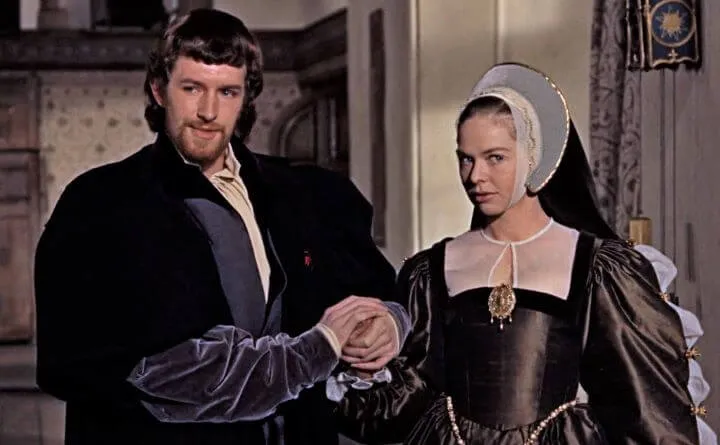
Susannah York as Margaret and Corin Redgrave as William Roper.
Part 9: The trial and Richard Rich’s perjury
After a brief prayer, More enters the court in Westminster Hall. He is asked whether he will abandon his “obstinate opinion” and receive the King’s mercy. Cromwell reads the charge: that he did wilfully and maliciously deny the King’s title as Supreme Head of the Church in England.
More’s defence rests on one old legal principle: silence gives consent. If his silence means anything in law, it means he agreed with the King, not that he denied him. Cromwell argues the opposite, that this silence was really “most eloquent denial.” The court cannot convict on silence alone, so Cromwell calls his witness.
Richard Rich, now richly dressed, testifies that when he came to collect the books in the Tower, More told him that Parliament could make a king but could not make a king head of the Church.
It is a lie. More offers to swear any oath that he never said it, and points out that if he were going to confide such a dangerous opinion, he would hardly choose “such a man as that.” As Rich leaves the witness box, More notices the chain of office around his neck and learns that Rich has been made Attorney General for Wales as his reward. More’s reply is the line everyone remembers: it profits a man nothing to give his soul for the whole world, “but for Wales?”
Part 10: The speech, the sentence and the scaffold
Under Cromwell’s direction, the jury finds More guilty without even leaving the courtroom. As the judges begin to pronounce sentence, More interrupts and reminds them that a prisoner must first be asked whether he has anything to say.
Asked at last, he lets go of his silence. Since the court has decided to condemn him, he now speaks his mind. The indictment, he says, is grounded on an Act of Parliament “directly repugnant to the law of God and His Holy Church.” No temporal ruler can take the supreme government of the Church, which Christ gave to Saint Peter and the bishops of Rome.
The Church’s freedom is promised in Magna Carta and in the King’s own coronation oath. And then he says what everyone in the hall knows: it is not for the Supremacy that they have sought his blood, but because he would not bend to the marriage.
The court sentences him to death for high treason. The scene cuts to Tower Hill on 6 July 1535. More climbs the scaffold, forgives and tips the executioner, and tells him not to be afraid of his office, because he is sending More to God. To the crowd, he keeps his last speech short, as the King has commanded:
“I die His Majesty’s good servant, but God’s first.”
He kneels at the block, and the axe falls off screen.
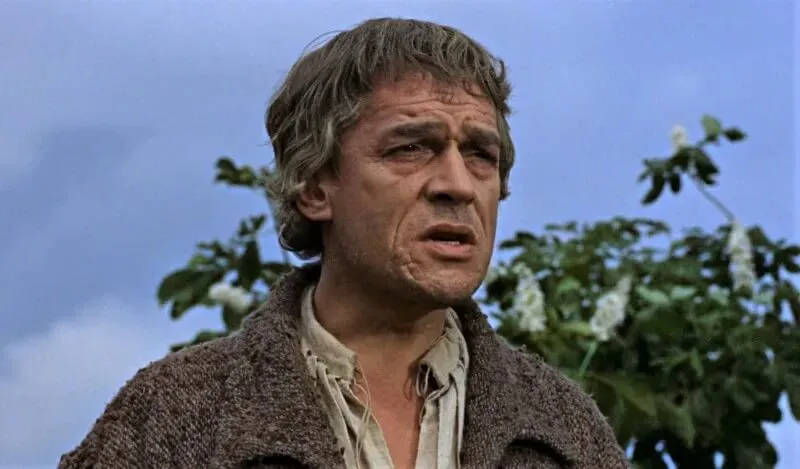
Sir Thomas More’s execution on Tower Hill in 1535, as shown in the film.
The epilogue
A narrator closes the film by listing what happened to the men who brought More down: Cromwell was beheaded for treason five years later, Archbishop Cranmer was burned at the stake, and Norfolk escaped execution only because the King died the night before. Richard Rich alone prospered. He became Chancellor of England and died in his bed.
What the film does not show: More’s head was parboiled and placed on a spike on London Bridge, where it stayed for about a month. His daughter Margaret bribed the man responsible for removing it, took it home, and preserved it.
When she died in 1544 she was buried with it, and it now lies in the Roper family vault at St Dunstan’s Church in Canterbury.
A Man for All Seasons Ending Explained: Why Did More Stay Silent?
More stayed silent because silence was his only legal shield. Under the maxim the film quotes, qui tacet consentire videtur (he who is silent is taken to consent), a man who said nothing could not be convicted of denying the King’s title. More was not hiding out of cowardice; he was using the law exactly as he believed it should be used, as a wall that protects even the people the powerful dislike.
That is why the ending lands so hard.
The law did protect him, right up until the state decided to break it. Cromwell could not convict More on his words, so he bought a witness. The final irony in the epilogue completes the point: the honest man is beheaded, his enemies are destroyed one by one by the same king, and the perjurer dies comfortably of old age.
Bolt is not saying virtue is rewarded.
He is saying it is worth keeping anyway.
Notice also what changes in the courtroom. Once the verdict is in, there is nothing left to protect by silence, so More finally speaks. The man who spent the whole film refusing to explain himself gives his reasons only when they can no longer save or harm anyone but himself.
Analysis: Is A Man for All Seasons Historically Accurate?
Partly. The broad events are right: More opposed the annulment, resigned in 1532, refused the oath, was imprisoned in the Tower, was convicted largely on Richard Rich’s testimony and was beheaded on 6 July 1535. His wit, his love for Margaret and his calm on the scaffold all come from early sources, especially the memoir written by his son-in-law William Roper, which the Tablet calls the ultimate source for Bolt’s play and film.
What the film leaves out is the More who, as a Crown agent and then as Lord Chancellor, actively pursued Protestant “heretics.” Six were burned during his chancellorship: Thomas Hitton, Thomas Bilney, Richard Bayfield, John Tewkesbery, Thomas Dusgate and James Bainham. More believed unrepentant heretics deserved to die, and his biographer Richard Marius was blunt about Bolt’s version. He accused the film of turning More into a “Catholic Abraham Lincoln”, an icon of purity that hides his furious polemics against Protestants.
There is also a deeper problem. Bolt, who was not a Catholic, wrote a More who defends something close to the modern right of individual conscience. Historians point out that Bolt wrote in the aftermath of McCarthyism, and Fordham’s Medieval Hollywood project notes that the film recast More as a liberal icon at the time of the Civil Rights Movement and protests against the Vietnam War.
The real More’s conscience was not “my private truth against the world.” It was his belief that the Church’s authority stood above the King’s. The Acton Institute makes this point well, arguing that More’s conscience testified to the Church’s authority over the King’s, which is close to the opposite of the modern idea.
Hilary Mantel’s Wolf Hall (2009) and the BBC series of 2015 swung the pendulum the other way, presenting More as a cold persecutor and Cromwell as the humane one. Many critics, Catholic and secular, thought that was just as one-sided. The fairest summary I found comes from the Tablet: More was a man of his times, not of ours.
A few smaller changes are worth knowing:
- Bolt cut the play’s narrator, the Common Man, and split him into the boatman, the steward, the jailer, the jury foreman and the executioner. The subplot with the Spanish ambassador Chapuys was dropped.
- The Chief Justice in the trial was invented for the film. Historically, Norfolk presided.
- The film dates Henry’s death in the epilogue as the night before Norfolk’s planned execution, which matches the record; the cause of Henry’s death is still debated.
Conscience or Egotism?
King Henry made it treason to question either his supremacy over the Church or the legitimacy of his new marriage. The punishment was death. Bishops, courtiers and friends, it made no difference; anyone who resisted him was treated as an enemy of his reforms and an enemy of God.
On the other hand, what King Henry did, breaking with Rome to escape his marriage to Catherine of Aragon and make Anne Boleyn his queen, went against everything Sir Thomas More believed in conscience. The King’s own needs pushed England toward the evangelical reform movement, because supporting it made him the supreme judge of spiritual questions in his kingdom.
A Man for All Seasons shows how much one honest and respected voice matters, even when it stands against a king. More’s loyalty to the Pope’s authority stayed with him until his final moment.
The film shows a man who meant no harm to anyone, a just lawyer, a true subject of the King and a sincere humanist who put God first, dying because of what he believed to be true. No argument, no pressure and no love of life could change his course.
Was it pride? The question is fair, and the film is braver than it looks because it lets other characters ask it. Norfolk thinks More is being stubborn; Alice thinks he is being selfish toward his family. Writers still argue the point; The Lamp magazine asks whether it would have been more prudent, even more virtuous, to take the oath and live to defend the cause. My answer: the film convinces me it was conscience, not ego, because More tries every legal escape first. He resigns, he keeps quiet, he looks for wording he can accept. He does not seek martyrdom.
He simply refuses to lie when every other door has been shut.
One more correction to an old line in this review. Under Catholic practice, the official Bible was in Latin, and More fought hard against William Tyndale’s English translation. A few years after More’s death, Henry authorised an English Bible for every parish church, the Great Bible of 1539. The film does not show this, but it is part of what More’s defeat made possible.
How Good Are the Performances?
Paul Scofield is the reason the film works. He had already played More on stage in the West End and on Broadway, winning a Tony for the Broadway run, and the producers nearly replaced him with a bigger name; Richard Burton turned the part down and Laurence Olivier was considered before Zinnemann insisted on Scofield.
Thank goodness he did. Scofield plays More with almost no visible effort: a dry smile, a soft voice, sudden flashes of steel. Watch his face when Rich walks past him with the chain of Wales. He won the Oscar for Best Actor.
Wendy Hiller as Alice earned an Oscar nomination for Best Supporting Actress, mostly, I think, for the final prison visit. Alice is loud, practical and furious, and Hiller makes you feel that her anger is love with nowhere to go.
Robert Shaw is only on screen for a short while as Henry VIII, but he makes every minute count. His Henry is boyish, warm, vain and frightening within the same scene. He earned an Oscar nomination for Best Supporting Actor and won Best Supporting Actor from the National Board of Review.
Leo McKern gives Cromwell a heavy, patient menace, a bureaucrat who enjoys his work. McKern had played the Common Man on the London stage, and he and Scofield are the only actors to appear in both the stage and screen versions.
Orson Welles gets one great scene as Wolsey and eats it alive. John Hurt, in his first major film role (reportedly paid £3,000), shows Rich’s slide from nervous ambition to cold perjury so well that you almost pity him. Nigel Davenport makes Norfolk a decent man who simply isn’t brave enough, which is more painful than villainy. Vanessa Redgrave appears briefly as Anne Boleyn and, according to the production history, refused payment and asked not to be billed.
The standout chemistry is between Scofield and Davenport. Their quarrel on the riverbank, when More deliberately wounds his friend to save him, is the emotional center of the film for me.
Themes and Messages: What Does the Film Say About Conscience and Power?
The film’s central message is that a person’s integrity is the one thing the state cannot take unless the person hands it over. Everything else (job, money, home, freedom, even life) can be removed. The self, in Bolt’s telling, can only be given away.
Conscience versus survival. Almost everyone around More survives by bending. The bishops sign, Parliament votes, Norfolk goes along “for fellowship.” The film never mocks them, which is why More’s refusal feels so lonely.
The law as shelter. More’s speech to Roper about cutting down the laws to get at the Devil is the film’s best argument and the one that matters most today. More defends due process even for a man he knows to be bad, because the same law is all that protects the innocent. The cruel joke is that he is destroyed by people who do exactly what he warned against: they bend the law to get at the man they want.
Silence as resistance. More fights entirely with what he does not say. In an age of instant opinions, there is something startling about a hero whose weapon is refusing to explain himself.
Ambition and the price of a soul. Richard Rich is the film’s mirror of us. He is not evil at the start, just eager and a little weak. Every step he takes is small. By the end, he has sold a man’s life for a government post in Wales.
Friendship and family. More’s love for Margaret, his patience with Alice, and his deliberate break with Norfolk show the human cost of conscience. He does not suffer alone; his family suffers with him.
Symbolism worth noticing
- Water and the river. The Thames carries More to power at the start and refuses to carry him home after he falls; the boatmen’s refusal shows his isolation better than any speech. His image of the oath as water held in the hands ties it together: once spilled, the self cannot be gathered again.
- The silver cup. A small bribe, passed from More to Rich, becomes the first link in the chain of corruption. Rich accepts gifts; More gives them away.
- The chain of office. Rich’s chain as Attorney General for Wales is the visible price of More’s head.
- Weather and seasons. The film moves from bright summer at Chelsea to a stormy night when the oath is announced, then to the cold stone of the Tower. The “seasons” of the title become literal.
- The window in the Tower. More watching the children by the river is the film’s quietest symbol: the ordinary life that his choice costs him.
King Ruled While Lust Rules the King: What Happened After More’s Death?
After More’s death, Henry’s court turned on itself, and almost everyone who helped destroy More was destroyed in turn. Together with Master Secretary Thomas Cromwell, the Duke of Norfolk and Queen Anne Boleyn, the King had made an innocent great man a victim of the cruelty of politics and religion. Their own stories ended no better.
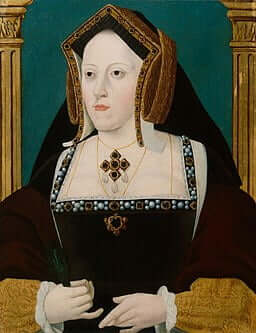
Catherine of Aragon, the first wife of King Henry VIII, whose marriage was annulled. Photo: Wikipedia.
The break with Rome came at a very high price. Between 1536 and 1540, England’s monasteries and their great estates passed into the King’s hands, making him the country’s biggest new landlord. One by one the religious houses were closed, stripped and their lands sold off.
Anne Boleyn was the most famous royal mistress in English history. By 1529 Henry had been in love with her for about three years. She promised to give him what Catherine had failed to give him in two decades, a son, but only as his wife.
Catherine refused to step aside as queen, and Henry’s attempts to end the marriage through the courts stalled because the case kept being referred back to the Pope, who was sympathetic to her. In the end Henry’s own Archbishop, Thomas Cranmer, declared the first marriage void in May 1533. Anne gave birth to a daughter, the future Elizabeth I, on 7 September 1533, just months after her coronation, but not to the son Henry wanted.
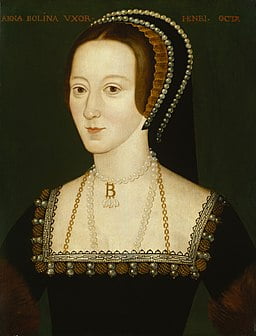
Anne Boleyn, King Henry VIII’s second wife, was beheaded in 1536.
On 24 January 1536 the King was thrown from his horse in a jousting accident at Greenwich and never jousted again. Five days later, on 29 January, Anne miscarried a male child, on the same day Catherine of Aragon was buried. Anne was losing the King’s favour, and he was already courting one of her ladies, Jane Seymour.
In May 1536 Anne was arrested along with several courtiers, including her own brother George, who was accused of incest with her. The charges of adultery, incest and treason were convenient ones. On 19 May 1536 Anne Boleyn was beheaded, and on 30 May the King married Jane Seymour, only eleven days later. In October 1537 Jane gave birth to the long-awaited son, Prince Edward, and died twelve days later of complications from the birth. The King had his heir.
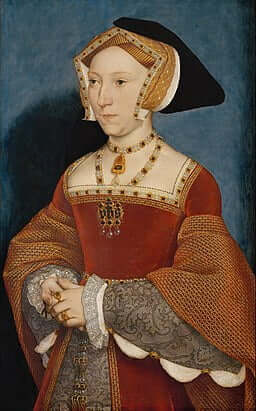
Jane Seymour, the third wife of King Henry VIII, died of complications after giving birth to Prince Edward. Photo: Google Art Project.
Cromwell then arranged a diplomatic marriage with a German princess, Anne of Cleves. Henry agreed partly on the strength of a portrait by Hans Holbein, without ever having seen her. When she arrived, the King was repelled, and the marriage, made in January 1540, was annulled that July without having been consummated. Anne of Cleves was 24.
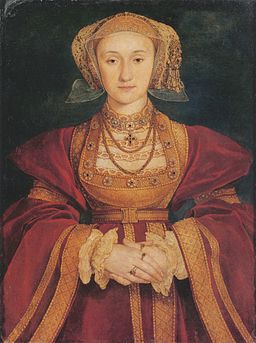
Anne of Cleves, the fourth wife of King Henry VIII, whose marriage was annulled without consummation. Portrait by Hans Holbein the Younger.
The real reason the King wanted out was that he had fallen for a teenage girl at court, Catherine Howard, the niece of the Duke of Norfolk. Norfolk, Cromwell’s old rival, saw his chance and pushed his niece into the royal bed, presenting her as innocence itself. Cromwell, who had served the King for about a decade, was arrested at a council meeting on 10 June 1540 and charged with treason.
On 28 July 1540 Cromwell was beheaded on Tower Hill, despite begging the King for mercy. That same day Henry married Catherine Howard. According to the French ambassador, the King later regretted it, calling Cromwell the most faithful servant he ever had.
In late 1541, evidence emerged of Catherine Howard’s past relationships and of secret meetings with Thomas Culpeper, including a love letter. Unlike Anne Boleyn, Catherine was very likely guilty of at least some of what she was accused of. She was executed on 13 February 1542.
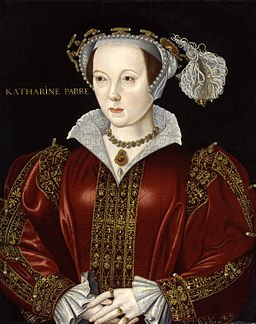
Catherine Parr, the sixth and last wife of King Henry VIII, who outlived the king by about a year and a half. Photo: Wikipedia.
On 12 July 1543 Henry married his sixth wife, Catherine Parr, a twice-widowed woman with evangelical sympathies. His later years brought war with France (he captured Boulogne in 1544) and an England bitterly divided over religion, where people on both sides were executed for heresy or treason. In 1546 conservative courtiers plotted to arrest Catherine Parr for heresy; a warrant was drawn up, but she submitted to the King and talked her way back into his favour.
Even though he was in constant pain and close to death, Henry still would not tolerate any rival to his throne. Along with his obesity, his leg had been badly ulcerated for years, and the old wound was made worse by his jousting falls. On 28 January 1547 King Henry died at the Palace of Whitehall, aged 55. Catherine Parr died in September 1548.
A Man for All Seasons is not just a film in itself. It is a picture of two men, one who became a saint and one who became, for many, the villain of English history. It gives you a sneak peek into the lives of people who changed the shape of English politics and religion for good.
How Does A Man for All Seasons Compare With Similar Films?
The 1988 remake. Charlton Heston directed and starred in a TV version that follows the stage play more literally, keeps the Common Man and runs about half an hour longer. Vanessa Redgrave, Anne Boleyn in 1966, played Lady Alice. It is more theatrical and less cinematic. Heston works hard, but Scofield’s quiet authority is missing.
Box office and adaptation note. Few prestige adaptations of a play have done this well. The 1966 film made about $28.35 million in the US on a budget held under $2 million because the cast took pay cuts.
Wolf Hall (BBC, 2015). The opposite telling: Cromwell (Mark Rylance) is the hero and More (Anton Lesser) the zealot. It is brilliant television, rated 98% on Rotten Tomatoes, and watching both is the best history lesson on the period you can get without a library.
Becket (1964). Another film about a king and his former friend turned churchman, Henry II and Thomas Becket. Becket is more flamboyant; A Man for All Seasons is more legal and more intimate.
Anne of the Thousand Days (1969) and The Other Boleyn Girl (2008). The BFI suggests both as other takes on Henry’s divorce. They focus on Anne and the bedroom politics; Bolt focuses on the man who would not sign.
Zinnemann’s own High Noon (1952). Different century, same story: a man of principle left alone as everyone around him finds reasons not to stand with him. Zinnemann clearly loved that shape.
What sets this film apart is its trust in language. Like Bergman’s The Seventh Seal, it treats a conversation about the soul as high drama. Where it falls short is in cinema itself; compared with something as visually daring as Citizen Kane, the camera mostly records good actors talking.
Audience Appeal, Reception and Awards
Who is it for? It suits both cinephiles and patient casual viewers. It is rated G in the US and U in the UK, with no violence on screen beyond the implied beheading, so it works for families with older children and for classrooms.
Critical reception. On release, Bosley Crowther of the New York Times praised it as an awesome view of a sturdy conscience and a steadfast heart. Not everyone agreed. Pauline Kael found it stiff, comparing its rhythm to a school pageant. Today it holds 89% on Rotten Tomatoes and 72 on Metacritic.
Honours. In 1995 the Vatican named it among the films on its list of important films for cinema’s centenary; in 1999 the BFI ranked it the 43rd greatest British film of all time; in 2008 Empire placed it 106th among the 500 greatest movies.
Awards:
- Academy Awards: Won Best Picture, Best Director (Zinnemann), Best Actor (Scofield), Best Adapted Screenplay (Bolt), Best Colour Cinematography (Ted Moore) and Best Colour Costume Design (Elizabeth Haffenden and Joan Bridge). Nominated for Best Supporting Actor (Shaw) and Best Supporting Actress (Hiller).
- BAFTA: Seven wins, including Best Film from any Source, Best British Film and Best British Actor (Scofield).
- Golden Globes: Best Motion Picture (Drama), Best Actor (Scofield), Best Director and Best Screenplay.
- Others: Directors Guild of America award for Zinnemann; New York Film Critics Circle Best Film, Director, Actor and Screenplay; National Board of Review Best Film.
All award details are from the film’s Wikipedia record, cross-checked with Encyclopedia.com’s VideoHound entry.
Personal Take: What Thomas More’s Silence Teaches Us Today
The lesson that matters most to me is this: the people who pay for honesty are rarely punished for lying; they are punished for refusing to say what power wants to hear. That was true in 1535, and the numbers say it is still true now.
Look at the modern workplace, the closest thing most of us have to a royal court. In the 2023 Global Business Ethics Survey by the Ethics & Compliance Initiative, 65% of employees worldwide said they had seen misconduct at work. That alone is not shocking. What should stop you is the next figure: 46% of those who reported misconduct said they experienced retaliation, a rate that did not move between the 2020 and 2023 surveys. And according to a summary of the same findings, companies never followed up with 45% of reporters to ask whether they had faced retaliation. Nearly half of the people who speak up get punished, and nearly half are never even asked.
That is Thomas More’s world with spreadsheets. Cromwell does not need More to be guilty. He needs him to be inconvenient and isolated. The boatmen who will not row More home are the colleagues who stop sitting with you at lunch once you have filed the complaint.
Notice too that the film’s More does not go looking for a fight. He resigns quietly, keeps his mouth shut, and uses every lawful protection available. I think that is the most practical part of the film, and the most misunderstood. Courage is not shouting.
Courage is knowing exactly where your line is, protecting yourself as well as you can, and then refusing to cross it when the protections run out.
It is also worth remembering that the Catholic Church now presents More as a model for public life. In 2000, Pope John Paul II declared him patron of statesmen and politicians, and the Church of England recognised him as a saint and hero of the Christian Church in 1980. And yet, as I said above, the same man sent heretics to the fire. That contradiction is part of the lesson. Even people who die for conscience can fail to respect the conscience of others. A film that makes you love More should also make you ask: whose conscience do I refuse to protect?
Five lessons from A Man for All Seasons for 2026
Know your line before the pressure arrives. More had decided what he would and would not swear long before Cromwell came for him. If you work anywhere near money, data or safety, write down your own red lines now, while it is easy.
Use every legal protection first. More’s silence was strategy. Today that means documenting concerns in writing, keeping dated records, and learning your country’s whistleblower channels before you need them.
Watch out for the Rich in yourself. Rich never decides to destroy a man. He just accepts one small favour after another. Ask yourself what your “Wales” would be, the reward big enough to make you say what isn’t true.
Defend the rules even for people you dislike. More refused to arrest a bad man without a law. When you cheer for bending a rule against someone you hate, remember that the same bent rule will be there when someone comes for you.
Protect your people, even at the cost of your pride. More broke with Norfolk to keep him safe and told his family to leave England. Integrity includes thinking about who else pays for your stand.
The problem the film solves, for me, is a very modern one: how do you stay yourself when every institution around you is asking you to sign something you don’t believe? Bolt’s answer is not comfortable, but it is clear. Keep your hands closed around the water.
Best A Man for All Seasons Quotes
These are brief quotations for review and criticism.
“I think that when statesmen forsake their own private conscience for the sake of their public duties, they lead their country by a short route to chaos.”
Sir Thomas More, to Wolsey
“When a man rises so high so swiftly, we must think he was misplaced in his origin.”
Richard Rich (the Italian Wikiquote attributes the line to Rich, quoting Aristotle)
“A man should go where he won’t be tempted.”
More to Richard Rich, offering him a teaching job
“But respect, man, that’s water in the desert.”
King Henry VIII to More, on why he needs More’s approval
“Sun and moon, Master More, you’re taken for a wise man! Is this wisdom?”
Alice More, after his resignation as Chancellor
“And when the last law was down, and the Devil turned round on you, where would you hide, Roper, the laws all being flat?”
More to William Roper
“Is there in the midst of all this muscle no single sinew that serves no appetite of Norfolk’s but is just Norfolk?”
More to the Duke of Norfolk, on the riverbank
“God made the angels to show Him splendour… But Man He made to serve Him wittily, in the tangle of his mind.”
More to Margaret
“Some men think the Earth is round, others think it flat; it is a matter capable of question. But if it is flat, will the King’s command make it round?”
More to the commission in the Tower
“I have no window to look into another man’s conscience. I condemn no one.”
More to Archbishop Cranmer
“You threaten like a dockside bully.”
More to Thomas Cromwell
“When a man takes an oath, Meg, he’s holding his own self in his own hands. Like water.”
More to Margaret in the Tower
“If we lived in a State where virtue was profitable, common sense would make us good.”
More to Margaret in the Tower (Bolt’s text; the film uses a close variant)
“This silence was, not silence at all, but most eloquent denial!”
Thomas Cromwell, at the trial
“Why Richard, it profits a man nothing to give his soul for the whole world… but for Wales?”
More to Richard Rich, at the trial
“I die His Majesty’s good servant, but God’s first.”
More on the scaffold
Pros and Cons
| Pros | Cons |
|---|---|
| A career-defining performance by Paul Scofield | Slow, dialogue-heavy pacing |
| One of the sharpest scripts ever adapted from the stage | Hides More’s role in burning Protestants |
| The Tower inquiry and trial are masterclasses in legal drama | Stagy blocking in several scenes |
| Six Oscars, including Best Picture, and still holds up | Margaret and Alice are written mostly around More |
| Short, focused, and only 120 minutes | Assumes you know some Tudor history |
| Morally serious without being preachy | Visual style is handsome but cautious |
Conclusion: Is A Man for All Seasons Worth Watching?
Yes. Many times I put A Man for All Seasons on just to have it playing in the background, but every time I do, I end up sitting down and spending time with it. When I do, all of it becomes vivid again: the characters, the morals, the beauty of truth and sincerity, the ugliness of power, the power of love and the strength of honesty. In fact, it speaks to me so strongly that I want to live a little more like the man Bolt imagined.
Like Socrates, Thomas More had a way to avoid his death. Not by running away from the truth, but by compromising with lies and moral corruption, keeping his conscience locked up and quiet, and living out the rest of his life with his wife and probably many grandchildren.
Again, like Socrates, Thomas More was ready to die for what he held true, beautiful, just and brave. He died the death his conscience called for.
My one reservation is the one I have tried to be honest about in this review. The film is a portrait of conscience, not a full portrait of the man, and the real More was harder, darker and more of his own time than Scofield’s gentle saint. Knowing that does not spoil the film for me.
If anything, it makes More’s final stand more interesting, because it belongs to a real, flawed human being and not a stained-glass window.
My recommendation: watch it if you enjoy legal and courtroom dramas, historical films like Becket or The Lion in Winter, or anything about the Tudors. Teachers of ethics, law and history will find few better films for a classroom.
Then, if you want the full picture, watch Wolf Hall and argue with yourself about who was right. A Man for All Seasons is still one of the best films you can give your time to.
References
- A Man for All Seasons (1966 film)
- A Man for All Seasons (1988 film), Wikipedia
- BFI film page
- Fordham Medieval Hollywood, A Man for All Seasons
- Marquette University Law School Faculty Blog, Who Is/Was Thomas More?
- The Tablet, More or less
- OUPblog via Goodreads, Wolf Hall: count up the bodies
- Smithsonian Magazine on More’s skull
- OSV News on More’s head and canonisation
- Wives of Henry VIII, Wikipedia
- The Anne Boleyn Files (dates for Catherine’s pregnancies, the 1536 joust, Anne’s miscarriage, Cromwell’s execution)
- Tudor History, Katherine Parr
- Ethics & Compliance Initiative, 2023 Global Business Ethics Survey
- Wikiquote, A Man for All Seasons (1966 film)
A Man for All Seasons

Director: Fred Zinnemann
Date Created: 1970-01-01 00:32
4.5
Pros
- Paul Scofield's Oscar-winning performance is restrained and unforgettable
- Robert Bolt's dialogue is sharp, witty and endlessly quotable
- The trial and the Tower interrogation are among the best legal scenes ever filmed
Cons
- The pacing is slow and the staging can feel theatrical
- It turns More into a near-flawless saint and hides his persecution of Protestants
- Viewers who don't know the history may struggle with who is who
- Henry VIII appears in only a few scenes







