
Last updated on October 18th, 2026 at 03:18 pm
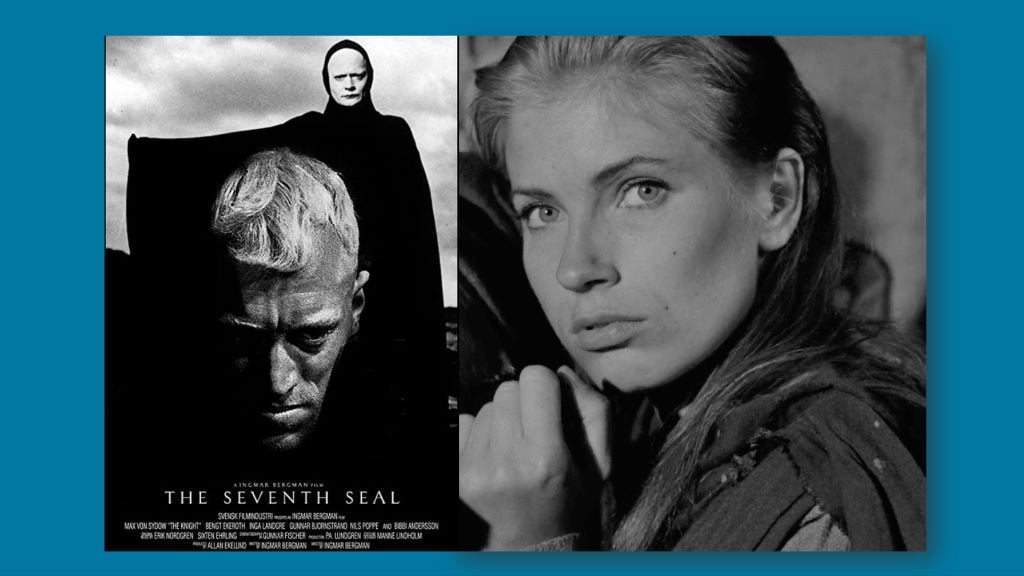
The Seventh Seal is the 1957 Ingmar Bergman film in which a knight plays chess with Death, and that single image has been copied so often that most people know it without ever seeing the film. That is a pity, because the famous chess game is only the frame. The heart of The Seventh Seal is a quiet picnic of milk and wild strawberries, a family of travelling actors, and a squire who jokes his way to the grave.
In this review I give you the full plot with spoilers, the ending explained, the production story, the critical record, and my honest verdict on whether Bergman’s most quoted film still deserves its reputation.
The Seventh Seal (Swedish: Det sjunde inseglet) is a Swedish historical fantasy written and directed by Ingmar Bergman, starring Max von Sydow as the knight Antonius Block and Bengt Ekerot as Death. It premiered in Sweden on 16 February 1957, runs 96 minutes, and was shot in black and white by Gunnar Fischer. Britannica describes it as widely considered Bergman’s greatest work.
My own view is a little more mixed, and a lot more affectionate. It is a gloomy film on the surface and a tender one underneath.
Table of Contents
The Seventh Seal at a glance
What it is: A 96-minute Swedish black-and-white allegory set during the Black Death, written and directed by Ingmar Bergman and released in February 1957.
The story: A crusader returns home to a plague-struck Sweden, meets Death, and challenges him to chess to buy time for one meaningful deed.
The title: It comes from Revelation 8:1, where the opening of The Seventh Seal brings silence in heaven. Silence, especially God’s, is the film’s central motif.
The prize: It shared the Special Jury Prize at Cannes in 1957 with Andrzej Wajda’s Kanał; the Palme d’Or went to Friendly Persuasion.
The cost: Bergman had 35 days and a budget of $150,000.
The reputation today: 93% on Rotten Tomatoes from 73 reviews, and #8 in Empire’s 2010 list of the best films of world cinema.
The surprise: It is funnier than its reputation. Critic Gary Giddins, writing for the Criterion Collection, calls it droll and argues that the juggler Jof is the film’s true point of view.
My verdict: Essential viewing for anyone who cares about cinema or about the question of how to live with death. Not ideal as a casual Friday-night pick.
Who should watch The Seventh Seal?
Best for:
- Cinephiles building their foundation in world cinema and art-house history.
- Students of philosophy, theology, literature or medieval history.
- Viewers who liked Persona and want the earlier, more direct Bergman.
- Anyone who has lived through a crisis and wondered what small joys are worth defending.
- Fans of Woody Allen’s Love and Death, which parodies this film’s ending.
Not for:
- Viewers who need fast pacing or conventional plot twists.
- Anyone who dislikes subtitles or theatrical dialogue.
- Younger children. The film includes a woman burned at the stake, an attempted rape and plague deaths.
Quick facts
| Detail | Information |
|---|---|
| Original title | Det sjunde inseglet |
| Director and writer | Ingmar Bergman |
| Based on | Bergman’s one-act play Trämålning (Wood Painting) |
| Swedish premiere | 16 February 1957 |
| US debut | Paris Theater, New York, October 1958 |
| Running time | 96 minutes |
| Budget | $150,000 |
| Cinematography | Gunnar Fischer |
| Producer | Allan Ekelund for Svensk Filmindustri |
| Main cast | Max von Sydow, Gunnar Björnstrand, Bengt Ekerot, Nils Poppe, Bibi Andersson, Inga Gill, Gunnel Lindblom, Maud Hansson, Åke Fridell |
| Major award | Special Jury Prize, Cannes 1957 (shared with Kanał) |
A small note on credits: Wikipedia credits the score to Erik Nordgren, while Roger Ebert’s credit list names Sixten Ehrling. I could not resolve that difference from a primary source, so I mention both.
Background: where did The Seventh Seal come from?
The Seventh Seal grew out of a stage play Bergman wrote himself. He composed Wood Painting in 1953 or 1954 for acting students at the Malmö City Theatre; it was first performed on radio in 1954 and later staged in Malmö and Stockholm. Bengt Ekerot, who directed the Stockholm stage version, went on to play Death in the film.
The roots go deeper still. The Ingmar Bergman Foundation notes that a white-faced figure in a black cape first appears in an unpublished story Bergman wrote at 20. The same source records that Bergman staged the medieval morality play Everyman in April 1956, with Max von Sydow in the lead, and that the screenplay for The Seventh Seal is dated 5 June 1956.
The famous chess image has a precise visual source. Bergman drew on a mural of Death playing chess painted around 1480 by Albertus Pictor in Täby Church, just north of Stockholm. Pictor’s vault paintings in Täby were never whitewashed, which is why the image survived for Bergman to see. In a neat bit of homage, Pictor himself appears in the film as the church painter, played by Gunnar Olsson.
Getting the film made was not easy. Svensk Filmindustri chief Carl Anders Dymling initially rejected the script and only approved it after Bergman’s comedy Smiles of a Summer Night succeeded at Cannes. Almost everything was shot in or around the Filmstaden studios in Solna. The two exceptions are the opening chess scene by the sea and the final Dance of Death, both filmed at Hovs Hallar, a rocky coastline in north-western Scania.
Bergman later remembered the film with mixed pride. In his autobiography The Magic Lantern, he called it an “uneven film which lies close to my heart”, made under hard conditions but with real energy and joy.
The Seventh Seal plot summary
Because this is a film and not a series, I have divided the plot into four movements rather than seasons. Every major event, including the ending, is below.
Part one: the beach, the chess board and the church
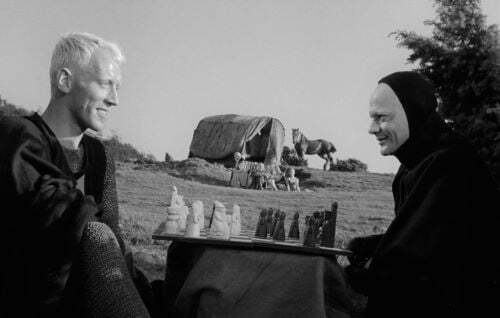
The film opens on a stormy sky and a gliding eagle, then cuts to a rocky beach. The knight Antonius Block and his squire Jöns have come home from the Crusades after about a decade away, only to find Sweden gripped by the plague. Block wakes, washes his face in the sea and sets out a chess board.
A pale figure in a black cloak is standing there. When Block asks who he is, the answer is short: he is Death, and he has been walking beside the knight for a long time. Block does not run. He proposes a game of chess. As long as the game continues, he lives. If he wins, he goes free. Death, who claims to be a fine player, agrees.
The two riders move inland and pass a caravan of travelling actors: Jof, his wife Mia, their baby son Mikael, and their manager Skat. Jof wakes early and sees a vision of the Virgin Mary leading the infant Jesus across a meadow. He tells Mia, who smiles at him with loving disbelief. Roger Ebert refers to the couple simply as Joseph and Mary, and that echo of the Holy Family matters by the end.
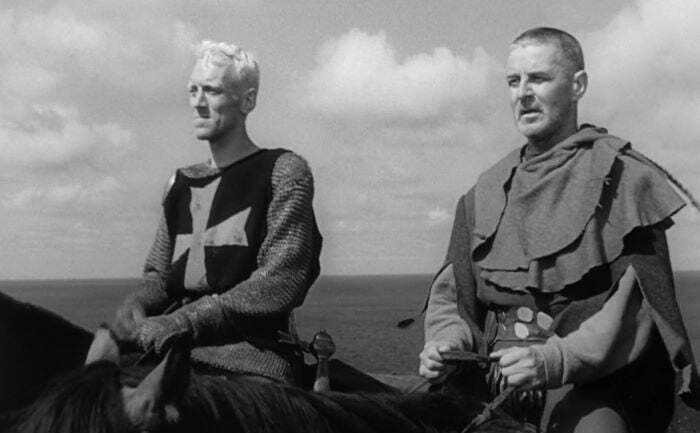
Block and Jöns stop at a church where a painter is working on a Danse Macabre fresco. Jöns, sardonic and earthy, mocks the painter for frightening people into the arms of priests. The painter shrugs; scared people, he suggests, are good for business.
Inside, Block kneels at the confessional and pours out his despair to a hooded figure behind the grille. He wants knowledge, not faith. He wants God to show himself. He admits that his own indifference has cut him off from other people, and he says he hopes to use his reprieve for one meaningful act. Then, pleased with himself, he reveals the chess tactic he plans to use against Death, a combination of bishop and knight.
The hooded figure turns. It is Death. Block has just told his opponent his strategy. It is a darkly funny moment, and Bergman plays it straight.
Outside the church, soldiers have chained a young woman who is to be burned at the stake for consorting with the Devil. Block is drawn to her. If she has met the Devil, she might know something about God.
Part two: the village, the actors and the flagellants
In a deserted village, Jöns enters a farmhouse looking for water. He catches a man stealing a bracelet from a plague victim’s corpse and then threatening a mute servant girl. The thief is Raval, the theologian who ten years earlier persuaded Block to join the Crusades. Jöns stops the assault and promises to brand Raval’s face if they ever meet again. He then invites the girl to come along as his housekeeper. She follows him, silent.
In a nearby town, Jof, Mia and Skat put on their show. During the performance, Skat is lured away by Lisa, the wife of the blacksmith Plog, and the two run off together.
Then the stage show is broken up. A procession of flagellants staggers through the square, men carrying crosses and whipping their own backs, while a monk screams at the crowd that the plague is God’s punishment and every one of them is doomed. The townspeople kneel. The actors watch in silence. It is one of the most frightening sequences Bergman ever filmed, because the fanaticism looks so ordinary.
At the inn, Jöns offers the abandoned Plog some mock wisdom about love and marriage. Raval, who is drinking there too, stirs up Plog and the other customers to intimidate Jof. Jöns arrives, sees Raval, and keeps his promise: he slashes the theologian’s face. Jof escapes.
Part three: milk, wild strawberries and the forest
This is the scene that, for me, explains the whole film. Block sits in a meadow with Jof, Mia, the baby, Jöns and the mute girl. Mia offers a bowl of milk and wild strawberries she gathered. Block eats, listens to Jof play the lute, and says he will remember this hour of peace, the dusk, the strawberries, the milk, for the rest of his life. He holds the bowl as if it were a sacrament.
Here Block also says the line about faith being a torment, like loving someone in the dark who never answers. The two ideas sit side by side: God is silent, and yet this afternoon is real.
Block invites the actors and Plog to shelter from the plague at his castle. In the forest they run into Lisa and Skat. Lisa abandons her lover and returns to her husband. Skat, cornered by Plog, stabs himself with a theatrical dagger and appears to die. It is a fake. Once the group moves on, Skat climbs a tree to spend the night safely. Then Death appears below with a saw and cuts the tree down. Skat argues that he has performances booked. Death is not interested.
Part four: the witch, the last move and the dance
That night the travellers reach the place where the accused woman is to be burned. Block asks her to show him the Devil. She tells him to look in her eyes; Block replies that he sees nothing but terror. Jöns, watching the fire, says she sees nothing at all, only emptiness. The knight refuses to accept that.
Soon after, Raval appears, sick with plague, begging for water. No one dares to help him, and he dies in the dark.
The chess game reaches its end in the forest. Jof, who sees things others cannot, catches sight of Death sitting across the board from the knight. Terrified, he gathers Mia and the baby and slips away. Block notices. He deliberately knocks the chess pieces over, and while Death pauses to restore the board, the family escapes. Critic Gary Giddins describes this as the knight diverting Death’s attention to save Jof’s family. Death puts the pieces back, checkmates Block, and promises to come for him and his companions at their next meeting. Block has lost the game, but he has done his one meaningful thing.
Block, Jöns, the mute girl, Plog and Lisa reach the castle. Block’s wife, Karin, has waited for him through the plague. Over a last meal, she reads aloud from the Book of Revelation, the passage about The Seventh Seal and the silence in heaven.
Death enters the hall. Each person meets him differently. Block prays desperately to a God he cannot feel. Jöns refuses to whimper and insists, as Giddins notes, on enjoying the triumph of the final moment while he can still move his toes. The mute girl, who has said nothing all film, faces Death with calm, almost relieved acceptance.
The next morning, Jof and Mia wake in their wagon after the storm. Jof looks up and sees a line of figures on a distant hill: Death leading the knight, the squire, Lisa and the others in a hand-in-hand dance across the horizon. In Ebert’s translation, Jof announces that the strict lord Death bids them dance. Mia smiles at her husband and his visions. The family drives on into the morning light.
That ending is the key to everything. The famous silhouette is a vision of the dead. The final image is of the living.
Critical analysis: is The Seventh Seal really a masterpiece?
Yes, though not for the reason most posters suggest. The Seventh Seal is a masterpiece of contrast, not of gloom.
The reputation problem. The Seventh Seal is a victim of its own fame. Writing in 2009, Giddins argued that the film had come to be respected as a monument more than enjoyed as a living work, saddled with the reputation of medicine you take because it is good for you. Roger Ebert, revisiting it for his Great Movies series on 16 April 2000, compared it to silent cinema and admitted it had fallen out of fashion because its subject, the absence of God, embarrasses an age of irony. He still placed it among the great films, and called its directness its strength. I agree with both men. The parodies have made the chess scene look like a costume sketch. The film itself is stranger and warmer.
The poll record reflects the cooling. Empire ranked it #8 among world-cinema films in 2010, but in Sight and Sound’s 2022 poll the BFI’s own player groups it in the 101 to 250 band, outside the critics’ top 100. I cannot confirm The Seventh Seal‘s exact 2022 position from a primary source, so I am giving the band rather than a number.
The visual grammar. Gunnar Fischer’s photography is the first thing that grabs you. An earlier essay published by the Criterion Collection argues that only Gregg Toland and Sven Nykvist have equalled Fischer’s lighting on this film. The beach scenes are flat and bleached, as if the world were overexposed. The forest at night is all black velvet and torchlight.
Bergman keeps compositions simple and frontal, almost like medieval panels. That stylisation is deliberate; the film is set in the 14th century but looks at it through painted church walls.
The structure. The film is a road movie disguised as a morality play. One reviewer at The Skinny called it essentially a road movie, and that is accurate. Each stop on the journey tests a different response to death: the painter’s commerce, the flagellants’ terror, the theologian’s greed, the witch-burners’ cruelty, the actors’ play, the squire’s irony and the knight’s search.
The humour. This is the most overlooked quality. Jöns’s bawdy songs, Skat’s fake suicide, Death’s deadpan bargaining, Block’s blunder in the confessional: the film is full of jokes. Giddins compares Jöns’s dialogue to the comic incongruities of Samuel Beckett. Ken Hanke at Mountain Xpress also noted that people tend to forget how darkly entertaining it is. If you go in expecting a sermon, you will be surprised how often you laugh.
The weaknesses. Even its admirers admit flaws. Bergman himself called it uneven. Some of the dialogue states its themes too plainly; the knight explains his crisis in speeches rather than living it. The early Swedish reception was mixed: one critic, Hanserik Hjertén, dismissed it as “a horror film for children”, and while the cinematography was praised, Bergman the writer was criticised. I think the theatricality is mostly a strength, but in the middle stretch, especially the inn sequence, the pacing does sag.
The political context. The film is not only about the Middle Ages. The Spectator’s 2007 tribute to Bergman said the medieval story drew on Cold War fear of nuclear destruction. Giddins notes that Bergman himself acknowledged the link between his medieval vision and midcentury fear of atomic war. The plague in the film stands in for any catastrophe that makes ordinary people feel the end is near.
Acting performances: who gives the best performance?
The best performance belongs to Gunnar Björnstrand as Jöns, though Max von Sydow gives the film its face.
Max von Sydow (Antonius Block). Von Sydow was still in his twenties, yet, as Giddins observes, he looks far older, with a rugged face that holds the camera. His stillness is the point. Block is a man who thinks instead of feeling, and von Sydow plays him with a locked jaw and searching eyes. This role was the first of many star parts for Bergman, and the beginning of one of cinema’s great director-actor partnerships.
Gunnar Björnstrand (Jöns). Björnstrand steals every scene. Jöns is cynical, crude, brave and kinder than his master. He saves the mute girl, protects Jof, and meets Death with dignity. Ebert singled out the squire’s wordless sneer of discontent, and once you notice it, you watch for it in every scene.
Bengt Ekerot (Death). Ekerot’s chalk-white face became one of the most recognisable images in film history. He plays Death not as a monster but as a tired professional, polite, a little smug, and oddly ignorant. When Block asks him what lies beyond, Death has nothing to reveal; Giddins calls him strangely clueless. That is the film’s most frightening joke.
Nils Poppe and Bibi Andersson (Jof and Mia). Poppe gives Jof a childlike openness that keeps the film from drowning in despair. Bibi Andersson, who was in a relationship with Bergman from 1955 to 1959, makes Mia warm and grounded. Swedish critic Nils Beyer praised her as looking “painted in faded watercolours” yet full of warmth.
Supporting cast. Gunnel Lindblom’s mute girl speaks with her eyes. Maud Hansson’s condemned woman is unsettling because she seems almost proud of her doom. Inga Gill and Åke Fridell, as Lisa and Plog, provide earthy marital comedy that would fit in Chaucer.
The best chemistry is between Block and Jöns: master and servant, believer and sceptic, who share the road but rarely the same conversation. Giddins points out that their most memorable exchanges are not with each other, which tells you how lonely both men are.
Themes and messages: what is The Seventh Seal really about?
The Seventh Seal is about how to live while waiting for an answer that may never come. Five themes carry that idea.
The silence of God
The title comes from Revelation 8:1, where the opening of The Seventh Seal brings silence in heaven for about half an hour. Britannica notes that silence is a major motif in the film and that it marks the point where Bergman’s religious questioning became central to his work. Block asks God to speak, and God does not. Even Death cannot answer.
Melvyn Bragg has suggested that this idea may connect to the punishments of silence Bergman received from his father, a Lutheran chaplain. Ebert also records that Bergman’s strict upbringing included being locked in a cupboard as a child. Read that way, the knight’s prayers are a son’s plea to a father who will not respond.
Fear of death, and Bergman’s own
Bergman did not hide that the film was personal. In a remark widely reported after his death, he said of the chess scene’s origin: “I was terribly scared of death.” The Ingmar Bergman Foundation states that working through the death motif, culminating in this film, helped Bergman make his peace with that fear. In other words, making The Seventh Seal was partly therapy.
Fanaticism and institutional cruelty
The flagellants, the preacher and the witch-burners show what fear does to a society. People desperate for an explanation blame a young woman and torture themselves. Jöns mocks the Crusade itself as a project so foolish that only an idealist could invent it, a line Giddins quotes in full in his essay. Raval, the theologian turned grave robber, embodies religious authority without conscience.
Art and play as resistance
The actors are the film’s moral centre. They perform comedies while the world burns, and Bergman never mocks them for it. Time Out’s review argues that the travelling players now read as quiet proof of how much Bergman cared about ordinary people. The film suggests that art does not defeat death, but it does make life worth defending.
One meaningful deed
Block’s mission is not to win. It is to do something that matters. His act turns out to be small and almost accidental: knocking over a chess board so a family can run. That is the film’s quiet answer to its own enormous questions. You may not get proof of God. You can still save someone.
Comparison: how does The Seventh Seal compare with other Bergman films and similar works?
Against Wild Strawberries (1957). Bergman released both films the same year, and Ebert notes that each follows an ageing man travelling toward death and looking for meaning. Wild Strawberries is more intimate and psychological; The Seventh Seal is more allegorical and theatrical. In my reading, the strawberries link them too, standing for brief, fragile happiness in both.
Against the “faith trilogy.” Through a Glass Darkly, Winter Light and The Silence, which AFP’s obituary of Bergman groups with The Seventh Seal as steps toward rejecting religious belief, continue the question of God’s absence in a modern, colder register. Ebert observes that The Seventh Seal opens that whole period of Bergman’s career. Where Winter Light is bleak and enclosed, The Seventh Seal still has sunshine, comedy and a surviving family.
Against Persona (1966). Persona is more experimental and more modern. It asks questions about identity rather than God, and it does so through form rather than allegory. If The Seventh Seal is Bergman speaking plainly, Persona is Bergman speaking in riddles.
Against Dreyer. At its Swedish release, critic Nils Beyer compared it to Carl Theodor Dreyer’s The Passion of Joan of Arc and Day of Wrath, finding Dreyer superior but noting how rare it was to make that comparison at all. I think Dreyer is more rigorous; Bergman is more playful.
Against its parodies. Woody Allen’s 1975 comedy Love and Death ends with Allen dancing away with Death, a direct send-up of this ending. Bill & Ted’s Bogus Journey (1991) has its heroes beat Death at board games. If you want a full breakdown of the Allen film, I covered it in my Love and Death review. For a wider list, see my guide to the best philosophical films of all time.
What sets it apart. Giddins makes a sharp point: of the many apocalypse-themed films of the mid-1950s, only The Seventh Seal insists on doubt the way others insist on piety or melodrama. That is still its distinction.
Where it falls short. It is less subtle than Bergman’s later work. The symbols are announced rather than discovered. A viewer coming from Persona or Cries and Whispers may find it a little obvious.
Audience appeal and reception: who is The Seventh Seal for?
The target audience is adults who enjoy reflective cinema, and it is more accessible than its reputation suggests. A casual viewer can follow the story easily; the plot is simple and episodic. What may test casual viewers is the pace and the long philosophical speeches. Cinephiles, students and anyone curious about the roots of art-house cinema will get the most from it.
Historical impact. The film launched art-house cinema in the United States. Giddins credits it with doing that for Bergman, von Sydow and the distributor Janus Films after its New York opening in October 1958. In The New York Times, Bosley Crowther called it “essentially intellectual” and a rewarding challenge. Critic James Monaco later observed that it quickly entered school and university literature courses, because its symbolism suited readers trained on books.
Awards and honours.
- Special Jury Prize, Cannes Film Festival, 1957, shared with Andrzej Wajda’s Kanał.
- Included in Roger Ebert’s Great Movies collection.
- Ranked #8 in Empire’s 100 Best Films of World Cinema (2010).
- 93% Tomatometer with 73 reviews at the time of writing.
Where to watch. Availability changes by country, so check a streaming guide such as JustWatch before you plan a viewing. The Criterion Collection has released it several times, most recently as a 4K UHD edition that includes Peter Cowie’s audio commentary and the documentary Bergman Island.
Personal reflection: what does The Seventh Seal teach us today?
Every time I return to The Seventh Seal, I notice that I am less interested in the knight than I used to be. When I first met this film, Block was the hero: the serious man asking the serious questions. Now he looks to me like someone who almost missed his own life because he was waiting for a sign.
That is the lesson I keep taking from it. Block demands knowledge, not faith. He wants God to show his face. Many people today are in a similar position, not certain enough to believe and not comfortable enough to stop wondering.
A January 2024 Pew Research Center study found that 28% of US adults now describe themselves as religiously unaffiliated, up from 16% in 2007, and that most of these “nones” still believe in God or some higher power. That is almost a statistical portrait of Antonius Block: people who want to believe but cannot fully commit. The film does not mock that condition. It simply asks what you will do while you wait.
Bergman’s answer is not a doctrine. It is a bowl of strawberries. In the picnic scene, Block does not receive revelation. He receives company, food, music and the evening light. He says he will remember it, and he holds the bowl as if it were the most precious thing in the world.
I think Bergman is telling us that meaning arrives sideways, through attention to small, shared moments, rather than through the big answers we demand.
There is also a practical lesson in Jöns. He has no faith and no illusions, but he is the one who acts. He stops an assault. He defends Jof. He gives the mute girl a place to go. His cynicism never becomes cruelty. In a time when cynicism is often an excuse for doing nothing, Jöns is a useful model: you can doubt everything and still protect the vulnerable.
The flagellants feel uncomfortably modern too. When people are afraid, they look for a culprit and a performance of penance. The film shows a crowd that blames a young woman for the plague and burns her. You do not need a medieval setting to recognise that pattern.
Every era of panic produces its own witch hunts, its own preachers shouting that the end is near, its own crowds that would rather punish than understand. Bergman does not lecture about it. He just lets the camera watch faces in the crowd, and the effect is chilling.
Then there is Death himself. The most surprising thing about Bergman’s Death is that he knows nothing. When Block asks him for the secret, he has nothing to tell. I find that strangely comforting. If even Death does not have the answer, then the knight’s anxiety about finding it before the end is beside the point. The question shifts from “What is the truth?” to “How will I spend the time I have?”
That shift is the same one Tolstoy makes in The Death of Ivan Ilyich, where a dying man realises too late that he has lived for appearances. Block realises it just in time. His single meaningful act is unplanned, quick and humble. He tips over a chess board so a young family can run into the night. No one thanks him. No one even knows.
If you watch The Seventh Seal today, my advice is simple. Do not watch it as a puzzle about God. Watch it as a guide to triage. When the world feels like it is ending, what do you protect? Who do you sit with in the meadow? What small deed can you still do? Jof and Mia drive off into the morning not because they solved anything, but because they stayed close to each other and kept their eyes open. That, more than the chess game, is the image I carry home.
Memorable quotes from The Seventh Seal
These are brief quotations from the film, cited by page in the source material.
Block continues “I want knowledge. Not faith or conjecture, but knowledge. I want God to reach out his hand, show his face, speak to me. But he is silent. I cry out to him in the darkness, but sometimes it feels like no one is there”. “Perhaps no one IS there”, said the priest. “Then life is just senseless horror. No man can live facing death knowing that everything is nothingness”, Block wondered.
“Most people give no thought to death or nothingness”, replied the priest. “One day they’ll stand on the far edge of life, peering into the darkness. I understand what you mean. We carve an idol out of our fear and call it God.”
Is it so cruelly inconceivable to grasp God with the senses? Why should He hide himself in a mist of half-spoken promises and unseen miracles?” (Block, in the confessional).
No one escapes me” (Death, during the final chess game).
It is finished” (the formerly mute servant girl, greeting Death at the final supper.
A skull is more interesting than a naked woman.
We were too well-off, too satisfied.
Farewell, my sweet. I could have raped you… but I don’t believe in that kind of love.
It’s hell with women, and hell without them. Best to kill them while you are still having fun.
Faith is a torment – did you know that? It is like loving someone who is out there in the darkness but never appears, no matter how loudly you call- (Block, at the strawberry picnic).
Well, wherever you turn, your rump’s always behind you.
Faith is a heavy burden, you know? It’s like loving someone out in the darkness who never comes, no matter how loud you call.
It’s hell with women and hell without them.
If everything is imperfect in this imperfect world, love is most perfect in its perfect imperfection.
Pros and cons of The Seventh Seal
| Pros | Cons |
|---|---|
| Gunnar Fischer’s black-and-white photography is stunning and still influential | The middle section, especially the inn scene, drags |
| Gunnar Björnstrand’s Jöns is one of cinema’s great sidekicks | Some dialogue spells out its themes too directly |
| Surprisingly funny, with dark wit throughout | Decades of parody can make key images feel like clichés |
| The ending balances despair with real hope | Women characters are thinly written compared with the men |
| Short at 96 minutes, with a simple, followable plot | Theatrical staging may feel stiff to modern viewers |
| Its questions about faith, fear and meaning remain current | Graphic themes (witch-burning, plague) make it unsuitable for children |
Conclusion: should you watch The Seventh Seal?
Yes. The Seventh Seal is not flawless, and Bergman himself admitted it was uneven. But it is one of the rare films that asks the biggest questions directly and then, almost slyly, answers them with something small. You come for the knight playing chess with Death. You stay for a squire who jokes in the face of the end, a juggler who sees visions, and a bowl of wild strawberries in the evening sun.
My recommendation: Watch it if you are serious about film history, philosophy or religion, or if you have ever wondered how to live with uncertainty. Watch it with full attention, ideally without distractions, and give it a second viewing; it rewards repetition. Skip it, for now, if you want fast entertainment. It is suitable for general adult audiences, not just specialists, but it is not a film for children.
Rating: 4.5 out of 5.
Recommendation for potential viewers
The people who will benefit most from The Seventh Seal are first-time viewers of world cinema, students of philosophy or religious studies, and anyone wrestling with doubt or grief.
It is suitable for general adult audiences, not only specialists; you do not need to know anything about Bergman, Swedish history or theology to follow it.
Specialists will find extra layers in its medieval art sources, its links to the Cold War and its place at the start of Bergman’s religious period. If you are new to Bergman, start here, then move to Wild Strawberries and Persona.
Related reading on Sopranu
- Persona (1966) explained
- Love and Death (1975) review
- Best philosophical films of all time
- The Death of Ivan Ilyich summary and analysis
- Annie Hall (1977) review
- 101 best films you need to see







