
Last updated on October 5th, 2026 at 05:21 pm
Why do we throw away the one thing we think about more than anything else? Food is on our minds around the clock. We plan our days around it, judge each other by it, pray over it, fight over it at weddings, and measure hospitality by how much of it we can pile on a guest’s plate. And then we throw away roughly a fifth of it.
That contradiction is what this essay is about. I first wrote it in 2022, when the headline figure was 931 million tonnes. The numbers have since been revised upward, and the paradox has only sharpened.
Food Waste in 60 Seconds
How much food is wasted? About 1.05 billion tonnes in 2022, or 132 kg per person, according to the UNEP Food Waste Index Report 2024. That is almost one-fifth of all food available to consumers.
Where is it wasted? Mostly at home. Households account for 60%, food service 28%, and retail 12%.
What about food lost before it reaches shops? FAO estimates 13.3% of production, about 1.31 billion tonnes, is lost between harvest and retail.
How many people are hungry? 645 million in 2025 (7.8% of humanity), according to SOFI 2026. About 2.1 billion faced moderate or severe food insecurity.
Why does it matter? Food loss and waste produce 8-10% of global greenhouse gas emissions and cost the world roughly USD 1 trillion a year.
My argument: we do not waste food because we care little about it. We waste it because we care about it so much that we turned it into a display of status, and display requires surplus.
Table of Contents
What Is Food Waste?
Food waste is food (including its inedible parts, such as bones, shells and peels) that is removed from the human food supply chain at the retail, food service or household stage. Food loss is the food that disappears earlier, between harvest and the shop shelf, through spoilage, pests, poor storage and transport.
The distinction matters. Food loss is mostly a problem of infrastructure. Food waste is mostly a problem of behaviour, and behaviour is a problem of culture. That is where my interest lies.
The United Nations defines food broadly: any substance, processed, semi-processed or raw, intended for human consumption, including drinks. By that definition, almost everything we put on a table and everything we scrape off a plate counts.
Food Waste Statistics 2026: The Latest Numbers
| Measure | Latest figure | Year of data | Source |
|---|---|---|---|
| Total food waste | 1.05 billion tonnes | 2022 | UNEP Food Waste Index Report 2024 |
| Food waste per person | 132 kg per year | 2022 | UNEP 2024 |
| Household food waste per person | 79 kg per year | 2022 | UNEP 2024 |
| Share of consumer food wasted | Almost one-fifth | 2022 | UNEP 2024 |
| Meals wasted | Over 1 billion a day | 2022 | UNEP 2024 |
| Food lost from harvest to retail | 13.3% (about 1.31 billion tonnes) | Published 2025 | FAO |
| Share of global greenhouse gas emissions | 8-10% | UNEP 2024 | |
| Economic cost | About USD 1 trillion a year | UNEP 2024 | |
| People facing hunger | 645 million (7.8%) | 2025 | SOFI 2026 |
| Moderate or severe food insecurity | About 2.1 billion | 2025 | SOFI 2026 |
| Bangladesh household food waste | 82 kg per person; 14.10 million tonnes | 2022 | UNEP 2024 |
| Bangladesh, acute food insecurity (IPC Phase 3+) | 15.3 million (May-Aug 2026); 18.1 million projected (Sep-Dec 2026) | 2026 | IPC Bangladesh |
Note: the waste figures and the hunger figures cover different years. The UNEP report released in March 2024 is still the most recent global food waste index as of October 2026.
There is some good news. Global hunger fell by 14 million people between 2024 and 2025, and by 43 million from the 2022 peak, according to FAO. Japan cut its food waste by 31% and the UK by 18% against their baselines, which shows reduction is possible. But the world has not yet halved food waste, the target set in Sustainable Development Goal 12.3 for 2030, and on current data it is hard to see how it will.
Food Thought: Why Food Rules the Human Mind
Food is not just one of our concerns. It is the concern underneath the others.
When the amount of food we have stored decides how long and how well we will live, it controls our psychology completely. Too little and we starve. Too much and we fall ill in other ways: obesity, diabetes, heart disease. Deficiency, excess and imbalance all leave their mark on the body and the mind. We are what our foods are.
Virginia Woolf saw this clearly in A Room of One’s Own: “One cannot think well, love well, sleep well, if one has not dined well.” Oscar Wilde put the social side of it more playfully in A Woman of No Importance: “After a good dinner one can forgive anybody, even one’s own relations.”
The old proverb says the way to a man’s heart is through his stomach. I would go further. A man’s way to his brain is through his stomach. A hungry child does not learn well. A hungry worker does not think clearly. Success, in the end, is an accumulation of opportunities, and the first opportunity is the chance to eat good food.
Food as insurance: what the economists found
Economists have documented how deeply food security shapes even our most personal choices. In a well-known study of villages in rural India, Mark Rosenzweig and Oded Stark found that farming households married their daughters into villages far away, so that a harvest failure at home would be less likely to hit both families at once. The in-laws became a form of crop insurance. Tellingly, wealthier households did this less, because they could insure themselves.
The lesson is uncomfortable: when food is uncertain, even marriage becomes a food-security strategy.
Food as power
History supports the same point at the scale of nations. Armies march on their stomachs, sieges are wars against food supplies, and a country that cannot feed itself cannot defend itself for long. Food is political power and physical power at once. It shapes how we look, how strong we are, and how well we think.
Even the Bible records a food rebellion. In the book of Exodus, the Israelites, newly free and hungry in the wilderness, complained to Moses that in Egypt they at least ate bread to the full. Freedom on an empty stomach felt worse to them than slavery with a full one. That is how strong food’s hold on us is.
Food Love: How Food Builds Identity and Class
If food only kept us alive, we would waste far less of it. But food also tells the world who we are.
In Food and Cultural Studies (2004), Bob Ashley, Joanne Hollows, Steve Jones and Ben Taylor argue that taste is not simply a reflection of identity. It helps construct it. Their example from Britain is balsamic vinegar, which once worked as a marker of middle-class knowledge about restaurants, travel and food fashion. Class shows up on the plate. In their account, working-class food culture has tended to value quantity and generosity, while upper-class food culture values quality, presentation and style.
The French sociologist Claude Fischler, in his 1988 essay “Food, Self and Identity,” described the tension between neophilia (the pull towards new foods) and neophobia (the fear of unfamiliar foods as risky). Think of the tourist who travels across the world and then looks for a familiar burger. We eat to belong, and we refuse food to protect who we think we are.
In South Asia, this is visible everywhere. In Chittagong, a family earns respect by feeding hundreds of guests at a mezban. Across Bangladesh and India, a wedding is judged by its food. I have seen news reports of a Bangladeshi wedding that turned violent when the food ran short, and of an Indian bride’s family calling off a marriage after the groom’s side caused chaos over a chicken dish. These are not odd stories. They show how much social weight we load onto a meal.
Food, faith and the limits of rules
Religion draws some of the sharpest food lines. Halal and haram, kosher and treif, the sanctity of the cow: food rules mark who belongs to which community, and in the Indian subcontinent they have also sparked bitter conflict between Hindus and Muslims over beef.
Yet these categories hold only while there is a choice. When there is none, the survival instinct overrides every rule. The most famous proof is the case of the yacht Mignonette. In 1884, after nearly three weeks adrift in a lifeboat, captain Tom Dudley killed the 17-year-old cabin boy, Richard Parker, with the help of mate Edwin Stephens, and the survivors ate him.
The English courts, in R v Dudley and Stephens, ruled that necessity was no defence to murder. The law held firm. Human hunger did not.
Who Eats Last? Food Waste and Gender
There is a cruel twist inside this paradox. The same households that overload a guest’s plate may underfeed their own women.
A 2019 study in Social Science & Medicine by Erin Lentz, Sudha Narayanan and Anuradha De, based on research in rural Odisha (India) and northwestern Bangladesh, found that most women reported eating “last and least” in their families. Social norms that put the family first, a partner’s heavy drinking, and fear of violence all pushed women to eat less or eat worse.
So food is wasted at the feast and withheld at the family table. Both come from the same root: food as a measure of whose needs count.
The Bangladesh Paradox: Hungry Nation, Wasteful Plate
Bangladesh is where my thinking on this started, and the latest numbers make the contradiction hard to ignore.
According to the UNEP Food Waste Index Report 2024, the average Bangladeshi household wastes 82 kg of food per person per year, about 14.10 million tonnes in total. That is higher than the 2021 estimate of 65 kg, higher than the global household average of 79 kg, and higher than the figures for the United States (73 kg) and Japan (60 kg). Speaking to The Business Standard, Dr MA Sattar Mandal called it “a paradox for a low-income country like Bangladesh.”
At the same time, the IPC analysis released in June 2026 found 15.3 million people in Bangladesh in crisis-level food insecurity or worse between May and August 2026, with 18.1 million projected for September to December. Bangladesh ranked 85th of 123 countries on the 2025 Global Hunger Index, with a score of 19.2, classed as “moderate.”
A necessary caution about the 82 kg figure
Honesty requires a caveat. Economist Golam Rasul, writing in The Financial Express in April 2024, argued that the Bangladesh estimate rests on very thin evidence: only a few small studies, including two from Chittagong with samples of 50 and 70 households. He contends that much of what was counted was kitchen waste, such as jackfruit peel and bones, which rural households often feed to animals or compost.
I think he has a point, and it sharpens rather than weakens my argument. If ordinary Bangladeshi homes waste less edible food than the headline suggests, then the real scandal sits elsewhere: in the supply chain (Rasul cites FAO estimates of 20-44% post-harvest loss for fruits and vegetables) and in the ceremonies where we waste food on purpose.
Wedding food waste: the feast as a performance
In a 2019 survey of 1,500 young people in Dhaka by ActionAid Bangladesh, 52% named wedding ceremonies as the main place they saw food wasted, ahead of restaurants at 30%.
This is the heart of my argument. At a Bangladeshi wedding, surplus is not an accident. It is the point. A host who runs out of food is shamed; a host whose guests leave half-full plates is praised. Leftover biryani is the receipt of generosity. The more we love food as a symbol, the more of it we are willing to destroy to prove that love.
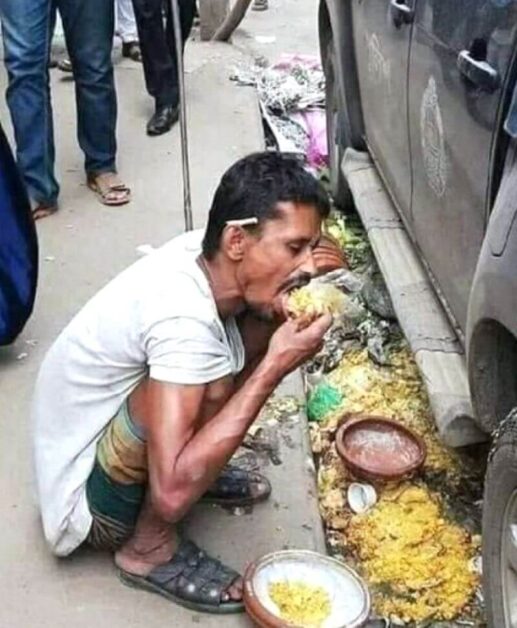
I keep returning to one image: a man in Bangladesh eating from a roadside gutter, picking through food thrown out after a ceremony. That image has stayed with me since I first wrote this essay. The food in that gutter had been cooked with care, served with pride, and thrown away without a thought, a few metres from someone who needed it.
How to Reduce Food Waste: What Actually Works
The data suggest that change is possible when people decide it matters. Some practical steps:
At home
- Plan meals and shop with a list, so you buy what you will eat.
- Store food properly. UNEP found that households in hotter countries waste more food per person, and points to more fresh food and weak cold chains as possible reasons. How you store food matters as much as how much you buy.
- Learn the difference between “use by” (safety) and “best before” (quality).
- Cook leftovers into new meals; South Asian kitchens already know how to do this well.
At weddings and ceremonies
- Hosts can cater for confirmed guests, not imagined crowds.
- Serve in smaller rounds rather than piling plates high.
- Arrange in advance for surplus food to go to food banks, shelters or local volunteers. In Dhaka, the Prochesta Foundation’s Food Bank project began collecting wedding leftovers in 2016 and, by its founder’s 2018 count, had gathered meals for over 60,000 people from more than 250 weddings.
- Change the measure of generosity. A well-fed guest, not a wasted plate, is the sign of a good host.
At the policy level
- Measure it properly. UNEP notes that only a few G20 countries (Australia, Japan, the UK and the US), plus the EU, have food waste data good enough to track progress.
- Invest in cold chains and storage to cut post-harvest loss.
- Include food waste in national climate plans; as of 2022, only 21 countries had done so.
Actual foods for thought
Although our first thought and love is food, it is nonetheless heartbreaking to see how much food humanity wastes owing to luxury. it is about food thought, food love and food waste of our time. Food is defined, by the United Nations, as any substance – whether processed, semi-processed or raw – that is intended for human consumption.
“Food” includes drinks and any substance that has been used in the manufacture, preparation or treatment of food. When the amount of our accumulated food determines our possibility of how long and how well to be alive, it controls the entire human psychology in the process of being alive. Lack of food leads to starvation, starvation to death, while excesses are responsible for the same as well.
News circulation makes us aware that many people in the country are facing or nearly facing starvation due either to high inflation or poverty. Their inability to secure two square meals or unexpected cutting of foods is responsible for psychological abnormality and low cognitive functionality. By contrast, there are numerous people who have to skip meals due to physical reasons.
For them, their physical and psychological well-being relies on eating less or skipping meals whenever possible. They are not affected by it. Because this kind of starvation is purposeful. Voluntary deficiency of something does not deplete mental strength but rather strengthens it.
The consumption of the sacrificial meat of Ram by the Hindu community in Bangladesh is considered forbidden by Islam while eating beef by a Hindu can cause his social orchestration. During the Second World War the Jews could not have the option to choose their Kosher foods, while the Muslim soldiers had to eat the same foods that were given to non-Muslim soldiers, instead of Halal consumption.
Foods are to be considered Haram, halal, forbidden or permitted only when there are options to do so. It is just a religious precept. But our natural instinct of survival does not count foods whether they are permitted to consume or not when situations present us with no option. This does not exempt cannibalism. A cabin boy, Richard Parker was killed and eaten by the Victorian sailors, when stranded in the middle of the South Atlantic during a voyage, in 1884.
In bygone days, even today in some areas or countries, female children and women would have been given less or substandard foods. Because they were thought to be the burden and unproductive hands by their parents and society. Moreover, the quality of foods determines the quality and the degree of our success in real-life situations. Because our success is the accumulation of opportunities, the opportunity to eat good foods.
God, gods and goddesses seemed to have favoured some particular foods for a particular community of people. Islam, Judaism, Hinduism and Christianity permit killing a particular set of cattle for consumption and for the purpose of offering to the creator. From the time unknown, the gods of the ages demanded food sacrifice from mere mortal creatures.
Just to know how valuable foods can be in regard to cultural legacy, and one’s honour we can shed some light on a few nations and their perception of food. In Indian subcontinental countries, wedding parties turn into battlegrounds and marriages get dissolved over food quality or shortage of food during a wedding party. People fought over the shortage of food at a wedding party in Bangladesh. A bride’s family refused to solemnise marriage because of the chaos created by the groom’s family over chicken dish.
A wedding day turned into chaos as guests fought with each other as food run out in India. These are a few pictures of frequent social phenomena revolving around food.
Bob Ashley and other in their Food and Cultural Studies observe that Our class and identity is judged by our taste of culinary, and it helps us judge if someone is ‘our kind of people’. For example, in the UK, balsamic vinegar has become a means of condensing a series of images of the middle-class foodie who wishes to demonstrate their associations with restaurant cuisine, international travel and knowledge of food fashions.
The ways in which what we eat and how we eat relate to class cultures and identities. The foods we eat are not simply an expression of individual tastes but have a wider basis in class cultures and lifestyles, and cultural identity. Tastes are not simply a reflection of our identity but work to construct our cultural identity: we may be what we eat, but what we eat also produces who we are.
While the working or middle-class people struggle for the quantity of foods, the upper-class people are much more concerned about the quality over quantity and the style and aesthetic quality of foods presented.
Claude Fischler identifies food-related ‘neophilia’, a favourable reaction to unfamiliar foods, accompanied by ‘neophobia’, which sees the new in terms of danger, rejects the unfamiliar (foods), and falls back on familiar and ‘safe’ foods. Current examples of neophobia are frequently seen in holiday-makers’ rejection of indigenous foods as ‘dangerous.
The conquering party always ate better foods than the vanquished people making the former better equipped to dominate the subordinates even better. Food is material, but also symbolic, and literally every day. Our experience of food is a physical, sensual, shared human experience. Food is embodied, mundane, and often gendered in its preparation and consumption.
Experience of it evokes recollections that are not simply cognitive, but also emotional and physical. during their exodus of Israelis to the promised land of milk and honey from Egyptian slavery, they rebelled against Moses for the lack of food in the middle of the desert. they recalled the time of slavery and the prospect of quality foods.
Frequently Asked Questions
How much food is wasted in the world each year?
About 1.05 billion tonnes in 2022, or 132 kg per person, according to the UNEP Food Waste Index Report 2024. That is almost one-fifth of all food available to consumers. A further 13.3% of food is lost between harvest and retail, according to FAO.
Where does most food waste happen?
In homes. Households produce about 60% of global food waste, food service about 28%, and retail about 12% (UNEP 2024).
What is the difference between food loss and food waste?
Food loss happens between harvest and retail, through spoilage, pests and poor storage. Food waste happens at the retail, food service and household stages, mostly because of what people buy, serve and throw away.
How many people are hungry in 2026?
The latest UN estimate, from the SOFI 2026 report published in July 2026, is that 645 million people faced hunger in 2025, about 7.8% of the world population.
How much food does Bangladesh waste?
UNEP estimates that Bangladeshi households waste 82 kg of food per person per year, about 14.10 million tonnes. Some economists question this figure because it rests on a few small studies and may include inedible kitchen waste.
Why is food wasted at weddings in Bangladesh?
Because generosity is measured by abundance. Hosts cook for more guests than will come and serve more than people can eat, since running short is a social disgrace. In a 2019 ActionAid Bangladesh survey, 52% of young respondents in Dhaka named weddings as the main place they saw food wasted.
How does food waste affect climate change?
Food loss and waste produce an estimated 8-10% of global greenhouse gas emissions, according to UNEP. Food rotting in landfills releases methane, a powerful greenhouse gas.
Conclusion: Let Us Live, and Let Others Live
We waste food because we love it in the wrong way. We love it as a symbol of status, faith, belonging and pride, and symbols demand excess. The result is a world that throws away over a billion meals a day while 645 million people go hungry.
Food is what we have in our minds around the clock. If we can think about it that much, we can think about it a little better. Cook what we will eat. Serve what our guests can finish. Give away what we cannot use. Judge a wedding by its kindness, not its leftovers.
Let us live, and let others live as well. Stop the waste.







