
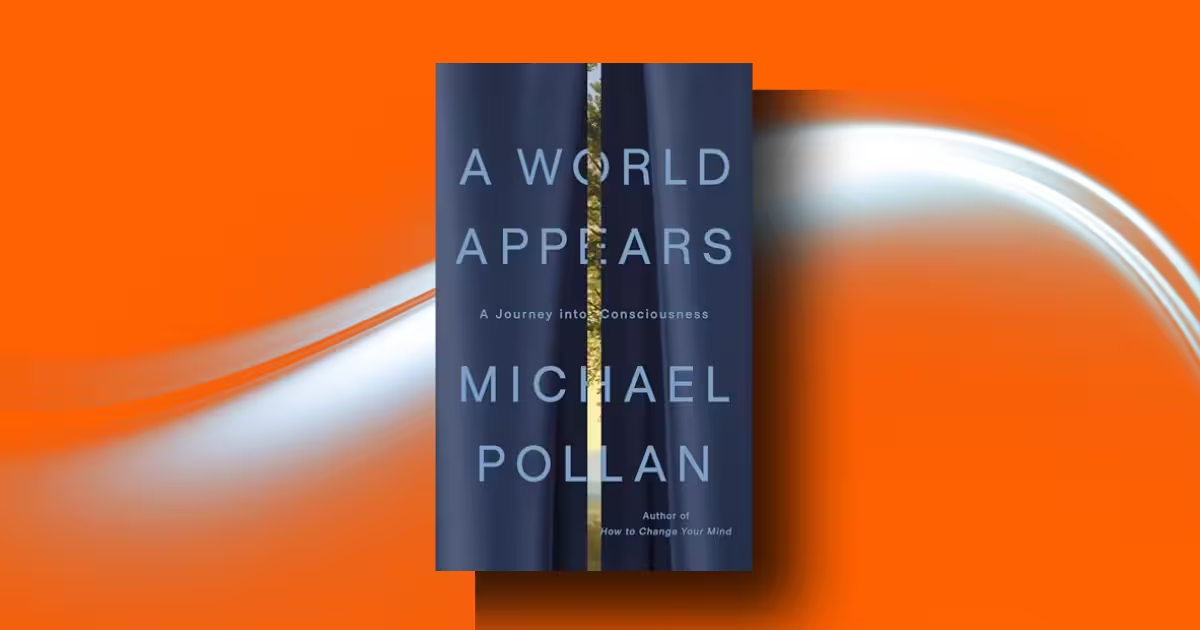
Can we ever truly pinpoint why it feels like something to be alive, or does the answer lie hidden outside our own minds? A World Appears: A Journey into Consciousness will show you how to break free from traditional, brain-centric science to uncover the startling reality of sentience in plants, machines, and the universe at large.
A World Appears is an absolute treasure for readers who are endlessly curious about neuroscience, philosophy, and the hidden depths of the mind. It is best for those who loved Pollan’s previous deep-dives like How to Change Your Mind and are comfortable wrestling with existential questions.
It is not for readers seeking a rigid, textbook-style biological breakdown of the brain, or those who prefer fast-paced, plot-driven narratives over sweeping philosophical meditations.
Table of Contents
1. Introduction
A World Appears: A Journey into Consciousness by Michael Pollan, published by Penguin Press (2026).
Michael Pollan, the celebrated author of The Omnivore’s Dilemma and How to Change Your Mind, pivots his investigative lens toward the ultimate mystery: human consciousness. Merging biography, neuroscience, philosophy, and botanical science, Pollan acts as a guide through the “unmapped continent” of our inner lives.
The central idea of A World Appears is that the traditional, purely materialist approach to understanding consciousness—assuming it is solely a product of the human brain’s neural networks—is fundamentally flawed and limited.
Pollan argues that to truly grasp awareness, we must decenter humanity and examine the phenomenon of sentience across the natural world, from plants and single-celled organisms to artificial intelligence, ultimately embracing a phenomenological (lived experience) perspective.
Background: The book uses a famous 1998 wager between neuroscientist Christof Koch and philosopher David Chalmers as its launching pad.
Koch bet a case of fine wine that science would discover the exact physical “neural correlates” of consciousness within 25 years. Chalmers, who famously coined the “hard problem of consciousness” (why physical processing is accompanied by an inner, felt experience), argued that reductive science alone would fail.
By 2023, Koch conceded, handing Chalmers the victory—and a case of Madeira.
2. A World Appears Summary
To fully comprehend the depth of A World Appears, we must unpack its journey step by step. Pollan constructs the narrative through an Introduction, four distinct thematic chapters (Sentience, Feeling, Thought, Self), and a Coda.
Introduction: The Wager
The book opens in a bar in Bremen in 1998, introducing the legendary clash between reductive science and philosophy.
Pollan outlines Chalmers’s distinction between the “easy problems” of consciousness (learning, memory, perception) and the “hard problem” (why any of this processing feels like anything internally).
We are introduced to leading contemporary theories, such as Giulio Tononi’s Integrated Information Theory (IIT), which argues that consciousness is integrated information, and Global Neuronal Workspace Theory (GNWT)1, which envisions the mind as a theater where information competes for the “spotlight” of awareness.
Pollan admits his own dual sympathies: he bristles at the arrogance of reductive chemistry, yet respects science’s track record of solving ancient mysteries.
He sets his own wager for the reader: by the end of this journey, the reader will be more conscious of their own mind and the world.
Chapter 1: Sentience
Pollan initiates his exploration not with humans, but at the absolute bottom of the evolutionary tree: plants. He explains how Western science, driven by Galileo and Descartes, “bifurcated” nature, separating objective, measurable qualities from subjective, qualitative experiences (like color or sweetness).
This division effectively stripped the natural world of its “soul” and left us blind to the sentience around us.
Pollan then dives into the controversial field of “plant neurobiology”.
He meets scientists like Paco Calvo and Stefano Mancuso, who argue that plants are highly intelligent problem-solvers.
Mancuso demonstrates how plant roots navigate mazes to find nutrients, while Calvo explains how plants exhibit a form of “lantern consciousness”. We learn staggering facts: the Mimosa pudica (sensitive plant) forms memories that last up to 28 days, and plants can be rendered unconscious using the exact same anesthetics that work on humans.
The chapter pushes the boundary of sentience even further with the work of developmental biologist Michael Levin. Levin demonstrates that neurons are not strictly necessary for memory or cognition; all cells communicate via bioelectric fields.
He proves this by decapitating a flatworm (planaria) and showing that its newly grown head retains old memories.
The chapter culminates with physicist Karl Friston’s “free-energy principle,” the theory that all self-organizing systems strive to minimize “surprise” (entropy) by making continuous inferences about their environment. In Friston’s view, sentience is born of the biological imperative to maintain homeostasis.
Chapter 2: Feeling
If sentience is the baseline, how does it evolve into conscious feeling? Pollan meets with psychologist Daniel Gilbert, who questions why information processing needs to feel like anything.
To answer this, Pollan turns to neurologist Antonio Damasio, who famously flipped Descartes’s maxim to “I feel, therefore I am”.
Damasio locates the origin of consciousness in the upper brainstem, driven by the body’s need to maintain homeostasis (temperature, hunger). Feelings are simply the conscious translation of these biological imperatives.
Pollan then investigates whether this biological imperative can be replicated in machines. He speaks with Mark Solms, a neuroscientist attempting to engineer artificial consciousness based on the idea that “consciousness is felt uncertainty”. Solms creates AI agents with conflicting “needs” (like hunger and fatigue) to force the machine into a state of uncertainty, theoretically generating “affect” or feeling.
The chapter also touches upon the hysteria surrounding Google’s LaMDA AI, where engineer Blake Lemoine became convinced the software was sentient. Pollan maintains a critical distance, warning of the “Moravec paradox” and questioning whether simulated feelings, stripped of genuine mortal vulnerability and biological flesh, can ever truly equate to human consciousness.
Chapter 3: Thought
Moving from raw feelings to the contents of the mind, Pollan asks: What exactly is a thought? He participates in a demanding psychological experiment run by Russell T. Hurlburt using Descriptive Experience Sampling (DES).
Armed with a beeper that goes off randomly, Pollan must record his exact inner experience at the microsecond of the beep. To his shock, he discovers his inner life is incredibly banal, heavily pre-verbal, and highly difficult to capture.
Pollan contrasts this rigid, moment-by-moment scientific sampling with the fluidity of the “stream of consciousness,” a concept championed by William James and literary giants like Virginia Woolf and James Joyce.
He interviews psychologist Kalina Christoff Hadjiilieva, who studies “spontaneous thought” and the brain’s Default Mode Network (DMN). She reveals that a thought often registers in the hippocampus up to four seconds before we become consciously aware of it—a staggering gap in mental time.
Pollan also interviews novelist Lucy Ellmann, author of the 1,000-page, single-sentence novel Ducks, Newburyport, to understand how artists map the swirling, spiraling, and often chaotic nature of our inner monologues.
Chapter 4: Self
The final conceptual pillar of the book is the “Self.”
Pollan highlights the paradox that the self is essential for our survival, yet practically impossible to locate. He interviews Alison Gopnik, who contrasts the panoramic, wide-open “lantern consciousness” of babies with the narrow, goal-oriented “spotlight consciousness” of adults.
Neuroscientist Anil Seth is brought in to explain that the self is not a perceiver, but rather a “controlled hallucination” constructed by the brain’s predictive processing engine. Michael Levin returns to explain “mnemonic improvisation,” the idea that our memories are not static files, but rather malleable narratives constantly rewritten by the self to ensure future survival.
To test the boundaries of the self, Pollan explores ego-dissolution through meditation and psychedelics. He recounts his own experience of taking psilocybin and watching his “self” dissolve into a puddle of blue Post-it notes.
He speaks with philosopher Thomas Metzinger, who compiles accounts of “Minimal Phenomenal Experience” (MPE) or pure awareness—consciousness completely devoid of a self. The chapter concludes with Christof Koch, the staunch physicalist from the Introduction, admitting he has abandoned strict materialism after a profound ayahuasca journey, pivoting toward idealist philosophy.
Coda: The Cave
The book finishes on a deeply resonant, grounded note.
Pollan travels to the Upaya Zen Center in New Mexico to meet Roshi Joan Halifax. Instead of answering his abstract theoretical questions, she sends him to a remote, dirt-floored cave at 9,400 feet to practice silence and meditation.
Alone with his chores and his mind, Pollan stops trying to intellectually “solve” consciousness.
Staring up at the night sky, he realizes that the intense drive to dissect the mind often prevents us from actually experiencing it. The grand takeaway is one of profound simplicity: “I open my eyes and a world appears”.
3. A World Appears Analysis
A World Appears is a breathtaking, panoptic achievement that successfully wrestles with one of the most stubborn mysteries of human existence. Following in the footsteps of his earlier masterworks, Pollan acts as the ultimate intellectual proxy for the reader.
Pollan’s strategy of decentralizing the human brain is highly effective.
By guiding us through the sentience of plants (via Mancuso) and the behavior of bioelectric cells (via Levin), he constructs a formidable argument against strict neurocentrism. The logical progression from Sentience to Feeling, to Thought, and finally to the Self provides a brilliant scaffolding for an otherwise esoteric subject.
However, Pollan’s foray into Artificial Intelligence feels slightly more tentative. While he effectively questions the “computational functionalism” driving conscious AI research, his own biases as a humanist writer occasionally overshadow a purely objective assessment.
He leans heavily on the idea that mortality and flesh are prerequisites for meaning, an argument that is philosophically romantic but perhaps dismissive of the purely functional definitions of consciousness proposed by researchers like Mark Solms.
Does the book fulfill its stated purpose? Unquestionably. Pollan never promised to solve the hard problem of consciousness; rather, he promised to guide us through its labyrinth.
By bridging the humanities, subjective phenomenology, and hard neuroscience, he contributes a deeply necessary, synthesizing perspective to a field often bogged down by its own specialized jargon.
4. Strengths and Weaknesses
Strengths:
Accessibility of Complex Science: Pollan excels at translating dense concepts—like Friston’s free-energy principle or the Bayesian brain hypothesis—into digestible, relatable metaphors.
Phenomenological Approach: The inclusion of literary perspectives (like Lucy Ellmann and Virginia Woolf) alongside scientific data grounds the book in the actual, lived human experience.
Narrative Vulnerability: Pollan’s willingness to subject himself to DES beepers, hypnosis, and cave retreats adds a layer of participatory journalism that is highly engaging.
Weaknesses:
Anti-Materialist Bias: While highlighting the failures of strict physicalism is valid, Pollan occasionally gives perhaps too much uncritical space to idealist or panpsychist viewpoints, allowing the “magic” he was warned against by Daniel Gilbert to seep into the scientific discourse.
Pacing in the Middle: The deep dive into DES sampling with Russell Hurlburt in Chapter 3 borders on the tedious, mimicking the banality of the thoughts being sampled.
5. Comparison with Similar Other Works
A World Appears enters a crowded field of literature attempting to decode the mind, but it stands out for its breadth.
Peter Godfrey-Smith’s Other Minds: While Godfrey-Smith elegantly explores the evolution of consciousness through cephalopods, Pollan pushes the boundary even further back to plants and cellular bioelectricity.
Anil Seth’s Being You: Seth (who features prominently in Pollan’s book) offers a deeply neuroscientific argument for predictive processing. Pollan zooms out, placing Seth’s theories in conversation with Buddhist philosophy and literary arts.
Michael Pollan’s How to Change Your Mind: This book feels like a natural sequel. Where his previous work explored how to alter consciousness, this book asks what the underlying mechanism actually is.
6. Conclusion
A World Appears: A Journey into Consciousness is highly recommended for anyone fascinated by the intersection of biology, philosophy, and psychology.
It is perfectly suited for general audiences; Pollan’s masterful prose ensures that one does not need a Ph.D. in cognitive science to grasp the profound implications of the text.
By the time you reach the Coda, you will find yourself staring at your own hands, listening to your own inner monologue, and looking at the trees outside your window with a renewed, almost childlike sense of awe.
Pollan reminds us that while science may one day map the wiring of the brain, the feeling of being alive remains a sublime, irreducible gift.
- Global Neuronal Workspace Theory (GNWT) posits that consciousness arises when local, unconscious brain activity is “ignited” and globally broadcast across a network of high-level cortical areas. ↩︎







