
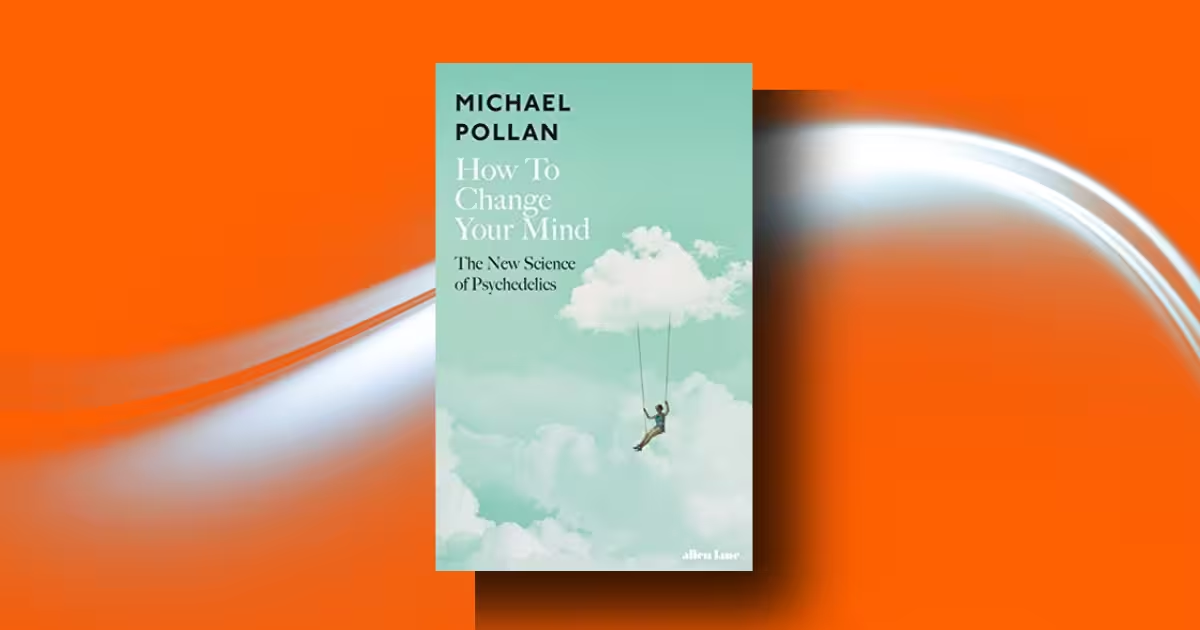
Did you ever wonder why you feel trapped in the endless, repetitive loops of your own mind, and what it would take to finally break free? How to Change Your Mind by Michael Pollan will show you how the suppressed science of psychedelics might hold the key to unlocking human consciousness, curing depression, and completely rewiring your brain.
How to Change Your Mind is best for: deep thinkers, science enthusiasts, biohackers, and anyone fascinated by neuroscience, psychology, or the mysteries of human consciousness. If you crave exhaustive, full-spoiler analyses of how the mind works and are seeking to optimize your mental frameworks, this is your goldmine.
This book is not for closed-minded readers who automatically dismiss psychedelics as a 1960s counterculture relic, or those looking for a light, breezy beach read.
Table of Contents
1. Introduction
The book is How to Change Your Mind: What the New Science of Psychedelics Teaches Us About Consciousness, Dying, Addiction, Depression, and Transcendence by Michael Pollan (Penguin Press, 2018).
Context: Michael Pollan, widely celebrated for his meticulous investigative reporting on food and nature (The Omnivore’s Dilemma, The Botany of Desire), shifts gears completely in this masterful work.
Entering his sixties as a self-proclaimed “reluctant psychonaut” and a steadfast philosophical materialist, Pollan steps into the highly stigmatized world of psychedelic science. This isn’t a nostalgic look at the 1960s counterculture; it is a rigorous, scientifically grounded, and deeply personal exploration of the human mind.
How to Change Your Mind’s central thesis is that classical psychedelics (like LSD, psilocybin, and 5-MeO-DMT) are not merely recreational drugs to be feared, but powerful, misunderstood psychiatric medicines.
When administered in a controlled, clinical setting, these compounds possess the unparalleled ability to dissolve the ego, quiet the brain’s rigid networks, and occasion profound mystical experiences.
These experiences, in turn, hold the potential to cure treatment-resistant depression, severe addiction, and the paralyzing existential dread of dying.
2. How to Change Your Mind Summary
I want to dive deep into the very fabric of this book so that you won’t even need to go back to the source material to grasp its monumental findings. What I learned from this book completely shattered my preconceptions about the brain, and I want you to know exactly how Pollan breaks it down, chapter by chapter.
The Prologue & The Renaissance (Chapter 1)
Pollan introduces us to the dual history of two molecules that changed the 20th century: LSD, accidentally synthesized by Swiss chemist Albert Hofmann at Sandoz Laboratories in 1938 (and accidentally ingested in 1943, leading to the world’s first acid trip); and psilocybin, the active ingredient in “magic mushrooms,” which was introduced to the Western world in 1957 by R. Gordon Wasson via a famous Life magazine article.
The narrative quickly fast-forwards to 2006, the birth year of the “psychedelic renaissance.” Pollan pinpoints a landmark paper published by Roland Griffiths at Johns Hopkins University: “Psilocybin Can Occasion Mystical-Type Experiences Having Substantial and Sustained Personal Meaning and Spiritual Significance.”
In a rigorous, double-blind study, Griffiths proved that psilocybin could reliably induce mystical experiences that volunteers ranked among the most meaningful events of their lives.
Behind the scenes, we meet figures like Bob Jesse and Rick Doblin (founder of MAPS), who tirelessly worked to bring psychedelic research out of the dark ages and into modern, FDA-approved clinical trials.
Natural History: Bemushroomed (Chapter 2)
Pollan doesn’t just read the science; he goes into the field. He introduces us to Paul Stamets, a legendary, eccentric mycologist who believes fungi possess a form of natural intelligence.
Stamets guides Pollan in foraging for Psilocybe azurescens (a highly potent species) in the Pacific Northwest. We learn about the “stoned ape” theory proposed by Terence McKenna, which suggests that early hominids consuming psilocybin mushrooms experienced a rapid expansion of brain capacity, language, and self-reflection.
While Pollan remains skeptical of the evolutionary mechanics of this theory, the chapter beautifully illustrates how mycelial networks function as “Earth’s natural Internet,” connecting ecosystems in ways we are only just beginning to understand.
History: The First Wave (Chapter 3)
Before Timothy Leary became the smiling, controversial poster boy for LSD in the 1960s, there was a legitimate, thriving era of psychedelic psychiatry. Pollan excavates this buried history.
We meet Al Hubbard, the “Johnny Appleseed of LSD,” a former bootlegger and spy who recognized the importance of “set and setting”—the mindset of the user and the physical environment of the trip. Hubbard introduced LSD to Silicon Valley engineers, sparking creative breakthroughs that arguably shaped the personal computer revolution.
We also meet Humphry Osmond, the psychiatrist who coined the term “psychedelic” (meaning “mind manifesting”) in a 1956 correspondence with author Aldous Huxley (The Doors of Perception).
During the 1950s, psychedelics were successfully used to treat alcoholism, with staggering success rates. However, the rise of Timothy Leary’s Harvard Psilocybin Project, his subsequent dismissal, and his urging of America’s youth to “turn on, tune in, drop out” triggered a massive cultural and political backlash.
By 1966, the government panicked, research was shut down, and the science went underground.
Travelogue: Journeying Underground (Chapter 4)
This is where the book becomes intimately personal. Pollan, seeking to understand the phenomenology of these drugs, hires underground guides to experience them firsthand.
Trip One (LSD): Guided by a German expatriate named Fritz, Pollan undergoes holotropic breathwork before taking a dose of LSD. He experiences a profound softening of his ego, navigating his family relationships with a flood of uncharacteristic compassion and love.
Trip Two (Psilocybin): Guided by Mary, Pollan consumes a large mushroom. The trip takes a dark turn into a simulated digital world, followed by a harrowing encounter with the faces of the dead (including his own grandfather’s skull). But when Mary plays Bach’s unaccompanied cello suite by Yo-Yo Ma, Pollan loses his ego entirely.
He becomes a “transparent ear,” merging completely with the music, experiencing a profound reconciliation with death.
Trip Three (5-MeO-DMT / The Toad): Smoked from the venom of the Sonoran Desert toad, this is the “Everest of psychedelics.” Pollan experiences a terrifying, absolute obliteration of the self—a big bang in reverse—followed by a blissful, ecstatic rebirth. He returns with the realization that simply being is as vital as doing.
The Neuroscience: Your Brain on Psychedelics (Chapter 5)
What exactly happens in the brain during ego dissolution? Pollan explores the groundbreaking neuroimaging work of Robin Carhart-Harris at Imperial College London. Carhart-Harris discovered that psychedelics actually decrease blood flow and activity in the Default Mode Network (DMN).
The DMN is the brain’s “orchestra conductor” or “corporate executive”—the seat of the ego, rumination, mental time travel, and our autobiographical narrative.
When the DMN is suppressed by psychedelics, the brain becomes “entropic” (highly plastic and interconnected). Regions of the brain that rarely communicate suddenly forge new connections. This explains synesthesia, hallucinations, and the profound “out of the box” thinking reported by users.
Pollan also draws on the work of Alison Gopnik, suggesting that psychedelics return the rigid, constrained adult brain to the fluid, “lantern consciousness” of a young child.
The Trip Treatment: Psychedelics in Psychotherapy (Chapter 6)
In the final, most emotional section, Pollan examines modern clinical trials:
Dying: At NYU and Hopkins, terminal cancer patients (like Patrick Mettes) are given psilocybin to treat existential distress. By experiencing “ego death” during their trips, these patients lose their terror of physical death, realizing that consciousness or love might be something larger than their physical bodies.
Addiction: Dr. Matthew Johnson at Hopkins is using psilocybin to treat smoking addiction. The psychedelic journey acts as a “biological control-alt-delete,” disrupting the rigid, destructive narrative loops of the addict’s brain.
Depression: Carhart-Harris’s trials in London show that treatment-resistant depression can be remarkably alleviated by psychedelics. The drugs temporarily flatten the deep, snowy grooves of depressive rumination, allowing patients to forge new, healthier neural pathways.
3. How to Change Your Mind Analysis
How to Change Your Mind is a groundbreaking, monumental achievement in science journalism. Reading it feels like watching a heavy, dark curtain being pulled back to reveal a universe of potential we were told to ignore.
Pollan effectively bridges the gap between the rigid materialism of modern science and the ineffable realm of human spirituality.
Pollan’s methodology is bulletproof. He does not rely on woo-woo mysticism; instead, he grounds every extraordinary claim in hard data, fMRI scans, and peer-reviewed clinical trials from elite institutions like Johns Hopkins and NYU. When he encounters the “ineffable,” he approaches it with the skepticism of a seasoned journalist, testing reality at every turn.
The book absolutely fulfills its stated purpose: it successfully rehabilitates psychedelics from the cultural baggage of the 1960s, presenting them as indispensable tools for understanding the brain.
According to major outlets like The New York Times and The Guardian, Pollan has single-handedly mainstreamed a taboo subject, and I wholeheartedly agree.
4. Strengths and Weaknesses
Strengths:
My most pleasant experience with this book was Pollan’s vulnerability. It is incredibly compelling to watch a rigid, 60-year-old intellectual completely dismantle his own ego. His vivid, first-person “travelogue” perfectly balances the dense neuroscience.
Furthermore, the historical excavation of the “First Wave” of psychedelic research is masterfully researched, rescuing figures like Al Hubbard and Humphry Osmond from obscurity.
Weaknesses:
If there is a negative, it is that the book occasionally gets bogged down in the minutiae of the historical turf wars between mid-century psychiatrists.
Additionally, Pollan focuses almost exclusively on LSD and Psilocybin (with a brief detour into 5-MeO-DMT), leaving other powerful entheogens like Ayahuasca or MDMA largely out of the primary clinical analysis, which leaves a slight gap in the overarching narrative of modern psychedelic therapy.
5. Comparison with Similar Works
Compared to Aldous Huxley’s classic The Doors of Perception, Pollan’s work is far more grounded in modern clinical science rather than pure philosophical musing.
While books like James Fadiman’s The Psychedelic Explorer’s Guide serve as practical manuals, How to Change Your Mind is a comprehensive cultural, historical, and neurological synthesis that stands alone in its depth and accessibility.
6. Conclusion
I cannot recommend How to Change Your Mind highly enough. It is an absolute must-read for anyone suffering from depression, anxiety, or addiction, as well as psychiatrists, neuroscientists, and the everyday seeker looking to optimize their mental health.
It is highly suitable for a general audience, yet rigorous enough to satisfy the most demanding specialist. It will literally change the way you view your own mind.







