
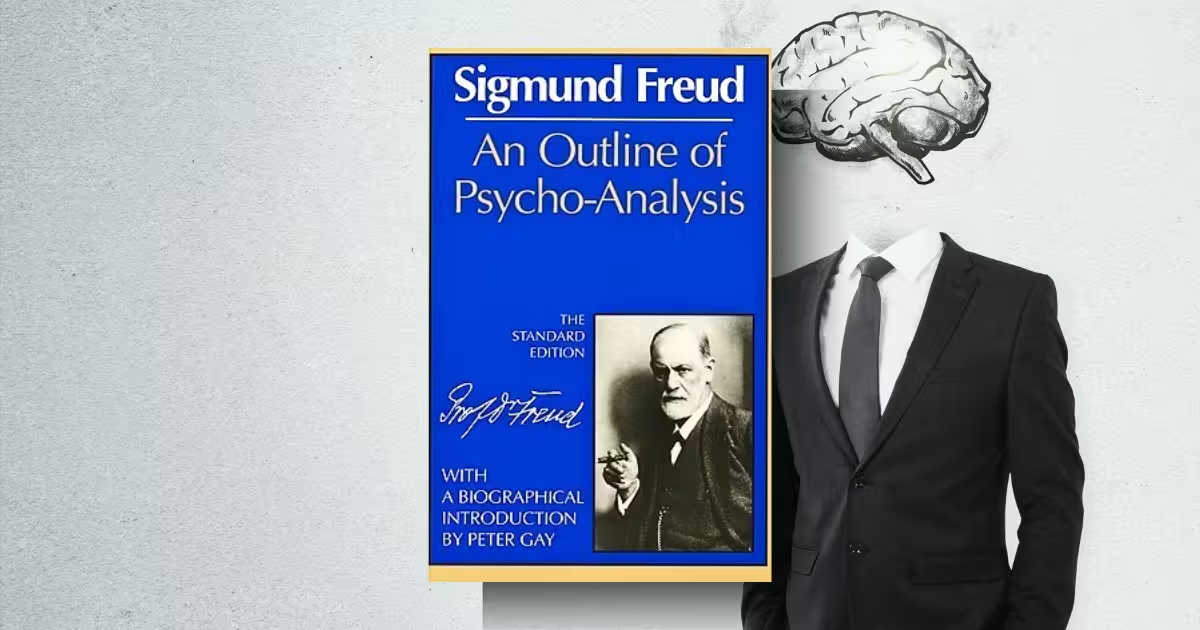
Have you ever wondered why your deepest fears and desires seem to control you from the shadows of your own mind? This question lies at the heart of Sigmund Freud’s final masterpiece, An Outline of Psychoanalysis, a book that distills a lifetime of revolutionary thinking into a concise, powerful statement about the architecture of the human psyche.
Overview
An Outline of Psychoanalysis represents Freud’s final attempt to synthesize his life’s work into a coherent, accessible framework. Written in 1938 while he was dying of cancer and fleeing Nazi persecution, this slim volume packs more insight than textbooks five times its size.
It presents Freud’s complete model of the mind—the id, ego, and superego—alongside his theories of drives, dreams, and neurosis.
What you’ll get:
- A crystal-clear explanation of how the unconscious shapes everyday behavior
- The definitive statement on the id, ego, and superego structure
- Revolutionary insights into why we repeat destructive patterns
- A glimpse into Freud’s final thinking on aggression and the death drive
- Practical understanding of psychoanalytic technique and its limitations
What this book is NOT:
- A comprehensive clinical manual for practicing therapy
- A defense of all of Freud’s controversial theories about women
- An easy, light read—it demands attention and reflection
- A replacement for later developments in psychoanalysis
Reader recommendation
An Outline of Psychoanalysis is recommended for:
- Psychology students seeking the clearest overview of Freud’s complete system
- Curious readers who want to understand why psychoanalysis still matters
- Writers and artists exploring the unconscious dimensions of creativity
- Anyone fascinated by how childhood shapes adult personality
- Critics of psychoanalysis who want to engage with the original source
An Outline of Psychoanalysis is not recommended for:
- Readers seeking modern therapeutic techniques or evidence-based treatments
- Those easily offended by Freud’s controversial views on female psychology
- People looking for feel-good self-help or quick solutions
- Readers who require every theory to be backed by contemporary neuroscience
Table of Contents
Introduction
Title: An Outline of Psychoanalysis (German title: Abriss der Psychoanalyse)
Author: Sigmund Freud (1856–1939)
Publication Details: First published posthumously in 1940 in the Internationale Zeitschrift für Psychoanalyse und Imago. This edition, translated by Helena Ragg-Kirkby, was published by Penguin Classics in 2003. The volume also includes Freud’s New Introductory Lectures on Psychoanalysis (1933), providing crucial context.
Author’s Credentials: Sigmund Freud needs little introduction as the founder of psychoanalysis.
Born in 1856 in Moravia (now part of the Czech Republic), Freud spent most of his life in Vienna until 1938, when Hitler’s annexation of Austria forced him to flee to London. His career began with groundbreaking work in neuroanatomy and physiology before he turned to psychology, initially studying under Charcot in Paris.
After ten years of clinical work with neurotic patients—first in collaboration with Josef Breuer—Freud developed what would become psychoanalysis.
His major works include The Interpretation of Dreams (1900), Three Essays on the Theory of Sexuality (1905), and The Ego and the Id (1923).
Context
An Outline of Psychoanalysis is exactly what its title suggests—a structural overview of Freud’s complete psychological system. Unlike his earlier case studies or theoretical papers, this book represents a conscious effort to present psychoanalysis “as it were a dogmatic conspectus” bringing together “all its doctrines in the most concentrated and clear-cut form” (p. 175).
This project is remarkable for its timing. Freud wrote the An Outline of Psychoanalysis during the final months of his life, as he was simultaneously battling cancer of the jaw and fleeing Nazi persecution.
An Outline of Psychoanalysis was completed in London, where Freud had found refuge after the Anschluss of March 1938. As Malcolm Bowie notes in his introduction, these circumstances lend the work “its own intellectual drama and its own atmosphere of risk” (p. 23).
The book represents not an old man’s retreat into safe consensus, but a courageous act of defiance against disease, infirmity, and what Freud called “almost prehistoric barbarism.”
Purpose
The central argument of An Outline of Psychoanalysis is that human behavior is governed by unconscious forces that can be understood scientifically, and that this understanding offers the possibility of therapeutic intervention.
Freud’s fundamental premise, stated early in the book, is that “the psychical in itself is unconscious” (p. 185). This seemingly simple assertion revolutionizes psychology by making it possible to study the mind as a natural science, “like any other” (p. 184).
The book argues for a tripartite structure of the mind—the id, ego, and superego—and demonstrates how conflict between these agencies produces neurosis. It presents the drives (Eros and the death drive) as the fundamental energies powering mental life, and it offers a model of how psychoanalytic treatment can strengthen the ego against the demands of both the id and the superego.
Throughout, Freud maintains a remarkable balance between scientific certainty and intellectual humility, acknowledging that his theories remain “too new” and that “nobody has tried so far to put them to any practical use” (p. 161).
Background
To understand An Outline of Psychoanalysis, we must appreciate the intellectual and historical context in which it was written.
By 1938, Freud had spent more than forty years developing psychoanalysis. The movement had grown from a small circle of Viennese physicians into an international organization with followers across Europe and America.
Yet it remained deeply controversial. In scientific circles, psychoanalysis was often dismissed as unscientific speculation; in popular culture, it was either derided or trivialized. Freud had weathered countless attacks and defections (most notably from Alfred Adler and Carl Jung), and his own health was failing.
The political situation was even more dire.
The rise of Nazism in Germany and its spread to Austria threatened not only Freud’s personal safety but the very survival of psychoanalysis. The Nazis burned Freud’s books and denounced his work as “Jewish science.” In March 1938, German troops entered Vienna, and Freud found himself trapped.
It was only through the intervention of influential friends—including Ernest Jones, Princess Marie Bonaparte, and even the American ambassador—that Freud was able to secure permission to leave. He arrived in London in June 1938, a dying man in a foreign land.
Yet the Outline shows no trace of despair. Instead, it demonstrates what Arnold Schoenberg called, in describing Mahler’s Ninth Symphony, “objective, almost passionless statements of a beauty which becomes perceptible only to one who can dispense with animal warmth” (p. 25).
This is Freud at his most lucid and systematic, distilling a lifetime’s work into a final testament.
An Outline of Psychoanalysis Summary
Part One: The Nature of Things Psychical
The Outline is divided into three parts. The first part, “The Nature of Things Psychical,” presents Freud’s complete model of the mind in five chapters.
Chapter 1: The Psychical Apparatus
Freud begins by establishing his fundamental premise: “Psychoanalysis makes a basic assumption… that psychical life is the function of an apparatus which, we say, extends spatially and consists of several pieces” (p. 175). This apparatus is not anatomical but psychological—a model of mental functioning rather than a description of brain structures.
The id (das Es) is described as “the oldest of these psychical provinces,” containing “everything that is inherited, everything present at birth, everything constitutionally determined—above all, then, the drives originating from the bodily organization” (p. 177). This is the unconscious core of personality, governed by the pleasure principle and seeking immediate gratification. It has no organization, no unified will, and “knows nothing of value-judgements, good and evil, or morality” (p. 124).
The ego (das Ich) develops from the id through contact with the external world. According to Freud, “the Ich is that part of the Es that has been modified through its proximity to the external world” (p. 125). The ego represents reason and prudence, mediating between the id’s demands and reality’s constraints. It “represents the claims of the external world” to the id and “dethrones the pleasure principle, which holds unrestricted sway over processes in the Es, and replaces it by the reality principle” (p. 126).
The superego (das Über-Ich) emerges later, as a residue of the child’s relationship with parents and their authority. As Freud explains, “the beginning of the Über-Ich can be described as an instance of successful identification with the parental authority” (p. 111). The superego becomes “the vehicle of the Ich-ideal” and represents all moral boundaries, functioning as our conscience.
Key insight from this chapter: The mind is not a unity but a battleground. As Freud famously states, “Where Es was, there shall Ich be” (p. 131)—the goal of psychoanalysis is to expand the ego’s territory at the expense of the id.
Chapter 2: The Theory of the Drives
Freud’s theory of drives represents one of his most controversial contributions. He argues that there are “only two basic drives: Eros and the destruction-drive” (p. 179).
Eros (the life drive) encompasses not just sexual desire but all urges toward “establishing and maintaining ever greater unities” (p. 179). It is conservative in nature, striving to bind things together.
The destruction-drive (or death drive) aims to “dissolve connections, and thus to destroy things,” ultimately returning the living to the inorganic state (p. 179).
Freud acknowledges that this theory has proven controversial: “The very idea of a strange drive that is occupied in destroying its own organic home” (p. 163) has struck many as implausible. However, he argues that “the cooperation and opposition of both drives produces the phenomena of life that death puts to an end” (p. 165).
Drive blending and fusion: Freud proposes that most drive-impulses involve “mergences or fusions of the two kinds of drive—in all sorts of different proportions” (p. 161). This insight is crucial for understanding pathology, as “de-mergences affect function in the most severe way” (p. 161).
The chapter also introduces the concept of libido, the energy of Eros. Libido is initially stored in the ego (primary narcissism) and then invested in objects. Freud compares this to a “protoplasm behav[ing] with its pseudopodia” (p. 181), constantly sending out and withdrawing investments.
Chapter 3: The Development of the Sexual Function
This chapter presents Freud’s theory of psychosexual development, one of his most famous and controversial contributions.
Freud challenges the popular view that “human sexual life essentially consists of the urge to bring our own genitals into contact with those of someone of the opposite sex” (p. 182). Instead, he argues that sexual life “doesn’t bide its time until puberty” but “starts to manifest itself very clearly soon after birth” (p. 183).
The oral phase: The first erogenous zone is the mouth. Freud notes that “the child’s stubborn and persistent sucking” represents “a need that—although it comes from and is stimulated by the taking in of nourishment—is nevertheless independent of nourishment and strives to gain pleasure” (p. 185).
The sadistic-anal phase: During this period, “gratification is sought in aggression and in the excretory function” (p. 185). This phase is divided into two stages: the earlier, destructive tendency and the later, “object-friendly” tendency (p. 154).
The phallic phase: The male member alone plays a role here, as “the female genitals remain unrecognized for a long time to come” (p. 185). During this phase, the child enters the Oedipus complex—the boy’s desire for his mother and rivalry with his father.
The latency period: After the phallic phase, sexual development pauses until puberty. This “two-phased onset of the function” (p. 188) is unique to humans and critically important for cultural development.
Chapter 4: Psychical Qualities
This chapter addresses what distinguishes psychology from other sciences: the quality of consciousness. Freud acknowledges that consciousness is “the unparalleled fact of consciousness, which defies all explanation and description” (p. 184).
However, he insists that “the psychical in itself is unconscious” (p. 185). This allows psychology to develop “like any other natural science” by studying processes “which are in themselves just as unknowable as those of other sciences” (p. 184).
Three qualities of psychical processes:
- Conscious: Processes that are immediately present to awareness
- Preconscious: Processes that can become conscious easily
- Unconscious: Processes that require effort to make conscious
Primary vs. secondary processes: The unconscious operates according to different laws than conscious thought. These “primary processes” are characterized by compression, displacement, and the absence of logic. Freud calls the unconscious “the Empire of the Illogical” (p. 189).
Chapter 5: Explanatory Notes Concerning the Interpretation of Dreams
Freud returns to the topic that first made psychoanalysis famous. He argues that dreams are “a psychosis, with all the inconsistencies, delusions, and tricks of the senses that the psychoses demonstrate” (p. 196)—but a harmless psychosis that serves a useful function.
The mechanisms of dream-work:
Compression: “A single element of the manifest dream often represents a whole host of latent dream thoughts” (p. 190)
Displacement: Psychical intensities are “displaced from one element to another, so that in the manifest dream one element that was unimportant in the dream thoughts often appears to be the clearest and, correspondingly, the most important” (p. 191)
Symbolism: Dreams make “unlimited use of linguistic symbols, the meaning of which the dreamer mostly doesn’t understand” (p. 190)
Secondary processing: The mind attempts to make sense of the dream after the fact.
The function of dreams: Dreams serve as “guardians of sleep” (p. 195). The sleeping ego, wishing to continue sleeping, meets disturbing demands with harmless wish-fulfillment.
Part Two: The Practical Task
Chapter 6: The Psychoanalytical Technique
This chapter explains how psychoanalysis works as therapy. Freud frames the therapeutic relationship as a kind of deal: “The ailing Ich promises to be fully honest with us… in return, we promise it the utmost discretion, and we put at its service our experience in interpreting material influenced by the unconscious” (p. 197).
Free association: The fundamental rule of analysis requires the patient to tell “everything that his self-observation yields to him; everything that comes into his mind, even if it is unpleasant for him to say it, even if it seems to him to be unimportant or even ridiculous” (p. 199).
Transference: Perhaps the most important discovery of psychoanalytic technique, transference occurs when “the patient doesn’t continue to see the analyst in a realistic light… but sees in the analyst the return—the reincarnation—of an important person from his childhood” (p. 200). Transference is ambivalent, encompassing “positive and tender attitudes as well as negative, hostile ones” (p. 200).
Resistance: The ego protects itself “against being invaded by undesired elements from the unconscious” (p. 203). Overcoming resistance “is the part of our work that takes up the most time and is the greatest trouble.
However, it is also worth it” (p. 204).
Freud identifies two additional sources of resistance:
- The unconscious sense of guilt: “The individual shall not become healthy: he shall remain ill, for he deserves nothing better” (p. 205)
- The need to suffer: In some patients, “the self-preservation drive has undergone a reversal. They seem to be set on nothing other than self-harm and self-destruction” (p. 206)
Chapter 7: A Sample of Psychoanalytical Work
Freud presents a case study that illustrates his model: the Oedipus complex and its resolution.
The boy’s trajectory: The boy enters the phallic phase and “becomes the mother’s lover… In short, his early awakened maleness tries to replace his father in her affections” (p. 214).
This leads to the castration threat: “She [the mother] threatens to take the thing away from him which he is using to defy her” (p. 214). The threat of castration destroys the Oedipus complex and ushers in the latency period.
The girl’s trajectory: The girl’s development is more complicated. Unlike the boy, “she doesn’t have to fear losing her penis; however, she does have to react to not having had one in the first place” (p. 217). This leads to penis envy, which “influenced by penis envy, can’t forgive for having sent her out into the world so ill-equipped” (p. 218).
The difference between sexes: Freud emphasizes that “the relationship between the Oedipus and castration complexes takes such a different—even opposing—form in women from the one it takes in men” (p. 219). In boys, the threat of castration ends the Oedipus complex; in girls, the lack of a penis creates it.
Part Three: What We Gain For Our Theory
Chapter 8: The Psychical Apparatus and the External World
This chapter examines the relationship between the mind and reality. Freud argues that “it is not scientifically feasible to distinguish between what is psychically normal and psychically abnormal” (p. 220). Neurosis and psychosis are not caused by foreign bodies but represent “quantitative disharmonies” (p. 209).
The weak spot: “The weak spot in the organization of the Ich lay in the way it related to the sexual function” (p. 211). Neurosis arises when the immature ego is confronted with sexual demands it cannot master.
Splitting of the ego: Freud introduces the concept of ego splitting, in which “two opposing outlooks, independent of one another, always set themselves up” (p. 224). This occurs in perversions like fetishism and in psychosis.
Chapter 9: The Internal World
The final chapter completes the model by examining the relationship between the ego and superego.
The superego as legacy: “The Über-Ich is indeed the legacy of the Oedipus complex” (p. 226). It represents “the in influence of the individual’s childhood” and “the past of the whole civilization that the child is meant to relive, as it were, in the short span of its early period of life” (p. 227).
The superego’s severity: Freud notes that “the Über-Ich often develops a severity for which the actual parents have provided no pattern” (p. 226). This severity corresponds to “the strength of the defense used against the temptations of the Oedipus complex” (p. 226).
The three powers: The ego is caught between three masters—”the external world, the Über-Ich, and the Es” (p. 128). Its task is to reconcile their conflicting demands. This is why, as Freud famously observes, “life is so difficult” (p. 129).
An Outline of Psychoanalysis Analysis
Evaluation of Content
An Outline of Psychoanalysis is nothing less than magnificent. It represents the culmination of Freud’s life’s work, presented with a clarity and concision that his earlier, more sprawling works often lacked. This is not a book for beginners—it assumes familiarity with basic psychoanalytic concepts—but for readers who have some grounding, it offers an unparalleled overview.
What the book does brilliantly:
Systematic presentation. Freud organizes his material with extraordinary skill. The tripartite structure—psychical apparatus, practical task, theoretical gains—creates a logical progression from theory to application to synthesis. Each chapter builds on the previous one.
Clarity of expression. In passages like “The poor Ich serves three tyrannical masters” (p. 128), Freud achieves a compression and vividness that makes complex ideas accessible. The analogy of the ego to a rider guiding a horse is memorable and instructive.
Intellectual honesty. Freud acknowledges the limitations of his theories. He admits that “we know nothing about” the nature of psychical energy (p. 191). He concedes that “nobody has tried so far” to apply his model of drive fusion (p. 161). This humility, typical of An Outline of Psychoanalysis, contrasts with the dogmatism of which Freud is often accused.
Integration of new ideas. The An Outline of Psychoanalysis incorporates Freud’s later concepts—the death drive, ego splitting, the superego—into a unified framework. This is not a simple restatement of old ideas but a genuine synthesis.
Therapeutic realism. Freud’s discussion of psychoanalytic therapy is remarkably honest. He acknowledges that “we don’t always emerge victorious” and that the outcome “depends on quantitative relations” (p. 208). This is the voice of a clinician who has seen success and failure.
Where the book falls short:
Controversial claims. Freud’s theory of female sexuality remains deeply problematic. His statement that “we ascribe a high degree of narcissism to females” (p. 198) and his discussion of penis envy reflect the prejudices of his time. The feminist critic will find much to object to.
Anthropological speculation. The phylogenetic claims in An Outline of Psychoanalysis—suggesting that experiences from human prehistory are somehow encoded in the unconscious—lack empirical support. Freud’s references to “an archaic inheritance” (p. 190) are speculative even by his own standards.
Limited therapeutic evidence. An Outline of Psychoanalysis does not provide systematic evidence for the effectiveness of psychoanalysis. Freud admits that “the final outcome depends on quantitative relations” but doesn’t explain how these could be measured.
Biologism. The tendency to treat psychological phenomena as biological in origin—the “destruction-drive” as a fundamental force, the two-phase development of sexuality as an evolutionary remnant—reflects the scientific reductionism of Freud’s time. Contemporary readers may find this approach limiting.
Significance and Impact
Despite these limitations, An Outline of Psychoanalysis has had an enduring impact. It codified the Freudian system in a form that could be taught, criticized, and debated. It provided a vocabulary—id, ego, superego, repression, transference, resistance—that shaped not only psychology but literature, art, philosophy, and popular culture.
The book has also inspired countless subsequent developments. Erik Erikson expanded Freud’s psychosexual stages into a psychosocial model.
Jacques Lacan reformulated Freudian concepts in structuralist terms. Melanie Klein and the object relations school shifted attention to early infancy. Even Freud’s critics—from feminist scholars to cognitive neuroscientists—engage with the framework he established.
As Malcolm Bowie notes, “the later politics of the psychoanalytic movement are already there in an early draft form” (p. 15). The debates between Kleinians and Anna Freudians, between Freudians and Lacanians, are anticipated in the tensions within An Outline of Psychoanalysis itself.
Strengths and Weaknesses
Strengths
Clarity and concision. An Outline of Psychoanalysis presents complex ideas with remarkable clarity. The structural model of id, ego, and superego, and the description of psychosexual development, have become part of our intellectual heritage.
Intellectual courage. Freud wrote this book while dying of cancer and facing political persecution. It represents an act of defiance against biology and history.
Synthesis. An Outline of Psychoanalysis integrates the full range of Freud’s thought—from the early dream theory to the late metapsychology—into a coherent whole.
Therapeutic insight. Freud’s discussion of transference, resistance, and the relationship between analyst and patient remains relevant for anyone engaged in psychological treatment.
Literary merit. An Outline of Psychoanalysis is beautifully written. Passages like “The poor Ich serves three tyrannical masters” (p. 128) have the concision of poetry.
Weaknesses
Controversial theories. Freud’s views on female sexuality, child development, and the death drive are deeply contested. An Outline of Psychoanalysis does not address criticisms or alternative perspectives.
Speculative elements. The phylogenetic arguments, the claim that “living substance was once a unity which was then torn apart” (p. 179), and the speculation about the origin of life reflect Freud’s willingness to go beyond evidence.
Therapeutic limitations. Freud acknowledges that psychoanalysis is not effective for all patients, but he does not provide a systematic account of its limitations or of alternative treatments.
Cultural bias. An Outline of Psychoanalysis reflects the assumptions of Freud’s time and place. It does not address cross-cultural variation, social determinants of mental health, or the impact of gender and racial inequality.
Comparison with Similar Works
Compared to The Interpretation of Dreams (1900)
The Interpretation of Dreams is Freud’s magnum opus, a sprawling work that presents the dream theory in exhaustive detail. An Outline of Psychoanalysis condenses this theory into a few pages, focusing on the structural model of the mind. While the earlier work is more exciting and revolutionary, the Outline is more systematic and mature.
Compared to The Ego and the Id (1923)
The Ego and the Id first presented the structural model that An Outline of Psychoanalysis makes central. The earlier work explores the implications of this model in depth. An Outline of Psychoanalysis integrates it into a comprehensive framework, but it lacks the intellectual excitement of the original formulation.
Compared to Civilization and Its Discontents (1930)
Civilization and Its Discontents applies psychoanalytic theory to social and cultural questions. An Outline of Psychoanalysis is more narrowly focused on individual psychology. However, An Outline of Psychoanalysis‘s discussion of the superego and cultural development connects to themes explored in the later work.
Compared to New Introductory Lectures on Psychoanalysis (1933)
The New Introductory Lectures and An Outline of Psychoanalysis are companion works, both written in the 1930s. The lectures are more accessible, addressing a general audience, while An Outline of Psychoanalysis is more technical.
The lectures include detailed discussions of dream theory and female sexuality that An Outline of Psychoanalysis summarizes briefly.
Compared to Carl Jung’s Works
Freud and Jung represent two divergent traditions. Jung’s The Archetypes and the Collective Unconscious emphasizes mythological and spiritual dimensions that Freud largely ignores.
For readers interested in the broader cultural implications of depth psychology, Jung may be more rewarding. For readers interested in clinical application, Freud remains essential.
Conclusion
Recommendation
An Outline of Psychoanalysis is essential reading for anyone who wants to understand the Freudian system. It is the clearest, most concise statement of Freud’s mature thought, written at the end of his life with a purity of style and purpose that makes it a masterpiece of intellectual distillation.
Who will benefit:
Psychology students. An Outline of Psychoanalysis provides the foundation for understanding not only Freud but the entire psychoanalytic tradition.
General readers. Despite its technical nature, An Outline of Psychoanalysis is accessible to any educated reader willing to engage with challenging ideas.
Critics. To criticize psychoanalysis effectively, one must understand it. An Outline of Psychoanalysis provides the most efficient route to this understanding.
Therapists. The discussion of transference, resistance, and the therapeutic relationship remains relevant for all forms of psychological treatment.
Who may want to skip it:
Readers seeking practical self-help. An Outline of Psychoanalysis is theoretical and clinical, not a guide to personal improvement.
Those seeking a contemporary perspective. An Outline of Psychoanalysis reflects Freud’s time and place; it does not incorporate later developments.
Readers easily offended. Freud’s views on female psychology and sexuality remain controversial.
Final Thoughts
An Outline of Psychoanalysis is a final testament from a towering figure. It offers what Lionel Trilling called “the pleasure of listening to a strong, decisive, self-limiting voice uttering statements to which I can give assent” (p. 22). Despite its flaws—and they are real—it remains a work of enduring power.
As Freud himself concludes: “Our best hope for the future is that the intellect—call it the scientific spirit, call it reason—will over the course of time establish a dictatorship over the human psyche” (p. 160). An Outline of Psychoanalysis is a monument to this hope.







