Last updated on October 19th, 2026 at 03:03 pm
And Then There Were None is not a murder mystery in the usual sense, because Agatha Christie removes the one figure readers expect to trust: the detective. Ten strangers arrive on a bare island off Devon, each accused of a killing the law could not punish, and then the nursery rhyme framed in their bedrooms begins to come true.
What makes the 1939 novel so durable is not the puzzle alone but the way Christie turns guilt into weather, something that presses down on every room and every conversation until suspicion starts to feel like instinct.
I have read it three times, and the shock never comes from the final name. It comes from how quickly ordinary people become willing to believe the worst of each other.
Table of Contents
And Then There Were None Review
The God of this island is not a detective. It is a man with a notebook, a gramophone, and a nursery rhyme. I have read And Then There Were None by Agatha Christie three times, and each reading leaves me colder than the last. The first time, I was a teenager chasing the puzzle. The second time, I was a writer studying its clockwork.
This time, I was a human being watching ten guilty people tear each other apart in a house with no exit. That shift matters, because Christie did not write a whodunit.
She wrote a howdunit that doubles as a psychological autopsy of people who have already gotten away with murder. If you want the plot summary, it is below.
If you want to know whether this 1939 novel still earns its reputation as the world’s best-selling mystery, the answer is yes, but not for the reasons most readers expect. It earns it because it is cruel in a way that feels honest.
And Then There Were None at glance
Reader recommendation for And Then There Were None: This book will thrill readers who love closed-circle puzzles, unreliable narration, and the slow horror of watching logic fail. It is perfect for fans of Knives Out who want a darker, older ancestor.

However, readers who need a likeable protagonist to anchor them will bounce hard. Christie gives you no detective to trust, no innocent to root for, and no comfort at the end.
And Then There Were None is not a fair-play mystery in the traditional sense because the killer is hidden not by clues but by the structure of the narrative itself. If you need a warm human centre, this island has none. If you want a masterclass in tension, it has no equal.
Introduction
And Then There Were None is a mystery novel by Agatha Christie, first published in the United Kingdom by the Collins Crime Club on 6 November 1939. It was originally released under a title I will not repeat here, drawn from an 1869 minstrel song that serves as the novel’s structural spine.
The United States edition arrived in January 1940 under the title we know today, taken from the last five words of that same rhyme. Christie herself described it as the most difficult of her books to write, and her author’s note at the front of the novel admits the technical problem: ten people must die without the murderer becoming obvious or the whole thing tipping into absurdity.
The book has sold more than 100 million copies worldwide and is widely listed as the best-selling crime novel of all time. It does not feature Hercule Poirot or Miss Marple. It features no detective at all.
Featured Snippet Sections
Quick Verdict: A ruthless, airtight puzzle that doubles as a study of guilt. Christie strips away the detective and leaves only the accused, making this the most unsettling novel in her catalogue.
Should You Read It?
| Pros | Cons |
|---|---|
| Unmatched structural precision; the nursery rhyme device works as both clue and clock | No likeable central figure; every character is guilty of something |
| Genuine psychological horror built from ordinary people under pressure | The ending depends on a confession, not a detective’s deduction, which frustrates some puzzle purists |
| Short chapters, propulsive pacing, and an atmosphere of paranoia that never lets up | The original title and rhyme contain racial language that many modern editions have changed |
| A rare mystery where the “detective” and the “murderer” are the same person | Readers who want a fair-play solution they can solve alongside a sleuth may feel cheated |
What Is It About? Ten strangers are lured to an isolated island off the Devon coast by a mysterious host who never arrives. A voice on a gramophone accuses each of them of a murder the law could not punish. One by one, they die in ways that mirror an old nursery rhyme, and the survivors realise the killer is not hiding on the island. The killer is one of them.
Rating: 4.5/5
Background
Christie wrote And Then There Were None in 1939, on the edge of a war that would change how Britain thought about justice, death, and the state’s power to kill.
The novel is often read as a thought experiment about capital punishment, but it is also a product of its moment: a country that had not yet entered the war, watching a continent slide toward organised slaughter, asking what it means to deserve death.
The island setting is borrowed from Burgh Island in Devon, where Christie often stayed, but the geography of the novel is deliberately bare. There are no trees, no caves, no hiding places.
Christie strips the landscape down to rock and sea so that the only terrain left to explore is the human mind under siege. The book’s original title was changed for the American market, and later editions replaced the rhyme’s language with “soldier boys” or “Indians,” a revision that has itself become part of the novel’s complicated afterlife.
And Then There Were None Plot Summary
And Then There Were None opens with eight people travelling separately to Soldier Island, a small rock off the Devon coast.
They are Vera Claythorne, a games mistress hired as a secretary; Philip Lombard, a former soldier of fortune; Dr Armstrong, a Harley Street physician; Emily Brent, a rigidly pious spinster; General Macarthur, a retired army officer; Anthony Marston, a rich and reckless young man; Mr Justice Wargrave, a recently retired judge; and William Blore, a former police inspector travelling under the false name “Mr Davis.”
They are met by a married couple, Thomas and Ethel Rogers, who have been hired as butler and cook.
The host, a Mr U. N. Owen, has not arrived. The name is a joke: U. N. Owen sounds like “Unknown.”
Each guest finds a framed copy of a nursery rhyme in their bedroom: “Ten little soldier boys went out to dine; One choked his little self and then there were Nine.” On the dining table sit ten china figurines. After dinner, a gramophone record plays.
A calm, inhuman voice accuses each person of a specific murder. Wargrave is accused of sentencing Edward Seton to death for a murder Seton did not commit. Vera is accused of allowing Cyril Hamilton, a child in her care, to drown. Lombard is accused of abandoning twenty-one men of an East African tribe to die.
Armstrong is accused of killing a patient through a drunken operation. Emily Brent is accused of driving her servant Beatrice Taylor to suicide. General Macarthur is accused of sending his wife’s lover, Arthur Richmond, to his death in the First World War. Anthony Marston is accused of running down two children, John and Lucy Combes, with his car.
Blore is accused of perjuring himself to convict an innocent man, James Landor, who died in prison. The Rogerses are accused of withholding a drug from their employer, Jennifer Brady, in order to inherit her money.
No one denies the accusations outright. They deny the legal consequences, but they do not deny the facts.
Anthony Marston dies first, choking on a whisky and soda laced with potassium cyanide. The doctor cannot find cyanide in the bottle, only in Marston’s glass, and the assumption is suicide. That night, Mrs Rogers dies in her sleep.
Armstrong cannot determine the cause, but the pattern is already forming. The china figures are disappearing. The survivors realise that the deaths are following the rhyme, and that the killer is not outside the house. The killer is among them.
The next morning, General Macarthur is found dead by the sea, his skull fractured. The search of the island finds no stranger. The judge takes charge, announces that “Mr Owen” is one of the seven remaining guests, and imposes a regime of mutual suspicion. Rogers is killed while chopping firewood, struck from behind with a heavy chopper. Emily Brent is injected with cyanide after a bumblebee is theatrically released near her. The judge is found shot through the head, dressed in a scarlet curtain and a judge’s wig made from Miss Brent’s grey wool. Three china figures remain.
Armstrong disappears. Blore, Lombard, and Vera are left.
Armstrong’s body is later found wedged in rocks, drowned. Vera and Lombard realise they are the only two left, and the revolver that Lombard had been carrying becomes the centre of a silent, deadly negotiation. Vera manages to take the revolver from Lombard’s pocket. When he lunges at her, she shoots him. She walks back to the house, alone, triumphant, and finds a rope hanging from a hook in her bedroom ceiling.
A chair waits beneath it. The final line of the rhyme is already written. She hangs herself.
The epilogue reveals that the police cannot solve the case. The manuscript found in a bottle at sea is written by Mr Justice Wargrave. He confesses everything. He had a lifelong sadistic urge to kill and a lifelong obsession with justice. He selected ten victims who had committed murders the law could not touch. He arranged every detail, including his own apparent death, by conspiring with Armstrong, who believed they were setting a trap for the real killer. Wargrave killed Armstrong by pushing him off a cliff, then staged his own death with red mud and a curtain.
He shot himself in his bedroom using an elastic cord and a handkerchief to leave no fingerprints, so that his death would complete the rhyme. The final message is the confession itself, thrown into the sea for someone to find.
The Ending Explained
The ending of And Then There Were None is not a solution delivered by a detective. It is a confession delivered by the murderer, and that changes everything. Wargrave is not caught. He is not outsmarted. He wins, and the only reason we know what happened is that he wanted recognition.
The epilogue is not a restoration of order. It is a postscript written by a man who could not resist explaining his own cleverness.
And Then There Were None’s final line, “And they will find ten dead bodies and an unsolved problem on Soldier Island,” is a taunt. Christie does not give the law a victory. She gives the killer a stage, and she gives the reader the uncomfortable job of being the only audience.
Analysis and Criticism
Characters
Wargrave is the most important character because he is the engine and the mask. He presents himself as a retired judge with a clear conscience, a man who did his duty. His confession reveals that he enjoyed the power of sentencing men to death, and that he crossed a line from judging to executing.
He is not a vigilante in the ordinary sense. He is an artist who has found a canvas large enough for his ego.
He chooses victims whose guilt is real but legally untouchable, and he chooses methods that fit a nursery rhyme, because he wants the murders to be beautiful as well as just. That combination of sadism and aesthetics is what makes him terrifying. He is not insane in a way that makes him unpredictable. He is insane in a way that makes him methodical.
Vera Claythorne is the closest thing the novel has to a protagonist, but she is not innocent. She is guilty of the child’s death, even if the law cleared her. Her guilt is tied to Hugo, the man she loved, who she believed would inherit a fortune if the child died. She did not push Cyril into the sea. She let him swim out, and she swam after him too late, on purpose. That distinction is the moral centre of the novel.
Vera is not a monster. She is a woman who made a choice that she has spent years justifying. When she shoots Lombard, she does it to survive, but she has already been broken by the knowledge of what she is capable of. The rope waiting for her is not just a trap. It is a verdict she passes on herself.
Philip Lombard is the only character who openly admits his guilt.
He abandoned twenty-one men to die and he does not pretend otherwise. He is a predator, but he is also the most honest person on the island. His honesty does not make him good. It makes him predictable, and predictability is a liability in a game designed by a man who has spent a lifetime studying human weakness.
Lombard is shot by Vera because he underestimates her, and because he cannot resist the urge to talk when action is required. He is the closest thing the novel has to a hero, and he dies like everyone else.
Emily Brent is the most quietly disturbing character. She believes in her own virtue with absolute certainty, and that certainty is a kind of violence. She drove Beatrice Taylor out of her house when the girl became pregnant, and she feels no remorse. Her death by cyanide, staged with a bumblebee, is almost a joke, but it is a joke told by a man who sees her righteousness as a form of vanity.
Blore is the failed detective, a man who perjured himself to secure a conviction and who spends the novel trying to atone for it by solving a crime he cannot solve.
Armstrong is the gullible professional, a doctor who is manipulated by Wargrave because he cannot imagine that a man of Wargrave’s standing could be the killer. Macarthur is the weary soldier who has carried his guilt for decades and who seems almost relieved when death comes for him.
Anthony Marston is the amoral rich boy who never considers the consequences of his actions.
The Rogerses are the servants, the working-class couple whose crime was greed and whose fear is the most visceral in And Then There Were None.
Themes and Symbolism
The central theme of And Then There Were None is the gap between legal justice and moral justice. Wargrave’s victims are all guilty of something, but none of them can be punished by a court of law. The judge’s project is an attempt to close that gap.
He is not interested in revenge. He is interested in completion. The novel asks whether it is possible to commit a murder that is also an act of justice, and it answers that question by showing what happens to the person who tries.
Wargrave becomes the thing he claims to punish. He becomes a murderer, and the novel does not let him off the hook. His confession is not a justification. It is a confession, and the reader is left to decide whether his victims deserved what they got. Christie does not decide for us.
The nursery rhyme is the novel’s most important symbol. It is a children’s counting song, and its structure is one of inexorable diminishment. Ten become nine, nine become eight, and so on, until there are none.
The rhyme is not a clue in the traditional sense. It is a script, and the killer follows it with the devotion of a believer. The rhyme also creates a sense of inevitability that is essential to the novel’s atmosphere. The characters know what is coming. They can count the figures on the table. They know the next verse.
They cannot stop it. That feeling of being trapped inside a story that has already been written is what makes the novel so oppressive.
The island itself is a symbol of isolation and exposure.
There is nowhere to hide, and there is no one to help. The house is modern and bright and comfortable, but it is also a cage. The sea is always there, a boundary that cannot be crossed. The weather turns, the storm cuts them off, and the outside world becomes a rumour.
The island is a laboratory for Christie’s experiment, and the experiment is what happens when people who have gotten away with murder are forced to live with each other and with themselves.
Evaluation
And Then There Were None is an outstanding, merciless, and structurally perfect novel. It is not a warm book, and it is not a fair book in the way that a Poirot mystery is fair. It is a book about the impossibility of escaping guilt, and it uses the machinery of the mystery genre to deliver a verdict that no court could deliver. Christie’s prose is spare and efficient, and her pacing is immaculate.
The chapters are short, the tension is relentless, and the final revelation is both shocking and inevitable. I finished the book feeling unsettled, not because the mystery was solved, but because the solution was a confession written by a man who had already won.
Strengths: The structure is flawless. The rhyme device is not a gimmick. It is the architecture of the entire plot. The characters are thin by the standards of literary fiction, but they are exactly as thick as they need to be for the story to work. The atmosphere of paranoia is sustained from the first death to the last, and the ending is one of the most audacious in the genre.
Weaknesses: The novel’s lack of a sympathetic protagonist will frustrate some readers. The dependence on a confession rather than a detective’s deduction means that the reader cannot solve the crime in the traditional way. The original title and rhyme are racially charged, and modern editions have had to grapple with that history. The book is also, by design, a cold experience. It does not offer comfort.
Impact and Controversy: The novel has been criticised for its bleakness, and Christie herself softened the ending when she adapted it for the stage in 1943. In the play, Vera and Lombard survive and fall in love, a change Christie made because wartime audiences needed something less grim.
The novel’s original ending has since been restored in some theatrical versions, and the debate about which ending is more truthful is a debate about what Christie was trying to say. The novel says that guilt is inescapable. The play says that survival is possible. Both are Christie, but they are not the same Christie.
Comparison with Similar Works: And Then There Were None is often compared to Murder on the Orient Express, another Christie novel in which the guilty are punished outside the law.
But Orient Express has Poirot, and Poirot makes a choice. And Then There Were None has no detective, and that absence is the point. The novel is closer in spirit to The Lottery by Shirley Jackson, another story about a community that turns murder into ritual.
It is also a clear ancestor of Saw and Knives Out, though it is colder than both.
Adaptation: The 1945 film, directed by René Clair, had a budget of $1 million and grossed $1 million at the box office. It is a stylish and faithful adaptation, but it softens the ending in the same way the stage play does.
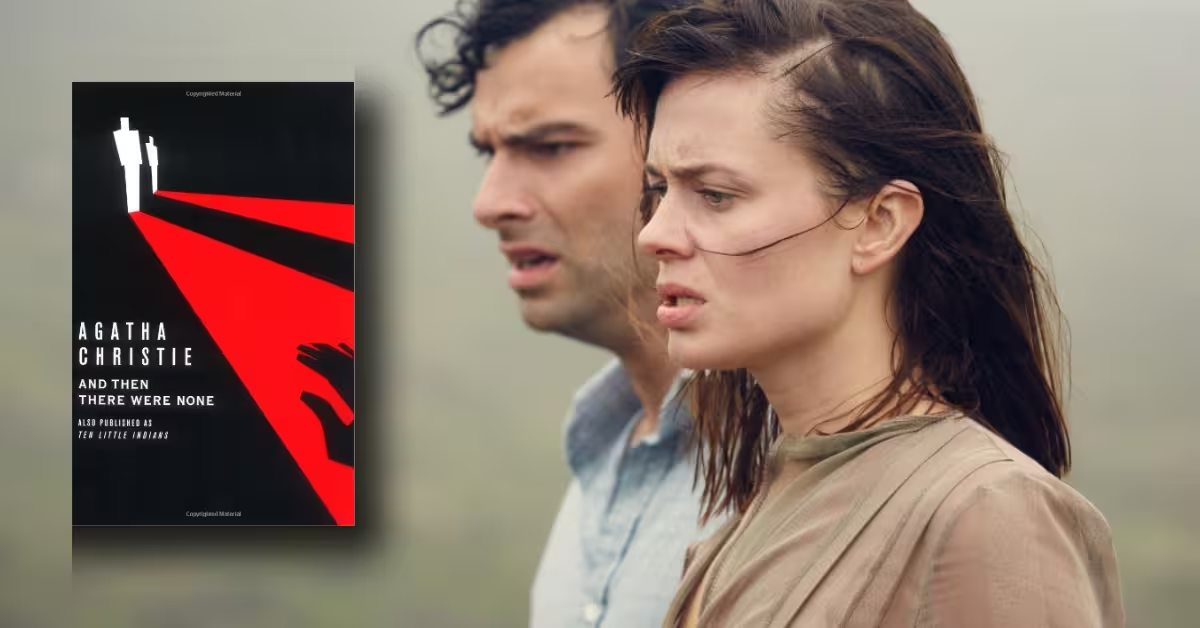
The 2015 BBC miniseries, written by Sarah Phelps, restores the novel’s darkness and is widely considered the most faithful screen version of Christie’s vision.
The miniseries does not flinch from the violence or the psychological cruelty, and it makes the case that And Then There Were None is not a cosy mystery. It is a horror story with a detective’s skeleton.
Personal Insight with Contemporary Educational Relevance
The most important problem And Then There Were None solves is the problem of what to do with people who are guilty but untouchable. Wargrave’s answer is murder. The novel’s answer is that his answer is wrong, but it does not offer a better one.
That tension is relevant to contemporary conversations about accountability, restorative justice, and the limits of the legal system. When a crime cannot be proved, does the absence of punishment mean the absence of guilt?
When a person has done something terrible but cannot be convicted, what does society owe to the victims, and what does it owe to the person? Christie does not answer these questions, but she makes them unavoidable.
Here are five lessons I take from the novel. First, guilt is not the same as legal guilt, and people know the difference even when they pretend not to. Second, a person who believes they are righteous is capable of more cruelty than a person who knows they are flawed.
Third, isolation amplifies fear, and fear makes people dangerous. Fourth, a story can be a trap, and the person who controls the story controls the outcome.
Fifth, justice without mercy is indistinguishable from revenge, and revenge is a cycle that does not end. These lessons are not comfortable, but they are useful. They are the reason the novel has lasted.
Quotable Lines and Passages
“One little soldier boy left all alone; He went and hanged himself and then there were None.” The final lines of the rhyme, and the blueprint for the final death.
“He had a definite sadistic delight in seeing or causing death… From an early age I knew very strongly the lust to kill.” Wargrave’s confession, which is both a diagnosis and a boast.
“The whole thing might be a dream….” Vera’s thought as she walks back to the house after shooting Lombard. It is the most human sentence in the book, and the most false.
Conclusion
And Then There Were None is a novel about the impossibility of getting away with anything. It is a mystery without a detective, a trial without a jury, and a confession without a judge. It is not a comforting book, and it is not meant to be.
I recommend it to readers who love closed-circle puzzles, to writers who want to study structure, and to anyone who has ever wondered what people are capable of when they believe no one is watching. It is not for readers who need a hero. There are no heroes on Soldier Island. There is only the rhyme, the figures on the table, and the voice that counts down to none.
And Then There Were None

And Then There Were None is not a murder mystery in the usual sense, because Agatha Christie removes the one figure readers expect to trust: the detective. Ten strangers arrive on a bare island off Devon, each accused of a killing the law could not punish, and then the nursery rhyme framed in their bedrooms begins to come true.
URL: #
Author: Agatha Christie
4.5
Pros
- Structurally flawless; relentless pacing; a genuinely unsettling study of guilt and paranoia; the nursery rhyme device works as both clue and clock.
Cons
- No sympathetic protagonist; the solution depends on a confession rather than a deduction; the original title and rhyme contain racially charged language; the novel offers no comfort.