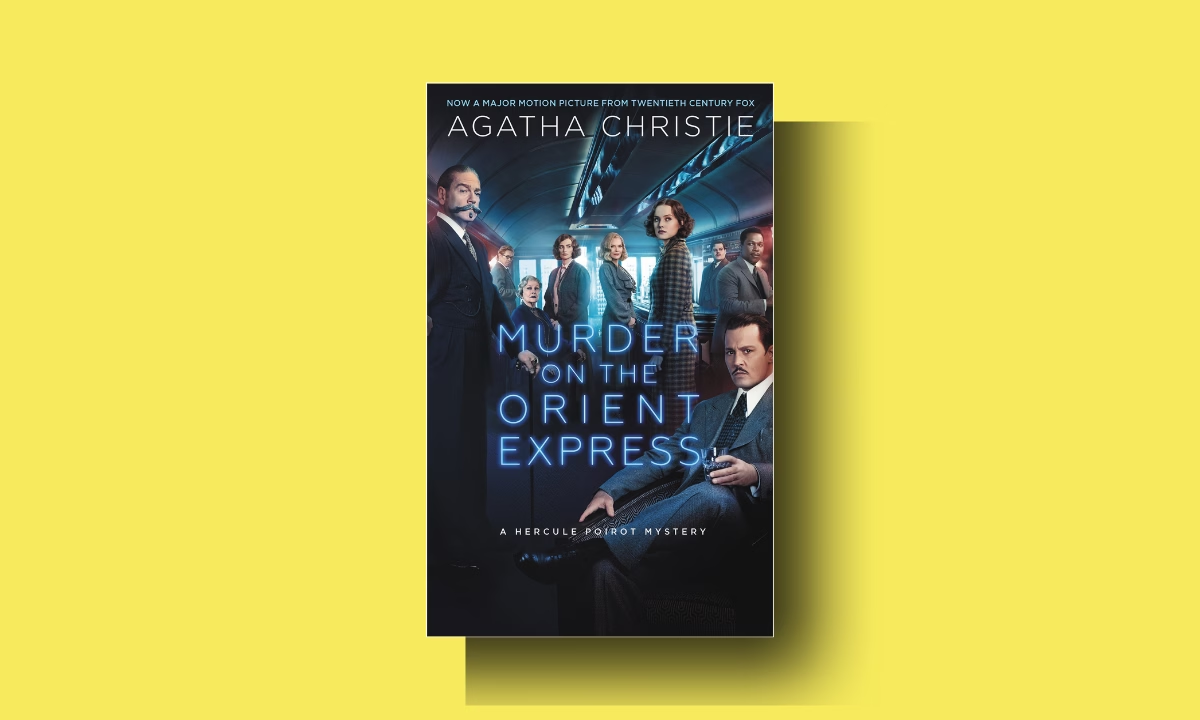
Murder on the Orient Express is not a whodunit in the ordinary sense. By the final pages, the question is no longer who killed Samuel Ratchett. The question is whether twelve people can become a court, a sentence, and an executioner all at once, and whether Hercule Poirot will let them walk away.
I have read this novel more than once, and the solution has never stopped bothering me, not because it is implausible, but because it is uncomfortably coherent.
Table of Contents
Quick Verdict: A ruthlessly structured mystery that disguises a moral tribunal as a train compartment. Recommended for readers who want their detective fiction to leave a mark.
Should You Read It?
| Pros | Cons |
|---|---|
| A solution that redefines what a detective novel can do | The middle section is heavily interview-based and slow for some readers |
| Poirot at his most morally conflicted | Requires patience with a large cast of passengers |
| Tight, snowbound atmosphere that makes the train a character | The central twist is widely spoiled in popular culture |
| A final chapter that refuses easy comfort | Some early-20th-century social attitudes have aged poorly |
What Is It About? A snowdrift stops the Simplon Orient Express in Yugoslavia. By morning, an American passenger named Ratchett is found stabbed twelve times in a locked compartment. Poirot, travelling by chance, is asked to solve the case before the police arrive.
What he finds is not a single killer but a closed circle of passengers with a shared history and a shared intention.
Rating: 4.5/5
Background: A Novel Written Against a Real Headline
Agatha Christie published Murder on the Orient Express in the United Kingdom through the Collins Crime Club on 1 January 1934, and in the United States as Murder in the Calais Coach on 28 February 1934 . By then, Christie was already the most commercially dominant figure in detective fiction, a position she never lost.

Guinness World Records lists her as the best-selling fiction writer of all time, with an estimated two billion copies of her novels sold in 44 languages .
The novel’s central crime, the kidnapping and murder of a child, was not invented from nothing. Christie drew on the Lindbergh kidnapping case of 1932, in which the infant son of aviator Charles Lindbergh was taken from his crib and later found dead .
In the real case, a household maid named Violet Sharp was repeatedly questioned and eventually took her own life; she was later cleared of involvement .
Christie transplanted that detail almost directly into the Armstrong subplot, where the nursery maid Susanne also dies by suicide after police suspicion. What she added, and what gives the novel its engine, was the acquittal. In Christie’s version, the kidnapper Cassetti escapes punishment through bribery and technicalities.
The murder on the train is not simply revenge; it is a correction of a legal failure.
That distinction matters. Christie was writing in the aftermath of a real trial that had divided public opinion, and she was writing for readers who understood what it felt like to watch a system fail. The novel does not excuse what happens in that snowbound carriage.
It asks whether the reader can condemn it cleanly.
Murder on the Orient Express Plot Summary
The novel opens not on the Orient Express but on the Taurus Express in Syria, where Poirot is finishing a delicate assignment and preparing to travel toward England. On the same train he encounters Mary Debenham, a poised young English governess, and Colonel Arbuthnot, an Indian Army officer. Their manner toward each other is strangely intimate for two people who claim to have just met.
Poirot overhears a fragment of conversation at Konya, in which Mary tells the Colonel, “Not now. Not now. When it’s all over. When it’s behind us” (Chapter 1). He files it away.
In Istanbul, Poirot learns of a telegram recalling him to London. He books a berth on the Simplon Orient Express through his old friend M. Bouc, a director of the Compagnie Internationale des Wagons-Lits. The train is unusually full for the season. Poirot ends up sharing a second-class compartment with Hector MacQueen, the young American secretary of a wealthy and unpleasant passenger named Samuel Edward Ratchett.
At dinner, Ratchett approaches Poirot and offers him a large sum to protect him from an enemy who has threatened his life. Poirot refuses, telling Ratchett plainly that he does not like his face (Chapter 3).
That night, Poirot is awakened by a cry from the compartment next door. Ratchett’s bell rings, and the conductor, Pierre Michel, knocks. A voice from inside calls out in French: “Ce n’est rien. Je me suis trompé” (It is nothing. I was mistaken). The train is stopped by heavy snow between Vincovci and Brod.
Later, Poirot hears a heavy thud against his door and sees a figure in a scarlet kimono retreating down the corridor.
In the morning, Ratchett is found dead. He has been stabbed twelve times, some wounds deep and forceful, others faint and glancing. The door was locked and chained from the inside, the window open but snow-free, and a dented watch in his pyjama pocket has stopped at 1:15. Dr. Constantine places death between midnight and 2 a.m.
Because the train is snowbound, no one could have left. M. Bouc asks Poirot to investigate before the Yugoslav police arrive.
The investigation proceeds passenger by passenger. The evidence accumulates in a deliberately confusing way. A pipe cleaner is found near the body, pointing toward Colonel Arbuthnot.
A fine cambric handkerchief with the initial H is found on the floor, pointing toward Mrs. Hubbard, Mary Debenham, or the maid Hildegarde Schmidt.
A Wagon Lit conductor’s button is found in Mrs. Hubbard’s compartment. Mrs. Hubbard insists a man was in her cabin during the night. Hildegarde Schmidt describes a small, dark man with a womanish voice in a conductor’s uniform. Hardman, the loud American, reveals he is actually a private detective hired by Ratchett. Greta Ohlsson, the Swedish missionary, admits she was the last person to see Ratchett alive. Antonio Foscarelli, the Italian car salesman, is evasive. Mary Debenham refuses to explain the Konya conversation. Princess Dragomiroff admits she knew the Armstrong family intimately and says the murder was “entirely admirable” (Chapter 10).
The breakthrough comes from a charred fragment of paper Poirot reconstructs with a hatbox wire and a spirit lamp: the words “member little Daisy Armstrong” (Chapter 7).
Ratchett was Cassetti, the man who kidnapped and murdered the three-year-old daughter of Colonel Armstrong and his wife Sonia, née Linda Arden’s daughter. The child’s death destroyed the family: Sonia died after a premature stillbirth, Colonel Armstrong shot himself, and the innocent French nursery maid Susanne threw herself from a window.
Cassetti was arrested but acquitted on a technicality and fled America under a new name.
Poirot then reconstructs the true solution. The twelve stab wounds correspond to twelve people. The passengers in the Stamboul-Calais coach are not strangers.
They are the Armstrong household, reassembled: Mary Debenham was the governess; Greta Ohlsson was the nurse; Foscarelli was the chauffeur; Masterman was Colonel Armstrong’s batman and later valet; Hildegarde Schmidt was the cook; Princess Dragomiroff was Sonia’s godmother; Countess Andrenyi is Helena Goldenberg, Sonia’s younger sister; Colonel Arbuthnot was Armstrong’s closest friend; Hardman was in love with Susanne; Pierre Michel was Susanne’s father; Hector MacQueen’s father prosecuted Cassetti and his admiration for Sonia made him a willing participant; and Mrs.
Hubbard is Linda Arden, the actress, Sonia’s mother. They formed a self-appointed jury, condemned Cassetti to death, and each entered his compartment in the dark and struck a blow. They did not know which blow killed him. They did not need to.
Poirot presents two solutions to the assembled passengers. The first is the “outside killer” theory: a mysterious enemy boarded at Vincovci, killed Ratchett, and escaped.
The second is the truth. M. Bouc and Dr. Constantine choose the first. The Yugoslav police will be told that a small dark man with a womanish voice, a figure no one can produce, committed the murder and vanished. Poirot retires from the case.
Analysis
Characters: A Household in Disguise
What makes the cast work is that none of them are detectives. They are domestic workers, family friends, and dependents, people whose lives were organized around the Armstrong household and who have spent years rehearsing ordinary identities in order to arrive on the same train at the same time. Mrs. Hubbard is the most audacious performance.
Linda Arden was one of the great tragic actresses of her day, and her American-mother comedy is a role she plays with total control until the final chapter, when her voice shifts and Poirot recognizes the artist beneath it. The novel’s most disarming moment is her quiet admission: “I always fancied myself in comedy parts” (Chapter 12).
Poirot himself is the character Christie tests most severely. He is not a policeman here. He has no jurisdiction, no forensics, no database.
He solves the case through psychology and pattern recognition, and the solution he reaches is one he cannot bring himself to punish. His decision to offer the false solution is not a failure of detection. It is a choice about what detection is for.
Themes: The Jury and the Knife
The novel’s central idea is that a jury can be a form of revenge when the law has already failed. Colonel Arbuthnot, the most conventional moral voice on the train, says he would have preferred to see Cassetti “properly hanged” (Chapter 9). But he boards the train anyway.
The conspirators do not pretend to be lawful. They pretend to be strangers. The crime is designed to look like an outside job so that no passenger will be suspected, and when the snow ruins that plan, they improvise a second layer of deception: false clues, a fake red kimono, a fabricated small dark man.
The whole architecture of the novel is a meditation on what happens when twelve people agree that justice has already been decided and only the execution remains.
There is also a quieter theme about performance and identity. Nearly every passenger is playing a role: the governess, the missionary, the detective, the bereaved mother, the Italian salesman, the Russian princess. Christie uses the train as a stage, and the murder as a script they have all agreed to perform.
The novel’s title is not ironic. The Orient Express is a vehicle for people who are already in costume.
Evaluation
This is not Christie’s warmest book, but it may be her most structurally audacious. The solution is not a surprise in the ordinary sense; it is a reclassification. The reader has been reading a murder investigation, and the novel quietly reveals that it has been reading a tribunal.
Strengths
The pacing of the reveal is nearly perfect. Christie withholds the Armstrong connection until the reader has already absorbed enough contradictory evidence to feel the impossibility of a single killer. The snowbound setting is used with real discipline: the train is not just a location but a pressure chamber.
The final chapter, in which Linda Arden drops the comedy voice and speaks as herself, is one of the finest scenes Christie ever wrote.
Weaknesses
The middle section, in which Poirot interviews passenger after passenger, can feel repetitive on a first reading, especially for readers accustomed to faster-paced crime fiction.
Some of the social attitudes, particularly around nationality and class, are dated. And the central twist has been so thoroughly absorbed into popular culture that first-time readers may arrive already knowing the answer, which diminishes but does not destroy the experience.
Comparison
Compared with The Murder of Roger Ackroyd, Christie’s other great structural shock, Orient Express is less interested in narrative deception and more interested in moral complicity. Compared with And Then There Were None, it is less bleak but more intimate: the killers in Orient Express are not punished by the plot. They are allowed to leave.
Adaptation
The 1974 film adaptation, directed by Sidney Lumet and starring Albert Finney as Poirot, earned approximately $37.7 million worldwide against a budget of roughly $1.4 million . Kenneth Branagh’s 2017 version grossed approximately $351.8 million worldwide .
Both films preserve the central solution, though the 2017 version expands Poirot’s moral anguish into a more explicit final dilemma. The novel remains the tightest version of the story because it does not need to show the killing; it only needs to show the aftermath.
Personal Insight: What a Snowbound Train Teaches About Real Juries
The most useful way to read this novel today is not as a puzzle but as a thought experiment about what happens when people who have been failed by institutions decide to act as institutions themselves. The Lindbergh case, which inspired Christie, ended with a conviction and an execution, but the trial was a media spectacle and the evidence was contested for decades .
Christie’s version removes the ambiguity: Cassetti is definitely guilty, and the law definitely failed. The novel then asks whether certainty of guilt is enough to justify a private verdict.
I think the book’s uncomfortable power comes from the fact that it does not make the conspirators monsters. They are cooks, nurses, chauffeurs, and governesses. They are the people who loved a child and watched her family disintegrate. The novel does not ask the reader to approve of what they did. It asks the reader to notice how close the line is between a jury and a mob, and how much of that line depends on whether the verdict is unanimous.
Five lessons I take from the novel, each tied to that tension:
- A unanimous verdict is not the same as a just one. Twelve people agreed, and that agreement is precisely what makes the crime possible.
- Institutions fail slowly, and private justice moves fast. The gap between a legal acquittal and a moral certainty is where the novel lives.
- Performance can be a form of survival. Linda Arden’s comedy voice is not a lie; it is a strategy for staying alive in a world that has already taken everything else.
- The detective’s final choice is a political choice. Poirot does not merely solve; he decides which account of reality the official record will contain.
- Snow does not freeze morality. The train is stopped, but the question is not. The closed setting does not simplify the ethics; it intensifies them.
Quotable Lines
“I do not like your face, M. Ratchett” (Poirot, Chapter 3). The line is famous because it is rude, but it is also accurate: Poirot is reading character before evidence, and character turns out to be the case.
“Ce n’est rien. Je me suis trompé” (Chapter 4). The French phrase spoken through Ratchett’s door is the novel’s most important clue, because Ratchett cannot speak French. It is the murderer’s voice, and it is the first crack in the locked-room illusion.
“You see, Mademoiselle, I have my little originalities” (Poirot to Mary Debenham, Chapter 11). A small line that explains his method: he does not follow procedure. He follows people.
“I always fancied myself in comedy parts” (Linda Arden, Chapter 12). The entire novel collapses into that sentence. The performance was the plan.
“Then, having placed my solution before you, I have the honour to retire from the case” (Poirot, Chapter 12). The most important line in the book. Poirot does not acquit the killers. He declines to prosecute them.
Conclusion
Murder on the Orient Express is a great detective novel because it understands that the most difficult mystery is not who did it, but what should be done once you know. Christie builds a perfect locked-room puzzle and then uses the solution to ask a question the genre usually avoids: what happens when the people who solve the crime are the same people who committed it?
I would recommend this book to readers who love classic detective fiction but want something more than a clever reveal. It is also essential for anyone interested in the ethics of justice, punishment, and private vengeance. If you have only seen the films, read the novel.
The films give you the twist. The book gives you the verdict, and the verdict is the part that stays with you.
Murder on the Orient Express
Murder on the Orient Express is not a whodunit in the ordinary sense. By the final pages, the question is no longer who killed Samuel Ratchett. The question is whether twelve people can become a court, a sentence, and an executioner all at once, and whether Hercule Poirot will let them walk away.
URL: #
Author: Agatha Christie
4.5
Pros
- Structurally daring solution; morally complex ending; atmospheric snowbound setting; Poirot's character tested in an unusual way
Cons
- Slow middle section; dated social attitudes; twist widely spoiled in popular culture