
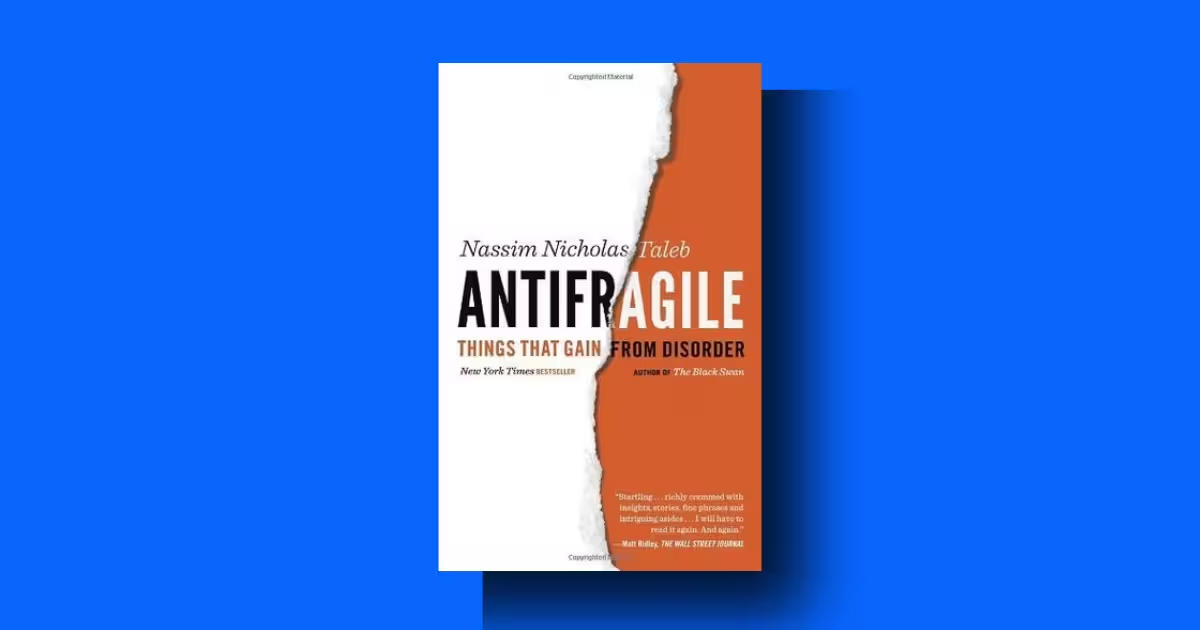
Does protecting yourself from every shock actually make you weaker? Reading Antifragile convinced me that comfort is not the same thing as safety, and that a little well-chosen disorder might be the most useful gift you can give your mind, your money, and your children.
Overview
Antifragile: Things That Gain from Disorder is Nassim Nicholas Taleb’s 2012 argument that some things do not just survive shocks, they need them. He splits the world into three categories: the fragile (hurt by disorder), the robust (unmoved by it), and the antifragile (improved by it), then spends over five hundred pages showing where each one hides, from your bones to your bank account to the nation-state.
The book is dense, funny, bad-tempered, and occasionally maddening, but its central claims, that we should build systems with limited downside and open upside (the barbell strategy), that decision-makers need “skin in the game,” and that removing every stressor from a system quietly destroys it, have aged remarkably well.
If you have read Jonathan Haidt’s The Anxious Generation, you have already met a direct descendant of this book’s core idea, since Haidt explicitly borrows Taleb’s language to argue that children are antifragile and that safety-obsessed parenting is what broke them.
Antifragile is best for readers who liked The Black Swan and want the practical follow-up; anyone making decisions under real uncertainty (investors, founders, parents, policymakers); people who enjoyed Haidt’s The Anxious Generation or The Coddling of the American Mind and want the philosophical root of the “safetyism” critique; fans of Stoic writers like Seneca who want to see ancient ideas rebuilt for modern risk.
Not for readers who want a tidy, linear self-help book with numbered steps; anyone allergic to a combative, first-person authorial voice; readers looking for a rigorous, peer-reviewed economics text rather than an essay collection dressed as one; people who want their nonfiction free of digressions into Roman history, Levantine food, and Brooklyn mob wisdom.
Table of Contents
Introduction
Antifragile: Things That Gain from Disorder is a nonfiction book by Nassim Nicholas Taleb, published on November 27, 2012, by Random House in the United States and Penguin in the United Kingdom. It is the fourth installment of Taleb’s five-book philosophical project on uncertainty, the Incerto, which also includes Fooled by Randomness (2001), The Black Swan (2007), The Bed of Procrustes (2010), and Skin in the Game (2018).
The hardcover first edition runs 426 pages, though later trade paperback printings, including the widely circulated edition with the added glossary and appendices, run well past 500 pages once the notes, bibliography, and index are included.
The book became a New York Times bestseller and drew praise from outlets including The Economist, Fortune, Newsweek, the Los Angeles Times, The Wall Street Journal, and the Harvard Business Review.
Taleb is not an academic who wandered into risk theory from a lecture hall. He spent close to two decades as an options trader and quantitative risk analyst before becoming a full-time essayist, and he is currently Distinguished Professor of Risk Engineering at New York University’s Tandon School of Engineering.
That trading background matters, because Antifragile reads less like a professor’s survey of a field and more like a trader’s field notes on what actually breaks and what actually gets stronger, written by someone who has personally profited from betting against fragile systems.
The book’s purpose is stated plainly in its own Prologue: there is no word in any major language for the opposite of “fragile,” so Taleb coins one, antifragile, and then argues that recognizing this missing category changes how we should build everything from a medical treatment plan to a financial portfolio to a school system.
His thesis, stripped to one line, is that we should stop trying to predict shocks and instead build things that do not need accurate predictions to survive them, or better yet, that actively improve when the prediction turns out wrong.
Background
To get the most out of Antifragile, it helps to know where it sits in Taleb’s body of work. Fooled by Randomness introduced his skepticism toward people who mistake luck for skill.
The Black Swan named the problem: rare, high-impact events that standard statistics cannot anticipate, and that we only “explain” after the fact. Antifragile is Taleb’s attempt to answer the question The Black Swan left open, namely, if we cannot predict these rare shocks, what can we actually do about them?
His answer is to stop focusing on prediction altogether and instead focus on exposure, building things, portfolios, and lives that have limited downside and open-ended upside when the unexpected inevitably happens.
The book also leans hard on a cast of recurring characters Taleb uses to dramatize his ideas: Fat Tony, a street-smart, instinctively risk-aware Brooklyn-and-New-Jersey businessman who represents practical wisdom, and Nero Tulip, a bookish, ascetic trader and part-time classicist who represents Taleb’s own more contemplative side.
Their running conversation gives an otherwise academic argument a human, sometimes comic texture, though how much you enjoy that texture will likely decide how much you enjoy the whole book.
Antifragile Summary
Antifragile is organized into seven “Books” plus a Prologue, Epilogue, and Glossary, and each one builds on the one before it. Here is what each part actually argues, so you do not need to go back to the source material to follow the logic.
The Core Idea: Fragile, Robust, Antifragile
Taleb opens with a thought experiment. Imagine mailing a package of champagne glasses. You would stamp it “fragile,” meaning it can only be hurt by turbulence in transit, never helped by it. Now imagine the opposite of that package, one that would improve from being tossed around.
There is no word for this in English, or in any other language Taleb checked, so he names it: antifragile.
As he puts it, “the resilient resists shocks and stays the same; the antifragile gets better.” Robustness, in other words, is not the true opposite of fragility. It is just a midpoint.
A rock is robust; it neither improves nor worsens much from being kicked around. The antifragile category is a different animal altogether, one that actively needs a certain amount of disorder to function well, the way your immune system needs early exposure to germs, or your bones need mechanical loading to stay dense.
He illustrates the idea with three figures from Greco-Roman myth: Damocles, who dined under a sword hung by a single horsehair (fragile, since one small failure ends everything); the Phoenix, which is destroyed and returns to exactly what it was before (robust); and the Hydra, which grows two heads for every one that is severed (antifragile).
Taleb, who grew up in Beirut, notes that his own city has been leveled and rebuilt roughly eight times across its history, each time slightly differently, which he treats as evidence that whole civilizations can display this same property.
From there, Book I widens the lens: antifragility, Taleb argues, is what separates the living from the inert. Evolution is antifragile because errors and deaths at the level of the individual organism are what allow the species to keep improving.
A restaurant industry is antifragile even though individual restaurants fail constantly, because the failures feed information back into the system about what works. The muscle that tears slightly under a heavy barbell grows back denser.
This overcompensation principle, small localized damage triggering a bigger-than-necessary repair response, is, in Taleb’s telling, the engine behind nearly every kind of durable growth, biological or otherwise.
Modernity’s War on Disorder
Book II turns from definition to diagnosis, and this is where the book gets its political edge. Taleb’s core claim here is that most of what we call “progress” in modern institutions is actually a systematic campaign to remove the very volatility that made those systems strong in the first place, and that this campaign quietly makes everything more fragile even as it looks safer on paper.
His running example is the difference between a souk (an organic, decentralized bazaar) and a modern corporate office building (centralized, top-down, standardized). Small, independently owned businesses fail constantly and invisibly, one at a time, which keeps the overall economic ecosystem healthy. Large, centralized institutions, banks, governments, multinational corporations, rarely fail in small ways.
Instead they accumulate hidden fragility for years and then collapse all at once, taking much of the surrounding economy down with them. He calls this the difference between Mediocristan (a statistical world of many small, independent events where no single data point can swing the average, like the height of adults in a country) and Extremistan (a world dominated by rare, extreme events where one data point, one war, one crash, one bestselling book, can dwarf everything else combined). Confusing which “-stan” you are operating in, he argues, is one of the most consequential and common errors in modern risk management.
This section also introduces what is probably the book’s most quoted parable: the turkey.
A turkey is fed every day for a thousand days by a butcher, and every single one of those days provides more statistical confidence, to the turkey, that the butcher loves turkeys. Then Thanksgiving arrives.
The turkey’s data was perfect right up until the moment it was completely wrong, and the surprise was a Black Swan only for the turkey, never for the butcher. Taleb uses this to explain why systems that look calm and stable right before a crisis (he points to the 2007 to 2008 financial run-up as the modern example) are often the most dangerous, since long stretches of apparent calm let hidden fragility build up completely undetected.
Book II closes with an extended argument against what Taleb calls naive interventionism, the reflexive belief among policymakers, doctors, and central planners that “doing something” is always better than doing nothing.
He introduces the term iatrogenics, harm caused by the healer, borrowed from medicine, and applies it broadly: to central banks that “smooth” markets until the eventual correction is catastrophic, to well-meaning parents who remove every risk from a child’s environment, and to foreign policy interventions that suppress small, local conflicts only to enable much larger ones later.
His example of Iraq after 2003 (a “constrained, volatility-choked” system whose sudden removal of a strongman produced far more chaos than a series of smaller local frictions might have) is one of the book’s most pointed illustrations of this pattern.
The Nonpredictive Life: Fat Tony, Seneca, and the Barbell
Book III shifts from systems to individuals, and this is where the book becomes closest to a practical guide. Taleb introduces Fat Tony, who instinctively understands, without any formal statistical training, that you should never trust a “sucker’s bet,” meaning any situation where the visible, stated odds do not match the real, structural risk.
Tony’s opposite number is the character Taleb calls “Dr. John,” a highly credentialed academic who trusts models over street smarts and consistently loses money because of it. The comparison sets up one of Taleb’s recurring arguments, that formal intelligence and practical risk-sense are not the same skill, and that the world rewards the second one far more reliably than the first.
The philosophical center of this section is Seneca, the Roman Stoic.
Taleb reads Seneca not as a philosopher of calm acceptance but as a wealthy, exiled statesman who built a kind of psychological insurance policy against ruin: he mentally rehearsed his own losses in advance so that an actual loss would cost him less emotional damage than it would cost someone who had never imagined it.
This is where Taleb introduces the barbell strategy by name. Rather than putting your resources into a single “medium risk” position (which he considers the most dangerous place to be, since medium-risk bets are the hardest to measure accurately), you split your resources between two extremes: something almost completely safe, and something aggressively speculative, with nothing in between.
A simple financial version: keep roughly 90 percent of your money in something close to cash, and put the remaining 10 percent into high-risk, high-upside bets. The most you can lose is that 10 percent, but the amount you can gain from a successful bet is, in principle, unlimited.
He extends the same logic to careers (a stable day job paired with unpaid creative risk-taking on the side, which is how he describes his own writing life as a former trader), diets, and even relationships.
Optionality, Tinkering, and Why History Gets Written Backward
Book IV is Taleb’s argument that most real technological and economic progress does not come from top-down research, it comes from decentralized trial and error carried out by people who did not know in advance what they were building.
He calls the reverse-engineered story we tell afterward, in which academic theory supposedly drove practical invention, the “lecturing birds how to fly” effect: universities and think tanks retroactively claim credit for innovations that were actually produced by tinkerers, craftsmen, and risk-takers working without any theory at all. The steam engine preceded thermodynamics.
Aspirin was used for centuries before anyone understood its mechanism. He is careful to note that formal science absolutely matters for confirming and refining what tinkering discovers, but he insists the initial discovery itself almost always runs in the opposite direction from the one taught in schools.
The engine behind this kind of progress, Taleb argues, is optionality, the ability to say yes to a good outcome and no to a bad one after you already have partial information, without having to correctly predict which outcome would occur beforehand.
He uses the Greek philosopher Thales, who reportedly used his understanding of weather patterns to corner the olive-press market ahead of a bumper harvest, as an early example of someone profiting from optionality rather than certainty.
He also introduces the “green lumber fallacy,” named after a trader who made a fortune trading “green lumber” while believing, incorrectly, that the term referred to lumber painted green rather than freshly cut wood. The lesson: the knowledge that outsiders assume is essential to succeeding in a field is often completely disconnected from the knowledge that actually matters inside it.
Nonlinearity and the Shape of Fragility
Book V is the most technical section of the book, and it explains, in plain language rather than equations, why fragility is not a straight-line phenomenon. Double the size of a shock, and the damage to a fragile object does not simply double, it grows far faster than that.
This is why, Taleb argues, a single large stone dropped on your head does far more damage than the same total weight delivered as a thousand small pebbles spread over time, even though the total mass is identical.
This asymmetry, harm accelerating disproportionately as the size of a single shock increases, is what makes concentration itself dangerous: concentrated debt, concentrated power, concentrated cities, concentrated supply chains. Spreading the same total exposure across many smaller, independent units, by contrast, tends to convert a potentially fatal single event into a manageable, absorbable one.
Via Negativa: Getting Better by Removing, Not Adding
Book VI introduces one of the book’s most genuinely useful frameworks for everyday decisions: via negativa, a term borrowed from theology describing the practice of defining something by what it is not.
Taleb applies this to action rather than definition: in medicine, in personal habits, and in policy, subtracting a harmful behavior is a far more reliable way to improve an outcome than adding a new intervention whose side effects are unknown.
He is blunt about his own preference here, arguing that we know with far more confidence what is bad for us (smoking, chronic stress without recovery, processed sugar, sedentary living) than we know what specific “positive” intervention will actually help, and that medicine in particular should default to removing known harms before adding unproven treatments.
This section also introduces the Lindy effect, one of the book’s most durable contributions to popular thinking. For anything perishable, a human, an animal, a piece of fruit, every additional day of life shortens its remaining life expectancy.
For anything nonperishable, a technology, an idea, a book still in print, the opposite holds: every additional year it survives increases the odds it will survive still longer.
A book that has been continuously in print for a century, Taleb argues, is a better bet to still be in print in another century than a book published last year, precisely because it has already passed a century’s worth of “tests” that the newer book has not.
He pairs this with neomania, his term for the modern, often unexamined bias toward whatever is newest simply because it is newest, regardless of whether the new option has actually earned any track record at all.
Skin in the Game: The Book’s Moral Core
Book VII is where Antifragile becomes explicitly an ethics book, and it is arguably the section with the most staying power.
Taleb’s argument is simple and, once stated, difficult to unsee: modern institutions have engineered a widening gap between who takes the risk and who reaps the reward. Bank executives who make catastrophic bets get bonuses in good years and bailouts in bad ones, while the actual downside lands on taxpayers, depositors, and employees who never consented to the bet in the first place.
He proposes what he calls “skin in the game” as both a diagnostic tool and a moral rule: never trust the judgment, forecast, or advice of anyone who does not bear a real cost if they turn out to be wrong. His stated ethical maxim for the whole system is this: no one should be allowed to become antifragile at the direct expense of someone else’s fragility.
The Ending
The book closes, in its Conclusion, on a compressed restatement of its own argument: “everything gains or loses from volatility,” and fragility is simply the name for whatever loses. Taleb closes with characteristic directness, thanking the reader for finishing what is, by any measure, a demanding and occasionally exhausting book.
The short Epilogue that follows takes the recurring character Nero back to Beirut for a personal, quieter close, a deliberate echo of the book’s opening image of a city that keeps rebuilding itself into something sturdier each time it falls.
Antifragile Analysis
Antifragile is an ambitious, occasionally brilliant, and genuinely uneven book, and I think all three of those things can be true at once. Where Taleb is at his best, in the barbell strategy, in the turkey parable, in the skin in the game argument, he produces ideas that are simple enough to use immediately and sturdy enough to survive contact with real decisions.
I have personally used the barbell framing to think through career risk, and I have used the skin in the game test to decide whose financial advice to actually trust. Few popular nonfiction books from the last fifteen years have supplied this many genuinely portable mental tools in a single volume.
Where the book struggles is in the gap between its ambition and its evidence.
Taleb is far better at naming a pattern than at rigorously proving it holds everywhere he claims it does. His use of ancient anecdotes, mythology, and personal recollection carries real rhetorical force, but it is not the same thing as the kind of controlled, falsifiable evidence he demands from everyone else. He is also, by his own design, an intentionally combative writer, and this cuts both ways: it makes the book memorable and quotable, but it also means entire pages are given over to settling scores with named academics and critics rather than developing the argument further.
Readers who want a purely dispassionate treatment of risk theory will find themselves fighting through a lot of personality to get to the substance.
Does the book fulfill its stated purpose? Largely, yes. Taleb set out to give a name to an overlooked category and to show that this category is not a curiosity but a load-bearing feature of how durable systems actually work, and he does that convincingly.
Whether every specific application (his skepticism toward standard medical trials, his preference for nation-states over city-states, his views on GDP-driven growth) survives close scrutiny from specialists in those individual fields is a separate and much more contested question, one I address directly in the next section.
Strengths and Weaknesses
What works:
The barbell strategy is, on its own, worth the price of the book. It is a genuinely reusable framework, not just for money, but for time, relationships, and career risk, and I have returned to it more than any other single idea from a business or self-help book in recent memory.
The skin in the game concept has become so widely used since the book’s publication that it is easy to forget how sharp and specific Taleb’s original formulation of it was. It gives you a concrete question to ask of any expert, forecaster, or institution: what do you personally lose if you are wrong?
The writing, whatever its flaws, is rarely boring. Taleb’s digressions into Roman history, Levantine cuisine, and Brooklyn street wisdom keep a genuinely technical argument moving at a pace most books about risk and probability cannot match.
What doesn’t:
The tone will not work for every reader. Taleb spends real space attacking named critics, academics, and public figures, and while some readers find this entertaining, others will find it a distraction from the ideas themselves.
The evidence base leans heavily on analogy and anecdote rather than the kind of rigorous, falsifiable data Taleb demands of everyone else, a tension multiple critics, including Michiko Kakutani in her New York Times review, pointed out directly. Taleb responded to that review by name, calling it a “pseudo-expert” take, which is itself a fairly on-brand example of the book’s combative streak.
Some of the specific claims have drawn serious pushback from specialists. His remarks on psychiatric medication in children, in particular, drew criticism from mental health professionals who felt his framing dismissed the real, documented risks of untreated conditions in favor of a rhetorical point about overmedication.
His debt-and-government-size arguments, criticized directly by Guardian reviewer David Runciman, who argued that antifragility is not automatically a solution and questioned Taleb’s claims about state debt, remain genuinely contested among economists rather than settled by the book.
Comparison With Similar Works
If you have already read Taleb’s earlier The Black Swan, you should think of Antifragile as the practical sequel: The Black Swan names the problem (unpredictable, high-impact events), while Antifragile proposes the response (build things that do not need accurate prediction to survive, or that improve from the shock itself). Readers new to Taleb can start with either, but Antifragile stands on its own.
The most directly relevant comparison for readers of this site is Jonathan Haidt’s The Anxious Generation. Haidt draws explicitly on Taleb’s framework, arguing that children are antifragile by nature and require real friction, risk, and unsupervised play to develop into resilient adults, and that the “safetyism” documented years earlier in Haidt and Greg Lukianoff’s The Coddling of the American Mind is, in Taleb’s terms, a fragilizing intervention dressed up as protection.
Reading Antifragile first genuinely changes how you read both of Haidt’s books, since you can see exactly where the underlying theory of “safetyism” came from decades before Haidt applied it to childhood.
Steven Pinker’s The Better Angels of Our Nature, which argues that violence has declined thanks to long-run historical trends, makes for an unusually pointed contrast, since Taleb and statistician Pasquale Cirillo later published a direct statistical challenge to Pinker’s methodology, arguing that Pinker’s data does not actually rule out the kind of rare, extreme violent event that Taleb’s Extremistan framework treats as inevitable over a long enough timeline.
Pinker responded in kind, and the exchange is a useful real-world illustration of the exact Mediocristan-versus-Extremistan disagreement that runs through Antifragile itself.
Readers who enjoyed the Stoic material in Antifragile, particularly the Seneca chapters, will likely also enjoy Seneca’s own Letters from a Stoic, discussed alongside other formative titles in Probinism’s own roundup of the 100 best nonfiction books that changed the world.
And for readers curious about the flip side of Taleb’s argument, why smart, credentialed people so often get risk wrong despite their intelligence, David Robson’s The Intelligence Trap makes an excellent companion read, since it examines from a cognitive-science angle much of the same “expert overconfidence” territory Taleb attacks with the term fragilista.
Conclusion
Antifragile is not a perfect book, and it is not always a comfortable one, but it is a genuinely useful one, and more than a decade after publication, its central claims have only become more relevant, not less.
If you make decisions under real uncertainty, whether that means running a business, managing your own money, raising children, or simply trying to build a life that can absorb a bad year without collapsing, the barbell strategy and the skin in the game test alone are worth sitting through Taleb’s more combative digressions.
General readers who want a gentler introduction to these ideas might do better starting with The Black Swan, but anyone who has already read Haidt’s The Anxious Generation and wants to understand where its central metaphor actually came from should treat this book as required, not optional, reading.
It rewards patience, tolerates disagreement, and, true to its own thesis, tends to leave you a little sturdier than it found you.







