Why do some people feel calm and safe in love, while others feel restless even when everything seems fine? Why does one person need constant reassurance, while another pulls away the moment a relationship becomes emotionally serious? Why do some couples communicate openly, and others fall into cycles of chasing, distancing, silence, jealousy, or fear?
The answer is not simply “personality.” Often, it has something to do with attachment styles.
Attachment styles are the emotional patterns we develop around closeness, trust, safety, and vulnerability.
They influence how we respond when someone gets close, when conflict appears, when love feels uncertain, or when we fear losing someone important. In simple terms, your attachment style helps explain why you love the way you do.
This is why attachment theory has become so widely discussed in relation.
The book People We Meet on Vacation, for example, notes that vulnerability is essential to love and points to attachment theory as a useful lens for understanding romantic development and emotional availability.
Attachment styles do not define your entire identity. They are not excuses for harmful behavior. They are not fixed life sentences. But they can reveal the hidden emotional script behind your relationship choices.
Table of Contents
What Are Attachment Styles?
Attachment styles are habitual patterns of thinking, feeling, and behaving in close relationships. They shape questions such as: Can I trust people? Am I lovable? Will people stay? Is closeness safe? Do I need to protect myself by pulling away?
Modern attachment theory began with the work of John Bowlby, who emphasized the importance of early emotional bonds between children and caregivers. Bowlby argued that these bonds are central to survival, security, and later emotional development.
Mary Ainsworth later expanded attachment research through the “Strange Situation,” a structured observation of how infants responded to separation and reunion with a caregiver.
This research helped identify early attachment patterns such as secure, avoidant, and anxious attachment.
In adulthood, attachment theory was applied to romantic relationships by researchers Cindy Hazan and Phillip Shaver. Their landmark work proposed that romantic love can be understood as an attachment process, similar in some ways to the emotional bonds formed earlier in life between children and caregivers.
That does not mean your childhood mechanically determines your love life.
Adult relationships, friendships, therapy, trauma, cultural expectations, and personal growth can all influence how you attach. But early experiences often create a kind of emotional blueprint.
The Two Core Questions Behind Attachment
Most adult attachment styles can be understood through two basic questions.
The first is: Do I believe I am worthy of love?
The second is: Do I believe other people are safe, reliable, and emotionally available?
When people generally answer yes to both, secure attachment becomes more likely. When one or both answers are uncertain, insecure attachment patterns may appear.
Simply Psychology summarizes adult attachment as being shaped by two major dimensions: attachment anxiety, which involves fear of rejection or abandonment, and attachment avoidance, which involves discomfort with emotional closeness or dependence.
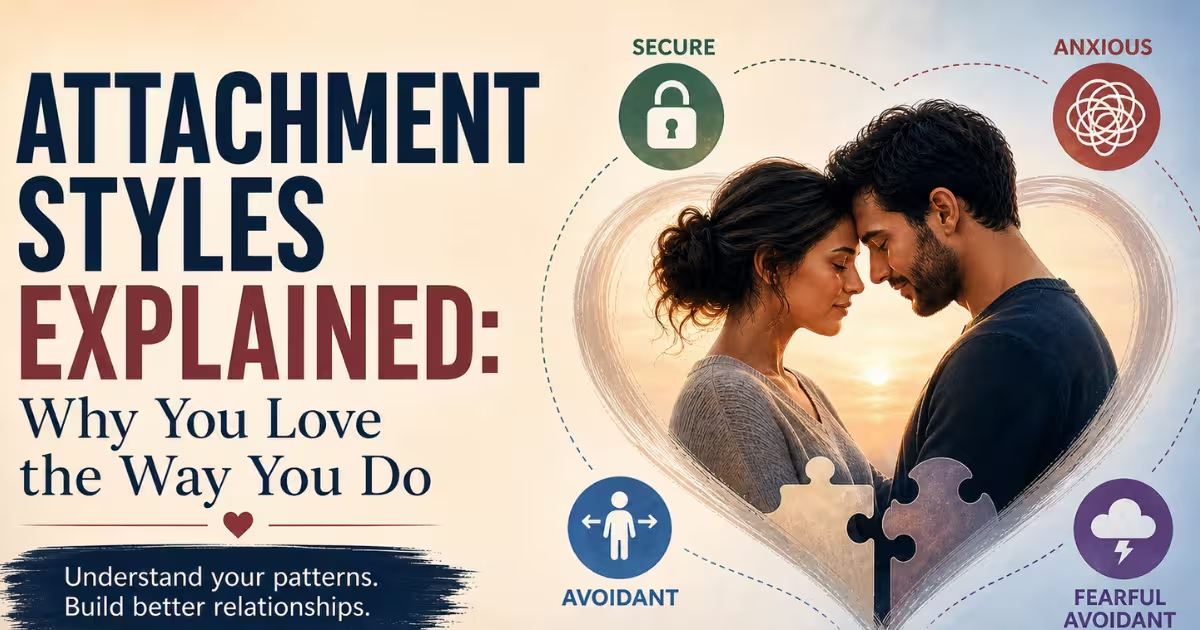
The intersection of these dimensions creates the four commonly discussed adult attachment styles.
These styles are usually called:
- Secure attachment
- Anxious-preoccupied attachment
- Dismissive-avoidant attachment
- Fearful-avoidant attachment, sometimes linked with disorganized attachment
Let’s look at each one.
1. Secure Attachment: “Love Feels Safe Enough”
People with a secure attachment style usually feel comfortable with closeness, honesty, emotional expression, and independence.
They can depend on others without losing themselves. They can be alone without feeling abandoned. They can discuss problems without assuming the relationship is about to collapse.
In romantic relationships, secure attachment often looks like emotional steadiness.
A securely attached person may still feel hurt, jealous, angry, or afraid at times, but they are usually able to communicate those feelings without turning them into a crisis.
They do not need constant proof of love, and they do not run from intimacy simply because it feels vulnerable.
Secure attachment does not mean perfect confidence. It means the nervous system is less likely to interpret normal relationship tension as danger.
A secure partner may say:
“I felt hurt when that happened. Can we talk about it?”
“I need some space tonight, but I love you and we are okay.”
“I trust you, but I also want us to be honest about what we need.”
Secure attachment is often associated with a positive view of self and others. Securely attached adults are generally comfortable with intimacy and can balance closeness with autonomy.
In a healthy relationship, secure attachment feels like room to breathe. Love is not a test, a chase, or a performance. It is a place where two people can be emotionally real.
2. Anxious Attachment: “Please Don’t Leave Me”
Anxious attachment, often called anxious-preoccupied attachment, is marked by a strong desire for closeness combined with fear of rejection or abandonment.
People with this style often care deeply, love intensely, and invest heavily in relationships. But they may also worry that they are too much, not enough, or about to be replaced.
An anxiously attached person may be highly sensitive to changes in tone, texting patterns, facial expressions, or emotional distance. A delayed reply can feel like evidence of rejection. A quiet evening can feel like the beginning of withdrawal. A partner needing space can feel like the end of love.
This style often appears as protest behavior: repeated texting, seeking reassurance, overexplaining, people-pleasing, jealousy, emotional spiraling, or trying to “fix” the relationship immediately.
The inner script may sound like:
“If they really loved me, they would reassure me.”
“I can feel something changing.”
“I need to know where I stand.”
“What if they leave?”
Hazan and Shaver’s early adult attachment descriptions included an anxious pattern in which adults worry that partners do not really love them or will not stay, and may desire more closeness than the other person is ready to give.
At its core, anxious attachment is not neediness for its own sake. It is a nervous system trying to secure connection.
The problem is that the more desperately someone seeks reassurance, the more pressure the relationship may feel, especially if their partner is avoidant.
3. Dismissive-Avoidant Attachment: “I’m Better Off Depending on Myself”
Dismissive-avoidant attachment is marked by discomfort with emotional dependence. People with this style often value independence, privacy, competence, and self-control. They may appear confident and low-maintenance, but underneath that independence can be a deep reluctance to need anyone too much.
Avoidant attachment often shows up when a relationship becomes emotionally demanding. At first, an avoidant person may enjoy connection. But when closeness increases, they may feel crowded, criticized, pressured, or trapped. Their instinct is to create distance.
This can look like:
Taking longer to reply
Changing the subject during emotional conversations
Minimizing problems
Avoiding labels or commitment
Needing a lot of alone time
Feeling irritated by a partner’s needs
Pulling away after intimacy
The avoidant inner script may sound like:
“I don’t want drama.”
“They want too much from me.”
“I need space.”
“I can handle things on my own.”
“Depending on people is risky.”
In the adult attachment descriptions discussed by Hazan and Shaver, avoidant adults often feel uncomfortable being close to others, struggle to trust completely, and become nervous when partners want more intimacy than they feel ready to give.
Avoidant attachment is often misunderstood as coldness. In reality, many avoidant people feel deeply but have learned to manage emotion by suppressing it, intellectualizing it, or stepping away from it.
Their distance is often protection, not absence of feeling.
4. Fearful-Avoidant Attachment: “I Want Love, But It Doesn’t Feel Safe”
Fearful-avoidant attachment, sometimes connected with disorganized attachment, is often the most internally conflicted style.
People with this pattern may crave intimacy and fear it at the same time. They want closeness, but closeness can activate alarm. They may move toward love, then pull away when it becomes real.
This attachment style can create intense relationship cycles. A person may pursue connection, feel vulnerable, become afraid, withdraw, regret withdrawing, then pursue again. Their partner may experience them as passionate but unpredictable.
The inner script may sound like:
“I want you close, but I don’t know if I can trust you.”
“I need love, but love hurts.”
“If I let you in, you may use it against me.”
“I’m scared you’ll leave, but I’m also scared you’ll stay.”
Simply Psychology describes fearful attachment as a style where people desire close relationships but fear vulnerability, often behaving unpredictably because they are caught between wanting intimacy and fearing it.
Fearful-avoidant attachment is not a character flaw. It is often a sign that closeness has been associated with both comfort and danger.
Healing usually requires patience, emotional regulation, and relationships where safety is built gradually, not demanded instantly.
How Attachment Styles Shape Romantic Relationships
Attachment styles often become most visible during emotional stress.
In the early stage of dating, chemistry can hide everything. People are charming, attentive, hopeful, and excited. But once uncertainty appears, attachment patterns start to surface.
During conflict, an anxious person may move closer and demand resolution immediately. An avoidant person may move away and need time before talking. A fearful-avoidant person may do both: escalate, withdraw, return, then withdraw again. A secure person is more likely to stay present while also respecting boundaries.
This is why many couples fall into the classic pursuer-distancer cycle.
One partner feels abandoned and pushes for connection. The other feels overwhelmed and retreats.
The more one pursues, the more the other distances. The more the other distances, the more abandoned the first person feels.
Neither person is necessarily trying to hurt the other. They are often trying to feel safe in opposite ways.
Attachment styles also influence communication. Anxious attachment may turn silence into threat. Avoidant attachment may turn emotional conversation into pressure. Fearful-avoidant attachment may turn vulnerability into danger. Secure attachment makes it easier to say what is true without attacking, disappearing, or collapsing.
Why You Choose the People You Choose
One of the hardest truths about attachment is that we do not always choose what is healthy. Often, we choose what feels familiar.
An anxiously attached person may be drawn to someone emotionally unavailable because the uncertainty activates an old longing to be chosen. A dismissive-avoidant person may be drawn to someone warm and expressive, then feel overwhelmed by the very closeness they initially enjoyed. A fearful-avoidant person may crave love but unconsciously test it, distrust it, or flee from it.
This does not mean attraction is fake. It means attraction can be shaped by emotional memory.
Attachment theory suggests that people develop internal models of self and others that influence later relationships. These internal working models can affect whether someone expects care, rejection, closeness, abandonment, trust, or disappointment.
When people say, “I keep dating the same person in a different body,” attachment may be part of the reason.
Can Your Attachment Style Change?
Yes. Attachment styles can change.
This point matters because attachment language is often used too rigidly online. People say, “I’m anxious,” “He’s avoidant,” or “She’s fearful-avoidant” as if these labels explain everything forever. But attachment is not destiny.
Research summaries note that attachment patterns can show stability, but they are not permanent.
They may shift through major life experiences, therapy, self-reflection, and healthier relationships. The idea of “earned security” describes people who develop a more secure attachment orientation despite earlier insecure experiences.
In practical terms, change begins when you stop asking only, “What is wrong with them?” and start asking, “What happens inside me when love feels uncertain?”
That question creates space between trigger and reaction.
How to Move Toward Secure Attachment
The goal is not to become emotionless, perfectly calm, or endlessly independent. The goal is to become more secure: more honest, more regulated, more trusting, and more capable of giving and receiving love without losing yourself.
Start by noticing your pattern.
Do you chase? Withdraw? Shut down? Test people? Overexplain? Avoid conflict? Panic when someone needs space? Feel trapped when someone needs closeness?
Next, learn to name the fear underneath the behavior. For anxious attachment, the fear may be abandonment. For avoidant attachment, it may be engulfment or loss of independence. For fearful-avoidant attachment, it may be betrayal, rejection, or emotional danger.
Then practice secure communication. Instead of saying, “You never care about me,” try, “I’m feeling disconnected and could use reassurance.” Instead of disappearing, try, “I need an hour to calm down, but I want to come back to this conversation.”
Instead of testing someone, try asking directly for what you need.
Secure attachment grows through repeated experiences of honesty plus safety.
Therapy can also help, especially if attachment wounds are connected to trauma, neglect, emotional inconsistency, or past relational harm. Couples therapy can be useful when both partners are willing to understand the cycle rather than blame each other for it.
Attachment Styles Are Explanations, Not Excuses
Understanding attachment styles should make you more responsible, not less.
An anxious person is still responsible for not controlling, accusing, or overwhelming a partner. An avoidant person is still responsible for not stonewalling, dismissing, or disappearing. A fearful-avoidant person is still responsible for not creating chaos in order to test love. A secure person is still responsible for empathy, patience, and boundaries.
Attachment explains the wound. It does not justify wounding someone else.
The healthiest use of attachment theory is compassionate accountability. You learn your pattern, understand where it may come from, and then choose a better response.
Conclusion: Love Becomes Clearer When You Understand Your Pattern
Attachment styles help explain why love feels different for different people. For one person, love feels like safety.
For another, it feels like uncertainty. For another, it feels like pressure. For someone else, it feels like both longing and danger.
When you understand your attachment style, you stop seeing your reactions as random. You begin to notice the pattern beneath the panic, distance, jealousy, silence, or fear. You learn that your way of loving was shaped by experience, but it does not have to remain unchanged.
The point is not to label yourself forever. The point is to become freer.
You can learn to love with more clarity. You can ask for reassurance without demanding it. You can take space without abandoning someone. You can be vulnerable without losing yourself.
You can build relationships where closeness does not feel like a threat and independence does not feel like rejection.
That is the real promise of understanding attachment styles: not just knowing why you love the way you do, but learning how to love in a way that feels safer, steadier, and more honest.
FAQ: Attachment Styles Explained
1. What is the healthiest attachment style?
Secure attachment is generally considered the healthiest because it allows people to balance intimacy and independence. Securely attached people can communicate needs, tolerate conflict, trust others, and maintain a stable sense of self in relationships.
2. Can two insecurely attached people have a healthy relationship?
Yes, but it requires awareness and effort. The couple must learn their cycle, communicate clearly, and avoid blaming each other. Two insecure partners can grow together if both are committed to emotional responsibility.
3. Is anxious attachment the same as being needy?
No. Anxious attachment is usually rooted in fear of disconnection or abandonment. It can appear as neediness, but underneath is often a strong desire for safety, consistency, and reassurance.
4. Is avoidant attachment the same as not caring?
No. Avoidant people may care deeply but feel unsafe with dependence, vulnerability, or emotional intensity. Their distance often protects them from feeling overwhelmed.
5. Can I become securely attached?
Yes. Many people move toward secure attachment through self-awareness, emotionally safe relationships, therapy, and consistent practice. Attachment patterns can change over time.