
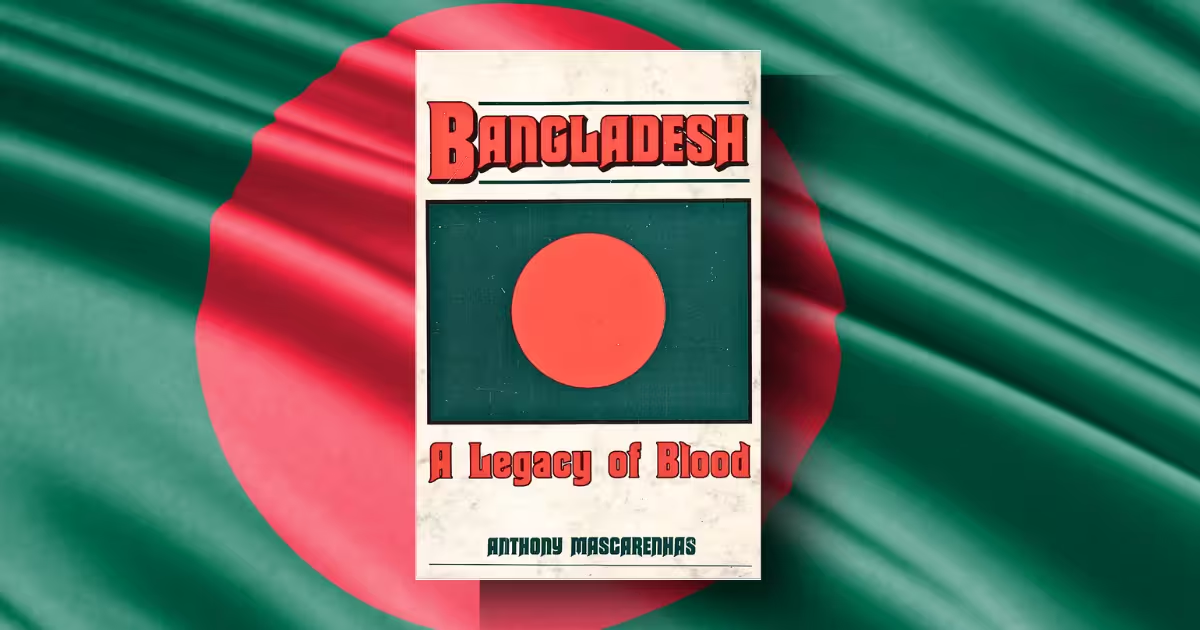
Can one book change how you see a nation’s founding heroes forever?
This is exactly what happened to me when I first picked up Anthony Mascarenhas’s Bangladesh: A Legacy of Blood. I thought I knew the story of Bangladesh’s birth, the heroic struggle, the liberation war, the triumph over oppression. But this book shattered that simple narrative.
What Mascarenhas reveals is a country that traded one form of tyranny for another, where the very leaders who fought for freedom became its greatest threat.
Overview
If you’re looking for a sugar-coated celebration of Bangladesh’s founding fathers, this is not your book. Mascarenhas delivers a brutal, unflinching account of the country’s first decade, from independence in 1971 to the assassination of President Ziaur Rahman in 1981.
The book is a relentless chronicle of corruption, famine, military coups, and political assassinations that reads more like a crime thriller than a work of history.
Who should read it: History buffs, political science students, journalists, and anyone trying to understand why Bangladesh, a country born from such hope, descended into such violence. If you’re sensitive to graphic descriptions of political violence or prefer sanitised national narratives, you might want to steer clear.
Who should skip it: Casual readers looking for light nonfiction or those who prefer their history neatly packaged with clear heroes and villains. Mascarenhas gives you neither.
The book’s central thesis is devastatingly simple: Bangladesh’s founding fathers, Sheikh Mujibur Rahman and Ziaur Rahman, were flawed, authoritarian figures whose actions created the very conditions that led to their own violent deaths.
As one reviewer put it, the book helped them realise that a man could be “a hero in struggle, an authoritarian in power”.
Table of Contents
1. Introduction
Book: Bangladesh: A Legacy of Blood
Author: Neville Anthony Mascarenhas
Publication Date: 1 March 1986
Publisher: Hodder and Stoughton
Pages: 192
Mascarenhas (10 July 1928 – 3 December 1986) was a Pakistani journalist of Goan Catholic descent who spent 14 years with The Sunday Times in London. Before this book, he had already made history. In June 1971, his article “Genocide” exposed the Pakistan army’s brutality in East Pakistan, shocking the world.
According to BBC, the report “helped turn world opinion against Pakistan and encouraged India to play a decisive role”.
Indira Gandhi herself told the editor of The Sunday Times that the article had shocked her so deeply “it had set her on a campaign of personal diplomacy in the European capitals and Moscow to prepare the ground for India’s armed intervention”.
Mascarenhas was no detached observer, he was a friend of Sheikh Mujibur Rahman, having first met him in 1956. This personal connection makes his later critique all the more devastating.
Context
Bangladesh: A Legacy of Blood covers the history of Bangladesh from its independence in 1971 through the first decade of its existence. It focuses specifically on two towering figures: Sheikh Mujibur Rahman (Bangabandhu) and Ziaur Rahman.
Both were assassinated, Mujib on 15 August 1975, Zia on 30 May 1981. Between them lies a trail of blood: military coups, jail killings, and a sepoys’ mutiny that nearly destroyed the country.
Purpose
The book’s central argument is that Bangladesh’s post-independence history was shaped not by noble ideals but by “machination and murder”. Mascarenhas argues that Sheikh Mujib’s authoritarian tendencies, corruption, and distrust of the military created the conditions for his own assassination.
The book also examines how Khandaker Moshtaque Ahmed, Mujib’s successor, and General Ziaur Rahman perpetuated the same cycle of violence.
2. Background
To understand this book, you need to understand the context of Bangladesh’s birth. The country emerged from the 1971 Liberation War, which saw the Pakistan army commit atrocities against Bengali civilians.
According to independent researchers, between 300,000 and 500,000 people died, though the Bangladesh government puts the figure at three million.
Mascarenhas had a front-row seat to these horrors. In April 1971, he was one of eight Pakistani journalists taken on a guided tour of East Pakistan by the military. The army wanted them to write propaganda about how they had “successfully quelled” the uprising.
Instead, Mascarenhas saw the truth: deserted streets, rotting corpses, and soldiers bragging about their kills.
He described the experience as deeply traumatising. “I did not know what to do. I was torn between my duty towards humanity and supporting the false narrative of a military dictator,” he later said. He chose humanity. His article changed the course of the war.
But that article, and the war itself, created a heroic narrative around Sheikh Mujib that Mascarenhas would later challenge. As he notes in the book, Mujib spent the entire war in a Pakistani prison, completely cut off from events. He emerged “out of touch and out of tune with the times”.
This disconnect would prove fatal for Bangladesh.
3. Bangladesh: A Legacy of Blood Summary
Let me walk you through what I learned from this book, and I mean learned, because Mascarenhas doesn’t hold back.
Chapter I: Mujib and the Majors
The book opens with a chilling scene. On 12 August 1975, Major Farook Rahman throws a lavish wedding anniversary party at the Dhaka Golf Club. The guests include Brigadier Khalid Musharraf (Farook’s uncle) and Brigadier Mashoorul Huq, Military Secretary to President Sheikh Mujibur Rahman. Everyone is having a wonderful time.
Three days later, Farook leads the tanks that kill Mujib.
The irony is staggering. Mascarenhas describes how Brigadier Huq presented a massive bouquet to Farook’s wife, a bouquet that may have saved his life. It’s one of those small details that makes history feel unbearably human.
Chapter II: A False Start
This chapter is perhaps the most devastating in the entire book. Mascarenhas describes Mujib’s release from Pakistani prison and his flight to London in January 1972. What should have been a moment of triumph becomes a revelation of the man’s profound ignorance.
Mujib had been in solitary confinement for nine months, receiving no letters, reading no newspapers, and listening to no radio. He had no idea what had happened in his country. “He did not know how his country had been devastated by the Pakistan army or how two million people had died,” Mascarenhas writes.
Even worse, Mujib was secretly considering a deal with Zulfiquar Ali Bhutto to maintain a “link” between Pakistan and Bangladesh. Mascarenhas describes his own horror when Mujib confided this to him: “‘Are you mad?’ I told him. ‘Don’t you know what’s happened in Bangladesh? After what the people have gone through they will lynch you on the streets of Dhaka… if you so much as utter one word about a link'”.
Mascarenhas also reveals that Mujib returned to a country in chaos. The government was dysfunctional, ministers were jostling for power, and corruption was rampant. One anecdote stands out: Khandaker Moshtaque Ahmed, the “foreign minister,” arrived at his office to find his chair occupied by a junior colleague. Nobody had bothered to tell him he’d been fired.
Chapter III: The Decline of the Demi-God
The title says it all. Mascarenhas traces how Mujib went from beloved “Bangabandhu” (Friend of the Bengalis) to target of public protests. On 17 September 1972, student leader Abdur Rab told a crowd of 100,000: “Mujib said no one would be allowed to die of starvation after independence. Now people are dying for want of food”.
Rab’s warning would prove prophetic: “The army will not fire on the people; but if you press it, it might take action against you and the ruling clique!”
Mascarenhas doesn’t just describe the decline, he explains it. Corruption was everywhere. Smuggling of food and jute across the border into India was costing the country an estimated 60,000 million Takkas (£2,000 million). Government officials were manipulating markets, taking bribes, and enriching themselves while people starved.
Perhaps most damning is Mascarenhas’s description of the sycophancy surrounding Mujib. Ministers touched his feet. One minister, Tahiruddin Thakur, turned the entire government information machinery into a Mujib propaganda machine. A bust of Mujib was commissioned for the Dhaka jail cell where he’d been imprisoned, but sycophants deemed it “insulting” to put Bangabandhu “in jail”.
Mujib’s response to criticism was to centralise power further. He created a one-party state (BKSAL) and gave himself absolute power.
Chapter IV: Mujib’s Military Nightmare
Mujib had good reason to fear the military. He’d spent years in Pakistani jails and didn’t want to create “another monster like the one we had in Pakistan”. But his solution, neglecting the army, only made things worse.
Mascarenhas describes how Mujib created the Jatiyo Rakhi Bahini, a paramilitary force of 25,000 men who swore personal loyalty to him. These “storm troopers” terrorised the population, committing murders and tortures with impunity. Mascarenhas compares them to the Nazi Brownshirts.
Meanwhile, the actual army was being humiliated. Officers like Major Farook Rahman and Major Khandaker Abdur Rashid, both Freedom Fighters, watched their careers stall while corrupt politicians flourished. They began to plot.
Chapter V: A Summer of Tigers
The famine of 1974 was the breaking point. Mascarenhas describes how 27,000 people died of starvation, though he notes this is a conservative estimate. The government opened 5,700 gruel kitchens to feed three to four million people daily. By January 1975, 200,000 destitutes were being forcibly moved out of Dhaka into camps that the Guardian described as “Mujib’s man-made disaster area”.
The book also details the Dalim incident, which proved pivotal. When the brother of an Awami League strongman insulted an army officer’s wife, the officers retaliated by wrecking the strongman’s bungalow. Mujib’s response? He dismissed 22 young officers from service. Among them were Majors Dalim, Noor, and Huda, all of whom would later participate in Mujib’s assassination.
Chapter VI: Moshtaque is Willing
This is where the conspiracy gets personal. Major Rashid began looking for a successor to Mujib, someone from within the Awami League who would reassure the party faithful and prevent Indian intervention.
He chose Khandaker Moshtaque Ahmed, a cunning politician who had been humiliated by Mujib’s ministers. Rashid met Moshtaque in July 1975 and asked: “Will there be any justification at this stage if somebody takes a decision to remove Sheikh by force?” Moshtaque replied: “Well, probably for the country’s interest it is a good thing”.
The majors were incredibly naive. They thought Moshtaque would be a puppet. In fact, he would eat them for breakfast.
Chapter VII: The Killing of Sheikh Mujib
The assassination itself is described with chilling precision. On 14 August 1975, Major Farook’s wife Farida consulted a blind holy man named Andha Hafiz. The holy man’s message: “His time has run out… Do what you have to do but do it very secretly”.
That night, the 1st Bengal Lancers and the 2nd Field Artillery began their “night training exercises”. In fact, they were preparing for murder. At 5:30 am on 15 August, tanks surrounded Mujib’s house in Dhanmandi. The guards were disarmed, and the assassins entered.
Sheikh Mujib was shot on the staircase, his right hand still clutching his favourite pipe. His wife, sons, daughters-in-law, and other family members were also killed. In total, 22 people died.
Chapter VIII: Moshtaque Takes Over
Moshtaque’s ascent to power is a masterclass in political manipulation. When Major Rashid arrived at his house, Moshtaque was terrified. He went to the toilet to compose himself. He tested Rashid by seeing who would open the car door, when a soldier opened it for him, he knew he was safe.
Once in power, Moshtaque quickly turned on the majors. He appointed his own people, created a Chief of Defence Staff position above the army chief, and reduced Farook and Rashid to figureheads. He also made a deal with Pakistan, opening diplomatic relations and appointing former Pakistani officials to key positions. Mahmood Ali, Bhutto’s special adviser, told Mascarenhas he wanted “reunification of Pakistan”.
Chapter IX: ‘Counter Coup’ and the Jail Killings
On 3 November 1975, Brigadier Khalid Musharraf launched a counter-coup. The majors surrendered, but not before something terrible happened. In Dhaka Central Jail, four Awami League leaders, Tajuddin Ahmad, Syed Nazrul Islam, Mansoor Ali, and Kamruzzaman, were killed.
Who gave the order? Mascarenhas suggests it was Moshtaque and Tahiruddin Thakur. But the evidence is circumstantial. What’s clear is that the killing of these four men, who had served as Mujib’s government-in-exile during the war, was a political crime of the first order.
Chapter X: A Night to Remember
The Sepoy Mutiny of 7 November 1975 was the bloodiest chapter yet. Soldiers, inspired by left-wing revolutionary Colonel Abu Taher, turned on their officers. They chanted: “All sepoys are brothers. We want the blood of officers”.
Khalid Musharraf was gunned down in a room at the 10th East Bengal headquarters. Brigadier Shafat Jamil was also killed. The mutiny was eventually crushed, but Bangladesh’s army would never be the same.
Chapter XI: Zia; the Man and the Myth
General Ziaur Rahman emerged as the unlikely victor of this chaos. Mascarenhas traces his rise from deputy chief of army staff under Moshtaque to the country’s de facto ruler. Zia was no saint, he’d known about the plot to kill Mujib and done nothing. He’d also presided over the sham trial and execution of Colonel Abu Taher.
Chapter XII: Coups, Mutinies, Executions
Zia’s rule was plagued by constant unrest, more than 20 coup attempts and mutinies between 1975 and 1981. He hanged Taher on 21 July 1976, a decision that would haunt him.
Mascarenhas describes Taher’s final moments with heartbreaking detail: he bathed, put on his artificial limb, and walked to the gallows saying, “Goodbye countrymen. Long live Bangladesh! Long live Revolution!”
Chapter XIII: The Killing of General Ziaur Rahman
The cycle of violence came full circle on 30 May 1981. Zia was assassinated in Chittagong by a group of army officers led by Major General Manzoor. Mascarenhas sees this as the inevitable result of the culture of violence he’d documented throughout the book.
4. Bangladesh: A Legacy of Blood Analysis
Is Bangladesh: A Legacy of Blood effective? Yes, and no.
What works: Mascarenhas’s access to key figures is extraordinary. He interviewed Farook and Rashid extensively, getting their firsthand accounts of Mujib’s assassination.
He also interviewed Moshtaque, Zia, and dozens of other participants. The result is a narrative that feels immediate and authentic.
The book also succeeds in humanising its subjects. Mascarenhas knew Mujib personally and doesn’t pretend otherwise. He describes him as “large-hearted, a kindly man, generous to a fault and who never forgot a face or a friendship”. But he also shows him as “an earthy, gut-fighting politician” bred in “intrigue and violence”. This complexity makes the critique more powerful, not less.
What doesn’t work: The book is highly critical of all sides, but some reviewers have noted a biased tone. Mascarenhas was, after all, a Pakistani journalist writing about Bangladesh’s leaders. His personal relationships with some of the subjects, and his enmity toward others, may have coloured his judgment.
The book also lacks context about geopolitical forces operating in Bangladesh. The Cold War, India’s regional ambitions, and the influence of the US and USSR are mentioned only in passing. This omission makes the narrative feel somewhat insular.
Does it fulfil its purpose? Yes. Mascarenhas set out to tell the “unvarnished story” of Bangladesh’s first decade, and he succeeds. The book is blunt, direct, and critical of everyone. It’s not a complete history, but it’s an essential one.
5. Strengths and Weaknesses
Strengths
Firsthand access: Mascarenhas interviewed the actual participants in the coups and assassinations. His conversations with Farook and Rashid are invaluable historical documents.
Unflinching honesty: He doesn’t spare anyone, not Mujib, not Zia, not Moshtaque, and not himself. He admits his own role as Mujib’s friend and his horror at what he witnessed.
Narrative power: The book reads like a thriller. The scene of Farook’s anniversary party, the tank assault on Mujib’s house, Moshtaque testing who would open the car door, these are unforgettable images.
Historical significance: As one reviewer put it, the book is “a masterpiece which needs to be read even if done so solely for educational purposes”.
Weaknesses
Bias: Mascarenhas’s personal relationships with some subjects and his enmity toward others create a biased tone. He’s particularly harsh on Mujib and Moshtaque.
Lack of context: The book doesn’t adequately explain the geopolitical forces shaping Bangladesh. The Cold War, India’s role, and US foreign policy are all under-explored.
Incomplete sourcing: Some claims are made without clear attribution. The book’s dialogue, though based on interviews, is presented as “faithful reproduction” but with limited documentation.
Polemical tone: The book is not a balanced history, it’s an indictment. Some readers may find this off-putting.
6. Comparison with Similar Works
If you’ve read Lawrence Lifschultz’s Bangladesh: The Unfinished Revolution, you’ll notice similarities. Both books cover the same period and are critical of Bangladesh’s political establishment.
But where Lifschultz focuses on the left-wing movement and the role of Colonel Abu Taher, Mascarenhas centres his narrative on the personalities of Mujib, Zia, and Moshtaque.
Mascarenhas’s earlier book, The Rape of Bangla Desh (1971), covers the Liberation War itself. That book is more straightforward journalism, a contemporary account of the atrocities. A Legacy of Blood is more reflective, written 15 years later with the benefit of hindsight and extensive interviews.
Another useful comparison is with Bangladeshi historian Muntassir Mamoon’s works, which offer a more academic perspective. Mascarenhas is a journalist, not an academic, his strength is narrative immediacy, not scholarly rigor.
7. Conclusion
Who should read this book?
If you’re a student of South Asian history, a journalist, or anyone trying to understand why democratic transitions so often fail, this book is essential reading. It’s not comfortable, it will make you angry, sad, and disillusioned. But that’s the point.
If you’re a Bangladeshi trying to understand your country’s turbulent past, this book is a painful but necessary mirror. As one Bangladeshi reviewer wrote: “Wow! As if I knew nothing of the history of my country”.
If you’re a casual reader looking for a feel-good story, skip it. This is not that book.
Final verdict: Bangladesh: A Legacy of Blood is a flawed but essential work. It’s biased, incomplete, and at times polemical. But it’s also the most vivid account we have of Bangladesh’s first decade, a decade of broken promises, bloodshed, and betrayal. As Mascarenhas himself concludes: “Machination and murder have been the curse of Bangladesh, its legacy of blood”.
The book was published in 1986, 38 years ago. Since then, Bangladesh has seen more coups, more assassinations, and more bloodshed. Mascarenhas’s legacy of blood continues.
Further Reading/Watching:
- The Rape of Bangla Desh by Anthony Mascarenhas (1971)
- Bangladesh: The Unfinished Revolution by Lawrence Lifschultz (1979)
- “Genocide” , Mascarenhas’s 1971 article in The Sunday Times
- India’s Near East: A New History by Avinash Pailwal (for broader regional context)







