
Last updated on November 6th, 2026 at 11:37 am
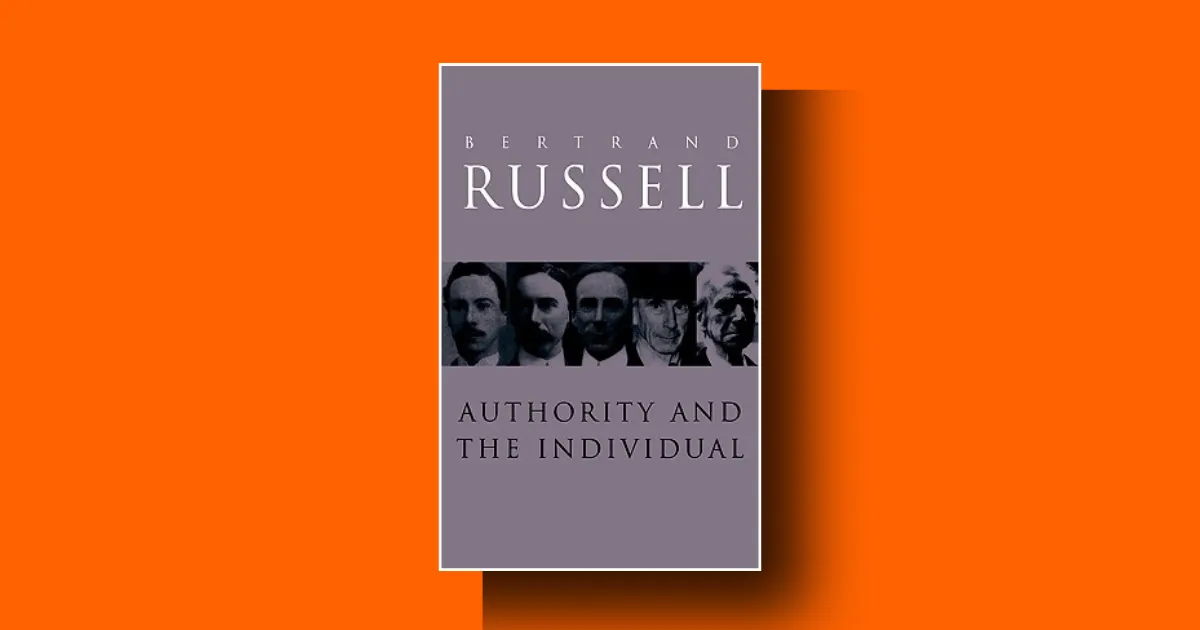
Why does modern life feel like a prison even when you’re free? That is the very warning Bertrand Russell gives about in his 1948 Authority and the Individual.
Authority and the Individual is not just another philosophy book. It is the transcript of the inaugural BBC Reith Lectures, delivered by Bertrand Russell in 1948 at the age of 76, at a moment when the world was still smoldering from World War II and the Cold War was beginning to freeze over Europe.
In six razor-sharp lectures, Russell dissects the fundamental tension of modern life: how do we preserve individual freedom when large-scale organisation—whether capitalist, socialist, or totalitarian—inevitably crushes it?
Russell’s answer is radical, practical, and eerily prophetic. He argues for devolution: power must be pushed down to the smallest possible units—local communities, worker co-operatives, independent universities.
He warns that bureaucracy is the new tyranny, that security without adventure is a form of death, and that equality without liberty creates slavery for all.
The book is a liberal humanist manifesto written in the shadow of atomic bombs and emerging police states—and it speaks directly to our age of algorithmic control, corporate surveillance, and political polarisation.
Table of Contents
Preferred readers
| Best For | Not For |
|---|---|
| Readers who feel alienated by modern bureaucracy and want to understand why | Those seeking a step-by-step political programme or detailed policy prescriptions |
| Fans of 1984, Brave New World, or The Road to Serfdom | Readers who prefer dry academic philosophy over passionate moral argument |
| Anyone who has ever asked: “What can one person do?” | Those who believe the State is the solution to every problem |
| Students of political theory, sociology, and ethics | Readers who dislike Bertrand Russell’s aristocratic manner and epigrammatic style |
| Citizens worried about surveillance, centralisation, and the loss of local community | Those who believe human nature is infinitely malleable and that “the system” can fix everything |
1. Introduction
Book: Authority and the Individual
Author: Bertrand Russell (1872–1970) — Nobel Laureate in Literature (1950), philosopher, logician, mathematician, historian, social critic, and lifelong campaigner for peace and civil liberties.
Publication: First published in 1949 by George Allen & Unwin (London) and Simon & Schuster (New York). Authority and the Individual is the published text of the first BBC Reith Lectures, delivered on the Home Service between December 1948 and January 1949.
Pages: 125 pages in the original edition—a short book with an immense scope.
Context
Authority and the Individual emerges from a specific historical moment. The year is 1948. World War II has ended just three years earlier.
The atomic bomb has been used twice. The Soviet Union is consolidating its grip on Eastern Europe. The Cold War is beginning. In Britain, the Attlee Labour Government is implementing a sweeping programme of nationalisation, the National Health Service, and the welfare state.
The BBC, under the legacy of its founding Director-General John Reith, has just launched its annual lecture series—and Russell is the first speaker.
But Russell is not writing as a detached academic. He is seventy-six years old, has lived through two world wars, has been imprisoned for his pacifism, has been barred from returning to Britain during World War II, and has just published the massive History of Western Philosophy (1945), which made him a global celebrity.
He is at once the grand old man of British philosophy and a controversial figure whose views on religion, sex, and politics have outraged conservatives for decades.
Purpose
Authority and the Individual‘s central question is stated in its very first sentence:
“The fundamental problem I propose to consider in these lectures is this: how can we combine that degree of individual initiative which is necessary for progress with the degree of social cohesion that is necessary for survival?”
Russell’s purpose is not to offer a utopian blueprint but to diagnose the disease of modern civilisation: the growing concentration of power in vast organisations—states, corporations, bureaucracies—and the corresponding atrophy of individual initiative, spontaneity, and creative energy.
He argues that both authority and freedom are necessary, but that the balance has tipped dangerously toward the former. His solution is devolution: pushing power down to the smallest possible units, restoring local autonomy, and protecting the exceptional individual—the artist, the scientist, the moral prophet—from the deadening uniformity of mass society.
2. Background
To understand Authority and the Individual, we need to understand Bertrand Russell’s intellectual journey.
Russell was born in 1872 into the British Whig aristocracy—his grandfather, Lord John Russell, had been Prime Minister twice. He was educated at Cambridge, where he became a Fellow of Trinity College.
In the decades before World War I, he produced some of the most important work in logic and the philosophy of mathematics, including Principia Mathematica (1910–1913) with Alfred North Whitehead.
But the Great War changed everything. Russell became a passionate anti-war campaigner, was fined and imprisoned, and was dismissed from Trinity College in 1916 for his pacifist views. From that point on, he was as much a public intellectual as an academic philosopher—writing on politics, education, marriage, religion, and science, often in a popular style that outraged the establishment.
By 1948, Russell had returned to Trinity, was lionised as a national treasure, and had become the perfect choice for the inaugural Reith Lectures.
The Spectator noted: “no living Englishman has Russell’s personal authority combined with his detachment from creeds and institutions”. The New York Times called the lectures “a distinguished contribution to social philosophy”.
3. Authority and the Individual Summary
Russell organises his argument into six lectures, each building on the last.
Lecture 1: Social Cohesion and Human Nature
Russell begins with human instincts.
He argues that our congenital mental equipment has changed little since the Paleolithic era. Early humans lived in small tribes of 50 to 100 individuals, with intense loyalty within the group and hostility toward outsiders. This dual instinct—friendship inside, enmity outside—is still with us.
“In all social animals, including Man, co-operation and the unity of a group has some foundation in instinct. This is most complete in ants and bees… But it has its drawbacks; ants and bees do not produce great works of art, or make scientific discoveries, or found religions teaching that all ants are sisters. Their social life, in fact, is mechanical, precise and static.”
Russell warns that modern civilisation has suppressed these instincts without providing innocent outlets. The result is listlessness or destructiveness. He quotes a Crow Indian who, living in security on a reservation, said he preferred the old dangerous life because “there was glory in it”.
“A life without adventure is likely to be unsatisfying, but a life in which adventure is allowed to take whatever form it will is sure to be short.”
Lecture 2: Social Cohesion and Government
Russell traces the growth of government from primitive anarchy to modern mega-states. The original mechanism of social cohesion was instinctive loyalty—no police, no magistrates, just shared customs. But as tribes grew through war and conquest, government became necessary. The Pharaohs, the Roman Empire, the modern nation-state—all represent an increasing scale of organisation and an increasing intensity of control.
Russell identifies a twofold historical movement:
“On the one hand, there is a periodic development, from a loose and primitive type of organisation to a gradually more orderly government, embracing a wider area, and regulating a greater part of the lives of individuals… But when the new civilisation becomes stereotyped… the society concerned enters upon a stagnant phase.”
He warns that modern technique—steam, telegraph, electricity, atomic power—has made large-scale control easier than ever before. The result is a new intensity of governmental control that would have astonished the 18th and 19th centuries.
Lecture 3: The Role of Individuality
This is perhaps the most poignant lecture. Russell argues that progress depends on exceptional individuals—artists, scientists, moral prophets—who do not conform to the general type.
“Practically all progress, artistic, moral, and intellectual, has depended upon such individuals, who have been a decisive factor in the transition from barbarism to civilisation.”
But modern society, with its vast organisations and uniform standards, stifles such individuals. Russell contrasts the Renaissance Italian city-states, where a painter could hope to be “the best painter in Siena”, with the modern world, where a painter must compete with the entire world and is likely to conclude he is mediocre.
“In regard to what is important we are passive; where we are active it is over trivialities.”
He warns that totalitarian states have made it impossible for moral innovators to gain a hearing—a new fact in human history.
Lecture 4: The Conflict of Technique and Human Nature
Russell turns to work. He argues that modern industry has divorced the worker from the product. In a large factory, the purpose of the organisation is to make cars, but the purpose of the workers is to earn wages.
“Subjectively, there is no common purpose.”
He traces this to two causes: the invention of currency (which makes things exchangeable rather than valued for themselves) and mass production (which makes the worker a tiny cog in a vast machine).
Russell also attacks bureaucracy. He describes the civil servant who says “no” to a project:
“A civil servant who says ‘no’ to a project satisfies at once his pleasure in exercising authority and his disinclination for effort.”
He argues that democracy in large States is a sham because the individual voter feels powerless. He quotes a Post Office official who can, if in a bad humour, cause a customer considerable annoyance—and yet is supposed to be a “servant” of the public.
“A society in which each is the slave of all is only a little better than one in which each is the slave of a despot. There is equality where all are slaves, as well as where all are free. This shows that equality, by itself, is not enough to make a good society.”
Lecture 5: Control and Initiative: Their Respective Spheres
Russell proposes a principle of division. The primary aims of government should be three: security, justice, and conservation. These are things that only government can do. But beyond these, government should encourage non-governmental initiative.
“A healthy and progressive society requires both central control and individual and group initiative: without control there is anarchy, and without initiative there is stagnation.”
Russell advocates devolution: power should be delegated to small groups—geographical, industrial, cultural—where the individual is not overwhelmed by mere numbers. He praises John Spedan Lewis’s experiment in industrial democracy at the John Lewis Partnership, where workers share in profits and have a say in management.
He also warns that uniformity is death:
“Uniformity of character and uniformity of culture are to be regretted. Biological evolution has depended upon inborn differences between individuals or tribes, and cultural evolution depends upon acquired differences. When these disappear, there is no longer any material for selection.”
Lecture 6: Individual and Social Ethics
Russell concludes with personal morality. He argues that civic morality (obedience to law) and personal morality (following one’s conscience) are both necessary.
“Without civic morality communities perish; without personal morality their survival has no value.”
He insists that individual excellence is not inferior to social duty. The artist, the scientist, the prophet—these are solitary men whose visions enrich humanity.
“Duty to my neighbour, at any rate as my neighbour conceives it, may not be the whole of my duty.”
Russell rejects the biological theory that survival is the supreme end. He argues that value lies in individuals, not in abstractions like “the State” or “the race”.
“The State is an abstraction; it does not feel pleasure or pain, it has no hopes or fears, and what we think of as its purposes are really the purposes of individuals who direct it.”
He ends on a note of qualified hope:
“In the world in which we find ourselves, the possibilities of good are almost limitless, and the possibilities of evil no less so.”
4. Authority and the Individual Analysis
What I Learned From This Book
Reading Authority and the Individual in 2026 is a strange and unsettling experience. Russell wrote Authority and the Individual seventy-eight years ago, yet it feels as if it could have been published yesterday.
Consider his diagnosis of modern work. Russell describes the factory worker who performs monotonous, unskilled labour with no pride in the product and no sense of common purpose with management.
Today, we have gig economy workers delivering food, Amazon warehouse employees scanning barcodes, call centre operators reading scripts—all performing work that is even more alienated than the assembly-line labour Russell described.
Consider his warning about bureaucracy. Russell describes the civil servant who says “no” to a project because it satisfies his love of power and dislike of effort. Today, we have algorithmic management—systems that say “no” automatically, without human intervention, based on opaque criteria that no one can appeal.
Consider his insight about democracy. Russell argues that in a large State, the individual voter has no real power; democracy becomes a ritual rather than a reality. Today, we have social media that gives us the illusion of participation while real power remains concentrated in the hands of a few.
Consider his plea for local autonomy. Russell argues that people need to feel they count—that their actions can have real effects on their immediate community. Today, we have global supply chains, multinational corporations, and international treaties that make local action feel irrelevant.
Russell’s Strengths
First, Russell writes with extraordinary clarity. The Spectator noted that “Russell has rarely written more lucidly, lightly and directly”. He avoids jargon, explains complex ideas with simple examples, and never loses sight of the human dimension.
Second, Russell is intellectually honest. He is a socialist but he is not blind to the dangers of state socialism.
He praises the Soviet Stakhanovite system for its competitive incentive while acknowledging its demerits. He advocates equality while warning that equality without liberty is slavery.
Third, Russell is prophetic. He foresaw the rise of totalitarian States that would make moral innovation impossible. He foresaw the dangers of centralisation and the need for devolution.
He foresaw that modern technique would create new forms of control more intense than anything in the past.
Russell’s Weaknesses
First, Russell’s argument is broad rather than deep. He sketches general principles but offers few concrete proposals. The Commentary review noted that “for all its suggestiveness… the results of the discussion are a bit disappointing”. Russell himself admitted that he did not “profess to know how to cure this evil completely”.
Second, Russell relies on a simplified view of human nature. He assumes that our instincts are essentially those of Paleolithic hunter-gatherers—a claim that anthropologists would dispute. The Spectator noted that “the whole terminology of ‘human nature’ and primitive instincts has the antique quality of pre-scientific speculation”.
Third, Russell’s solution—devolution—may be impractical. The Commentary review asked: “how far they can be carried out is another matter. Our huge industrial edifice is here to stay. We cannot turn the clock back”. Russell himself acknowledged that the trend toward centralisation might be “too strong to be resisted until they have led to disaster”.
Fourth, Russell’s elitism shows through. He speaks of “exceptional individuals” as the drivers of progress. He worries about the loss of “glory” and “adventure” —values that matter more to the privileged than to those struggling for survival.
5. Key Takeaways (Bullet-Point Summary)
✓: The central problem: How to balance individual initiative (needed for progress) with social cohesion (needed for survival).
✓: Human instincts are those of Paleolithic hunter-gatherers—loyalty to the in-group, hostility to the out-group.
✓: Modern civilisation suppresses these instincts without providing innocent outlets, leading to listlessness or destructiveness.
✓: Government has grown through war and conquest—from tribes to empires to nation-states.
✓: Modern technique (steam, electricity, atomic power) makes centralised control easier than ever.
✓: Progress depends on exceptional individuals—artists, scientists, moral prophets—who do not conform.
✓: Totalitarian states make moral innovation impossible.
✓: Modern work is alienating—the worker has no pride in the product and no common purpose with management.
✓: Bureaucracy is a new tyranny—civil servants say “no” to satisfy their love of power and dislike of effort.
✓: Democracy in large States is a sham—the individual voter feels powerless.
✓: The primary aims of government should be security, justice, and conservation—nothing more.
✓: The solution is devolution—power to small groups where individuals can feel they count.
✓: Uniformity is death—diversity is the material for selection.
✓: Civic morality (obedience to law) and personal morality (following conscience) are both necessary.
✓: Value lies in individuals, not in abstractions like “the State”.
✓: Hope is justified—the possibilities of good are almost limitless.
6. Comparison with Similar Works
| Book | Author | Year | Comparison |
|---|---|---|---|
| The Road to Serfdom | F.A. Hayek | 1944 | Both warn against central planning, but Hayek focuses on economics, Russell on psychology and human nature. |
| 1984 | George Orwell | 1949 | Both depict totalitarian control, but Orwell uses fiction, Russell uses philosophical argument. |
| Brave New World | Aldous Huxley | 1932 | Both warn against technological control, but Huxley focuses on pleasure, Russell on bureaucracy. |
| One-Dimensional Man | Herbert Marcuse | 1964 | Both critique advanced industrial society, but Marcuse is Marxist, Russell is liberal humanist. |
| The Power Elite | C. Wright Mills | 1956 | Both analyse concentrated power, but Mills focuses on sociology, Russell on philosophy. |
| The Open Society and Its Enemies | Karl Popper | 1945 | Both defend liberal democracy against totalitarianism, but Popper focuses on epistemology, Russell on psychology. |
7. Conclusion
Who Should Read Authority and the Individual?
Authority and the Individual is for anyone who has ever felt that modern life is too fast, too impersonal, too controlled—and wondered why.
It is for the office worker who stares at a screen all day and feels nothing. It is for the activist who campaigns for change but feels powerless. It is for the artist who creates but feels unseen. It is for the citizen who votes but feels ignored.
It is also for students of philosophy, politics, and sociology—anyone who wants to understand the intellectual foundations of the debate between liberty and authority.
But it is not for those who want easy answers. Russell offers principles, not policies. He asks questions, he does not dictate solutions. He challenges you to think for yourself.
Final Verdict
Authority and the Individual is a masterpiece of popular philosophy—lucid, provocative, and deeply humane.
It is not a perfect book: it is too short, too general, and too optimistic about the possibility of devolution. But it is a necessary book—a warning against the creeping tyranny of bureaucracy, centralisation, and uniformity.
Russell reminds us that progress depends on the exceptional individual—the prophet, the poet, the scientist—who dares to think differently. He reminds us that security without adventure is death. He reminds us that equality without liberty is slavery.
And he ends with a note of hope:
“Our emancipation from bondage to external nature has made possible a greater degree of human well-being than has ever hitherto existed… In the world in which we find ourselves, the possibilities of good are almost limitless.”
The question is whether we have the wisdom to realise them.







