
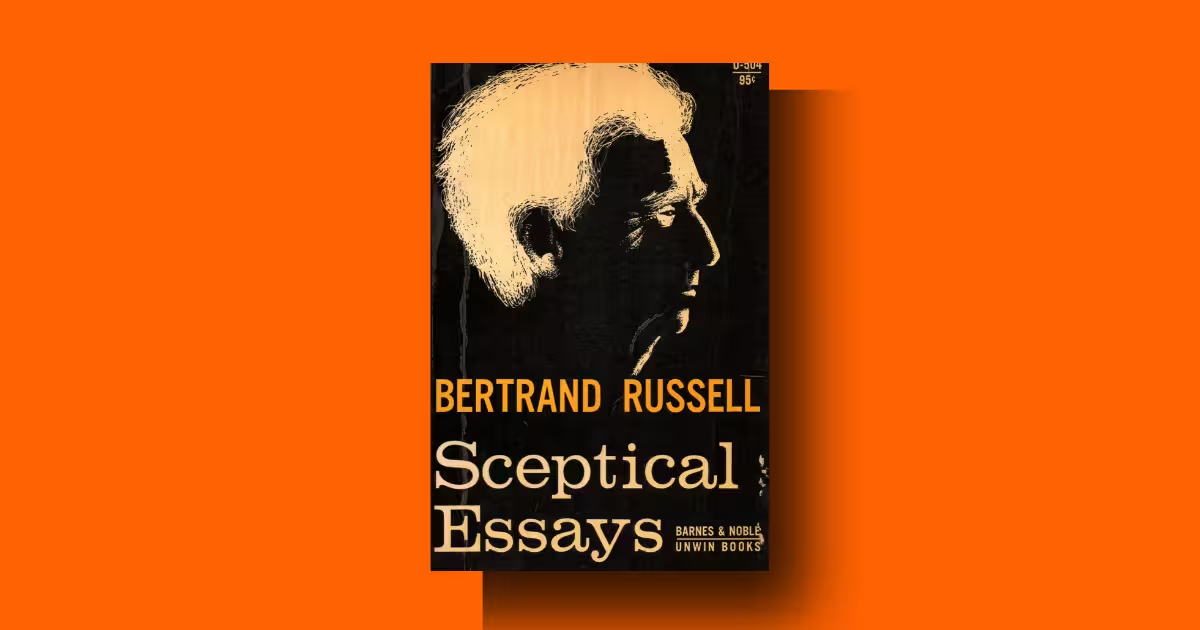
Do you really know why you believe what you believe—or have you just been taught to repeat what’s convenient? Bertrand Russell’s Sceptical Essays doesn’t just ask that question; it forces you to sit with the discomfort of not having a good answer.
Overview
Sceptical Essays (1928) is Bertrand Russell’s masterclass in intellectual humility. Across seventeen essays, Russell argues that most of what we hold dear—our politics, our religion, our moral outrage, even our nationalism—rests on wishful thinking rather than evidence.
He doesn’t ask you to abandon all beliefs. He asks you to hold them with the degree of certainty they deserve—which, for most things, is very little.
Sceptical Essays is a defence of rational doubt, written in some of the clearest, most devastating prose in the English language. It’s not a comfortable read. It’s meant to be.
Reader suggestion
Sceptical Essays is suggested for anyone who’s ever felt uneasy about the confidence with which politicians, preachers, and pundits declare “the truth.” Philosophy beginners looking for an accessible entry point.
Sceptics who want their scepticism sharpened. Readers who enjoy being intellectually provoked.
Sceptical Essays is not suggested to people who prefer their beliefs unchallenged. Those seeking a systematic philosophical treatise—this is essayistic, not academic. Anyone who thinks certainty is a virtue.
Table of Contents
Background
Bertrand Russell (1872–1970) needs little introduction. He was one of the most influential philosophers of the twentieth century, a logician, mathematician, social critic, and Nobel laureate in Literature (1950). But Sceptical Essays isn’t a technical work.
It’s Russell the public intellectual, writing for ordinary people about ordinary problems—freedom, happiness, education, politics, and the stubborn human habit of believing nonsense.
The book first appeared in 1928, a decade after the First World War had shattered Europe’s confidence in progress.
Russell, who had been imprisoned during the war for his pacifist activities, watched as nations doubled down on the very irrationality that had caused the catastrophe. Sceptical Essays was his response: a plea for intellectual honesty in an age of propaganda, nationalism, and creed wars.
The 2004 Routledge edition includes a new preface by political philosopher John Gray, who notes the tension at the heart of Russell’s project: “A sceptic in his theory of knowledge, he was naïve and credulous in his approach to human affairs”.
That tension—between doubt and hope, reason and passion—runs through every page.
Sceptical Essays Summary
Russell opens with a proposition he admits sounds “wildly paradoxical and subversive”: that it is undesirable to believe a proposition when there is no ground whatever for supposing it true. He immediately acknowledges the consequences: if widely adopted, this principle “would completely transform our social life and our political system”.
The book then unfolds as a series of applications.
1. On the Value of Scepticism
Russell defines his scepticism carefully.
He’s not Pyrrho—the ancient philosopher who allegedly watched his teacher stuck in a ditch and walked on because he couldn’t be sure pulling him out would help.
Russell advocates a middle position: accept well-established science as probable, suspend judgement when experts disagree, and never treat certainty as a virtue.
“The opinions that are held with passion are always those for which no good ground exists; indeed the passion is the measure of the holder’s lack of rational conviction.”
This is the book’s central insight. The louder the conviction, the weaker the evidence.
2. Dreams and Facts
Russell argues that most beliefs are “merely the bodying forth of desire, corrected here and there, at isolated points, by the rude shock of fact”. We are dreamers who occasionally wake up.
He traces this from individual vanity (“Every man, wherever he goes, is encompassed by a cloud of comforting convictions”) to national delusions (“Foreign nations, I am sorry to say, do as they do do”).
The solution isn’t to abandon dreams but to recognise them as dreams. Russell writes:
“There is a stark joy in the unflinching perception of our true place in the world, and a more vivid drama than any that is possible to those who hide behind the enclosing walls of myth.”
3. Is Science Superstitious?
This essay tackles a paradox. Science depends on induction—the belief that the future will resemble the past. Yet as David Hume showed, induction has no rational foundation. Russell admits: “We all believe in both, but Hume made it appear that our belief is a blind faith for which no rational ground can be assigned”.
He concludes that science cannot be fully justified, but neither can we abandon it. The scientific temper—tentative, evidence-based, self-correcting—is the best tool we have.
4. Can Men Be Rational?
Russell defines rationality as “the habit of taking account of all relevant evidence in arriving at a belief”. He acknowledges that psychoanalysis has shown how often our beliefs are shaped by unconscious desires.
But he insists that awareness of these biases can make us more rational, not less.
He also distinguishes between rationality in opinion and rationality in action. The latter means “remembering all our relevant desires, and not only the one which happens at the moment to be strongest”.
5. Philosophy in the Twentieth Century
Russell surveys the philosophical landscape of his time: German idealism, pragmatism, Bergsonism, and the new realism. He’s sharply critical of Bergson, whom he accuses of substituting rhetoric for argument. But he’s also honest about the limits of his own analytic tradition.
6. Machines and the Emotions
Russell worries that industrial society is turning humans into machines—reliable, punctual, and emotionally starved.
The result, he argues, is a “dissatisfaction (mostly unconscious) caused by the regularity, monotony and tameness of modern life”. This dissatisfaction fuels the love of war.
The remedy is not to abolish machinery but to provide “breaks in the monotony, with every encouragement to high adventure during the intervals”.
7. Behaviourism and Values
Russell engages with John B. Watson’s behaviourism, which reduced mental life to bodily processes. He finds the scientific part valuable but rejects its ethical implications.
When Watson suggests that a writer’s worth can be measured by “the prices he gets for his stories year by year,” Russell replies: “Applying this criterion to Buddha, Christ and Mahomet, to Milton and Blake, we see that it involves an interesting readjustment in our estimates of the values of personalities”.
8. Eastern and Western Ideals of Happiness
Russell contrasts Chinese civilisation—rooted in Confucius, valuing leisure, courtesy, and enjoyment—with Western civilisation, which values power, hustle, and material success. He writes:
“If I were to try to sum up in a phrase the main difference between the Chinese and ourselves, I should say that they, in the main, aim at enjoyment, while we, in the main, aim at power.”
He acknowledges that China’s pacific temper makes it vulnerable to more aggressive nations. But he doesn’t celebrate the West’s “progress.” He sees it as a mixed blessing at best.
9. The Harm That Good Men Do
This is one of the book’s most devastating essays. Russell argues that conventional “good” men—respectable, churchgoing, patriotic—often do more harm than self-confessed “bad” men. Why? Because they support the status quo, persecute dissent, and confuse morality with obedience.
“A good man is one whose opinions and activities are pleasing to the holders of power.”
He cites Bentham, who was denounced as wicked despite doing immense good through his reforms. The moral: what passes for virtue is often just conformity.
10. The Recrudescence of Puritanism
Russell defines a Puritan as someone who believes certain acts are inherently sinful and must be suppressed—by law if possible, by public opinion if not. He traces the resurgence of Puritanism to America’s victory in the First World War and warns that it threatens liberty.
“The Puritan imagines that his moral standard is the moral standard; he does not realise that other ages and other countries, and even other groups in his own country, have moral standards different from his, to which they have as good a right as he has to his.”
11. The Need for Political Scepticism
Russell argues that party politics thrives on division and hatred. Politicians succeed by arousing passions, not by presenting evidence. The result is that harmful policies are adopted because they’re popular, while beneficial policies are ignored because they’re boring.
“A policy that injures no one wins no support, and a policy that wins much support also rouses fierce opposition.”
His solution: widespread political scepticism—not cynicism, but a refusal to believe that any party has the answer.
12. Free Thought and Official Propaganda
Russell examines the obstacles to free thought: legal penalties, economic pressure, and propaganda. He notes that in modern England, an avowed agnostic could lose a parliamentary candidacy or a college fellowship.
In America, teachers were required to swear loyalty to the state. In Russia, the opposite orthodoxy prevailed.
He concludes that “the only method of securing wide publicity for an unpopular cause” is the suffragette method—disruptive, passionate, and unsuitable for complex issues.
13. Freedom in Society
Russell distinguishes between physical and social obstacles to freedom. He argues that the community may legitimately interfere with individuals to secure basic necessities—food, health, housing—but not to suppress opinion, art, or personal morality.
“In opinion, thought, art, etc., one man’s possessions are not obtained at the expense of another’s.”
14. Freedom Versus Authority in Education
Russell argues that education should aim at intellectual independence, not obedience. He criticises the State, the Church, and parents for treating children as means to their own ends.
“No man is fit to educate unless he feels each pupil an end in himself, with his own rights and his own personality, not merely a piece in a jigsaw puzzle, or a soldier in a regiment, or a citizen in a State.”
15. Psychology and Politics
Russell predicts that psychology will become a tool of power—used to manipulate populations, not to liberate them. He warns that “if psychological knowledge is wielded by an aristocracy, it will prolong and intensify all the old evils”.
16. The Danger of Creed Wars
Russell sees the twentieth century as heading toward a new age of ideological conflict, with America and Russia as the two great powers, each with its own infallible creed. He writes:
“The fundamental delusion of our time, in my opinion, is the excessive emphasis upon the economic aspects of life.”
17. Some Prospects: Cheerful and Otherwise
Russell ends on a cautiously hopeful note. He imagines a world with a central authority, shorter working hours, and greater material comfort—but warns that without constructive outlets for human energy, boredom and destructiveness will follow.
“Into every tidy scheme for arranging the pattern of human life it is necessary to inject a certain dose of anarchism, enough to prevent immobility leading to decay, but not enough to bring about disruption.”
Sceptical Essays Analysis
Reading Sceptical Essays in 2026 is a strange experience. On one hand, Russell’s arguments feel urgent and contemporary. His warnings about propaganda, nationalism, and the weaponisation of morality could have been written this morning.
His defence of intellectual honesty in an age of manufactured outrage is precisely what we need.
On the other hand, there’s something almost touching about his faith in reason. Russell genuinely believed that if people just thought more carefully, they’d stop killing each other.
John Gray, in his preface, captures this tension perfectly: “As reformer, he believed reason could save the world. As a sceptical follower of Hume he knew reason could never be more than the slave of the passions.”
This is the book’s central drama. Russell is a rationalist who knows rationality has limits. He’s a sceptic who can’t quite give up hope. The result is a collection of essays that are brilliant, provocative, and occasionally naive.
Take his essay on China. Russell celebrates Chinese civilisation for its emphasis on enjoyment over power, its courtesy, its lack of Puritanism. He’s not wrong about the contrast.
But he underestimates the fragility of that civilisation in the face of industrial militarism. Within a decade of his writing, China would be invaded by Japan. Within two decades, it would be engulfed in civil war. Russell’s admiration is genuine, but his optimism is misplaced.
Similarly, his faith in psychoanalysis as a tool for peace seems quaint. He writes: “Combined with a training in the scientific outlook, this method could, if it were widely taught, enable people to be infinitely more rational than they are at present”.
As Gray points out, tyrants can use psychoanalysis to manipulate as easily as to liberate. Russell knew this, but he chose not to dwell on it.
Nevertheless, the book’s strengths far outweigh its weaknesses. Russell’s prose is a model of clarity. He never talks down to his reader, but he never shows off. He argues with wit, passion, and an almost brutal honesty. His essay on “The Harm That Good Men Do” is a masterpiece of moral provocation. His essay on “Eastern and Western Ideals of Happiness” is a model of cross-cultural empathy.
Perhaps the book’s greatest achievement is its defence of doubt as a moral virtue. In an age that demands certainty, Russell insists that uncertainty is the mark of an honest mind. He writes:
“No man is liberated from fear who dare not see his place in the world as it is; no man can achieve the greatness of which he is capable until he has allowed himself to see his own littleness.”
That’s not cynicism. That’s wisdom.
Strengths and Weaknesses
Strengths
1. Prose that cuts like a knife. Russell is one of the finest stylists in the English language. Every sentence is clear, every argument is sharp. You never have to read a paragraph twice to understand it—though you may want to, just to savour it.
2. Intellectual courage. Russell takes on sacred cows—religion, nationalism, conventional morality—and doesn’t flinch. He’s not trying to be provocative for its own sake. He genuinely believes that these beliefs are harmful, and he says so.
3. Timeliness. Written in 1928, the book feels like it was written for 2026. Russell’s warnings about propaganda, censorship, and the weaponisation of identity are eerily prescient.
4. Practical philosophy. This isn’t abstract theory. Russell applies his scepticism to everyday life—education, politics, marriage, work. He wants you to use these ideas.
Weaknesses
1. Overconfidence in reason. Russell believes that better thinking will solve our problems. But as he himself admits, reason is a small force compared to passion. He never fully grapples with the implications of his own scepticism.
2. Naivety about politics. Russell’s faith in expert opinion and international co-operation seems optimistic, even by 1920s standards. He underestimates the power of self-interest and the difficulty of institutional change.
3. Dated references. Some of the essays reference figures and debates that are no longer familiar—Bergson, behaviourism, the gold standard. A modern reader may need to do some background reading.
4. The China essay. Russell’s praise for Chinese civilisation is well-intentioned but romanticised. He overlooks the realities of poverty, political instability, and social hierarchy.
Comparison with Similar Works
Sceptical Essays belongs to a tradition of popular philosophy that includes:
George Orwell’s essays – Orwell shared Russell’s clarity, his suspicion of power, and his commitment to intellectual honesty. But Orwell was more pessimistic about human nature and more willing to confront the limits of reason.
Aldous Huxley’s Brave New World (1932) – Huxley explored similar themes—the dehumanising effects of technology, the loss of individuality, the power of propaganda. But Huxley wrote fiction; Russell wrote argument.
Karl Popper’s The Open Society and Its Enemies (1945) – Popper defended liberal democracy against totalitarianism with arguments that echo Russell’s defence of scepticism and free inquiry. But Popper was more systematic and more explicitly political.
John Gray’s Straw Dogs (2002) – Gray, who wrote the preface to this edition, is Russell’s intellectual heir in many ways.
But Gray is more thoroughly sceptical—he doubts not only our beliefs but our capacity for progress. Russell, despite everything, remained a hopeful rationalist.
Conclusion
Sceptical Essays is for anyone who’s tired of being told what to think. It’s for people who suspect that their convictions might be less rational than they appear. It’s for readers who want philosophy that’s practical, provocative, and beautifully written.
Russell doesn’t offer easy answers. He offers something rarer: the courage to ask hard questions. He shows that doubt is not weakness but strength—that the willingness to say “I don’t know” is the beginning of wisdom.
As he writes in the introduction:
“These propositions may seem mild, yet, if accepted, they would absolutely revolutionise human life.”
A century later, they still would.







