


Last updated on September 15th, 2026 at 05:48 pm
Do you ever tell yourself that your anxiety, your procrastination, or your short temper is just “how you’re wired”? I believed that too, for a long time. Then I worked through the ten books on this list, and I want to save you the guesswork: here is exactly what each one gets right, where the science gets stretched a little thin, and which one to pick up first.
Overview: The Best Books on Neuroplasticity
- The Brain That Changes Itself by Norman Doidge: the classic starting point, told through patient stories.
- The Brain’s Way of Healing by Norman Doidge: the follow-up, focused on recovery from stroke, chronic pain, and injury.
- Livewired by David Eagleman: the most current, technical account of how the brain rewires itself.
- Soft-Wired by Michael Merzenich: written by the scientist whose lab research helped start the field.
- Train Your Mind, Change Your Brain by Sharon Begley: neuroscience meets the Dalai Lama and meditation research.
- The Mind and the Brain by Jeffrey Schwartz and Sharon Begley: plasticity through the lens of OCD treatment and attention.
- The Neuroscience of You by Chantel Prat: why your brain is different from everyone else’s, not just changeable.
- Neuroplasticity by Moheb Costandi: a short, no-nonsense academic primer.
- Rewire Your Brain by John B. Arden: a practical, therapy-style workbook.
- The Tell-Tale Brain by V. S. Ramachandran: plasticity explained through neurology’s strangest case studies.
Table of Contents
What Neuroplasticity Actually Means
Neuroplasticity is the brain’s ability to reorganize its own structure and function throughout life, in response to what you do, learn, and experience, rather than staying fixed after childhood. For most of the twentieth century, neuroscience treated the adult brain as a finished product.
That assumption started collapsing in the 1970s and 80s, once researchers like Michael Merzenich showed that the brain’s own map of the body could be redrawn in adult monkeys after nerve injury.
The books below cover that story from different angles: some through patient recovery, some through lab research, some through meditation science, and one through the strangest neurological case studies on record.
The 10 Best Books on Neuroplasticity
1. The Brain That Changes Itself by Norman Doidge
Published: Viking, 2007 · 427 pages · New York Times bestseller
Norman Doidge is a Toronto-based psychiatrist and psychoanalyst who spent thirty years on the University of Toronto’s Department of Psychiatry faculty and served on the research faculty of Columbia University’s Center for Psychoanalytic Training and Research.

For this book, he traveled the country interviewing the scientists who built the case for neuroplasticity and the patients whose lives changed because of it: a woman born with half a brain that rewired itself to function as a whole, blind people who learned to “see” through their tongues, stroke victims who relearned speech decades after doctors called their condition permanent.
This is the book that put the word “neuroplasticity” into everyday conversation, and it still works as the most readable door into the subject. Doidge writes:
“Ironically, some of our most stubborn habits and disorders are products of our plasticity.”
That line is worth sitting with, because it flips the usual pitch for this topic. Plasticity is not only how you improve; it’s also how a bad habit or a compulsion gets carved so deeply that it feels permanent.
Where to be careful: the book leans on individual case studies rather than large trial data, so treat the more dramatic recovery stories as illustrations of a real mechanism, not guarantees of a specific outcome for you or a family member.
Best for: anyone starting from zero who wants the human stories before the underlying biology.
2. The Brain’s Way of Healing by Norman Doidge
Published: Viking, 2015 · Winner, 2015 Gold Nautilus Book Award (Science & Cosmology)
Doidge’s follow-up narrows the focus to healing itself: how light, sound, vibration, and movement can activate the brain’s capacity to repair after stroke, traumatic brain injury, chronic pain, multiple sclerosis, Parkinson’s disease, autism, and cerebral palsy. He writes:
“In other words, the brain evolved to learn.”

That single sentence sums up his argument for why the brain retains a healing capacity most doctors were trained to assume it lost: a brain built to keep learning from a changing world doesn’t stop being able to reorganize itself just because it has been injured.
Where to be careful: some of the therapies covered here, particularly light and sound-based treatments, rest on a thinner and more contested evidence base than the stroke and pain rehabilitation chapters.
Doidge is transparent about naming the researchers and clinics behind each approach, but the strength of the underlying science varies noticeably from chapter to chapter, so it’s worth reading each one on its own terms rather than assuming uniform rigor throughout.
Best for: readers or caregivers dealing with a specific diagnosis, stroke, chronic pain, MS, or a brain injury, who want the recovery-focused half of Doidge’s work.
3. Livewired by David Eagleman
Published: Pantheon Books, 2020 · Nominated for the Pulitzer Prize
David Eagleman is a neuroscientist at Stanford University and the writer and presenter of the PBS/BBC series The Brain. His argument in Livewired goes a step past standard plasticity talk: he says the brain isn’t simply “plastic” in the sense of being reshaped within a fixed structure.

It’s “livewired,” meaning entire circuits can be reassigned to new jobs based on what information they actually receive, not what their genetic blueprint originally intended.
He backs this with research from his own lab, including a wearable vest that translates sound into patterns of vibration on the torso, letting deaf users process speech through touch instead of hearing. He writes:
“If you’re predicting perfectly, your brain doesn’t need to change further.”
That’s the engine behind his whole model: the brain changes precisely where reality surprises it, and stops changing where it doesn’t.
Where to be careful: this is the most technically dense book on the list. It reads closer to a well-written textbook than a page-turner in places, so it rewards patience more than the Doidge books do.
Best for: readers who already know the basics and want the current, mechanism-first account rather than another collection of recovery stories.
4. Soft-Wired by Michael Merzenich
Published: Parnassus Publishing, 2013
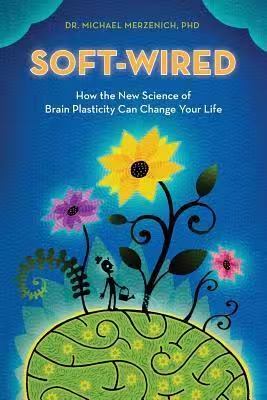
Michael Merzenich is Professor Emeritus at UCSF, a member of both the National Academy of Sciences and the Institute of Medicine, and co-founder of Scientific Learning and Posit Science.
His own 1980s cortical mapping experiments, showing that a monkey’s brain map of its hand physically reorganizes after nerve injury, are part of the foundational research the entire field builds on, which is why he’s often called the field’s father figure.
Soft-Wired reads less like Doidge’s narrative journalism and more like a coach’s manual grounded in that same body of research. He writes:
“Every human has the built-in power to improve, to change for the better.”
Where to be careful: because Merzenich co-founded a commercial brain-training company, it’s worth reading his specific product and exercise recommendations with the same healthy skepticism you’d apply to any founder promoting a tool they built, even though the underlying plasticity research behind the book is solid and well established.
Best for: readers who want a prescriptive, exercise-based approach rather than narrative case studies.
5. Train Your Mind Change Your Brain by Sharon Begley
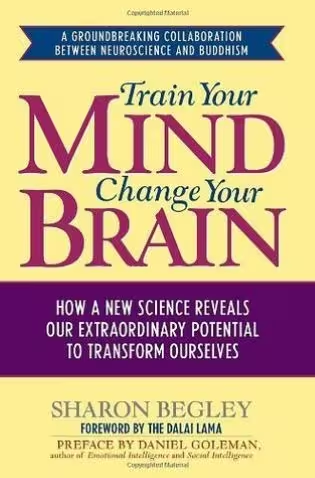
Published: Ballantine Books, 2007 · Foreword by the Dalai Lama, preface by Daniel Goleman
Sharon Begley (1956 to 2021) was a Yale-educated science journalist who covered neuroscience for the Wall Street Journal, Newsweek, and later STAT.
This book grew out of a 2004 meeting the Mind and Life Institute organized in Dharamsala, India, where Western neuroscientists sat down with the Dalai Lama and Buddhist scholars to discuss whether meditation could measurably change the brain. Begley writes:
“People who are suffering from depression are unable to recognize novelty.”
That’s one of the sharper findings she reports on: depression doesn’t just change mood, it appears to change how flexible attention itself is, which connects directly back to why mental training might help.
Where to be careful: because the book closely follows the structure of that 2004 conference, some readers find the argument looser than a book built around a single thesis; it works best as a bridge between contemplative practice and lab research rather than a complete plasticity textbook.
Best for: readers specifically curious about what meditation research actually shows about the brain, rather than plasticity in general.
6. The Mind and the Brain by Jeffrey M. Schwartz and Sharon Begley

Published: ReganBooks/HarperCollins, 2002
Jeffrey Schwartz is a Research Professor of Psychiatry at the UCLA School of Medicine and a longtime authority on obsessive-compulsive disorder.
He coined the term “self-directed neuroplasticity” in this book, built directly on his OCD treatment work: patients who learned to relabel and redirect compulsive urges, instead of acting on them, showed measurable changes in caudate nucleus activity on PET scans. Schwartz and Begley write:
“The mind chooses which aspect of that experience receives attention.”
That’s the clinical core of the book: attention itself, deliberately directed, appears to be able to reshape brain activity over time.
Where to be careful: the later chapters lean on Schwartz’s collaboration with physicist Henry Stapp to argue for “mental force” through quantum mechanics, and this is the most argued-over part of the book. A number of reviewers, including working scientists, consider the quantum framing a reach that the OCD evidence doesn’t actually require.
The clinical chapters on OCD and attention hold up considerably better on their own than the free-will philosophy built on top of them.
Best for: readers specifically interested in OCD treatment, attention, and the philosophical debate over free will, more than plasticity as a general topic.
7. The Neuroscience of You by Chantel Prat
Published: Dutton, 2022
Chantel Prat is a professor at the University of Washington across the Departments of Psychology, Neuroscience, and Linguistics.

Her book takes a different angle from everything else on this list: instead of explaining how brains change, she explains why brains differ from one another to begin with, using self-assessments readers can take alongside the chapters. Her stated thesis, as Publishers Weekly quotes it directly, is that:
“Every brain really is unique.”
Prat argues that most popular neuroscience describes an “average” brain, and that this average obscures more than it explains, since dopamine levels, hemispheric balance, and attention style all vary meaningfully between individuals and shape how each person’s plasticity actually plays out.
Where to be careful: this is not a “how to rewire your brain” manual. If you want concrete change-your-brain exercises, pair this with Merzenich’s or Arden’s book rather than expecting that here.
Best for: readers who want to understand individual brain differences, not just the general mechanics of change.
8. Neuroplasticity by Moheb Costandi
Published: MIT Press, 2016 (MIT Press Essential Knowledge series) · 181 pages

Moheb Costandi trained as a neuroscientist and writes the Neurophilosophy blog for The Guardian. This is the shortest and most academic book on the list by design, part of MIT Press’s compact primer series.
It directly addresses the commercial “brain training” industry that grew up around plasticity research, and it’s skeptical of gadget and app claims specifically, distinguishing them from what sustained tasks like learning a musical instrument or a new language actually demonstrate in the research. The book’s own summary line states it plainly:
“Neuroplasticity is at the heart of what makes us human.”
Where to be careful: it is genuinely dry compared to everything else on this list. That’s a feature, not a flaw, since it’s built as a college-level primer rather than pop science, but it’s not the place to start if you want a story-driven introduction.
Best for: readers who’ve already read one or two of the narrative books here and want the underlying mechanisms laid out cleanly, without the anecdotes attached.
9. Rewire Your Brain by John B. Arden
Published: Wiley, 2010

John B. Arden was Director of Training in Mental Health for Kaiser Permanente’s Northern California region and worked in Brain-Based Therapy.
His book is organized around specific, everyday goals: memory, mood, relationships, sleep, built on the idea of activating brain circuits that have gone underused and calming ones that have become overactive. He writes:
“Your brain is not hardwired, it’s softwired by experience.”
Where to be careful: it reads more like an extended, tip-heavy magazine feature (nutrition notes, sleep hygiene, bulleted checklists) than a deep scientific dive, and some readers find it thinner on the “why” than they expected. Treat it as a practical companion to the more research-heavy books on this list rather than your only neuroplasticity read.
Best for: readers who want a checklist-style, therapy-adjacent approach they can start applying immediately.
10. The Tell-Tale Brain by V. S. Ramachandran
Published: W. W. Norton, 2011 (UK edition, 2010) · Winner, 2010 Vodafone Crossword Book Award
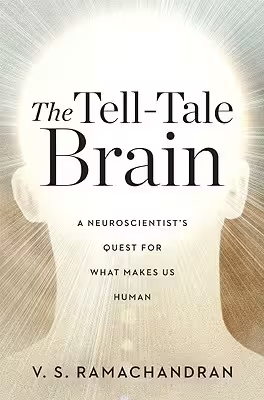
V. S. Ramachandran is Distinguished Professor and Director of the Center for Brain and Cognition at UC San Diego, a scientist Richard Dawkins once called “the Marco Polo of neuroscience.”
This isn’t strictly a neuroplasticity book. It’s broader: a study of what makes the human brain unique, built from some of neurology’s strangest documented cases, including phantom limb pain, synesthesia, and autism, and reasoned backward from those cases to how ordinary brains work and reorganize. Ramachandran writes:
“Cases of prefrontal damage are especially distressing to relatives.”
That line captures his method well: he uses what goes wrong in specific patients to explain what a healthy, adaptable brain is quietly doing right.
Where to be careful: plasticity is one thread among several here, alongside language, art, and self-awareness, so if you want a book that stays entirely on the topic of brain change, save this one for last and go in specifically for the phantom-limb and mirror-box chapters.
Best for: readers who want plasticity explained through some of neuroscience’s most memorable, strangest case studies, rather than a straight survey of the topic.
Which Neuroplasticity Book Should You Read First?
If you want a decision instead of a list, here’s my honest breakdown:
- New to the topic entirely? Start with The Brain That Changes Itself.
- Recovering from stroke, chronic pain, or a brain injury, or supporting someone who is? Go straight to The Brain’s Way of Healing.
- Already comfortable with the basics and want the current, technical picture? Read Livewired.
- Want exercises and a practical program, not just theory? Pick Soft-Wired or Rewire Your Brain.
- Curious specifically about meditation and mental training? Read Train Your Mind, Change Your Brain.
- Dealing with OCD or intrusive thoughts, or interested in the free-will debate? Read The Mind and the Brain.
- More interested in why your brain is different from everyone else’s than in “fixing” it? Read The Neuroscience of You.
- Want the short, academic version with no stories attached? Read Costandi’s Neuroplasticity.
- Want plasticity through the lens of neurology’s strangest cases? Finish with The Tell-Tale Brain.
If you’d rather widen the lens beyond neuroplasticity specifically, our 100 Best Psychology Books of All Time list and our review of The Male Brain both sit next to this topic well. Carol Dweck’s growth-mindset research, which we cover in our Mindset review, draws directly on Doidge’s work too.
Frequently Asked Questions
What is the best neuroplasticity book for a complete beginner?
The Brain That Changes Itself by Norman Doidge. It introduces the science through patient stories rather than jargon, which is why it remains the most widely recommended entry point almost two decades after it was published.
Is neuroplasticity actually real, or is it an overused buzzword at this point?
The underlying mechanism is real and well documented in peer-reviewed research going back to Merzenich’s cortical mapping studies in the 1980s. What gets oversold is usually the marketing around specific “brain training” apps and supplements, not the biology itself. Costandi’s Neuroplasticity is the most useful book on this list for separating the two.
Can adults really rewire their brains, or does plasticity mostly apply to children?
Adult brains are less plastic than developing ones, but adult neuroplasticity is well established, through skill learning, recovery from injury, and sustained practices like learning an instrument or a new language. Several books here (Merzenich’s and Doidge’s in particular) are built specifically around adult and even elderly case studies.
What’s the difference between Doidge’s two books?
The Brain That Changes Itself (2007) is the broad introduction. The Brain’s Way of Healing (2015) is the sequel, narrowed specifically to recovery from injury, illness, and chronic pain.
Do I need a science background to understand these books?
No. Doidge, Begley, Arden, and Prat all write for a general audience. Eagleman’s Livewired and Costandi’s Neuroplasticity ask a little more of the reader, but neither assumes formal training.
Final Thoughts
I said at the start that I used to believe my anxiety and my bad habits were just fixed features of who I am. What changed my mind wasn’t one single book on this list, it was reading Doidge’s stories next to Merzenich’s research next to Ramachandran’s case studies, and noticing the same mechanism showing up from three completely different directions.
That’s really the best case I can make for the best books on neuroplasticity as a set: no single one gives you the whole picture, but reading two or three of them against each other will.
Start with whichever one matches your actual situation from the list above, not whichever one has the flashiest title.