
Last updated on May 22nd, 2026 at 10:43 am
In 2018, director Ryan Coogler didn’t just deliver another Marvel Cinematic Universe (MCU) entry; he unleashed a seismic cultural event. Black Panther arrived as a visually stunning, thematically rich, and profoundly significant film that transcended the superhero genre.
Starring the late, great Chadwick Boseman, it presented the world with T’Challa, king of the hidden, technologically advanced African nation of Wakanda. More than a film, Black Panther became a celebration of Afrofuturism, a discourse on global responsibility, and a landmark in representation.
This in-depth review and spoiler-filled analysis dives into why Black Panther remains one of the MCU’s most important and compelling chapters.
Table of Contents
Black Panther plot Summary
Act I: The New King and a Challenger from the Past
Following the death of his father, T’Chaka (John Kani), in Captain America: Civil War, Prince T’Challa (Chadwick Boseman) returns to the secretive, futuristic nation of Wakanda to assume the throne.
Wakanda, hidden behind a holographic shield, poses as a poor agrarian nation while secretly thriving on the universe’s strongest metal, Vibranium. The film opens with a mythic recounting of Wakanda’s origin and its first “Black Panther,” established by the warrior Bashenga.
T’Challa’s coronation ritual involves a ceremonial challenge. He is challenged by M’Baku (Winston Duke) of the mountainous Jabari tribe and emerges victorious but spares M’Baku’s life—a crucial act of mercy that establishes his character.
Meanwhile, in London, arms dealer Ulysses Klaue (Andy Serkis) steals a Vibranium artifact from a museum with the help of Eric “Killmonger” Stevens (Michael B. Jordan). Klaue is a relic from Wakanda’s past, responsible for a bombing that killed several Wakandans.
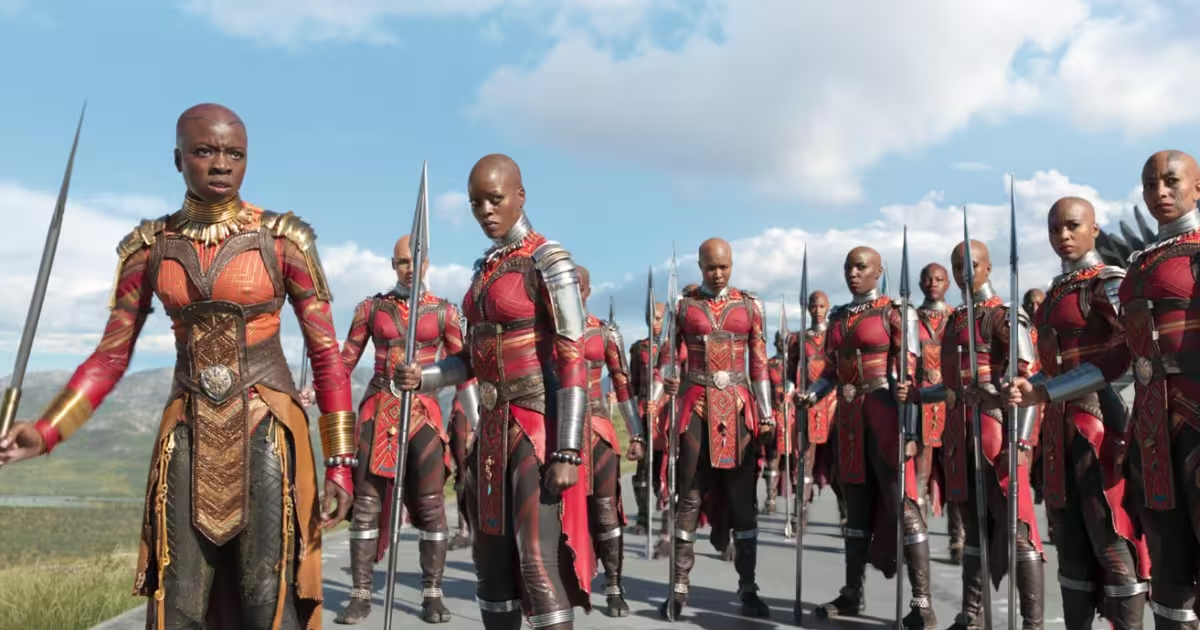
T’Challa, alongside his elite guard the Dora Milaje—led by the formidable Okoye (Danai Gurira) and including his ex-lover Nakia (Lupita Nyong’o)—travels to South Korea to capture Klaue. A spectacular car chase ensues, but Klaue is apprehended by CIA agent Everett K. Ross (Martin Freeman).
The mission is compromised when Killmonger, revealed to be working his own agenda, breaks Klaue out, leading to a firefight where Ross is critically injured. To save his life, T’Challa takes him to Wakanda, breaching centuries of secrecy.
Act II: The Return of a Prince and the Fall of a King
This is where the film’s heart and conflict are laid bare. Killmonger arrives in Wakanda with Klaue’s body as a “tribute.” He reveals his true identity: N’Jadaka, the son of T’Chaka’s brother, N’Jobu. In a flashback, we learn N’Jobu, stationed in Oakland, California, as a undercover operative, grew disillusioned with Wakanda’s isolationism.
He planned to share Vibranium weapons with oppressed people worldwide. T’Chaka discovered this and, in a tragic confrontation, killed his own brother to protect Wakanda’s secret. He abandoned his young nephew, Eric, in Oakland.
Killmonger, a U.S. Black Ops soldier haunted by this abandonment, now invokes his birthright and challenges T’Challa for the throne. In a brutal ritual combat on the Warrior Falls, fueled by generations of pent-up rage, Killmonger defeats T’Challa and hurls him over the waterfall, presumed dead.
He consumes the Heart-Shaped Herb, burns the garden of remaining herbs, and ascends as the new king with a radical vision: to arm the diaspora with Vibranium weapons, sparking a global revolution to overthrow all oppressive regimes.
Act III: The Rebirth and the Battle for Wakanda’s Soul
T’Challa, however, survived the fall. He is rescued by the Jabari tribe, healed by their shaman, and revived by a Heart-Shaped Herb M’Baku had secretly kept. Meanwhile, Killmonger prepares to ship weapons worldwide. Shuri (Letitia Wright), Nakia, and Ross work with a reluctant Okoye and the Dora Milaje to resist Killmonger’s plan from within.
The film culminates in a multifaceted battle. In the skies, Ross, piloting a remotely controlled Wakanda jet, shoots down the outgoing Vibranium shipments. On the ground, the loyal Dora Milaje and the Jabari tribe, led by M’Baku (honoring his life-debt), clash with Killmonger’s followers. The core conflict, however, is personal: a final showdown between T’Challa and Killmonger.
Their fight moves from the throne room to an underground Vibranium railroad, bathed in surreal purple light. It is both a physical and ideological battle. T’Challa, now understanding the cost of isolation, offers Killmonger a chance to be healed.
But Killmonger, a man shaped by the violence of the world and Wakanda’s neglect, refuses. “Bury me in the ocean with my ancestors who jumped from the ships,” he says, “because they knew death was better than bondage.”
He chooses to die a free man, removing the spear from his chest. T’Challa watches his cousin pass, a tragic figure whose pain was legitimate, even if his methods were monstrous.
Epilogue: A New Path for Wakanda
In the aftermath, T’Challa establishes an outreach center in the very Oakland apartment where his father killed N’Jobu. He reveals Wakanda’s truth to the United Nations, moving from isolation to guided engagement. The final, powerful shot shows Shuri and a young local boy looking out over the Oakland skyline, symbolizing hope and a new future.
Thematic Analysis of Black Panther
1. Identity and Legacy: T’Challa’s journey is about defining his own kingship beyond his father’s shadow. He must reconcile the sins of the past (his father’s murder of N’Jobu) with the needs of the future. The film asks: What do we owe to the legacy we inherit, and how do we correct its mistakes?
2. Isolationism vs. Global Responsibility: This is the central political conflict. Wakanda’s prosperity is built on secrecy. Killmonger forces the question: Does a powerful, unconquered African nation have a duty to help its oppressed kin worldwide? The film wisely offers no easy answer but concludes with a middle path—sharing resources and knowledge, not weapons.
3. The Villain as a Dark Reflection: Michael B. Jordan’s Killmonger is arguably the MCU’s best villain because he is morally coherent and tragically right in his diagnosis, but wrong in his cure. He is the direct product of Wakanda’s inaction. His final words are not of evil, but of profound historical pain, making his defeat feel like a profound loss.
4. Afrofuturism Realized: Black Panther is a landmark of Afrofuturism—the cultural aesthetic that combines African diaspora culture with technology and futurism. From Ruth E. Carter’s Oscar-winning costumes, blending traditional attire with high-tech designs, to Hannah Beachler’s production design that fuses advanced tech with organic, African-inspired architecture, Wakanda feels both authentically African and dazzlingly futuristic.
Character and Performance Highlights
- Chadwick Boseman as T’Challa/Black Panther: Boseman embodies regal grace, deep empathy, and burgeoning strength. His performance is layered with the weight of duty and the pain of discovery.
- Michael B. Jordan as Killmonger: Jordan brings ferocious charisma and palpable pain. He makes you understand, and even sympathize with, his world-ending rage.
- The Women of Wakanda: The film shines in its portrayal of powerful, intelligent, and independent women. Letitia Wright’s Shuri is a genius and the heart of the film’s humor. Danai Gurira’s Okoye is the epitome of loyal badassery. Lupita Nyong’o’s Nakia is a humanitarian with her own moral compass. They are allies, not sidekicks.
- Supporting Excellence: Winston Duke’s M’Baku provides both menace and unexpected honor. Angela Bassett as Queen Ramonda brings dignified power. Forest Whitaker as the elder statesman Zuri adds gravitas.
Cultural Impact and Legacy
Black Panther was a global box office sensation, proving the immense power of diverse storytelling. It sparked conversations about representation, African identity, and post-colonial politics. It became a social touchstone, with children and adults alike dressing in African attire for screenings, celebrating a positive, powerful vision of Africa rarely seen in mainstream media.
Tragically, the film is now also a poignant tribute to Chadwick Boseman, whose private battle with cancer makes his portrayal of a noble king facing mortality even more powerful in retrospect.
Final Verdict
Rating: 5/5
Black Panther is a masterpiece of modern blockbuster cinema. Ryan Coogler crafted a film that is thrilling, emotionally resonant, and intellectually engaging.
It delivers superb action, a compelling family drama, and a Shakespearean tragedy in the story of Killmonger. It succeeds flawlessly as a Marvel movie while being so much more—a culturally defining work that challenged Hollywood norms and inspired millions.
It is not just a great superhero film; it is a great film, period. Its exploration of duty, heritage, and justice ensures its place as a classic, and its heart, embodied by Chadwick Boseman, continues to beat strong.
“Wakanda Forever!” is more than a salute; it’s a promise of a legacy that endures.







